Hydrolyzed Vegetable Protein Market Size, Share, Demand & Growth Report By Type (Acid Hydrolyzed Vegetable Protein, Enzymatic Hydrolyzed Vegetable Protein), By Application (Soups, Sauces & Seasonings, Snacks & Convenience Foods, Processed Meat Products, Frozen & Ready-to-Eat Meals), By End-Use (Food Processing Industry, Foodservice Industry, Household/Retail Consumption) and By Region – Global Industry Forecast 2026–2034
USD 3950
Market Overview
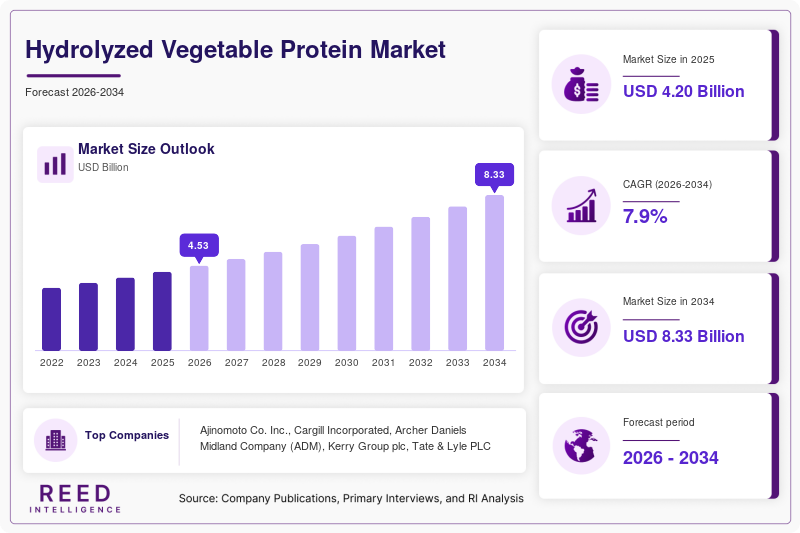
The Hydrolyzed Vegetable Protein Market size is projected to be valued at approximately USD 4.2 billion in 2026 and is anticipated to reach USD 7.8 billion by 2034, expanding at a CAGR of 7.9% during 2026–2034. Growth in the market is primarily driven by the rising demand for cost-effective flavor enhancers in processed food applications, especially in ready-to-eat meals and packaged savory products. Increasing urbanization and changing dietary habits have significantly influenced the consumption of convenience foods, which in turn supports the adoption of hydrolyzed vegetable protein (HVP) as a flavoring and protein-enriching ingredient.
A key global factor supporting market expansion is the growing shift toward plant-derived food ingredients, driven by consumer preference for vegetarian and vegan-friendly formulations. Food manufacturers are increasingly integrating HVP as a substitute for animal-based flavor enhancers, improving both cost efficiency and product shelf stability.
Key Highlights
- North America dominated the market with a 33.8% share in 2025.
- Asia Pacific is expected to grow at the fastest CAGR of 8.6% during 2026–2034.
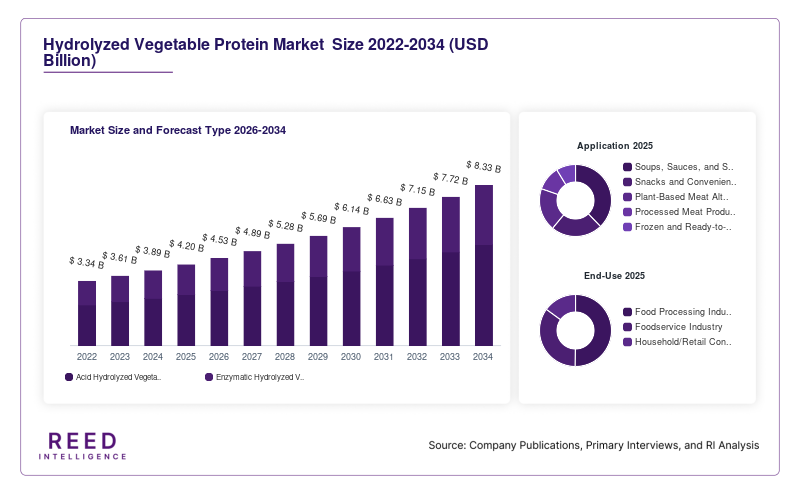
- By type, acid hydrolyzed vegetable protein accounted for the largest share of 57.4%.
- while enzymatic hydrolyzed vegetable protein is projected to grow at a CAGR of 9.1%.
- By application, soups, sauces, and seasonings led with a 36.2% share, whereas plant-based meat alternatives are expected to expand at a CAGR of 10.3%.
- By end-use, the food processing industry remained dominant with a 61.5% share, while foodservice applications are projected to grow at a CAGR of 8.4%.
- The United States recorded market values of USD 820 million in 2024 and USD 870 million in 2025.
Market Trends
Rising Adoption of Clean-Label Flavor Enhancers
One of the most prominent trends in the Hydrolyzed Vegetable Protein Market is the increasing demand for clean-label and naturally derived ingredients. Consumers are becoming more conscious of ingredient transparency and are actively avoiding artificial flavor enhancers. As a result, manufacturers are reformulating products using hydrolyzed vegetable protein derived from soy, corn, and wheat. This shift is particularly visible in packaged soups, snacks, and ready meals. Food brands are also investing in enzymatic hydrolysis techniques to produce cleaner-tasting profiles with reduced sodium content. The trend is further supported by regulatory pressures on monosodium glutamate labeling in several developed markets, pushing companies to adopt HVP as a natural umami enhancer.
Expansion of Plant-Based and Convenience Food Applications
Another significant trend is the rapid integration of hydrolyzed vegetable protein in plant-based meat alternatives and convenience foods. As the plant-based food industry grows, manufacturers require ingredients that can replicate meat-like savory flavors and textures. HVP plays a crucial role in enhancing umami taste profiles in vegan burgers, sausages, and ready-to-cook meals. Additionally, busy urban lifestyles have driven demand for instant noodles, canned soups, and frozen meals, where HVP is widely used to improve flavor intensity. This trend is especially strong in Asia Pacific and North America, where processed food consumption continues to rise steadily.
Market Drivers
Growth of Processed and Packaged Food Industry
The expansion of the global processed food industry is a major driver for the Hydrolyzed Vegetable Protein Market. Increasing urbanization, dual-income households, and busy lifestyles have significantly boosted demand for convenience foods such as instant soups, frozen meals, and ready-to-eat snacks. HVP is widely used in these products to enhance flavor consistency and reduce production costs. Food manufacturers prefer HVP due to its ability to provide strong umami taste at relatively low concentrations. The rising penetration of supermarkets and online grocery platforms has further increased packaged food consumption, thereby supporting continuous demand for hydrolyzed vegetable protein across global markets.
Cost Efficiency and Flavor Enhancement Benefits
Hydrolyzed vegetable protein is increasingly preferred by food manufacturers due to its cost efficiency compared to natural meat extracts and yeast-based flavor enhancers. It offers a strong savory profile while maintaining affordability in large-scale production. This makes it particularly valuable for mass-market food products. Additionally, HVP improves flavor stability during high-temperature processing, which is essential in canned and frozen food applications. Manufacturers are leveraging these benefits to optimize product formulations without compromising taste quality. As global food production scales up, cost optimization and consistent flavor delivery continue to drive widespread adoption of HVP across multiple food categories.
Market Restraint
Regulatory Concerns and Consumer Perception Issues
A key restraint affecting the Hydrolyzed Vegetable Protein Market is the growing scrutiny over labeling regulations and consumer perception regarding processed flavor enhancers. Although HVP is plant-derived, certain production methods involve acid hydrolysis, which has raised concerns among health-conscious consumers about sodium content and potential formation of undesirable compounds. Regulatory bodies in some regions have introduced stricter labeling requirements for flavor enhancers, which increases compliance complexity for manufacturers. Additionally, the clean-label movement has led some consumers to associate hydrolyzed ingredients with artificial additives, limiting acceptance in premium food segments. This perception challenge forces companies to invest in enzymatic alternatives and transparent labeling strategies, increasing production costs and affecting overall market expansion in highly regulated regions such as Europe and North America.
Market Opportunities
Expansion in Plant-Based Meat Analog Industry
The growing plant-based meat analog industry presents a strong opportunity for the Hydrolyzed Vegetable Protein Market. As consumers shift toward vegetarian and vegan diets, food manufacturers are seeking ingredients that replicate meat-like flavor profiles. HVP plays a crucial role in delivering umami taste and enhancing sensory attributes in plant-based burgers, nuggets, and protein snacks. Its compatibility with soy, pea, and wheat protein formulations makes it highly versatile. The increasing investment in alternative protein startups and food innovation labs is expected to accelerate adoption. This opportunity is particularly strong in North America and Europe, where plant-based food consumption is expanding rapidly.
Growth in Emerging Economies Food Processing Sector
Emerging economies in Asia Pacific, Latin America, and Africa offer significant growth opportunities due to rapid industrialization of food processing sectors. Rising disposable income and urban population growth are driving demand for packaged and convenience foods. Local manufacturers are increasingly incorporating hydrolyzed vegetable protein to enhance flavor at low cost. Government initiatives supporting food manufacturing infrastructure are further strengthening market penetration. Additionally, the expansion of retail chains and e-commerce grocery platforms is improving product accessibility. These factors collectively create a favorable environment for sustained demand for HVP in emerging markets.
Segmental Analysis
By Type
Acid hydrolyzed vegetable protein dominated the market with approximately 57.4% share in 2024, driven by its strong flavor intensity and cost-effectiveness. It is widely used in soups, seasonings, and processed meat products due to its ability to deliver rich umami taste at low production cost. Food manufacturers prefer this segment for large-scale applications where consistent flavor is required.
However, concerns regarding sodium content and processing methods have limited its use in premium clean-label products. Despite this, its affordability ensures continued dominance in mass-market food applications across developing economies.
By Type
Enzymatic hydrolyzed vegetable protein is projected to grow at a CAGR of 9.1% during 2026–2034, making it the fastest-growing subsegment. This growth is driven by increasing demand for clean-label and natural flavor enhancers.
It is produced using enzymatic processes that preserve amino acid integrity and reduce undesirable by-products. This makes it highly suitable for health-focused food formulations and premium product categories. Rising consumer awareness and regulatory support for natural ingredients are further accelerating adoption.
By Application
Soups, sauces, and seasonings accounted for approximately 36.2% share in 2024, making it the dominant application segment. Hydrolyzed vegetable protein is extensively used in these products to enhance savory taste and improve flavor consistency across batches.
The segment benefits from strong demand in both household and foodservice sectors. Manufacturers rely on HVP to maintain stable taste profiles in packaged and instant food products, ensuring repeat consumer purchases.
By Application
Plant-based meat alternatives are projected to grow at a CAGR of 10.3%, representing the fastest-growing application segment. The growth is driven by increasing adoption of vegan and flexitarian diets globally.
Hydrolyzed vegetable protein plays a critical role in replicating meat-like umami flavor in plant-based burgers, sausages, and nuggets. Food innovation in alternative protein formulations is expected to further boost demand.
By End-Use
The food processing industry dominated with approximately 61.5% share in 2024, driven by large-scale production of packaged foods, snacks, and frozen meals. HVP is widely used to enhance flavor efficiency and reduce ingredient costs in industrial food manufacturing.
Strong demand from multinational food brands and private label manufacturers supports continued dominance of this segment across global markets.
By End-Use
The foodservice industry is projected to grow at a CAGR of 8.4%, driven by expansion of restaurants, quick-service chains, and institutional catering services.
Hydrolyzed vegetable protein is increasingly used in bulk food preparation to ensure consistent flavor in soups, gravies, and sauces. Rising global dining-out trends are supporting steady growth.
Regional Analysis
North America
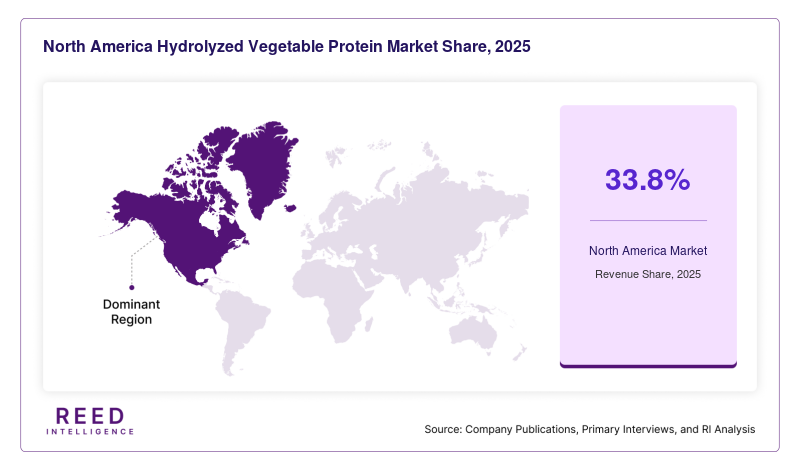
North America accounted for approximately 33.8% market share in 2025, with a projected CAGR of 7.2% during 2026–2034. The region continues to maintain strong demand due to its well-established processed food industry and high consumption of convenience foods. Hydrolyzed vegetable protein is widely used in packaged soups, sauces, and frozen meals across retail channels.
The United States remains the dominant country in the region, driven by advanced food manufacturing infrastructure and strong presence of global flavoring companies. Increasing demand for plant-based food alternatives and clean-label formulations is also contributing to steady market growth.
Europe
Europe held around 27.1% market share in 2025, with a projected CAGR of 6.8% during 2026–2034. The region demonstrates stable demand supported by strict food quality standards and growing preference for natural ingredients in processed foods.
Germany leads the European market, supported by its strong food processing industry and innovation in flavor technology. Growing consumer awareness regarding food labeling and ingredient transparency is driving manufacturers toward enzymatic hydrolyzed vegetable protein solutions.
Asia Pacific
Asia Pacific accounted for 25.6% share in 2025 and is expected to grow at the fastest CAGR of 8.6% during 2026–2034. The region benefits from rapid urbanization, population growth, and increasing consumption of packaged foods.
China dominates the regional market due to its large-scale food manufacturing sector and strong demand for instant noodles and savory snacks. Rising disposable incomes and expansion of modern retail channels are further boosting demand for hydrolyzed vegetable protein.
Middle East & Africa
Middle East & Africa held approximately 7.3% market share in 2025, with a projected CAGR of 7.5% during 2026–2034. The region is witnessing gradual growth in processed food consumption driven by urbanization and tourism development.
Saudi Arabia leads the regional market, supported by increasing investment in food processing industries and expanding hospitality sector demand. Rising imports of packaged foods also contribute to steady HVP consumption.
Latin America
Latin America accounted for 6.2% market share in 2025, with an expected CAGR of 7.0% during 2026–2034. Growth is driven by expanding middle-class population and increasing demand for affordable convenience foods.
Brazil remains the dominant country due to its large food and beverage industry and growing adoption of processed food products. Expansion of retail distribution networks is further enhancing product accessibility.
Competitive Landscape
The Hydrolyzed Vegetable Protein Market is moderately consolidated, with leading companies focusing on product innovation, enzymatic processing technologies, and clean-label formulations. Key players include Ajinomoto Co. Inc., Cargill Incorporated, Archer Daniels Midland Company (ADM), Kerry Group, and Tate & Lyle PLC. These companies maintain strong global distribution networks and invest heavily in research and development to enhance flavor optimization technologies.
Ajinomoto Co. Inc. remains a leading player, known for its advanced amino acid and flavor enhancement solutions. Recently, the company expanded its enzymatic protein production capacity to meet rising demand for clean-label ingredients. Strategic collaborations and acquisitions remain key growth strategies across the competitive landscape.
Key Players List
- Ajinomoto Co. Inc.
- Cargill Incorporated
- Archer Daniels Midland Company
- Kerry Group
- Tate & Lyle PLC
- Corbion N.V.
- DSM-Firmenich
- Sensient Technologies Corporation
- Bunge Limited
- Ingredion Incorporated
- Givaudan SA
- IFF (International Flavors & Fragrances)
- McCormick & Company
- Unilever PLC
- Griffith Foods
Recent Developments
- In 2025, a major flavor company expanded enzymatic hydrolysis production facilities to increase clean-label HVP output.
- In 2024, a leading food ingredient manufacturer launched a low-sodium hydrolyzed vegetable protein variant for health-focused applications.
- In 2026, several companies announced partnerships with plant-based meat producers to integrate HVP into next-generation protein products.
Hydrolyzed Vegetable Protein Market Segments
Type
- Acid Hydrolyzed Vegetable Protein
- Enzymatic Hydrolyzed Vegetable Protein
Application
- Soups, Sauces, and Seasonings
- Snacks and Convenience Foods
- Plant-Based Meat Alternatives
- Processed Meat Products
- Frozen and Ready-to-Eat Meals
End-Use
- Food Processing Industry
- Foodservice Industry
- Household/Retail Consumption
By Region
- North America
- Europe
- APAC
- Middle East and Africa
- LATAM