Hydrolyzed Wheat Protein Market Size, Share Demand Report By Type (Liquid Hydrolyzed Wheat Protein, Powder Hydrolyzed Wheat Protein), By Application (Personal Care & Cosmetics, Food & Beverage, Pharmaceuticals, Animal Feed), By Function (Conditioning Agent, Emulsifier, Film Former, Texture Enhancer), By Distribution Channel (Direct Sales, Distributors, Online Retail), By Region & Segment Forecasts, 2026–2034
USD 3950
Market Overview
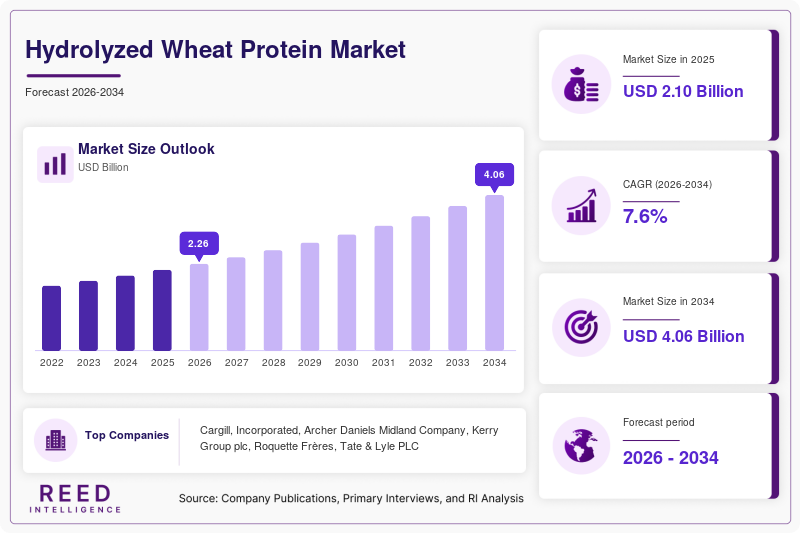
The global Hydrolyzed Wheat Protein Market size was valued at approximately USD 2.1 billion in 2026 and is projected to reach USD 3.8 billion by 2034, expanding at a CAGR of 7.6% from 2026 to 2034. The market growth has been consistently supported by the increasing global demand for plant-derived functional ingredients, particularly in personal care, cosmetics, and food formulations.
A major global factor driving the expansion of the Hydrolyzed Wheat Protein Market is the rising shift toward plant-based and sustainable ingredients across industries. Manufacturers are actively replacing synthetic additives with bio-based alternatives, where hydrolyzed wheat protein plays a key role due to its conditioning, emulsifying, and strengthening properties.
Key Highlights
- Dominant Region: Europe held approximately 34.2% market share in 2025, while Asia Pacific is projected to grow at a CAGR of 8.9% through 2034.
- Leading Subsegments:
- By Type: Liquid hydrolyzed wheat protein led with 58.6% share (2025)
- By Application: Personal care & cosmetics dominated with 42.8% share (2025)
- Fastest-Growing Subsegments:
- Powder form is expected to grow at a CAGR of 8.4%
- Food & beverage application is projected at 8.7% CAGR
- Dominant Country: The U.S. market was valued at USD 410 million in 2024 and USD 438 million in 2025, driven by strong demand in clean-label formulations.
Market Trends
Rising Demand for Clean-Label and Natural Ingredients
The Hydrolyzed Wheat Protein Market is experiencing a structural shift driven by consumer preference for clean-label products. Manufacturers in cosmetics and food sectors are reformulating products to exclude synthetic additives. Hydrolyzed wheat protein is increasingly used as a natural conditioning agent, emulsifier, and texture enhancer, aligning with regulatory and consumer expectations for transparency and sustainability.
Expansion of Plant-Based Protein Applications
The growing popularity of plant-based diets has expanded the application scope of hydrolyzed wheat protein beyond traditional uses. It is increasingly incorporated into meat alternatives, sports nutrition, and fortified beverages due to its amino acid profile and functional properties. This trend is influencing product innovation and diversifying revenue streams for market participants.
Market Drivers
Increasing Demand in Personal Care and Cosmetic Formulations
Hydrolyzed wheat protein is widely used in shampoos, conditioners, and skincare products due to its ability to improve moisture retention and elasticity. The growing global cosmetics industry, particularly in emerging economies, is driving consistent demand. Its compatibility with various formulations enhances its adoption among manufacturers.
Growth in Functional Food and Nutritional Products
The expanding functional food sector has created strong demand for protein-based ingredients that enhance nutritional value and texture. Hydrolyzed wheat protein is used in bakery, beverages, and dietary supplements, contributing to improved protein content and product stability. This driver is particularly evident in developed markets with mature health-conscious consumer bases.
Market Restraint
Allergen Concerns Associated with Wheat-Based Ingredients
One of the key challenges for the Hydrolyzed Wheat Protein Market is the presence of gluten-related allergen concerns. Consumers with gluten intolerance or celiac conditions tend to avoid wheat-derived ingredients, limiting market penetration in certain product categories and regions.
Market Opportunities
Increasing Demand in Emerging Economies
Rapid urbanization and rising disposable income in emerging markets are creating opportunities for hydrolyzed wheat protein in cosmetics and processed food industries. Local manufacturers are expanding production capacity to cater to this growing demand.
Technological Advancements in Protein Hydrolysis
Advancements in enzymatic hydrolysis techniques are improving the efficiency and quality of hydrolyzed wheat protein production. Enhanced processing methods are enabling the development of customized protein profiles, opening new application areas in specialized nutrition and premium cosmetics.
Segmental Analysis
By Type
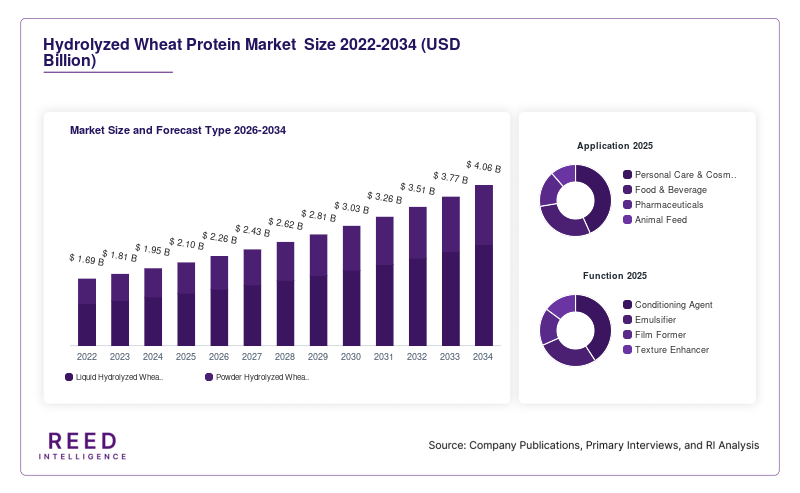
The liquid hydrolyzed wheat protein segment dominated the market with a 58.6% share in 2025, driven by its ease of incorporation in cosmetic and liquid food formulations. Its superior solubility and compatibility with emulsions have made it the preferred choice among manufacturers.
The powder segment is projected to grow at the fastest CAGR of 8.4% through 2034. This growth will be driven by its extended shelf life and suitability for dry food applications, including bakery and nutritional supplements.
By Application
The personal care & cosmetics segment accounted for 42.8% share in 2025, owing to extensive use in hair and skin care products. Its ability to improve texture and moisture retention has strengthened its adoption across premium product lines.
The food & beverage segment is expected to grow at a CAGR of 8.7%, supported by increasing demand for protein-enriched foods. Its role in improving nutritional value and product stability will continue to drive its expansion.
By Function
The conditioning agent segment held a dominant 36.5% share in 2025, as hydrolyzed wheat protein is widely used to enhance softness and elasticity in cosmetic formulations.
The emulsifier segment is projected to grow at a CAGR of 8.1%, driven by increasing demand in processed food and cosmetic applications where stable emulsions are required.
By End-Use Industry
The cosmetics industry dominated with a 40.2% share in 2025, supported by increasing product innovation and demand for natural ingredients.
The nutritional supplements segment is expected to grow at a CAGR of 8.6%, driven by rising health awareness and demand for plant-based protein sources.
By Distribution Channel
The direct sales segment accounted for 55.3% share in 2025, as manufacturers prefer direct sourcing for bulk procurement and quality assurance.
The online distribution segment is projected to grow at a CAGR of 9.2%, driven by increasing digitalization and accessibility of specialty ingredients.
Regional Analysis
North America
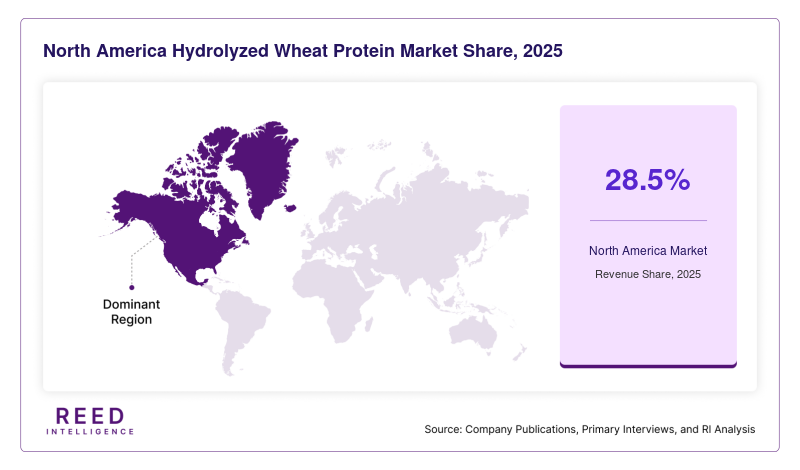
North America accounted for 28.5% of the Hydrolyzed Wheat Protein Market share in 2025 and is expected to grow at a CAGR of 7.2% during the forecast period. The U.S. dominated the region due to strong demand for natural cosmetic ingredients. A key growth factor is the increasing adoption of clean-label food products, which has driven ingredient innovation.
Europe
Europe held the largest share of 34.2% in 2025 and is projected to grow at a CAGR of 7.4% through 2034. Germany led the region due to its advanced cosmetic manufacturing industry. Stringent regulations promoting natural ingredients have accelerated the use of hydrolyzed wheat protein across multiple applications.
Asia Pacific
Asia Pacific represented 22.8% of the market in 2025 and is anticipated to grow at the fastest CAGR of 8.9%. China dominated the region due to its expanding personal care and food processing industries. Increasing middle-class population and changing consumption patterns are key growth contributors.
Middle East & Africa
The Middle East & Africa held 7.1% share in 2025 and is forecast to grow at a CAGR of 6.8%. The UAE emerged as a key market due to rising demand for premium personal care products. Growth is supported by increasing urbanization and retail expansion.
Latin America
Latin America accounted for 7.4% of the market in 2025 and is expected to grow at a CAGR of 6.9%. Brazil dominated the region, driven by a strong cosmetics industry and increasing demand for natural ingredients in beauty products.
Competitive Landscape
The Hydrolyzed Wheat Protein Market is moderately fragmented, with key players focusing on product innovation and strategic partnerships. Cargill, Incorporated is a leading player, leveraging its extensive supply chain and product portfolio. The company recently introduced enhanced plant protein formulations aimed at improving functionality in food applications.
Other prominent players include Archer Daniels Midland Company, Kerry Group plc, Roquette Frères, and Tate & Lyle PLC. These companies are investing in research and development to improve protein extraction processes and expand application areas.
Market participants are also focusing on sustainability initiatives and expanding their presence in emerging markets. Strategic collaborations with cosmetic and food manufacturers are helping companies strengthen their market position and diversify their revenue streams.
Key Players List
- Cargill, Incorporated
- Archer Daniels Midland Company
- Kerry Group plc
- Roquette Frères
- Tate & Lyle PLC
- Manildra Group
- CropEnergies AG
- MGP Ingredients, Inc.
- Tereos Group
- Crespel & Deiters Group
- Kröner-Stärke GmbH
- Glico Nutrition Co., Ltd.
- Agridient Inc.
- Foodchem International Corporation
- Henan Tianguan Enterprise Group
Recent Developments
- In 2025, major manufacturers expanded production facilities to meet rising demand for plant-based proteins.
- New enzymatic processing technologies were introduced to improve protein quality and functionality.
- Several companies launched clean-label hydrolyzed wheat protein variants targeting premium cosmetic applications.
- Strategic partnerships between ingredient suppliers and cosmetic brands increased to accelerate product innovation.
- Investments in emerging markets focused on strengthening supply chains and distribution networks.
Hydrolyzed Wheat Protein Market Segments
Type
- Liquid Hydrolyzed Wheat Protein
- Powder Hydrolyzed Wheat Protein
Application
- Personal Care & Cosmetics
- Food & Beverage
- Pharmaceuticals
- Animal Feed
Function
- Conditioning Agent
- Emulsifier
- Film Former
- Texture Enhancer
Distribution Channel
- Direct Sales
- Distributors
- Online Retail
By Region
- North America
- Europe
- APAC
- Middle East and Africa
- LATAM