Hydroquinone Market Size, Share & Demand Report By Type (Industrial Grade Hydroquinone, Cosmetic Grade Hydroquinone, Pharmaceutical Grade Hydroquinone), By Application (Polymerization Inhibitors, Cosmetic & Dermatology Formulations, Photographic Chemicals, Chemical Intermediates, Rubber Antioxidants), By End-Use Industry (Chemical Manufacturing, Pharmaceutical & Dermatology, Cosmetics & Personal Care, Polymer & Rubber Industry), By Region & Segment Forecasts, 2025–2034
USD 3950
Market Overview
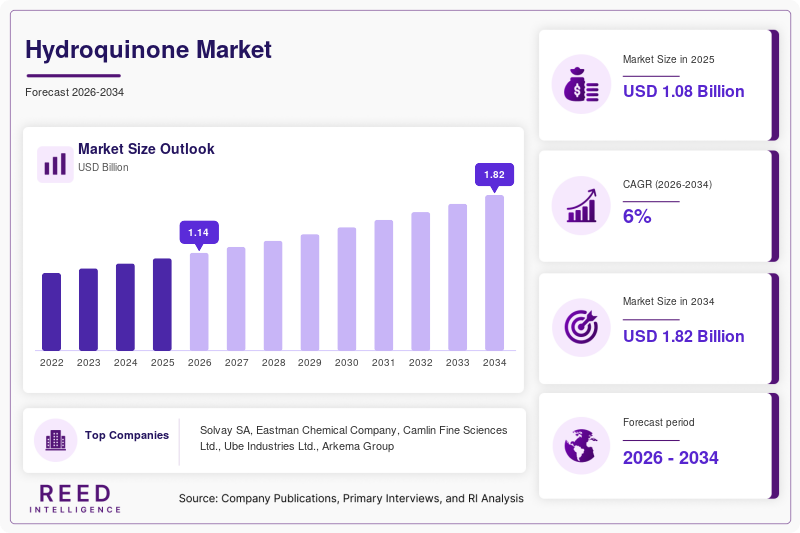
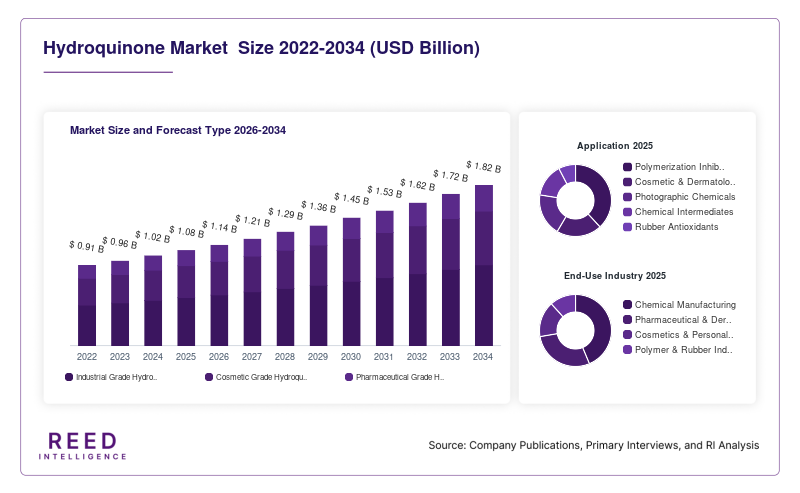
The Hydroquinone Market size was valued at USD 1.08 billion in 2025 and is projected to reach USD 1.82 billion by 2034, expanding at a CAGR of 6.0% from 2025 to 2034. Hydroquinone is widely used as a chemical intermediate and antioxidant across sectors such as cosmetics, pharmaceuticals, rubber processing, coatings, and polymer manufacturing. Its effectiveness as a skin-lightening agent and polymerization inhibitor continues to support steady demand from multiple end-use industries.
One global factor that supported the growth of the Hydroquinone Market size was the expansion of specialty chemical production worldwide. As manufacturers increased investment in polymer stabilizers, rubber additives, and photographic chemicals, hydroquinone consumption grew as an essential ingredient for controlling oxidation and polymerization reactions. In addition, hydroquinone derivatives are widely used in dye manufacturing and advanced material processing, which further supported the Hydroquinone Market share across industrial value chains.
Key Highlights
- Dominant region: Asia Pacific accounted for 38.6% of the Hydroquinone Market share in 2025, while Latin America will grow the fastest at a CAGR of 6.9% through 2034.
- Leading segments: The Industrial Grade type segment held 56.3% share in 2025, while Cosmetic Grade will grow fastest at a CAGR of 6.7%.
- Top application: Polymer inhibitors dominated with 34.8% share, while cosmetic formulations will expand fastest at 7.1% CAGR.
- Dominant country: The United States Hydroquinone Market was valued at USD 214 million in 2025 and is estimated to reach USD 226 million in 2026.
Market Trends
Expansion of Hydroquinone Use in Dermatology Formulations
One notable trend shaping the Hydroquinone Market is the growing use of hydroquinone in dermatology formulations aimed at addressing hyperpigmentation and skin discoloration conditions. Pharmaceutical and skincare manufacturers are investing in research to develop controlled-dosage topical treatments that improve safety and effectiveness. This trend is particularly visible in developed economies where dermatological solutions are increasingly recommended by healthcare professionals. Product innovation involving combination therapies with retinoids and corticosteroids is also influencing Hydroquinone Market trends, enabling manufacturers to expand therapeutic applications.
Rising Integration in Polymer Stabilization and Industrial Processing
Another emerging trend in the Hydroquinone Market analysis is the rising integration of hydroquinone as a polymerization inhibitor and stabilizing agent in industrial processing. The compound plays a vital role in preventing premature polymer formation during the storage and transportation of monomers such as acrylic acid and styrene. As chemical manufacturers increase production of synthetic polymers and specialty resins, hydroquinone demand continues to expand. The trend reflects broader industrial adoption of oxidation inhibitors and stabilizers to maintain chemical product quality during long supply chains, thereby strengthening the Hydroquinone Market outlook.
Market Drivers
Increasing Demand from Polymer and Rubber Industries
A key driver supporting Hydroquinone Market growth is its increasing utilization in polymer and rubber processing industries. Hydroquinone functions as a polymerization inhibitor that prevents unwanted chemical reactions during storage and transportation of monomers. With global demand for plastics, synthetic rubber, and industrial coatings rising steadily, manufacturers require reliable stabilizing agents to maintain production efficiency. Hydroquinone’s strong antioxidant properties make it suitable for preventing degradation in chemical intermediates, thereby contributing to expanding industrial demand.
Expanding Applications in Photographic and Chemical Intermediates
Another important factor driving the Hydroquinone Market size is the compound’s role in photographic developers and chemical intermediate production. Hydroquinone has historically been used in photographic development processes because of its ability to reduce silver halides and produce stable image contrast. Although digital photography has reduced traditional film consumption, specialized imaging applications in printing, radiography, and industrial inspection continue to rely on hydroquinone-based formulations. Additionally, the compound serves as a precursor in the production of dyes, agrochemicals, and pharmaceuticals, supporting the broader Hydroquinone Market analysis across specialty chemical manufacturing.
Market Restraint
Regulatory Restrictions on Cosmetic Hydroquinone Usage
One of the major challenges affecting the Hydroquinone Market share is the regulatory scrutiny associated with hydroquinone use in cosmetic products. Several regulatory agencies have implemented strict concentration limits or restrictions due to concerns about potential side effects from prolonged topical application. These regulatory frameworks require manufacturers to reformulate skincare products or seek alternative depigmentation ingredients.
The impact of regulatory oversight is particularly visible in regions where consumer safety regulations are evolving rapidly. Manufacturers must comply with detailed product testing, labeling requirements, and ingredient concentration limits before launching hydroquinone-based formulations. Such compliance processes can increase development costs and delay product approvals.
In addition, rising consumer preference for naturally derived skincare ingredients may influence purchasing behavior in some markets. As a result, certain cosmetic manufacturers are exploring botanical alternatives for skin-brightening products.
Despite these limitations, hydroquinone remains widely used in pharmaceutical dermatology treatments and industrial applications. However, regulatory constraints in cosmetics represent a structural restraint that may influence the overall Hydroquinone Market forecast over the next decade.
Market Opportunities
Development of High-Purity Hydroquinone for Advanced Chemical Applications
A significant opportunity within the Hydroquinone Market lies in the development of high-purity hydroquinone grades designed for advanced chemical manufacturing. Specialty chemical producers are increasingly seeking high-quality inhibitors and antioxidants for use in precision manufacturing environments. High-purity hydroquinone can enhance stability in polymer resins, coatings, and electronic chemical intermediates. Manufacturers that invest in refining technologies and quality control processes may gain competitive advantages by supplying these specialized grades to high-value industrial sectors.
Expansion of Dermatology and Medical Skincare Markets
Another promising opportunity in the Hydroquinone Market analysis is the growth of dermatology and medical skincare sectors. Rising awareness of skin disorders such as melasma, post-inflammatory hyperpigmentation, and sun damage has encouraged healthcare professionals to recommend clinically validated treatments. Pharmaceutical companies are exploring prescription-based hydroquinone formulations that combine active ingredients to improve therapeutic outcomes. As dermatology clinics and aesthetic treatment centers expand globally, demand for regulated hydroquinone formulations is expected to increase, supporting the long-term Hydroquinone Market outlook.
Segmental Analysis
By Type
The Industrial Grade hydroquinone segment dominated the Hydroquinone Market with 56.3% share in 2025. Industrial grade hydroquinone has been widely used in polymer stabilization, rubber processing, and chemical manufacturing applications. The compound’s strong antioxidant properties make it suitable for preventing oxidation and unwanted polymerization reactions in industrial environments. Chemical manufacturers have relied on industrial grade hydroquinone to maintain product stability during storage and transportation of monomers and chemical intermediates.
The Cosmetic Grade hydroquinone segment will grow the fastest at a CAGR of 6.7% through 2034. Cosmetic grade hydroquinone is expected to experience rising demand due to its increasing use in dermatology-focused skincare formulations. Pharmaceutical and skincare companies will continue to develop regulated formulations designed to address hyperpigmentation conditions. The growth of dermatology clinics and aesthetic treatment centers will further support expansion of this subsegment within the Hydroquinone Market forecast.
By Application
The Polymer Inhibitors segment held the largest share of 34.8% in the Hydroquinone Market in 2025. Hydroquinone has been widely utilized as a polymerization inhibitor in the storage and transportation of reactive monomers such as acrylic acid, methyl methacrylate, and styrene. The compound prevents premature polymer formation that could compromise chemical product quality. As polymer production continued to expand globally, hydroquinone remained a critical stabilizing agent in industrial chemical supply chains.
The Cosmetic Formulations segment will expand at the fastest CAGR of 7.1% during the forecast period. The segment will benefit from the expansion of dermatology treatments and regulated medical skincare products. Pharmaceutical companies will continue to research improved hydroquinone-based formulations that address pigmentation disorders with controlled dosage levels. As dermatology treatments become more accessible, hydroquinone demand from cosmetic and medical skincare manufacturers will rise.
By End-Use Industry
The Chemical Industry segment accounted for 44.2% of the Hydroquinone Market share in 2025. Hydroquinone has been widely used as a chemical intermediate and stabilizer in various chemical manufacturing processes. Producers of dyes, agrochemicals, and polymer additives have incorporated hydroquinone to improve product stability and processing efficiency. The chemical industry’s broad application base has made it the dominant end-use sector within the global market.
The Pharmaceutical and Dermatology segment will grow at a CAGR of 6.8% through 2034. This growth will be supported by expanding clinical research in dermatological treatments. Pharmaceutical companies will continue to develop prescription-based hydroquinone formulations that target pigmentation disorders and skin discoloration conditions. Increasing demand for dermatology services and specialized skincare treatments will further strengthen the segment’s contribution to the overall Hydroquinone Market outlook.
Regional Analysis
North America
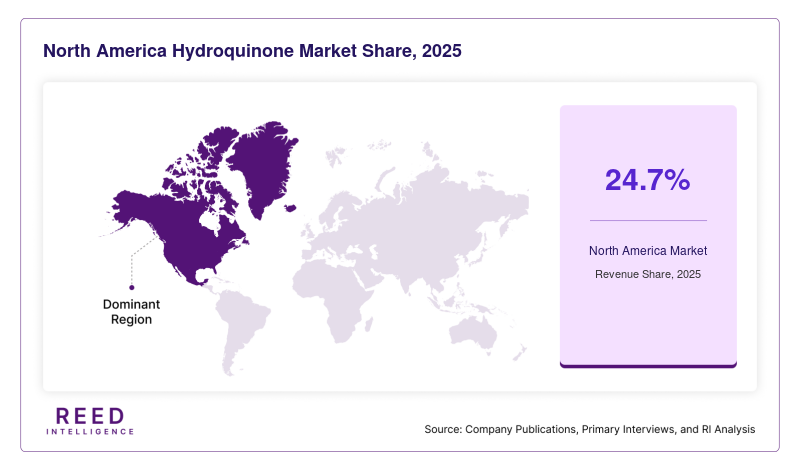
North America accounted for 24.7% of the Hydroquinone Market share in 2025 and will grow at a CAGR of 5.4% from 2025 to 2034. The region has historically maintained a strong position due to the presence of established chemical manufacturers and pharmaceutical companies. Hydroquinone demand remained steady across polymer processing, industrial chemical manufacturing, and dermatological treatments. Advanced research infrastructure and a well-regulated pharmaceutical sector have supported stable product development and distribution channels within the region.
The United States represented the dominant country in the regional Hydroquinone Market size. The country’s strong chemical manufacturing sector has supported hydroquinone consumption in polymer stabilizers and specialty chemicals. Additionally, dermatology clinics and pharmaceutical companies continued to utilize hydroquinone formulations for treating pigmentation disorders. Continuous research in dermatological therapeutics and controlled prescription products has further supported demand across medical skincare applications.
Europe
Europe held 21.9% of the Hydroquinone Market share in 2025 and will expand at a CAGR of 5.2% through 2034. The region’s hydroquinone consumption has been influenced by the presence of advanced chemical processing industries and specialty polymer manufacturing. European manufacturers have maintained stable demand for hydroquinone in resin stabilization and rubber processing. Additionally, industrial coating manufacturers have incorporated hydroquinone inhibitors to maintain product stability during production and storage.
Germany emerged as the leading country in the European Hydroquinone Market analysis. The country’s strong industrial base, particularly in specialty chemicals and polymer manufacturing, supported hydroquinone demand. German chemical companies have continued to invest in high-performance materials and additives that enhance chemical stability during manufacturing processes. As a result, hydroquinone consumption remained consistent across industrial supply chains within the region.
Asia Pacific
Asia Pacific dominated the global Hydroquinone Market share with 38.6% in 2025 and will grow at a CAGR of 6.4% during the forecast period. The region’s large chemical manufacturing capacity and expanding polymer production industries contributed significantly to hydroquinone consumption. Rapid industrialization and infrastructure development across several Asian economies have increased demand for polymer resins, coatings, and adhesives, all of which require stabilizing agents such as hydroquinone.
China represented the largest country market in the region. The country’s extensive chemical manufacturing ecosystem has supported hydroquinone production and consumption across various industrial applications. Chinese manufacturers have integrated hydroquinone inhibitors into polymer processing and synthetic rubber production. Large-scale industrial output and integrated chemical supply chains have enabled China to maintain a significant role in the global Hydroquinone Market growth.
Middle East & Africa
The Middle East & Africa Hydroquinone Market accounted for 7.8% share in 2025 and will expand at a CAGR of 5.8% through 2034. The region’s hydroquinone demand has been primarily influenced by expanding chemical processing and industrial manufacturing sectors. Hydroquinone consumption has been associated with polymer production, rubber processing, and specialty chemical manufacturing across emerging industrial clusters.
Saudi Arabia remained the leading country within the regional Hydroquinone Market outlook. The country’s petrochemical industry and industrial diversification initiatives supported demand for chemical intermediates and stabilizers. Hydroquinone usage in polymer processing and chemical manufacturing continued to expand as industrial facilities increased production capacity in downstream petrochemical industries.
Latin America
Latin America held 7.0% of the Hydroquinone Market share in 2025 and will grow at the fastest CAGR of 6.9% through 2034. The region has experienced increasing industrial chemical demand due to the expansion of polymer processing industries and growing manufacturing activity. Hydroquinone consumption has gradually increased across rubber additives, polymer stabilizers, and specialty chemical production.
Brazil dominated the regional Hydroquinone Market size. The country’s developing chemical manufacturing industry and growing polymer production capacity have supported hydroquinone demand. Additionally, pharmaceutical manufacturing expansion has contributed to the usage of hydroquinone in dermatology formulations. These factors collectively supported Brazil’s role as the leading national market in the region.
Competitive Landscape
The Hydroquinone Market is moderately consolidated, with several global chemical manufacturers operating across industrial and pharmaceutical supply chains. Leading companies focus on production capacity expansion, high-purity hydroquinone development, and strategic partnerships with specialty chemical distributors.
Solvay SA is recognized as a key market leader due to its diversified chemical portfolio and strong production capabilities in phenolic compounds. The company has focused on developing advanced hydroquinone derivatives used in polymer stabilization and specialty chemical manufacturing.
Other notable participants include Eastman Chemical Company, Camlin Fine Sciences Ltd., Ube Industries Ltd., and Arkema Group. These companies maintain strong presence across industrial chemical applications and continue to expand their distribution networks globally.
Market participants are also investing in process optimization and production efficiency to meet the growing demand for high-purity hydroquinone in specialty chemical and dermatological applications.
Key Players
- Solvay SA
- Eastman Chemical Company
- Camlin Fine Sciences Ltd.
- Ube Industries Ltd.
- Arkema Group
- Mitsui Chemicals Inc.
- Lanxess AG
- Lianyungang Sanjili Chemical Industry Co., Ltd.
- Alfa Aesar
- Jiangsu Zhongneng Chemical Technology Co., Ltd.
- Tokyo Chemical Industry Co., Ltd.
- Parchem Fine & Specialty Chemicals
- Haihang Industry Co., Ltd.
- Chemours Company
- Sigma-Aldrich (Merck Group)
Recent Developments
- 2024: Solvay expanded specialty phenolic compound production capacity to support hydroquinone supply for polymer stabilization applications.
- 2024: Camlin Fine Sciences invested in manufacturing process upgrades aimed at improving hydroquinone purity for specialty chemical applications.
- 2023: Eastman Chemical Company enhanced its chemical additives portfolio with new inhibitor formulations incorporating hydroquinone derivatives.
- 2023: Arkema strengthened its distribution partnerships in Asia Pacific to support specialty chemical supply chains.
- 2023: Ube Industries increased production efficiency in phenolic intermediates to meet growing industrial chemical demand.
Hydroquinone Market Segments
Type
- Industrial Grade Hydroquinone
- Cosmetic Grade Hydroquinone
- Pharmaceutical Grade Hydroquinone
Application
- Polymerization Inhibitors
- Cosmetic & Dermatology Formulations
- Photographic Chemicals
- Chemical Intermediates
- Rubber Antioxidants
End-Use Industry
- Chemical Manufacturing
- Pharmaceutical & Dermatology
- Cosmetics & Personal Care
- Polymer & Rubber Industry
By Region
- North America
- Europe
- APAC
- Middle East and Africa
- LATAM