Hydroseeding Market Size, Share & Demand Report By Mulch Type (Wood Fiber Mulch, Bonded Fiber Matrix Mulch), By Application (Erosion Control, Landscaping, Mine Reclamation, Sports Turf Establishment), By End-Use Industry (Construction and Infrastructure, Mining, Municipal Landscaping), By Equipment Type (Hydraulic Hydroseeders, Jet Agitation Hydroseeders, Mechanical Agitation Hydroseeders) By Region & Segment Forecasts, 2026–2034
USD 3950
Market Overview
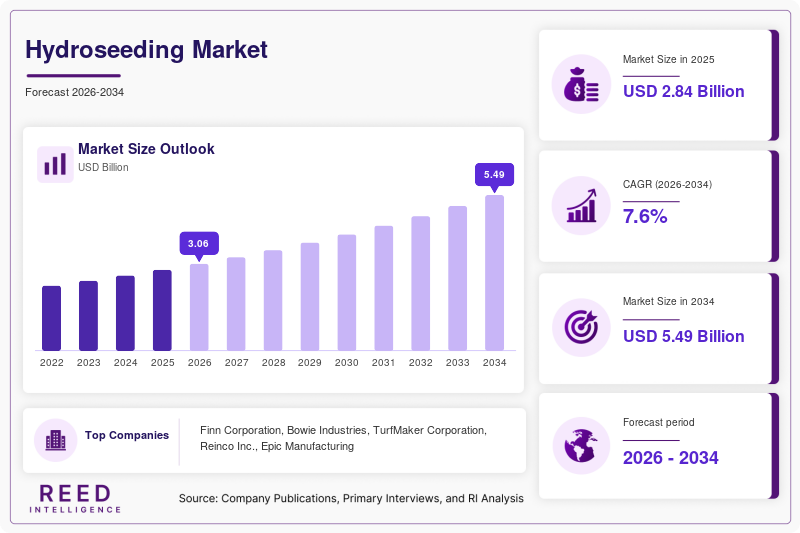
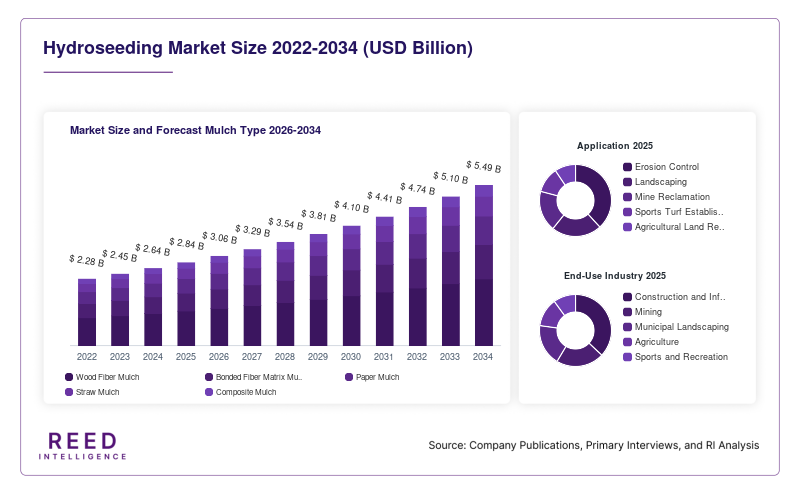
The global Hydroseeding Market was valued at USD 2.84 billion in 2026 and is projected to reach USD 5.12 billion by 2034, expanding at a CAGR of 7.6% during the forecast period from 2026 to 2034. The market growth has been supported by increasing investments in land restoration, infrastructure landscaping, and erosion control activities across developed and developing economies. Hydroseeding has become a preferred vegetation establishment technique due to its cost efficiency, rapid seed application capabilities, and ability to cover large areas with uniform seed distribution.
The rising focus on sustainable land management practices and environmental rehabilitation projects has accelerated adoption of hydroseeding solutions worldwide. Governments and private contractors are increasingly implementing vegetation restoration programs for highways, mining sites, construction zones, and public landscapes to prevent soil erosion and improve ecological stability. Hydroseeding offers faster germination and reduced soil displacement compared to traditional seeding methods, making it highly suitable for large-scale projects.
Key Highlights
- North America accounted for 36.2% of the global Hydroseeding Market share in 2025, while Asia Pacific is projected to register the fastest CAGR of 8.5% during the forecast period.
- By mulch type, wood fiber mulch held the leading share of 41.7% in 2025, while bonded fiber matrix mulch is expected to witness the fastest CAGR of 8.8% through 2034.
- By application, erosion control dominated with 38.5% market share in 2025, whereas landscaping applications are anticipated to grow at a CAGR of 8.2%.
- By end-use industry, construction and infrastructure represented 34.6% of the market in 2025, while mining reclamation is projected to expand at a CAGR of 8.6%.
- By equipment type, hydraulic hydroseeders remained the dominant segment with 57.1% share in 2025, while jet agitation hydroseeders are expected to grow at a CAGR of 8.3%.
- The United States Hydroseeding Market was valued at USD 698 million in 2024 and reached USD 741 million in 2025 due to increasing roadside vegetation and erosion management projects.
Market Trends
Increasing Adoption of Biodegradable Mulch Materials
The Hydroseeding Market is witnessing growing adoption of biodegradable mulch materials designed to improve moisture retention and reduce environmental impact. Manufacturers are introducing mulch formulations made from recycled paper, wood fibers, and organic compounds to support sustainable vegetation establishment. These materials improve soil stability while minimizing long-term environmental residue, making them increasingly suitable for public landscaping and ecological restoration projects.
Integration of Precision Spraying Technologies
Advanced spraying systems and automated hydroseeding equipment are becoming important trends in the Hydroseeding Market. Contractors are increasingly adopting GPS-enabled spraying systems and precision flow controls to improve seed placement accuracy and reduce material waste. These technologies enhance operational efficiency, especially in large-scale infrastructure and slope stabilization projects.
Market Drivers
Expansion of Infrastructure and Land Development Projects
The rapid expansion of infrastructure construction activities is a major driver supporting the Hydroseeding Market. Governments and private developers are investing heavily in highways, airports, rail corridors, and commercial construction projects that require vegetation restoration and erosion prevention measures.
Hydroseeding provides an efficient solution for stabilizing disturbed land areas after excavation and construction activities. The technique allows rapid application of seed mixtures across uneven terrains, reducing labor costs and improving vegetation establishment rates in large development projects.
Rising Focus on Soil Erosion Prevention
Increasing awareness regarding soil degradation and environmental conservation is significantly driving the Hydroseeding Market. Soil erosion caused by deforestation, mining activities, and urban development has encouraged governments and environmental agencies to adopt effective land stabilization methods.
Hydroseeding helps reduce runoff, improve soil retention, and promote vegetation growth on slopes and exposed land surfaces. The technique is increasingly being used in environmental rehabilitation programs and stormwater management systems to protect land quality and water resources.
Market Restraint
High Initial Equipment and Operational Costs
The high cost associated with hydroseeding equipment and slurry preparation remains a key restraint for the Hydroseeding Market. Advanced hydroseeders, pumping systems, and specialized mulch materials require substantial investment, particularly for small contractors and landscaping businesses. Operational costs related to maintenance, transportation, and skilled labor can also limit adoption in price-sensitive regions.
Market Opportunities
Growing Demand for Mine Site Rehabilitation
The increasing focus on post-mining land restoration is creating new opportunities in the Hydroseeding Market. Mining operators are adopting hydroseeding techniques to stabilize soil, reduce dust generation, and restore vegetation in reclaimed mining zones. Governments are also implementing stricter environmental restoration regulations that encourage vegetation recovery programs.
Expansion of Urban Green Infrastructure Projects
The development of urban green infrastructure is expected to create strong growth opportunities for the Hydroseeding Market. Municipal authorities are investing in green belts, public parks, rain gardens, and roadside vegetation to improve urban sustainability and environmental quality. Hydroseeding offers an efficient vegetation establishment solution for large urban landscaping projects.
Segmental Analysis
By Mulch Type
Wood Fiber Mulch: Wood fiber mulch accounted for 41.7% of the Hydroseeding Market share in 2025. Its dominance was supported by strong moisture retention capability, cost efficiency, and compatibility with a wide range of vegetation applications. Wood fiber mulch remained widely used in roadside landscaping and erosion control projects.
Bonded Fiber Matrix Mulch: Bonded fiber matrix mulch is projected to grow at a CAGR of 8.8% through 2034. Increasing demand for high-performance erosion control solutions will support segment expansion. These materials provide enhanced slope stabilization and water absorption properties, making them suitable for environmentally sensitive projects.
By Application
Erosion Control: Erosion control applications held the largest share of 38.5% in 2025 due to increasing investments in slope stabilization, stormwater management, and land rehabilitation projects. Hydroseeding remained widely used for reducing soil displacement and improving vegetation growth on exposed land surfaces.
Landscaping Applications: Landscaping applications are expected to register a CAGR of 8.2% during the forecast period. Rising investments in public parks, commercial landscapes, and residential green spaces will accelerate demand for rapid vegetation establishment techniques.
By End-Use Industry
Construction and Infrastructure: Construction and infrastructure accounted for 34.6% of the Hydroseeding Market share in 2025. Demand remained strong due to increasing highway construction, urban development, and transportation infrastructure projects requiring vegetation restoration solutions.
Mining Reclamation: Mining reclamation is projected to grow at a CAGR of 8.6% through 2034. Expanding environmental restoration requirements and post-mining land rehabilitation initiatives will strengthen adoption of hydroseeding technologies.
By Equipment Type
Hydraulic Hydroseeders: Hydraulic hydroseeders held the largest share of 57.1% in 2025 due to their high spraying efficiency and suitability for large-scale applications. These systems remained commonly used in commercial landscaping and roadside vegetation projects.
Jet Agitation Hydroseeders: Jet agitation hydroseeders are expected to witness a CAGR of 8.3% during the forecast period. Their ability to improve slurry mixing efficiency and reduce application time will increase adoption among contractors handling complex terrain projects.
Regional Analysis
North America
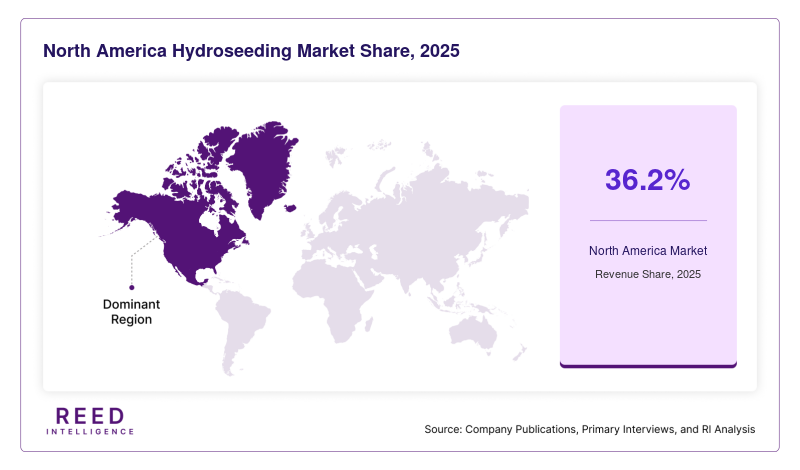
North America accounted for 36.2% of the global Hydroseeding Market share in 2025 and is expected to grow at a CAGR of 7.0% through 2034. The regional market benefited from strong investments in highway infrastructure maintenance and erosion control initiatives.
The United States dominated the regional market due to increasing adoption of hydroseeding for transportation corridor landscaping and commercial land development projects. Municipal governments and environmental agencies also increased investments in vegetation restoration programs for flood-prone areas.
Europe
Europe represented 26.4% of the Hydroseeding Market in 2025 and is projected to expand at a CAGR of 7.1% during the forecast period. The market was supported by rising environmental restoration projects and strict land management regulations.
Germany emerged as the leading country in the region owing to increasing investments in ecological rehabilitation and sustainable urban landscaping programs. Hydroseeding was increasingly adopted for slope stabilization and roadside vegetation management projects.
Asia Pacific
Asia Pacific held 24.5% of the Hydroseeding Market share in 2025 and is anticipated to witness the fastest CAGR of 8.5% from 2026 to 2034. Rapid urbanization, infrastructure development, and land reclamation activities supported regional market growth.
China dominated the regional market due to extensive railway, highway, and mining infrastructure projects requiring large-scale vegetation establishment. Government-led environmental restoration programs also contributed to increased hydroseeding adoption.
Middle East & Africa
The Middle East & Africa accounted for 7.1% of the Hydroseeding Market in 2025 and is forecast to grow at a CAGR of 6.8% through 2034. The market benefited from increasing landscaping projects and investments in desert greening initiatives.
Saudi Arabia emerged as the dominant country in the region because of growing investments in urban beautification and large-scale infrastructure development programs. Hydroseeding gained popularity for vegetation establishment in commercial and public landscape projects.
Latin America
Latin America captured 5.8% of the Hydroseeding Market share in 2025 and is expected to grow at a CAGR of 6.5% during the forecast period. Rising environmental awareness and infrastructure expansion activities supported regional market growth.
Brazil led the regional market owing to increasing reforestation projects and growing demand for erosion control solutions in agricultural and construction sectors. Public landscaping programs also contributed to increased hydroseeding adoption.
Competitive Landscape
The Hydroseeding Market remains moderately fragmented with the presence of equipment manufacturers, environmental service providers, and landscaping solution companies. Market participants are focusing on advanced spraying technologies, biodegradable slurry formulations, and equipment efficiency improvements to strengthen their market position.
Finn Corporation remained a leading participant in the Hydroseeding Market due to its broad hydroseeding equipment portfolio and strong contractor distribution network. The company recently introduced an advanced hydroseeding system with precision spray controls designed for large-scale erosion control applications.
Bowie Industries focused on expanding high-capacity hydroseeders for infrastructure and mining projects. TurfMaker Corporation emphasized compact hydroseeding systems for landscaping and residential applications. Reinco Inc. strengthened its erosion control equipment offerings through technological upgrades. Epic Manufacturing expanded mulch application equipment solutions targeting environmental restoration contractors.
Key Players List
- Finn Corporation
- Bowie Industries
- TurfMaker Corporation
- Reinco Inc.
- Epic Manufacturing
- Turbo Turf
- VIT Company
- Easy Lawn Inc.
- Express Blower Inc.
- Ero-Guard Pty Ltd.
- Hydromulch LLC
- Eco Turf Solutions
- Greenfix Soil Stabilisation & Erosion Control Ltd.
- Profile Products LLC
- Mat Inc.
Recent Developments
- In February 2026, Finn Corporation launched a precision-controlled hydroseeding system designed for large infrastructure vegetation projects.
- In November 2025, Bowie Industries expanded manufacturing capacity for high-volume hydroseeders targeting mining reclamation applications.
- In September 2025, TurfMaker Corporation introduced compact hydroseeding units for residential and urban landscaping projects.
- In June 2025, Reinco Inc. upgraded its erosion control equipment portfolio with enhanced slurry mixing technology.
- In March 2025, Profile Products LLC introduced biodegradable mulch formulations designed for environmentally sensitive restoration projects.
Hydroseeding Market Segments
Mulch Type
- Wood Fiber Mulch
- Bonded Fiber Matrix Mulch
- Paper Mulch
- Straw Mulch
- Composite Mulch
Application
- Erosion Control
- Landscaping
- Mine Reclamation
- Sports Turf Establishment
- Agricultural Land Restoration
End-Use Industry
- Construction and Infrastructure
- Mining
- Municipal Landscaping
- Agriculture
- Sports and Recreation
Equipment Type
- Hydraulic Hydroseeders
- Jet Agitation Hydroseeders
- Mechanical Agitation Hydroseeders
- Trailer-Mounted Systems
By Region
- North America
- Europe
- APAC
- Middle East and Africa
- LATAM