Hydroxyacetic Acid Market Size, Share & Demand Report By Grade (Cosmetic Grade, Pharmaceutical Grade, Industrial Grade), By Application (Personal Care & Cosmetics, Pharmaceuticals, Industrial Cleaning, Textile Processing), By End-Use Industry (Cosmetics Industry, Healthcare Industry, Chemical Industry, Textile Industry), By Distribution Channel (Online Retail, Pharmacies & Drug Stores, Specialty Chemical Stores, Direct Sales), By Region & Segment Forecasts, 2026–2034
USD 3950
Market Overview
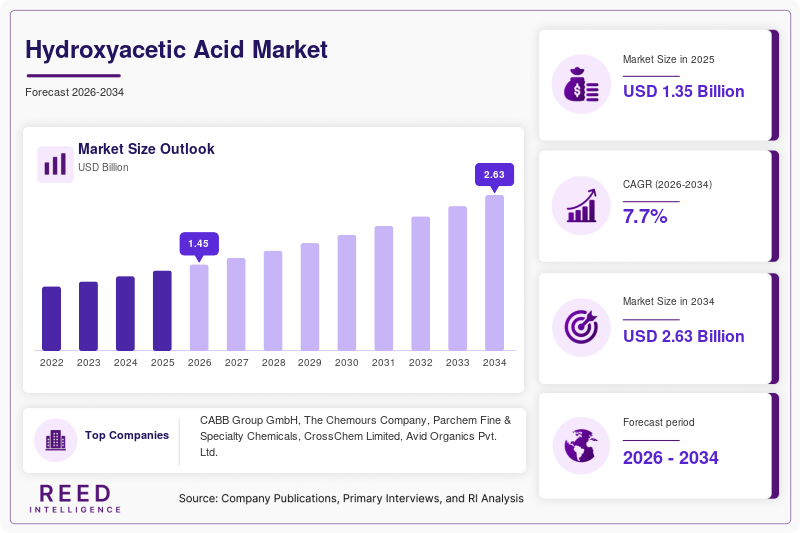
The global Hydroxyacetic Acid Market size was valued at approximately USD 1.35 billion in 2026 and is projected to reach USD 2.45 billion by 2034, expanding at a compound annual growth rate (CAGR) of 7.7% during the forecast period (2026–2034). Hydroxyacetic acid, commonly known as glycolic acid, is widely used in personal care, pharmaceuticals, textiles, and industrial cleaning applications due to its exfoliating, chelating, and biodegradable properties.
A significant global factor supporting the growth of the Hydroxyacetic Acid Market is the rising demand for advanced skincare formulations. Increasing consumer awareness regarding skin health and anti-aging solutions has led to a surge in the adoption of alpha hydroxy acids (AHAs), particularly in emerging economies. Additionally, regulatory shifts toward environmentally friendly chemicals have further driven demand for biodegradable acids such as hydroxyacetic acid in industrial applications.
Key Highlights:
- North America dominated the market with a 34% share in 2025, while Asia Pacific is projected to register the fastest CAGR of 8.9% during the forecast period.
- Personal care & cosmetics emerged as the leading application segment with a 41% share, whereas pharmaceutical applications are expected to grow at a CAGR of 9.2%.
- The cosmetic grade segment accounted for the largest share, while pharmaceutical grade is anticipated to witness the fastest growth.
- The United States led the market with USD 410 million in 2024 and USD 435 million in 2025.
Market Trends
Rising Demand for Clean Beauty and Dermatological Products
The Hydroxyacetic Acid Market is witnessing strong momentum due to the increasing preference for clean-label and dermatologically tested skincare products. Consumers are actively seeking formulations that offer effective exfoliation without harsh side effects. Hydroxyacetic acid, being a naturally derived alpha hydroxy acid, aligns well with this demand. Manufacturers are incorporating it into serums, chemical peels, and anti-aging creams. Furthermore, innovations in low-irritation formulations and controlled-release technologies are enhancing product efficacy and safety, thereby expanding consumer adoption across sensitive skin segments.
Shift Toward Bio-Based Production Processes
Another notable trend in the Hydroxyacetic Acid Market is the transition from conventional chemical synthesis to bio-based production methods. Companies are investing in fermentation-based processes that utilize renewable feedstocks, reducing environmental impact and complying with sustainability regulations. This shift is particularly prominent in Europe and North America, where regulatory frameworks emphasize eco-friendly manufacturing. Bio-based hydroxyacetic acid also appeals to environmentally conscious consumers, strengthening its demand across multiple industries, including textiles and industrial cleaning.
Market Drivers
Expanding Applications in Personal Care Industry
The increasing use of hydroxyacetic acid in skincare and cosmetic products is a major driver of the Hydroxyacetic Acid Market. Its ability to promote cell turnover, improve skin texture, and reduce hyperpigmentation makes it a preferred ingredient in dermatological formulations. The growth of e-commerce platforms and digital marketing has further accelerated product visibility, boosting sales globally.
Growing Demand in Industrial and Cleaning Applications
Hydroxyacetic acid is widely used in industrial cleaning due to its chelating and descaling properties. Industries such as oil & gas, food processing, and manufacturing are adopting it as a safer alternative to harsh chemicals. Its biodegradability and low toxicity enhance its appeal in environmentally regulated markets, thereby supporting long-term demand growth.
Market Restraint
Skin Sensitivity and Regulatory Limitations
One of the major challenges in the Hydroxyacetic Acid Market is the potential for skin irritation when used in high concentrations. Regulatory authorities in several regions impose strict limits on permissible concentrations in cosmetic formulations. These restrictions can limit product innovation and reduce formulation flexibility for manufacturers. Additionally, concerns regarding misuse or overuse by consumers may impact brand trust and market expansion. Companies must invest in clinical testing and consumer education to mitigate these risks.
Market Opportunities
Growth in Pharmaceutical Formulations
The Hydroxyacetic Acid Market presents significant opportunities in pharmaceutical applications. Hydroxyacetic acid is increasingly used in topical treatments for acne, keratosis, and other dermatological conditions. Advancements in drug delivery systems and dermatology research are expected to expand its application scope, creating new revenue streams for manufacturers.
Emerging Demand in Developing Economies
Rapid urbanization and rising disposable incomes in developing regions are creating new growth avenues for the Hydroxyacetic Acid Market. Countries in Asia Pacific and Latin America are witnessing increased demand for personal care products and industrial cleaning solutions. Local production capabilities and favorable government policies are expected to further accelerate market penetration in these regions.
Segmental Analysis
By Grade
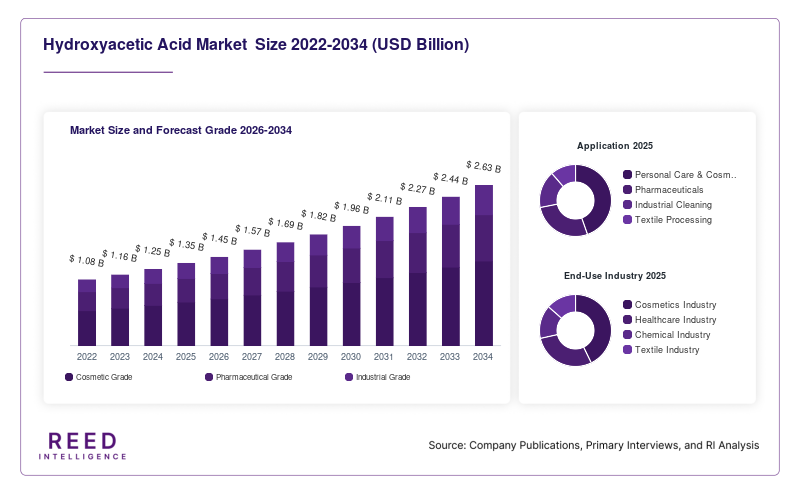
The cosmetic grade segment dominated the Hydroxyacetic Acid Market in 2025, accounting for approximately 48% of the total share. This dominance was attributed to its extensive use in skincare and beauty products, including exfoliants and anti-aging formulations.
The pharmaceutical grade segment is expected to grow at the fastest CAGR of 9.2% during the forecast period. This growth will be driven by increasing applications in dermatological treatments and advancements in pharmaceutical formulations.
By Application
The personal care & cosmetics segment held the largest share of 41% in 2025. The segment benefited from rising consumer awareness and demand for effective skincare solutions.
The pharmaceutical segment is anticipated to grow at the fastest CAGR of 9.2%. Increasing research in dermatology and the development of advanced topical treatments will support this growth.
By End-Use Industry
The cosmetics industry dominated the Hydroxyacetic Acid Market with a share of 39% in 2025. The widespread use of hydroxyacetic acid in anti-aging and exfoliating products contributed to this dominance.
The healthcare industry is projected to witness the fastest CAGR of 8.8%. The growing demand for dermatological treatments and medical-grade skincare products will drive segment expansion.
By Distribution Channel
The offline distribution channel accounted for the largest share of 62% in 2025. Traditional retail stores and pharmacies remained key distribution points for hydroxyacetic acid-based products.
The online distribution channel is expected to grow at a CAGR of 10.1%, driven by increasing e-commerce penetration and digital marketing strategies.
Regional Analysis
North America
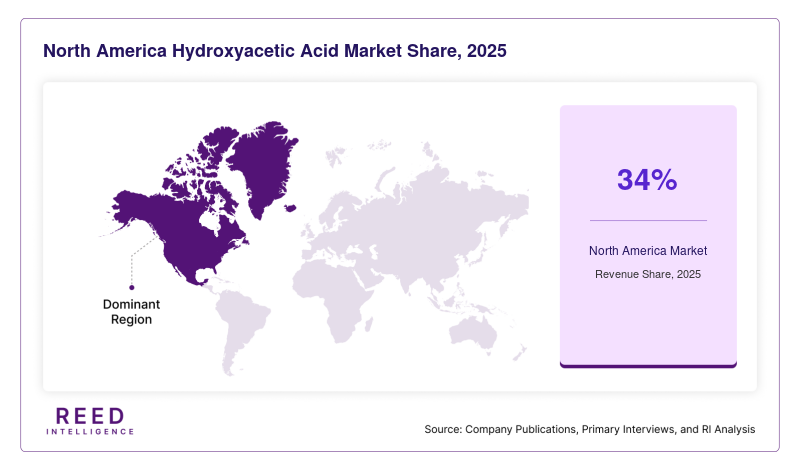
North America accounted for approximately 34% of the Hydroxyacetic Acid Market share in 2025 and is expected to grow at a CAGR of 7.2% during the forecast period. The region has demonstrated steady demand across personal care and industrial applications due to established manufacturing infrastructure and high consumer awareness.
The United States dominated the regional market due to strong demand for dermatological products and advanced skincare solutions. The presence of major cosmetic brands and research institutions has supported continuous innovation in product formulations, contributing to sustained market growth.
Europe
Europe held around 27% of the Hydroxyacetic Acid Market share in 2025 and is projected to expand at a CAGR of 7.5% from 2026 to 2034. The region’s growth is supported by stringent environmental regulations promoting the use of biodegradable chemicals.
Germany emerged as the leading country due to its well-developed chemical industry and focus on sustainable manufacturing practices. The adoption of bio-based hydroxyacetic acid production methods has further strengthened market growth in the region.
Asia Pacific
Asia Pacific represented approximately 23% of the Hydroxyacetic Acid Market in 2025 and is expected to register the fastest CAGR of 8.9% during the forecast period. The region is experiencing rapid industrialization and increasing demand for personal care products.
China dominated the regional market due to its large-scale production capabilities and growing consumer base. The expansion of domestic cosmetic brands and rising awareness of skincare benefits have significantly contributed to market growth.
Middle East & Africa
The Middle East & Africa accounted for about 9% of the Hydroxyacetic Acid Market share in 2025 and is anticipated to grow at a CAGR of 6.8% through 2034. The region is gradually adopting advanced chemical solutions across industrial sectors.
Saudi Arabia led the market due to increasing investments in industrial cleaning and oil & gas applications. The demand for efficient descaling agents has supported the adoption of hydroxyacetic acid in the region.
Latin America
Latin America held nearly 7% of the Hydroxyacetic Acid Market share in 2025 and is projected to grow at a CAGR of 7.1% during the forecast period. The region is witnessing growing demand for personal care and cosmetic products.
Brazil dominated the market owing to its expanding beauty and personal care industry. Increasing consumer spending and the presence of local manufacturers have driven the adoption of hydroxyacetic acid-based products.
Competitive Landscape
The Hydroxyacetic Acid Market is moderately fragmented, with several global and regional players competing based on product quality, pricing, and innovation. Leading companies focus on expanding their product portfolios and investing in sustainable production technologies.
The market leader, CABB Group GmbH, has strengthened its position through continuous investments in production capacity and eco-friendly manufacturing processes. The company recently introduced a bio-based hydroxyacetic acid variant, aligning with sustainability trends.
Other key players are emphasizing strategic partnerships, mergers, and geographic expansion to enhance their market presence. Innovation in formulation and application development remains a critical factor for maintaining competitive advantage.
Key Players List
- CABB Group GmbH
- The Chemours Company
- Parchem Fine & Specialty Chemicals
- CrossChem Limited
- Avid Organics Pvt. Ltd.
- Zhonglan Industry Co., Ltd.
- Mehul Dye Chem Industries
- Kanto Chemical Co., Inc.
- Spectrum Chemical Manufacturing Corp.
- Water Chemical Co., Ltd.
- Phibro Animal Health Corporation
- Tokyo Chemical Industry Co., Ltd.
- Shandong Xinhua Pharmaceutical Company
- Junsei Chemical Co., Ltd.
- Haihang Industry Co., Ltd.
Recent Developments
- 2025: A leading manufacturer introduced a bio-based hydroxyacetic acid product line to meet sustainability requirements.
- 2024: Several companies expanded production facilities in Asia Pacific to cater to rising regional demand.
- 2025: Strategic collaborations between chemical manufacturers and cosmetic brands enhanced product innovation.
- 2026: Increased investment in R&D led to the development of low-irritation formulations for sensitive skin applications.
Hydroxyacetic Acid Market Segments
Grade
- Cosmetic Grade
- Pharmaceutical Grade
- Industrial Grade
Application
- Personal Care & Cosmetics
- Pharmaceuticals
- Industrial Cleaning
- Textile Processing
End-Use Industry
- Cosmetics Industry
- Healthcare Industry
- Chemical Industry
- Textile Industry
Distribution Channel
- Online Retail
- Pharmacies & Drug Stores
- Specialty Chemical Stores
- Direct Sales (B2B)
By Region
- North America
- Europe
- APAC
- Middle East and Africa
- LATAM