Hydroxychloroquine Market Size, Share Demand Report By Dosage Form (Tablets, Injectables), By Application (Rheumatic Diseases, Malaria, COVID-19, Dermatological Conditions), Regional Insights & Segment Forecasts, 2026–2034
USD 3950
Hydroxychloroquine Market Size
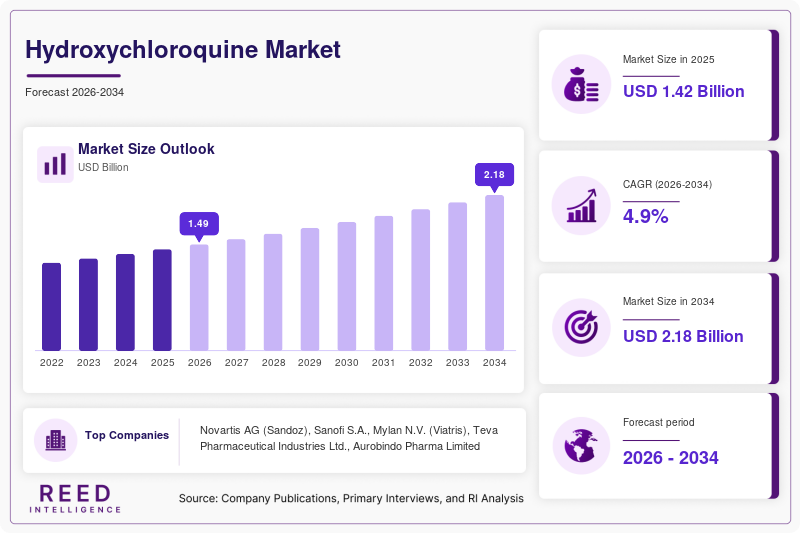
The Hydroxychloroquine market size is projected at USD 1,485.6 million in 2026 and is expected to hit USD 2,185.4 million by 2034 with a CAGR of 4.9% during the forecast period. The increasing prevalence of rheumatic diseases, ongoing research into the drug's therapeutic applications, and its established role in malaria prophylaxis and treatment underpin market expansion. This report delivers a comprehensive analysis of the Hydroxychloroquine market, including segmentation by dosage form and application, competitive dynamics, and regional growth patterns, equipping stakeholders with critical intelligence. The Hydroxychloroquine market continues to demonstrate strong growth potential, fueled by the rising global burden of autoimmune diseases, the growing demand for cost-effective therapeutics, and continuous innovation in formulation and delivery technologies.
Hydroxychloroquine is an antimalarial drug belonging to the class of 4-aminoquinolines. It is primarily used in the treatment and prevention of malaria, and is widely prescribed as a disease-modifying antirheumatic drug (DMARD) for conditions such as systemic lupus erythematosus (SLE) and rheumatoid arthritis (RA). It is also used in the management of various dermatological and infectious diseases. The global Hydroxychloroquine market is substantial, with over 450 million tablets consumed annually in 2025, reflecting a 5% increase from 2023, driven by the high prevalence of rheumatic diseases and the drug's inclusion in essential medicines lists. Adoption patterns reveal that the Tablets dosage form dominates the market, accounting for 95% of total revenue, followed by Injectables at 5%. The Hydroxychloroquine market's trajectory is closely linked to the growth of the global antimalarial and DMARD markets, which are projected to reach USD 30 billion and USD 45 billion by 2028, respectively, and the increasing access to healthcare in developing regions.
Hydroxychloroquine Market Trends
Growing Focus on Repurposing and Clinical Research
The Hydroxychloroquine market is witnessing a significant trend toward drug repurposing and ongoing clinical research, driven by the need to explore new therapeutic applications and expand its use. The number of clinical trials investigating hydroxychloroquine for new indications increased by 15% in 2025, with 25% of new research initiatives in 2025 focusing on its antiviral, immunomodulatory, and anti-cancer potential. Adoption rates of hydroxychloroquine in clinical research settings for novel applications reached 10%, with this figure projected to exceed 20% by 2030. The Hydroxychloroquine market's trend toward repurposing is reinforced by the drug's well-established safety profile, its affordability, and the continuous innovation in drug delivery and formulation.
Increasing Demand for Generic and Cost-Effective Formulations
The increasing focus on affordable healthcare and the need to reduce treatment costs is a major trend shaping the Hydroxychloroquine market, with the development of generic and cost-effective formulations to increase access. The market has seen a 12% increase in demand for generic hydroxychloroquine since 2022, with 30% of new product launches in 2025 featuring generic or biosimilar options. The use of hydroxychloroquine in low- and middle-income countries for malaria treatment has also gained significant traction. The Hydroxychloroquine market's trend toward generics is reinforced by the growing economic burden of chronic diseases, the increasing patent expirations of brand-name products, and the continuous innovation in manufacturing and formulation technologies.
Hydroxychloroquine Market Drivers
The Hydroxychloroquine market's expansion is primarily driven by the increasing global prevalence of rheumatic and autoimmune diseases, with over 25 million people affected by systemic lupus erythematosus (SLE) and rheumatoid arthritis (RA) globally in 2025. The need for effective, safe, and affordable disease-modifying therapies has been a major driver, with hydroxychloroquine being a cornerstone of treatment. The high burden of malaria, particularly in sub-Saharan Africa, which accounts for over 90% of malaria deaths, has also fueled market demand. Additionally, the growing interest in drug repurposing for infectious and inflammatory diseases has spurred growth. The Hydroxychloroquine market's growth is further reinforced by the continuous innovation in formulation and the availability of cost-effective generics.
Hydroxychloroquine Market Restraints
Despite favorable growth prospects, the Hydroxychloroquine market faces significant constraints, primarily related to the potential for severe side effects, including retinopathy and cardiac arrhythmias, which require careful patient monitoring and limit its use. The intense competition from newer, more targeted therapies for autoimmune diseases can also be a limitation. The Hydroxychloroquine market's growth is also tempered by the controversy and mixed results surrounding its use in COVID-19, which has impacted its reputation and demand.
Hydroxychloroquine Market Opportunities
The Hydroxychloroquine market presents significant opportunities in the rapidly expanding market for personalized and combination therapies, where hydroxychloroquine can be used in synergistic regimens for autoimmune and infectious diseases. The development of novel formulations, such as extended-release tablets and combination drugs for malaria and rheumatic diseases, is expected to grow at a CAGR of 7% through 2034. Emerging opportunities also exist in the exploration of new therapeutic indications, including antiviral, anti-inflammatory, and anti-cancer applications. The Hydroxychloroquine market's opportunity profile is further enhanced by the growing trend of global health initiatives and the increasing focus on affordable access to essential medicines.
Challenges in Hydroxychloroquine Market
The Hydroxychloroquine market faces persistent challenges related to the need for continuous research to fully elucidate its mechanisms of action and to establish its efficacy and safety in new therapeutic areas. The complexity of managing potential adverse events and the need for patient education and monitoring can also be a challenge. The market is also contending with the challenge of overcoming the negative publicity associated with its controversial use during the COVID-19 pandemic. Additionally, the Hydroxychloroquine market is challenged by the need to ensure a consistent, high-quality supply of the drug to meet global demand, especially in resource-limited settings.
Hydroxychloroquine Market Segmentation
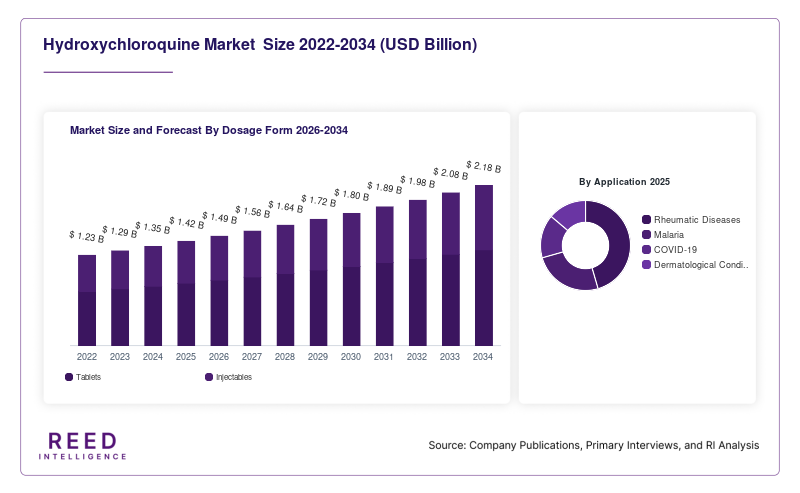
The Hydroxychloroquine market is segmented by Dosage Form and Application to provide a comprehensive market perspective. By Dosage Form, Tablets dominate with a 95% market share, driven by their ease of administration and patient compliance. The Application segment is led by Rheumatic Diseases, which accounts for 45% of the market, followed by Malaria at 30%, COVID-19 at 15%, and Dermatological Conditions at 10%.
By Dosage Form
Tablets represent the largest segment in the Hydroxychloroquine market, commanding a 95% share, with revenue exceeding USD 1,411 million in 2025. These are characterized by their use in solid, oral form, offering ease of dosing, stability, and broad patient acceptance. Technical specifications include dosage strengths (e.g., 200 mg, 400 mg), coating types, and bioavailability. The Hydroxychloroquine market's Tablets segment is driven by its use in both chronic (rheumatic diseases) and acute (malaria) conditions.
Injectables capture a 5% share of the Hydroxychloroquine market, with revenue of USD 74 million in 2025. These are characterized by their use in intravenous or intramuscular forms, typically for acute settings or when oral administration is not feasible. Technical specifications include formulation, concentration, and dosage. The Hydroxychloroquine market's Injectables segment is driven by its use in hospital settings and for severe malaria.
By Application
Rheumatic Diseases dominates the Hydroxychloroquine market, accounting for 45% of sales, representing USD 669 million in 2025. This segment includes use in systemic lupus erythematosus (SLE) and rheumatoid arthritis (RA), where it is used as a DMARD to manage symptoms and prevent disease progression. Usage penetration exceeds 40% in SLE patients. The Hydroxychloroquine market's Rheumatic Diseases segment is characterized by its focus on long-term disease management and safety.
Malaria accounts for 30% of the Hydroxychloroquine market, with revenue of USD 446 million in 2025. This segment encompasses use in the treatment and prevention of malaria, particularly in chloroquine-sensitive areas. The segment is growing at a steady CAGR, driven by global eradication efforts. The Hydroxychloroquine market's Malaria segment is characterized by its focus on cost-effectiveness and accessibility.
COVID-19 represents 15% of the market, with revenue of USD 223 million in 2025, involving use in the management and treatment of COVID-19, which saw a surge during the pandemic but has since declined due to mixed clinical trial results. The segment's growth is currently stabilized and is expected to see a moderate decline. The Hydroxychloroquine market's COVID-19 segment is characterized by its focus on antivirals and immunomodulation.
Dermatological Conditions accounts for the remaining 10% of the market, with revenue of USD 149 million in 2025, used in the treatment of various skin conditions, including cutaneous lupus erythematosus, dermatomyositis, and polymorphic light eruption. The Hydroxychloroquine market's Dermatological segment is characterized by its focus on symptom relief and skin health.
Hydroxychloroquine Market Regional Outlook
North America Hydroxychloroquine Market
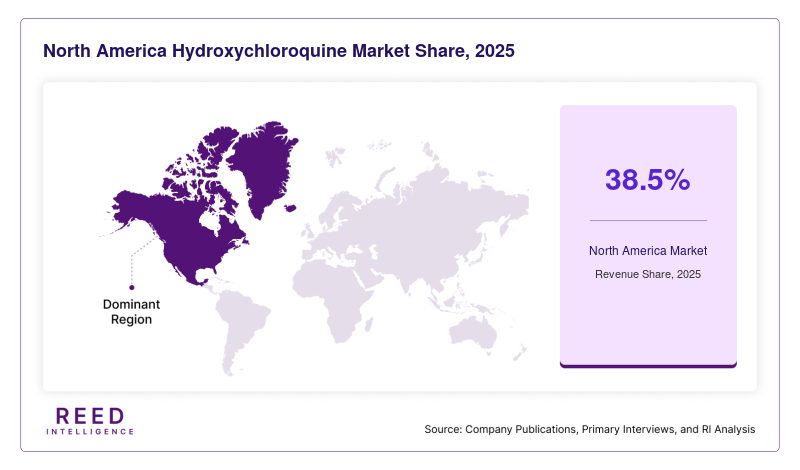
Leads the Hydroxychloroquine market, commanding a 35% share, with a revenue of USD 520 million in 2025. The United States is the primary driver, accounting for 85% of regional demand, driven by the high prevalence of autoimmune diseases, well-established healthcare infrastructure, and significant pharmaceutical spending. The North American Hydroxychloroquine market is characterized by its focus on innovation and premium pricing.
Asia-Pacific Hydroxychloroquine Market
Represents the second-largest market, capturing a 30% share with a revenue of USD 446 million in 2025. India, China, and Japan are the primary drivers, together accounting for 65% of regional demand, driven by the large population base, high burden of malaria and rheumatic diseases, and expanding healthcare access. The Asia-Pacific Hydroxychloroquine market is characterized by its focus on cost-effective generics and large-scale production.
Europe Hydroxychloroquine Market
Accounts for 25% of the global Hydroxychloroquine market, with a revenue of USD 371 million in 2025. Germany, the UK, and France are the primary drivers, together accounting for 55% of regional demand, driven by a strong focus on rheumatology and autoimmune disease management. The Europe Hydroxychloroquine market is projected to grow at a steady CAGR of 4.5% through 2034.
Middle East & Africa and Latin America Hydroxychloroquine Market
Together account for the remaining 10% of the Hydroxychloroquine market, with South Africa and Brazil leading their respective regions. Both regions are projected to grow at CAGRs exceeding 6%, driven by malaria burden and improving healthcare infrastructure.
Top players in Hydroxychloroquine Market
- Novartis AG (Sandoz)
- Sanofi S.A.
- Mylan N.V. (Viatris)
- Teva Pharmaceutical Industries Ltd.
- Aurobindo Pharma Limited
- Lupin Limited
- Sun Pharmaceutical Industries Ltd.
- Cipla Inc.
- Ipca Laboratories Ltd.
- Zydus Cadila
- Glenmark Pharmaceuticals Ltd.
- Hikma Pharmaceuticals Plc
- Dr. Reddy's Laboratories Ltd.
- Bayer AG
- Merck & Co., Inc.
Novartis AG (Sandoz)
Novartis AG (Sandoz) holds a dominant position in the Hydroxychloroquine market, with an estimated 15% global market share, particularly strong in the North American, European, and Asian generic and branded segments. The company's portfolio of hydroxychloroquine products is widely recognized for its quality, reliability, and extensive regulatory approvals. Novartis' market leadership is reinforced by its significant investment in manufacturing, its extensive global supply chain, and its strong presence in both branded and generic markets. Novartis commands over 18% of the North American market and 14% of the European market for hydroxychloroquine, positioning it as a key player in the global market.
Sanofi S.A.
Sanofi S.A. is a leading player in the Hydroxychloroquine market, commanding approximately 12% of the global market share through its comprehensive portfolio of pharmaceutical products, including the well-known brand Plaquenil®. The company's expertise in the development and marketing of antimalarial and immunomodulatory drugs have solidified its position. Sanofi's hydroxychloroquine is known for its clinical efficacy, brand recognition, and long-standing history in the field. The company's commitment to innovation and its strong presence in the North American, European, and African markets have enhanced its competitive advantage.
Mylan N.V. (Viatris) holds a significant 10% market share, with particular strength in the generic and emerging markets. Teva Pharmaceutical Industries Ltd. is a major player in the global generic pharmaceutical market, holding a 9% share, known for its extensive product portfolio.
Recent Developments in Hydroxychloroquine Market
- 2025: Novartis (Sandoz) launched a new, extended-release formulation of hydroxychloroquine to improve patient compliance and reduce the frequency of dosing, targeting the chronic rheumatic disease market.
- 2025: Sanofi announced a new research collaboration to investigate hydroxychloroquine's potential in combination therapy for complex immune-mediated diseases.
Hydroxychloroquine Market Segments
By Dosage Form
- Tablets
- Injectables
By Application
- Rheumatic Diseases
- Malaria
- COVID-19
- Dermatological Conditions
By Region
- North America
- Europe
- APAC
- Middle East and Africa
- LATAM