Hydroxyl Terminated Polybutadiene Market Size, Share & Demand Report By Type (Propellant Grade, Adhesive Grade, Coating Grade), By Application (Aerospace & Defense, Construction, Industrial Applications, Automotive), By End-Use Industry (Aerospace Industry, Automotive Industry, Construction Industry, Industrial Manufacturing), By Region & Segment Forecasts, 2026–2034
USD 3950
Market Overview
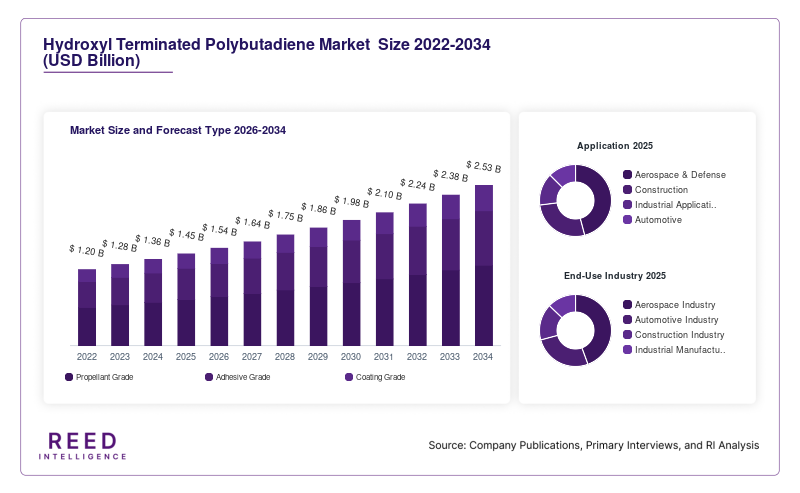
The global Hydroxyl Terminated Polybutadiene Market size was valued at approximately USD 1.45 billion in 2026 and is projected to reach USD 2.38 billion by 2034, expanding at a CAGR of 6.4% during the forecast period (2026–2034). Hydroxyl terminated polybutadiene (HTPB) is a liquid rubber polymer widely used in adhesives, sealants, coatings, and aerospace propellants due to its superior flexibility, chemical resistance, and mechanical strength. The material’s compatibility with polyurethane systems and its ability to enhance durability have made it a preferred choice across multiple industries.
A key global factor driving market growth is the steady expansion of the aerospace and defense sector, particularly in emerging economies. Increased investments in missile systems, satellite launches, and space exploration programs have boosted demand for HTPB as a binder in solid rocket propellants. Additionally, industrial growth in construction and automotive sectors has supported demand for high-performance coatings and sealants.
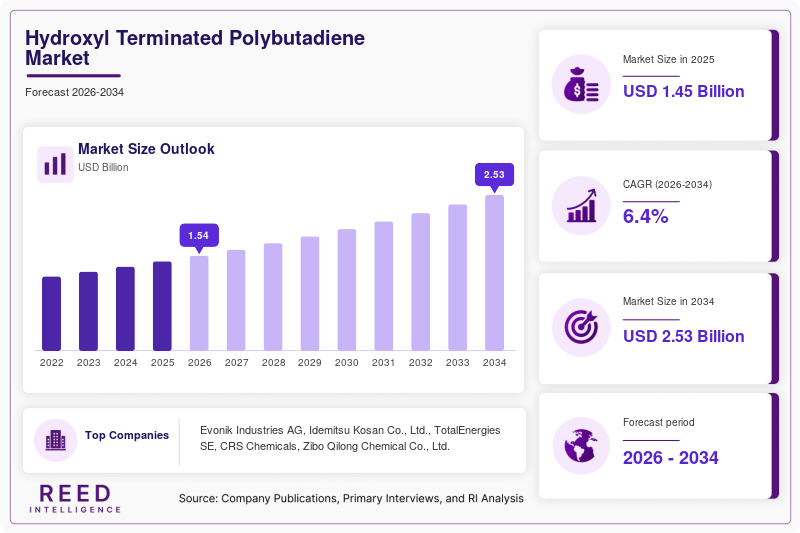
Key Highlights
- Asia Pacific dominated the market with a 41% share in 2025 and is projected to grow at the fastest CAGR of 7.2%
- The propellant-grade segment led the type category with a 46% share, while adhesive-grade HTPB is expected to grow fastest at a CAGR of 7.5%
- The aerospace & defense application segment dominated with a 39% share, while construction applications are projected to grow fastest at a CAGR of 6.9%
- China remained the dominant country, with market values of USD 420 million in 2024 and USD 455 million in 2025
Market Trends
Increasing Use of HTPB in Space Exploration Programs
The growing number of space missions and satellite launches is shaping the Hydroxyl Terminated Polybutadiene Market. Governments and private aerospace companies are increasing investments in launch vehicles and propulsion systems, where HTPB plays a key role as a binder in solid rocket fuels. The polymer provides stability, energy efficiency, and structural integrity under extreme conditions. Countries such as India, China, and the United States are expanding their space programs, which is directly influencing demand. Moreover, the rise of private space companies has intensified the need for cost-effective and high-performance propellant materials. This trend is expected to sustain long-term demand, particularly as reusable launch systems become more common and require consistent material performance.
Growing Adoption in Sustainable and High-Performance Coatings
Another notable trend is the increasing use of HTPB in advanced coatings and environmentally conscious formulations. Manufacturers are focusing on developing coatings that offer longer life cycles and reduced maintenance requirements. HTPB-based polyurethane coatings provide excellent resistance to moisture, chemicals, and abrasion, making them suitable for industrial infrastructure and marine applications. Additionally, regulatory pressure to reduce volatile organic compound (VOC) emissions is encouraging the development of modified HTPB formulations with improved environmental profiles. This shift is driving innovation in product design, allowing companies to cater to both performance and sustainability requirements.
Market Drivers
Rising Demand from Aerospace and Defense Industry
The aerospace and defense sector remains a primary driver for the Hydroxyl Terminated Polybutadiene Market. HTPB is widely used in solid rocket propellants due to its excellent binding properties and energy output. With increasing geopolitical tensions and defense modernization programs, countries are investing heavily in missile systems and defense technologies. This has led to a surge in demand for reliable and high-performance propellant materials. Additionally, advancements in aerospace technologies, including reusable rockets and long-range missiles, require materials that can maintain stability under high stress and temperature conditions. HTPB meets these requirements, making it indispensable in this sector.
Expansion of Construction and Infrastructure Activities
Rapid urbanization and infrastructure development are contributing significantly to market growth. HTPB-based sealants and coatings are widely used in construction due to their flexibility, water resistance, and durability. Governments in emerging economies are investing in large-scale infrastructure projects, including highways, bridges, and commercial buildings. These projects require materials that can withstand environmental stress and provide long-term performance. HTPB-based products help extend the lifespan of structures, reducing maintenance costs. As construction standards evolve toward higher performance materials, demand for HTPB is expected to increase steadily.
Market Restraint
Volatility in Raw Material Prices and Supply Chain Constraints
One of the primary challenges affecting the Hydroxyl Terminated Polybutadiene Market is the volatility in raw material prices. HTPB is derived from petrochemical feedstocks, and fluctuations in crude oil prices directly impact production costs. This creates uncertainty for manufacturers and can lead to price instability in the final product. Additionally, supply chain disruptions, such as those caused by geopolitical conflicts or trade restrictions, can affect the availability of raw materials and finished products.
The impact of this restraint is particularly evident in industries that operate on tight margins, such as construction and automotive manufacturing. For example, sudden increases in raw material costs can force manufacturers to adjust pricing strategies or delay projects. Smaller companies may find it difficult to absorb these cost fluctuations, leading to reduced competitiveness. Furthermore, dependence on limited suppliers for specialized grades of HTPB adds to the risk. Addressing these challenges requires strategic sourcing, diversification of supply chains, and investment in alternative materials or production technologies.
Market Opportunities
Development of Bio-Based and Sustainable HTPB Alternatives
The growing emphasis on sustainability presents a significant opportunity for the Hydroxyl Terminated Polybutadiene Market. Manufacturers are exploring bio-based alternatives and greener production processes to reduce environmental impact. Developing HTPB from renewable sources can help companies comply with environmental regulations and appeal to eco-conscious customers. Additionally, sustainable products can open new market segments, particularly in regions with strict environmental policies. Research and development efforts in this area are expected to yield innovative solutions that combine performance with sustainability, creating long-term growth opportunities.
Expansion in Emerging Economies
Emerging economies offer substantial growth potential due to rapid industrialization and increasing investments in infrastructure and defense. Countries in Asia Pacific, Latin America, and the Middle East are experiencing strong economic growth, which is driving demand for construction materials, adhesives, and coatings. Additionally, government initiatives to strengthen domestic manufacturing capabilities are boosting demand for specialty chemicals like HTPB. Companies that expand their presence in these regions can benefit from lower production costs and access to a growing customer base. Strategic partnerships and local manufacturing facilities can further enhance market penetration.
Segmental Analysis
By Type
The propellant-grade segment dominated the Hydroxyl Terminated Polybutadiene Market in 2024, accounting for approximately 46% of the total share. This dominance is attributed to its extensive use in aerospace and defense applications, particularly in solid rocket propellants. Propellant-grade HTPB offers high energy output, stability, and excellent binding properties, making it suitable for demanding environments. The increasing number of space missions and defense projects has further strengthened the demand for this segment. Additionally, advancements in propulsion technologies are driving the need for high-performance materials, reinforcing the position of propellant-grade HTPB in the market.
The adhesive-grade segment is expected to grow at the fastest CAGR of 7.5% during the forecast period. This growth is driven by increasing demand from construction, automotive, and industrial applications. Adhesive-grade HTPB provides strong bonding properties, flexibility, and resistance to environmental factors. The rising adoption of advanced adhesives in manufacturing processes is a key growth factor. Additionally, the shift toward lightweight and durable materials in automotive applications is further boosting demand for this segment.
By Application
The aerospace & defense segment dominated the market in 2024, with a share of approximately 39%. This segment’s dominance is driven by the widespread use of HTPB in solid rocket propellants and missile systems. The material’s ability to withstand extreme temperatures and pressures makes it essential for these applications. Increasing defense budgets and advancements in space exploration are contributing to sustained demand in this segment. Additionally, the development of new propulsion technologies is expected to further enhance the use of HTPB.
The construction segment is projected to grow at the fastest CAGR of 6.9%. This growth is driven by increasing infrastructure development and the need for durable materials. HTPB-based coatings and sealants provide excellent resistance to moisture and environmental stress, making them suitable for construction applications. The rising focus on sustainable and long-lasting building materials is also contributing to the growth of this segment.
By End-Use Industry
The aerospace industry dominated the market in 2024, accounting for a significant share due to its reliance on HTPB for propulsion systems. The industry’s demand for high-performance materials that can withstand extreme conditions has made HTPB a preferred choice. Increasing investments in space exploration and defense technologies are further driving demand. Additionally, the growth of private aerospace companies is contributing to market expansion.
The automotive industry is expected to grow at the fastest CAGR of 6.7%. This growth is driven by the increasing use of advanced materials in vehicle manufacturing. HTPB-based adhesives and coatings are used to improve durability and reduce weight. The shift toward electric vehicles and lightweight materials is a key growth factor. Additionally, advancements in automotive design and manufacturing processes are expected to further increase demand for HTPB in this segment.
Regional Analysis
North America
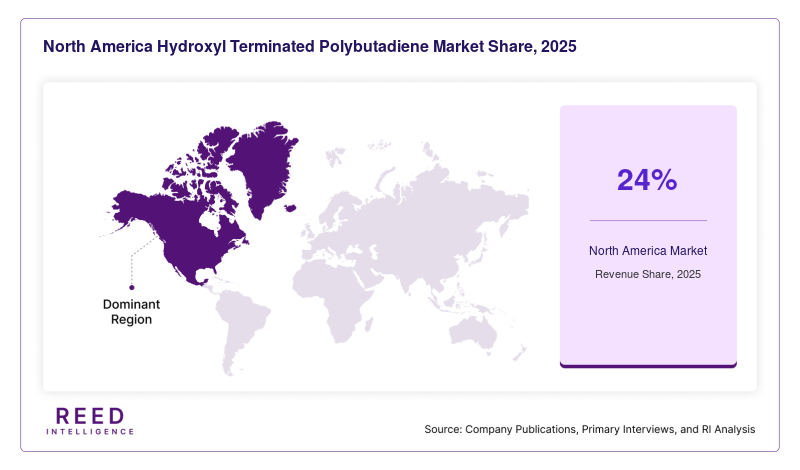
North America accounted for approximately 24% of the Hydroxyl Terminated Polybutadiene Market share in 2025 and is expected to grow at a CAGR of 5.8% during the forecast period. The region benefits from a well-established aerospace and defense sector, which drives consistent demand for HTPB-based propellants. Additionally, the presence of advanced manufacturing infrastructure and strong research capabilities supports product innovation and market growth.
The United States dominates the regional market due to its extensive defense spending and advanced space exploration programs. A unique growth factor in this region is the increasing involvement of private aerospace companies, which are driving demand for cost-efficient and high-performance materials. This has led to increased adoption of HTPB in commercial space applications.
Europe
Europe held a market share of around 21% in 2025 and is projected to grow at a CAGR of 5.6%. The region’s focus on sustainable materials and stringent environmental regulations is influencing the development of advanced HTPB formulations. The automotive and construction industries also contribute to market demand through the use of high-performance coatings and sealants.
Germany is the dominant country in Europe, supported by its strong industrial base and innovation in chemical manufacturing. A unique growth factor is the region’s emphasis on green chemistry, which is encouraging the development of low-emission and sustainable HTPB products. This trend is expected to drive long-term market growth.
Asia Pacific
Asia Pacific led the Hydroxyl Terminated Polybutadiene Market with a 41% share in 2025 and is expected to grow at the fastest CAGR of 7.2%. Rapid industrialization, urbanization, and increasing defense budgets are key factors driving market expansion in this region. The growing construction sector also contributes significantly to demand for HTPB-based materials.
China is the dominant country, supported by its large-scale manufacturing capabilities and strong government investments in aerospace and infrastructure. A unique growth factor is the country’s expanding space program, which requires significant volumes of propellant-grade HTPB. This has positioned China as a major contributor to global market growth.
Middle East & Africa
The Middle East & Africa region accounted for approximately 7% of the market share in 2025 and is expected to grow at a CAGR of 6.1%. The region is witnessing increasing investments in infrastructure and defense, which are driving demand for HTPB-based products. Additionally, the availability of petrochemical resources supports local production.
Saudi Arabia dominates the regional market due to its strong petrochemical industry and infrastructure development projects. A unique growth factor is the region’s focus on diversifying its economy through industrial expansion, which includes the development of specialty chemicals like HTPB. This is expected to create new growth opportunities.
Latin America
Latin America held a market share of around 7% in 2025 and is projected to grow at a CAGR of 5.9%. The region’s construction and automotive industries are key drivers of demand for HTPB-based materials. Economic recovery and infrastructure investments are supporting market growth.
Brazil is the dominant country in this region, driven by its expanding industrial base and infrastructure projects. A unique growth factor is the increasing adoption of advanced coatings in construction, which enhances durability and reduces maintenance costs. This is expected to boost demand for HTPB in the coming years.
Competitive Landscape
The Hydroxyl Terminated Polybutadiene Market is moderately consolidated, with key players focusing on product innovation, strategic partnerships, and capacity expansion. Leading companies are investing in research and development to enhance product performance and meet evolving industry requirements. The market is characterized by strong competition, with players aiming to expand their global presence and strengthen their supply chains.
One of the leading players is Evonik Industries AG, which has established a strong position through its advanced product portfolio and global distribution network. A recent development includes the expansion of its specialty polymer production capacity to meet growing demand from aerospace and industrial applications. Other major players are also focusing on collaborations and technological advancements to gain a competitive edge.
Key Players
- Evonik Industries AG
- Idemitsu Kosan Co., Ltd.
- TotalEnergies SE
- CRS Chemicals
- Zibo Qilong Chemical Co., Ltd.
- Island Pyrochemical Industries
- Anhui Xinyuan Chemical Co., Ltd.
- Formosa Plastics Corporation
- LANXESS AG
- Kuraray Co., Ltd.
- BASF SE
- SIBUR International GmbH
- Nippon Soda Co., Ltd.
- Arkema S.A.
- Emerald Performance Materials
Recent Developments
- In 2025, Evonik Industries expanded its HTPB production facility to increase supply for aerospace applications.
- In 2024, Idemitsu Kosan introduced a new grade of HTPB designed for improved environmental performance.
- In 2025, TotalEnergies announced a strategic partnership to develop sustainable polymer solutions, including HTPB variants.
Hydroxyl Terminated Polybutadiene Market Segments
Type
- Propellant Grade
- Adhesive Grade
- Coating Grade
Application
- Aerospace & Defense
- Construction
- Industrial Applications
- Automotive
End-Use Industry
- Aerospace Industry
- Automotive Industry
- Construction Industry
- Industrial Manufacturing
By Region
- North America
- Europe
- APAC
- Middle East and Africa
- LATAM