Hydroxypropionic Acid Market Size, Share & Demand Report By Type (Bio-Based Hydroxypropionic Acid, Synthetic Hydroxypropionic Acid), By Application (Chemical Intermediates, Pharmaceuticals, Cosmetics & Personal Care, Biodegradable Polymers), By End-Use Industry (Chemical Industry, Pharmaceutical Industry, Personal Care Industry, Packaging Industry), By Form (Liquid, Powder), By Region & Segment Forecasts, 2025–2034
USD 3950
Market Overview
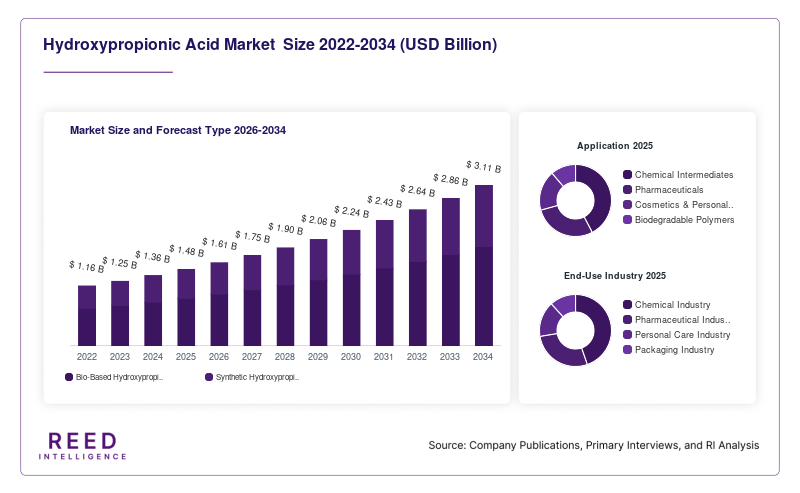
The global Hydroxypropionic Acid Market size was valued at approximately USD 1.48 billion in 2025 and is projected to reach USD 3.12 billion by 2034, expanding at a compound annual growth rate (CAGR) of 8.6% during the forecast period (2025–2034). The market growth is being supported by increasing demand for bio-based chemicals across multiple industries, including pharmaceuticals, cosmetics, and biodegradable plastics. Hydroxypropionic acid, widely recognized for its role as a key intermediate in chemical synthesis and polymer production, has gained traction due to its compatibility with sustainable manufacturing processes.
A major global factor driving the Hydroxypropionic Acid Market is the rising shift toward environmentally friendly and renewable raw materials. Governments and industries are progressively emphasizing green chemistry initiatives, leading to higher adoption of hydroxypropionic acid in biodegradable polymers such as polylactic acid alternatives and specialty chemicals.
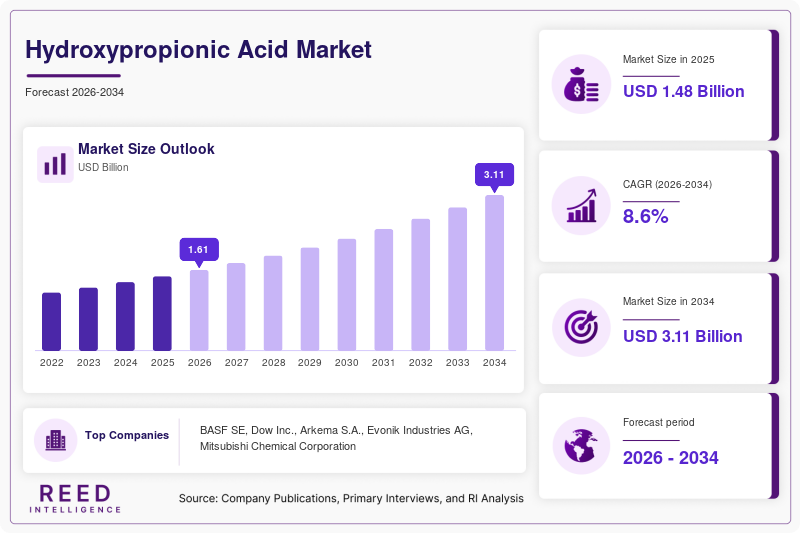
Key Highlights:
- Asia Pacific dominated the market with a 38% share in 2025 and is expected to grow at the fastest CAGR of 9.4%.
- The bio-based type segment led with a 56% share, while pharmaceutical applications are projected to grow fastest at a CAGR of 9.8%.
- The United States remained the dominant country, with market values of USD 320 million in 2024 and USD 345 million in 2025.
Market Trends
Rising Adoption of Bio-Based Production Technologies
The Hydroxypropionic Acid Market is experiencing a notable shift toward bio-based production methods, particularly fermentation processes using renewable feedstocks such as glucose and glycerol. This trend reflects the growing emphasis on sustainability and reduction of carbon footprints across industries. Manufacturers are investing in biotechnology to enhance yield efficiency and reduce reliance on petrochemical-derived inputs. As a result, bio-based hydroxypropionic acid is gaining preference in applications such as biodegradable plastics and eco-friendly solvents, shaping long-term market trends.
Expanding Use in Personal Care and Cosmetics
Another emerging trend in the Hydroxypropionic Acid Market is its increasing application in personal care products. Hydroxypropionic acid is widely used in skincare formulations due to its exfoliating and moisturizing properties. With the rising consumer preference for dermatologically safe and naturally derived ingredients, cosmetic manufacturers are incorporating hydroxypropionic acid into premium product lines. This trend is further supported by the growth of the global beauty and wellness industry, contributing to overall market expansion.
Market Drivers
Growing Demand for Biodegradable Polymers
The increasing demand for biodegradable and compostable plastics is a key driver of the Hydroxypropionic Acid Market. Hydroxypropionic acid serves as a precursor in the production of advanced polymers that offer environmental benefits over traditional plastics. With stricter regulations on plastic waste and rising environmental awareness, industries are shifting toward sustainable materials, thereby boosting demand for hydroxypropionic acid.
Expansion of Pharmaceutical Applications
The pharmaceutical industry is another significant contributor to the growth of the Hydroxypropionic Acid Market. The compound is widely used as an intermediate in drug synthesis and formulation. Increasing global healthcare expenditure, along with rising demand for specialty drugs, has accelerated the use of hydroxypropionic acid. Its chemical versatility and compatibility with various active ingredients make it an essential component in pharmaceutical manufacturing processes.
Market Restraint
High Production Costs of Bio-Based Hydroxypropionic Acid
One of the major challenges restraining the Hydroxypropionic Acid Market is the high cost associated with bio-based production methods. While fermentation-based processes offer environmental advantages, they often involve expensive raw materials, advanced infrastructure, and complex operational requirements. These factors contribute to higher overall production costs compared to conventional petrochemical routes.
Additionally, scalability remains a concern for many manufacturers, as maintaining consistent quality and yield at industrial levels can be challenging. This cost disparity limits the widespread adoption of bio-based hydroxypropionic acid, particularly in price-sensitive markets. As a result, some end-use industries continue to rely on traditional chemical alternatives, slowing the growth potential of the market.
Market Opportunities
Advancements in Industrial Biotechnology
Technological advancements in industrial biotechnology present significant opportunities for the Hydroxypropionic Acid Market. Innovations in metabolic engineering and microbial strain development are expected to enhance production efficiency and reduce costs. These improvements will enable manufacturers to scale up production and meet growing demand across industries, creating new growth avenues.
Increasing Demand in Emerging Economies
Emerging economies in Asia Pacific and Latin America offer substantial growth opportunities for the Hydroxypropionic Acid Market. Rapid industrialization, expanding manufacturing sectors, and rising consumer awareness about sustainable products are driving demand in these regions. Additionally, favorable government policies promoting green chemicals are expected to accelerate market penetration, making these regions key contributors to future market expansion.
Segmental Analysis
By Type
The bio-based hydroxypropionic acid segment dominated the Hydroxypropionic Acid Market, accounting for approximately 56% of the market share in 2024. This dominance was attributed to increasing environmental concerns and the growing adoption of sustainable production methods. Bio-based variants are widely preferred in industries aiming to reduce carbon emissions and comply with environmental regulations.
The synthetic hydroxypropionic acid segment is expected to grow at a CAGR of 8.9% during the forecast period. This growth will be driven by its cost-effectiveness and consistent quality. Synthetic variants will continue to find applications in industries where cost considerations outweigh sustainability concerns.
By Application
The chemical intermediates segment held the largest share of the Hydroxypropionic Acid Market in 2024, contributing around 42% of the total market. Hydroxypropionic acid is extensively used as a building block in the synthesis of various chemicals, making it a critical component in industrial processes.
The pharmaceutical applications segment is projected to grow at the fastest CAGR of 9.8% through 2034. This growth will be driven by increasing demand for specialty drugs and advancements in drug formulation technologies, where hydroxypropionic acid plays a vital role.
By End-Use Industry
The chemical industry dominated the Hydroxypropionic Acid Market in 2024, accounting for nearly 48% of the market share. The widespread use of hydroxypropionic acid in chemical synthesis and polymer production has contributed to its strong presence in this segment.
The personal care and cosmetics industry is expected to grow at a CAGR of 9.5% during the forecast period. This growth will be fueled by rising consumer demand for skincare products containing natural and effective ingredients.
By Form
The liquid form segment held the largest share of the Hydroxypropionic Acid Market in 2024, accounting for approximately 61% of the total market. Liquid hydroxypropionic acid is preferred due to its ease of handling and compatibility with various industrial processes.
The powder form segment is anticipated to grow at a CAGR of 8.7% through 2034. This growth will be driven by its longer shelf life and suitability for specific applications requiring solid formulations.
Regional Analysis
North America
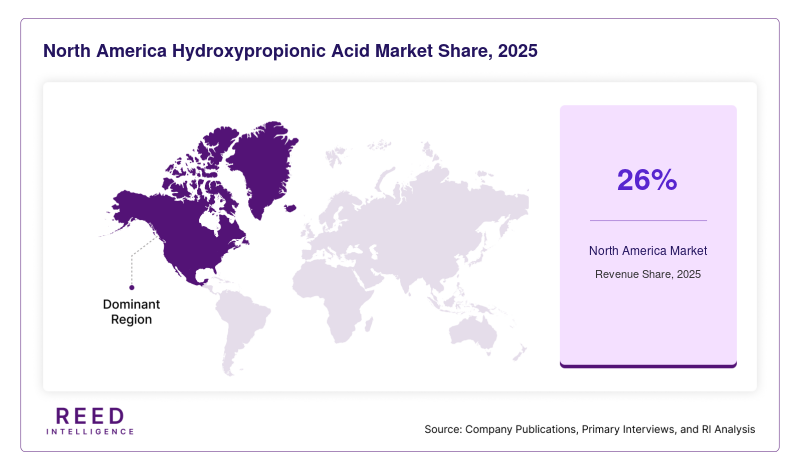
North America accounted for approximately 26% of the Hydroxypropionic Acid Market share in 2025 and is expected to grow at a CAGR of 7.8% during the forecast period. The region’s growth trajectory will be supported by increasing investments in bio-based chemical production and strong demand from pharmaceutical and personal care industries.
The United States dominated the regional market due to its well-established chemical manufacturing sector and advanced research infrastructure. The presence of leading biotechnology firms and ongoing innovation in sustainable materials has significantly contributed to market growth in the country.
Europe
Europe held around 24% of the Hydroxypropionic Acid Market share in 2025 and is projected to expand at a CAGR of 8.1% through 2034. The region’s growth will be driven by stringent environmental regulations and increasing adoption of green chemistry practices.
Germany emerged as the leading country in Europe, supported by its strong industrial base and focus on sustainable manufacturing. Government initiatives promoting circular economy practices have encouraged the use of bio-based chemicals, including hydroxypropionic acid.
Asia Pacific
Asia Pacific dominated the Hydroxypropionic Acid Market with a 38% share in 2025 and is anticipated to grow at the fastest CAGR of 9.4%. The region’s growth will be fueled by rapid industrialization, expanding end-use industries, and increasing investments in chemical production.
China led the regional market due to its large-scale manufacturing capabilities and growing demand for biodegradable materials. The country’s focus on reducing environmental impact has accelerated the adoption of hydroxypropionic acid in various applications.
Middle East & Africa
The Middle East & Africa accounted for approximately 6% of the Hydroxypropionic Acid Market share in 2025 and is expected to grow at a CAGR of 7.2% during the forecast period. Growth in this region will be supported by increasing industrial diversification and investments in chemical manufacturing.
Saudi Arabia dominated the regional market, driven by its expanding petrochemical sector and initiatives to diversify the economy. The country is gradually adopting sustainable chemical solutions, contributing to market development.
Latin America
Latin America held around 6% of the Hydroxypropionic Acid Market share in 2025 and is projected to grow at a CAGR of 7.5% through 2034. The region’s growth will be supported by rising demand for eco-friendly materials and expanding industrial activities.
Brazil led the regional market due to its strong agricultural base, which provides raw materials for bio-based production. The country’s focus on renewable resources has encouraged the adoption of hydroxypropionic acid in various applications.
Competitive Landscape
The Hydroxypropionic Acid Market is moderately consolidated, with several key players focusing on research and development to enhance product efficiency and sustainability. Companies are investing in bio-based production technologies to gain a competitive edge.
BASF SE is recognized as a leading player in the market, leveraging its strong global presence and advanced chemical manufacturing capabilities. The company recently expanded its bio-based product portfolio to strengthen its position in sustainable chemicals.
Other prominent players are adopting strategies such as mergers, partnerships, and capacity expansions to increase market share. Continuous innovation and technological advancements remain critical factors influencing competition in the Hydroxypropionic Acid Market.
Key Players
- BASF SE
- Dow Inc.
- Arkema S.A.
- Evonik Industries AG
- Mitsubishi Chemical Corporation
- LG Chem Ltd.
- Corbion N.V.
- Cargill, Incorporated
- Eastman Chemical Company
- DSM-Firmenich
Recent Developments
- In 2025, BASF SE announced the expansion of its bio-based chemical production facility to increase hydroxypropionic acid output.
- Corbion N.V. introduced a new fermentation-based process to improve yield efficiency.
- Evonik Industries AG partnered with biotechnology firms to develop sustainable production methods.
- Cargill, Incorporated invested in renewable feedstock supply chains to support bio-based chemical manufacturing.
- Mitsubishi Chemical Corporation launched a new line of high-purity hydroxypropionic acid for pharmaceutical applications.
Hydroxypropionic Acid Market Segments
Type
- Bio-Based Hydroxypropionic Acid
- Synthetic Hydroxypropionic Acid
Application
- Chemical Intermediates
- Pharmaceuticals
- Cosmetics & Personal Care
- Biodegradable Polymers
End-Use Industry
- Chemical Industry
- Pharmaceutical Industry
- Personal Care Industry
- Packaging Industry
Form
- Liquid
- Powder
Distribution Channel
- Direct Sales (B2B)
- Distributors & Wholesalers
- Online Chemical Marketplaces
By Region
- North America
- Europe
- APAC
- Middle East and Africa
- LATAM