Hyperacusis Drug Market Size, Share & Demand Report By Drug Type (Benzodiazepines, Antidepressants, Anticonvulsants, NMDA Receptor Antagonists), By Indication Severity (Mild Hyperacusis, Moderate Hyperacusis, Severe Hyperacusis), By Distribution Channel (Hospital Pharmacies, Retail Pharmacies, Online Pharmacies), By End User (Hospitals, Specialty Clinics, Homecare Settings), By Region & Segment Forecasts, 2025–2034
USD 3950
Market Overview
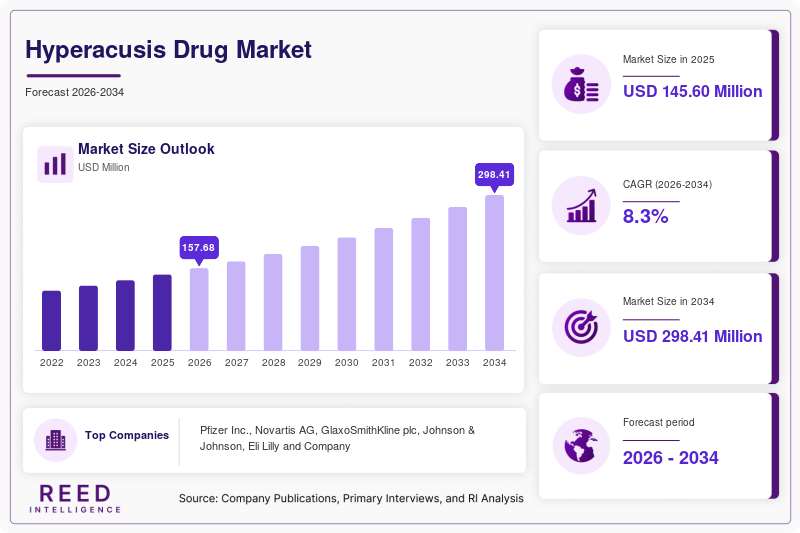
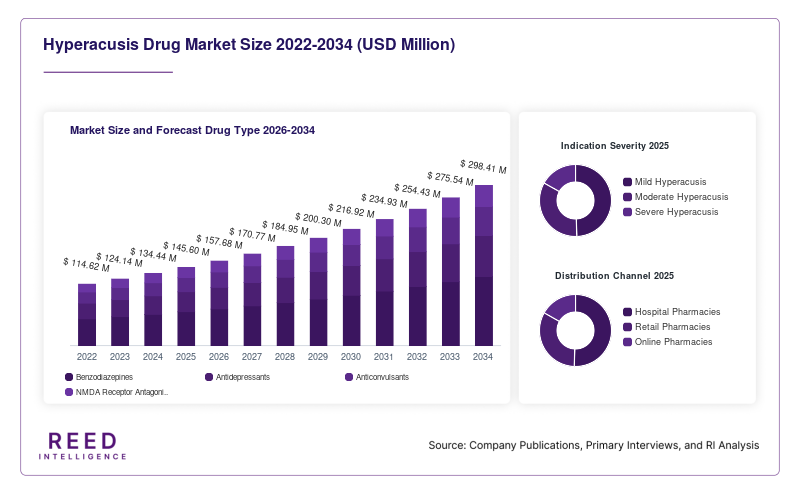
The global Hyperacusis Drug Market size was valued at USD 145.6 million in 2025 and is projected to reach USD 298.4 million by 2034, expanding at a CAGR of 8.3% during the forecast period (2025–2034). The market growth is being shaped by the increasing awareness of auditory disorders and the rising prevalence of sound sensitivity conditions worldwide. Hyperacusis, characterized by an abnormal sensitivity to everyday sounds, has gained clinical attention due to its association with tinnitus, neurological conditions, and mental health disorders.
A key global factor supporting the Hyperacusis Drug Market growth is the growing integration of multidisciplinary treatment approaches that combine pharmacological therapies with behavioral and sound therapies. This integration has improved diagnosis rates and expanded treatment adoption, especially in developed healthcare systems.
Key Highlights:
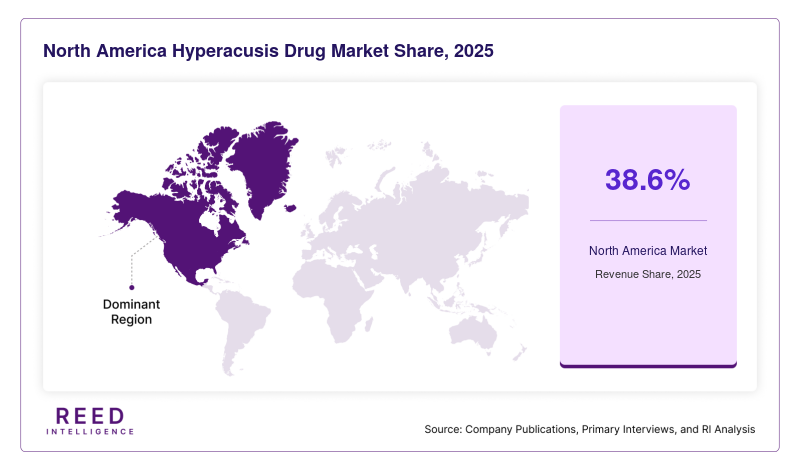
- North America dominated the market with a 38.6% share in 2025, while Asia Pacific is projected to register the fastest CAGR of 9.7% during the forecast period.
- By drug type, benzodiazepines held the leading share of 34.2% in 2024, whereas NMDA receptor antagonists are expected to grow at the fastest CAGR of 10.2%.
- By distribution channel, hospital pharmacies led with a 46.5% share, while online pharmacies are forecast to grow at a CAGR of 11.1%.
- The United States recorded market values of USD 52.3 million in 2024 and USD 56.8 million in 2025.
Market Trends
Rising Focus on Neurological Mechanisms in Treatment
A notable trend in the Hyperacusis Drug Market is the increasing emphasis on understanding the neurological basis of sound sensitivity. Researchers are shifting focus from purely symptomatic treatment to targeting central auditory processing pathways. This has led to the development of drugs that modulate neurotransmitters such as glutamate and GABA, which play a key role in auditory signal processing. This trend is reshaping treatment protocols and driving innovation in drug pipelines.
Growth of Personalized Treatment Approaches
Another emerging trend is the adoption of personalized medicine in hyperacusis management. Clinicians are increasingly tailoring treatment plans based on individual patient profiles, including severity levels, co-existing conditions like tinnitus or anxiety, and genetic predispositions. This has increased the demand for targeted drug therapies and improved patient outcomes. The use of digital health tools to monitor patient response and adjust medication dosage is also gaining traction, further enhancing the effectiveness of personalized approaches in the Hyperacusis Drug Market.
Market Drivers
Increasing Prevalence of Auditory Disorders
The rising incidence of auditory conditions such as tinnitus, noise-induced hearing loss, and hyperacusis is a key driver for the Hyperacusis Drug Market. Urbanization, prolonged exposure to high-decibel environments, and widespread use of personal audio devices have significantly increased the risk of sound sensitivity disorders. This growing patient population has fueled demand for effective pharmacological treatments.
Advancements in Pharmaceutical Research
Ongoing advancements in pharmaceutical research have accelerated the development of drugs specifically targeting hyperacusis symptoms. Innovations in neuropharmacology and auditory neuroscience have enabled the creation of therapies that address the root causes of sound sensitivity. Increased investment in clinical trials and research collaborations between pharmaceutical companies and academic institutions have further strengthened the market growth trajectory.
Market Restraint
Limited Standardized Treatment Protocols
One of the primary challenges in the Hyperacusis Drug Market is the lack of standardized treatment guidelines. Hyperacusis is a complex and often subjective condition, making it difficult to establish uniform diagnostic and therapeutic protocols. This variability leads to inconsistent treatment outcomes and limits the widespread adoption of drug therapies.
Additionally, the absence of FDA-approved drugs specifically for hyperacusis forces clinicians to rely on off-label use of medications such as antidepressants and anxiolytics. This creates uncertainty among healthcare providers and patients regarding treatment efficacy and safety. Regulatory hurdles and limited large-scale clinical studies further constrain market growth.
Market Opportunities
Expansion in Emerging Markets
Emerging economies present significant growth opportunities for the Hyperacusis Drug Market. Increasing healthcare infrastructure development, rising awareness about auditory disorders, and improving access to medical services are driving market expansion in regions such as Asia Pacific and Latin America. Pharmaceutical companies are actively exploring these markets to expand their geographic presence.
Development of Target-Specific Therapies
The growing understanding of the biological mechanisms underlying hyperacusis is opening avenues for the development of target-specific therapies. Drugs designed to modulate specific neural pathways involved in sound perception are expected to gain traction. These therapies have the potential to offer improved efficacy and reduced side effects, making them highly attractive in the evolving market landscape.
Segmental Analysis
By Drug Type
Benzodiazepines dominated the Hyperacusis Drug Market in 2024, accounting for a 34.2% share. These drugs were widely prescribed due to their effectiveness in reducing anxiety and calming the central nervous system, which plays a role in sound sensitivity. Their established use and availability contributed to their leading position.
NMDA receptor antagonists are expected to witness the fastest growth, with a projected CAGR of 10.2%. These drugs will gain traction due to their ability to modulate glutamate activity in the brain, addressing the neurological basis of hyperacusis. Increasing research into targeted therapies will further support their adoption.
By Indication Severity
Moderate hyperacusis cases held the largest share of 41.6% in 2024. This segment dominated due to the higher number of patients seeking medical intervention at this stage, where symptoms are disruptive but manageable with medication.
Severe hyperacusis cases are projected to grow at the fastest CAGR of 9.5%. The increasing need for intensive treatment and combination therapies will drive growth in this segment, as patients require more advanced pharmacological interventions.
By Distribution Channel
Hospital pharmacies accounted for the largest share of 46.5% in 2024. These channels dominated due to the availability of specialized medications and the presence of healthcare professionals guiding treatment decisions.
Online pharmacies are expected to grow at the fastest CAGR of 11.1%. The convenience of home delivery, increasing digital adoption, and rising preference for online healthcare services will contribute to their rapid expansion.
By End User
Hospitals held the leading share of 49.3% in 2024. This dominance was attributed to the availability of multidisciplinary treatment approaches and access to specialized healthcare professionals.
Specialty clinics are anticipated to grow at the fastest CAGR of 9.8%. The increasing number of dedicated audiology and neurology clinics will drive demand for targeted hyperacusis treatments.
Regional Analysis
North America
North America accounted for 38.6% of the Hyperacusis Drug Market share in 2025 and is expected to grow at a CAGR of 7.9% during the forecast period. The region’s established healthcare infrastructure and high awareness levels contributed to its leading position. The presence of specialized audiology clinics and strong reimbursement frameworks supported treatment adoption.
The United States dominated the regional market due to the increasing prevalence of auditory disorders and strong research capabilities. The country’s focus on advanced therapeutic development and clinical trials has accelerated drug innovation, contributing to sustained market growth.
Europe
Europe held a 27.4% share of the Hyperacusis Drug Market in 2025 and is projected to grow at a CAGR of 7.6%. The region benefited from well-developed healthcare systems and increasing focus on mental health and auditory disorders. Government initiatives aimed at improving hearing health further supported market expansion.
Germany emerged as the dominant country in the region, driven by its strong pharmaceutical industry and high healthcare expenditure. The country’s emphasis on research and innovation has facilitated the development of new treatment options for hyperacusis.
Asia Pacific
Asia Pacific captured 19.8% of the Hyperacusis Drug Market share in 2025 and is anticipated to grow at the fastest CAGR of 9.7% during the forecast period. Rapid urbanization and increasing exposure to noise pollution have contributed to the rising prevalence of hyperacusis in the region.
China led the regional market due to its large population base and expanding healthcare infrastructure. The government’s focus on improving access to healthcare services and increasing investments in medical research have driven market growth.
Middle East & Africa
The Middle East & Africa region accounted for 7.2% of the Hyperacusis Drug Market in 2025 and is expected to grow at a CAGR of 6.8%. The market growth was supported by improving healthcare facilities and increasing awareness about auditory health.
Saudi Arabia dominated the region, driven by government initiatives to modernize healthcare infrastructure and increase access to specialized medical services. The country’s investment in healthcare reforms has positively impacted market development.
Latin America
Latin America held a 7.0% share of the Hyperacusis Drug Market in 2025 and is projected to grow at a CAGR of 7.1%. The region’s growth was influenced by improving healthcare access and rising awareness of auditory disorders.
Brazil emerged as the leading country due to its large patient population and growing focus on healthcare improvements. The expansion of private healthcare facilities and increasing adoption of advanced treatment options have supported market growth.
Competitive Landscape
The Hyperacusis Drug Market is characterized by the presence of several pharmaceutical companies focusing on neurological and auditory disorder treatments. The market is moderately fragmented, with players investing in research and development to strengthen their product portfolios.
Pfizer Inc. emerged as a leading player due to its strong presence in neurological therapeutics and continuous investment in innovative drug development. The company recently advanced a clinical trial focusing on neuromodulation-based therapy for auditory disorders, enhancing its competitive position.
Other key players are focusing on strategic collaborations, product launches, and geographic expansion to gain market share. The increasing emphasis on targeted therapies and personalized medicine is expected to intensify competition in the coming years.
Key Players List
- Pfizer Inc.
- Novartis AG
- GlaxoSmithKline plc
- Johnson & Johnson
- Eli Lilly and Company
- AbbVie Inc.
- Sanofi S.A.
- AstraZeneca plc
- Teva Pharmaceutical Industries Ltd.
- Sun Pharmaceutical Industries Ltd.
- Cipla Ltd.
- Dr. Reddy’s Laboratories Ltd.
- Merck & Co., Inc.
- Amgen Inc.
- Takeda Pharmaceutical Company Limited
Recent Developments
- In 2024, Pfizer Inc. initiated a Phase II clinical trial targeting central auditory processing disorders.
- Novartis AG expanded its neuroscience research division to include hyperacusis-focused drug development.
- GlaxoSmithKline plc collaborated with academic institutions to explore novel treatment pathways.
- Sun Pharmaceutical Industries Ltd. launched a generic formulation targeting anxiety-linked hyperacusis symptoms.
- Takeda Pharmaceutical Company Limited invested in digital therapeutics integration with pharmacological treatments.
Hyperacusis Drug Market Segments
Drug Type
- Benzodiazepines
- Antidepressants
- Anticonvulsants
- NMDA Receptor Antagonists
Indication Severity
- Mild Hyperacusis
- Moderate Hyperacusis
- Severe Hyperacusis
Distribution Channel
- Hospital Pharmacies
- Retail Pharmacies
- Online Pharmacies
End User
- Hospitals
- Specialty Clinics
- Homecare Settings
By Region
- North America
- Europe
- APAC
- Middle East and Africa
- LATAM