Hypnotherapy Market Size, Share & Trends Analysis Report By Type (Solution-Focused Hypnotherapy, Cognitive-Behavioural Hypnotherapy, Regression Hypnotherapy, Ericksonian Hypnosis,), By Delivery Mode (Offline, Online & Digital), By Application (Anxiety & Stress, Sleep Disorders, Pain Management, Phobias & Fears, Smoking & Behavioral Change), By Service Provider (Specialty Clinics & Private Practitioners, Hospitals & Healthcare Systems, and Forecasts, 2026–2034
USD 3950
Hypnotherapy Market Size
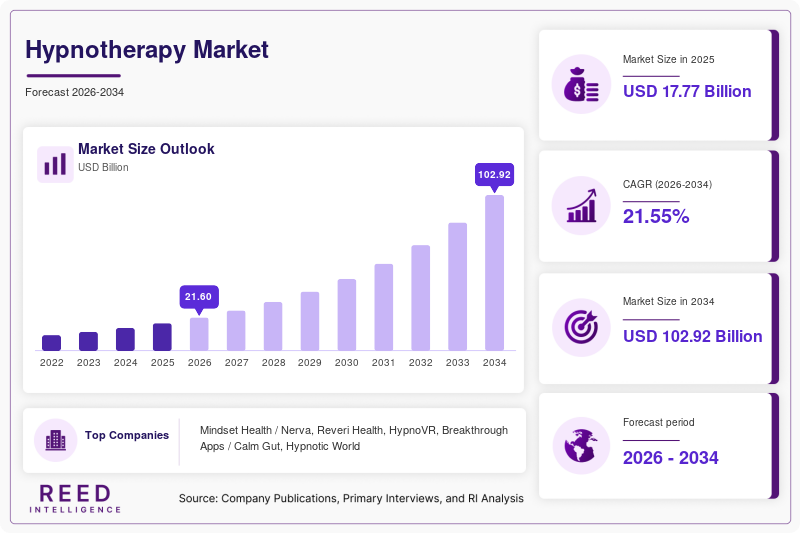
The global hypnotherapy market is valued at USD 17.77 Billion in 2025 and USD 21.60 Billion in 2026. The market is projected to reach USD 102.92 Billion by 2034, registering a 21.55% CAGR during the forecast period.
The hypnotherapy market comprises professional hypnosis and hypnotherapy services, digital self-hypnosis programs, clinical hypnosis platforms, immersive virtual-reality hypnosis systems, practitioner-led treatment programs and related education or wellness services. The market spans clinical and behavioral applications including anxiety and stress management, pain support, gastrointestinal disorders, sleep-related problems, smoking and habit-change programs, and selected procedural settings.
Clinical hypnosis should be distinguished from general relaxation or wellness content. The American Psychological Association's clinical-hypnosis literature describes hypnosis as a therapeutic technique used in evidence-based practice for problems including anxiety, depression, acute and chronic pain and behavioral conditions. The National Center for Complementary and Integrative Health notes that hypnosis has been studied particularly for anxiety associated with medical and dental procedures; it reports promising findings in some areas but states that the overall evidence is not conclusive.
Hypnotherapy Market Drivers
Growing evidence in specific clinical applications is expanding provider and consumer interest
The market is gaining credibility through evidence concentrated in defined indications. The 2025 gut-directed hypnotherapy meta-analysis found benefits for global IBS symptoms and pain, while the 2025 procedural-hypnosis meta-analysis found reductions in anxiety and pain during invasive procedures.
This does not establish hypnotherapy as equally effective for every condition, but it gives providers clearer use cases around gastrointestinal disorders, procedural anxiety and pain support.
The result is greater segmentation of the market. Rather than selling an undifferentiated hypnosis service, providers increasingly build programs around specific clinical needs, patient populations and treatment pathways.
Digital delivery is lowering cost and access barriers
Therapist-led hypnotherapy can be constrained by geography, practitioner availability and session cost. Smartphone delivery creates a scalable alternative for selected programs.
The 2026 IBS RCT directly tested this model and found a 33% FDA-defined pain response rate in the smartphone group versus 22% for online psychoeducation, while noting that non-inferiority versus therapist-led treatment could not be established.
The commercial implication is that digital programs can expand access without implying that they fully replace clinicians. This hybrid model is particularly relevant to chronic conditions where regular audio-based practice can complement conventional care.
Rising interest in non-drug and technology-enabled supportive care is broadening adoption
Healthcare providers continue to explore approaches that can complement conventional care and potentially reduce procedural distress or reliance on some medications.
HypnoVR's hospital-focused model provides a technology-enabled example, using immersive hypnosis for surgical, dental, imaging and anesthesia settings. The company reports more than 300 hospitals and clinics using its solution.
Consumer platforms such as Reveri and Nerva are extending the same concept into home-based care and routine self-management, broadening the potential audience beyond specialist clinics.
Hypnotherapy Market Restraints
Evidence quality varies substantially by indication and delivery format
The scientific base for hypnotherapy is heterogeneous. NCCIH states that evidence for hypnosis in anxiety-related applications is promising in some settings but not conclusive overall.
The 2026 IBS trial also showed an important distinction between delivery models: smartphone self-guided hypnotherapy produced a meaningful response in a portion of participants but did not meet the predefined non-inferiority threshold against therapist-led treatment.
This means providers and digital platforms must avoid generalizing evidence from one indication or delivery format to another.
Professional quality, patient screening and appropriate clinical positioning remain important
Hypnotherapy services require clear boundaries around diagnosis, medical assessment and practitioner qualifications. NCCIH notes that hypnosis is considered safe when practiced by a trained, experienced, licensed healthcare provider.
Digital providers are also adopting more explicit positioning. Mindset Health states that Nerva is intended for self-management and wellness and is not a replacement for professional diagnosis or medical treatment.
This creates a need for provider screening, clinical escalation pathways, appropriate disclaimers and carefully bounded claims, particularly as AI-generated and self-guided hypnosis becomes more widespread.
Hypnotherapy Market Opportunities
AI-personalized self-hypnosis can expand the addressable consumer market
AI is increasingly being applied to personalize hypnosis sessions according to symptoms, goals, preferences and previous interactions.
Reveri's current product describes real-time voice interaction and AI-supported personalization, while Nerva reports AI-supported adjustment of coaching and guidance according to symptoms, triggers and progress. Onira similarly uses on-device AI to generate and narrate individualized hypnosis scripts.
This could reduce content-development limitations and enable a wider range of specialized sessions without requiring a separate manually recorded program for every use case.
Payer and employer models can shift digital hypnotherapy from direct subscription toward covered care
Health-plan adoption creates a pathway for digital hypnotherapy platforms to monetize through population-health contracts rather than relying exclusively on individual subscriptions.
Mindset Health states that Nerva has participated in the HIF member-health program since March 2025 and entered the CMS ACCESS Model in July 2026 for eligible Original Medicare patients. The company is also actively marketing Nerva to commercial health plans and employers.
This opens opportunities around outcome-based reimbursement, employer wellness benefits and condition-specific digital-care contracts.
Immersive medical hypnosis can expand into procedure-specific hospital workflows
VR creates a different value proposition from smartphone audio because it can control visual, auditory and attentional stimuli during procedures.
HypnoVR's product portfolio covers surgery, anesthesia, dental care and imaging, with customizable therapeutic environments and narratives.
The opportunity extends to procedural anxiety, pediatric care, oncology, rehabilitation and other environments where standardized non-pharmacological support can be integrated into a hospital workflow.
Type Analysis
Solution-Focused Hypnotherapy holds the dominant type share because short, goal-oriented programs fit both clinical and consumer delivery
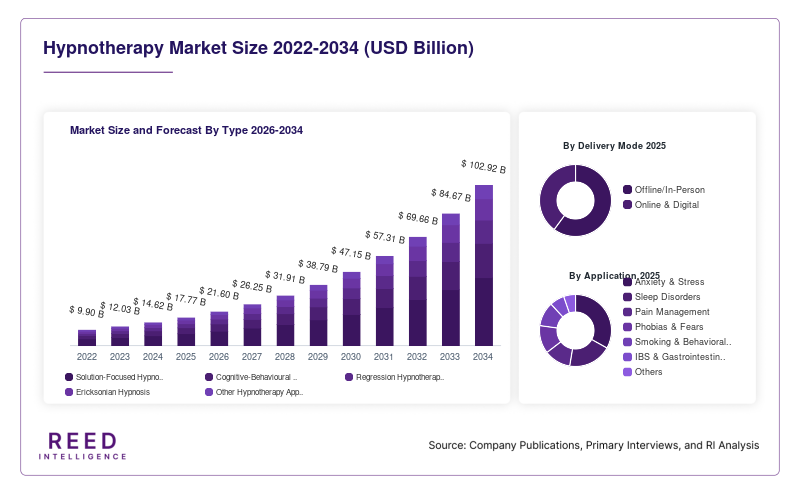
The Solution-Focused Hypnotherapy segment accounts for 28% of the global market in 2026 and is projected to register a 20.40% CAGR.
The approach is commercially compatible with structured programs focused on specific outcomes such as stress reduction, confidence, habits, sleep and behavioral change. Its goal-oriented structure also adapts well to short digital sessions and standardized practitioner packages.
Cognitive-Behavioural Hypnotherapy is the fastest-growing major approach as evidence-based psychological frameworks are increasingly integrated with hypnosis
The Cognitive-Behavioural Hypnotherapy segment accounts for 21% of the global market in 2026 and is projected to register a 23.80% CAGR, making it the fastest-growing major type.
CBH combines hypnotic techniques with cognitive and behavioral strategies, allowing providers to position programs around established psychological frameworks rather than hypnosis alone.
The broader clinical-hypnosis literature includes anxiety, depression and behavioral applications, providing a foundation for combined approaches.
Regression Hypnotherapy remains relevant in practitioner-led settings
The segment is projected to register a 19.10% CAGR.
Regression approaches remain part of the broader hypnotherapy ecosystem, particularly within practitioner-led practices where individualized sessions and extended consultation are commercially important.
Because the evidence base is less standardized across regression-oriented applications, market expansion is more dependent on practitioner positioning and consumer demand than on large clinical programs.
Ericksonian Hypnosis supports specialized practitioner demand
The segment is projected to register a 18.70% CAGR.
Ericksonian approaches emphasize individualized language, metaphor and indirect suggestion and are used within certain clinical and private-practice models.
The segment's development remains linked to practitioner education, professional training and the broader adoption of personalized hypnotherapy.
Other Hypnotherapy Approaches broaden the market across specialty use cases
The segment is projected to register a 17.80% CAGR.
The category includes clinical hypnosis variants, self-hypnosis protocols and practitioner-developed techniques designed for specific behavioral, wellness or supportive-care applications.
Delivery Mode Analysis
Offline/In-Person delivery remains the dominant model because therapist-led treatment continues to anchor clinical hypnotherapy
The Offline/In-Person segment accounts for 54% of the global market in 2026 and is projected to register a 19.10% CAGR.
In-person treatment remains important for individualized assessment, clinical supervision, complex conditions and procedural applications. The 2026 IBS randomized trial found a 48% FDA-defined abdominal-pain response rate with therapist-delivered treatment compared with 33% for smartphone self-guided treatment, although the study did not directly establish superiority across every outcome.
Hospitals and specialty clinics also rely on clinician involvement when hypnosis is integrated into anesthesia, surgery or other medical pathways.
Online & Digital delivery is the fastest-growing delivery model as smartphones and AI reduce access barriers
The Online & Digital segment accounts for 46% of the global market in 2026 and is projected to register a 24.80% CAGR, making it the fastest-growing delivery category.
Nerva, Reveri, Calm Gut and Onira illustrate different models spanning structured digital programs, interactive self-hypnosis, condition-specific audio and AI-generated sessions.
The 2026 IBS RCT also provides evidence that smartphone delivery can reach meaningful levels of symptom response, although it did not demonstrate non-inferiority against therapist-led treatment.
Application Analysis
Anxiety & Stress remains the dominant application because hypnosis is widely used around psychological and procedural distress
The Anxiety & Stress segment accounts for 29% of the global market in 2026 and is projected to register a 21.00% CAGR.
NCCIH identifies medical and dental procedure-related anxiety as an important research area and reports promising findings from multiple studies, while clinical-hypnosis literature includes anxiety among established application categories.
Consumer digital platforms also devote substantial content to stress and anxiety management, broadening the market beyond clinical settings.
Sleep Disorders is the fastest-growing major application as self-guided audio delivery aligns closely with sleep routines
The Sleep Disorders segment accounts for 22% of the global market in 2026 and is projected to register a 25.30% CAGR, making it the fastest-growing major application.
Sleep-focused hypnotherapy can be delivered repeatedly at home through mobile applications, headphones and other audio devices, reducing the need for repeated in-person appointments.
Reveri currently provides dedicated sleep and insomnia self-hypnosis sessions, while broader clinical-hypnosis research continues to examine sleep-related outcomes.
Pain Management is expanding through both clinical hypnosis and immersive digital systems
The segment is projected to register a 22.10% CAGR.
Evidence from the 2024 systematic review of 70 randomized comparisons found small additional analgesic effects when hypnosis was used alongside usual care for chronic pain, medical or surgical pain and burn care.
HypnoVR and Reveri are expanding this application through different delivery models, with HypnoVR focused on healthcare procedures and Reveri focused on consumer self-hypnosis.
Service Provider Analysis
Specialty Clinics & Private Practitioners remain the dominant service-provider category because individualized delivery continues to anchor the market
The Specialty Clinics & Private Practitioners segment accounts for 41% of the global market in 2026 and is projected to register a 20.40% CAGR.
These providers can tailor treatment length, therapeutic scripts, patient goals and follow-up according to individual needs. They also remain central to applications where the intervention needs to be adapted following clinical assessment.
The practitioner model is particularly resilient because the 2026 IBS trial still showed a higher abdominal-pain response rate for therapist-delivered treatment than for smartphone self-guided treatment.
Hospitals & Healthcare Systems are the fastest-growing major provider category as hypnosis becomes integrated into procedure and supportive-care pathways
The Hospitals & Healthcare Systems segment accounts for 22% of the global market in 2026 and is projected to register a 23.70% CAGR, making it the fastest-growing major service-provider category.
HypnoVR reports deployment across hundreds of hospitals and clinics for anesthesia, surgery, dentistry and imaging, while procedural-hypnosis research continues to demonstrate reductions in pain and anxiety in selected settings.
The hospital opportunity is increasingly technology-enabled, with standardized hypnosis programs that can be deployed across departments.
Hypnotherapy Market Regional Analysis
North America Hypnotherapy Market
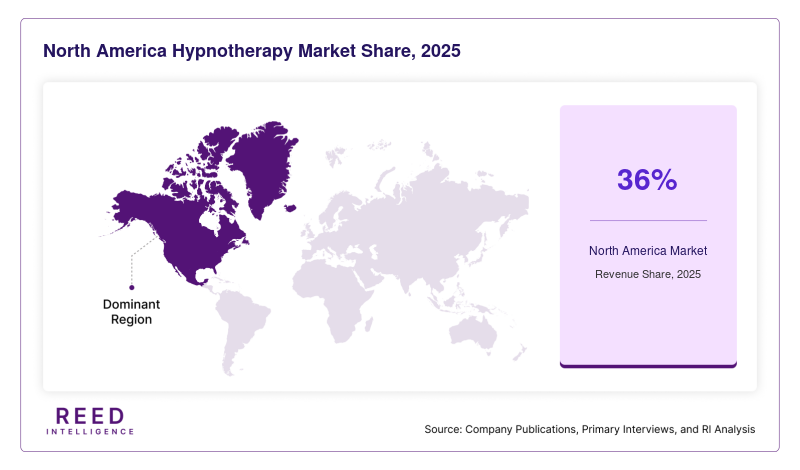
North America remains the dominant regional market because of its established clinical-hypnosis ecosystem, large private healthcare market, strong digital-health infrastructure and concentration of technology-oriented providers.
The North America region accounts for 36% of the global market in 2026 and is projected to register a 20.20% CAGR.
The region has a significant research and technology base. Reveri was co-founded by Stanford psychiatrist David Spiegel, while HypnoVR and other digital suppliers are developing technology-assisted clinical hypnosis.
Digital reimbursement is also becoming more relevant. Mindset Health states that eligible Original Medicare patients can access Nerva through the CMS ACCESS Model from July 2026, creating a new pathway for technology-enabled hypnotherapy-related care.
Europe Hypnotherapy Market
Europe is projected to register a 21.40% CAGR, supported by professional hypnotherapy practices, clinical research, digital-health adoption and advanced medical-VR deployment.
The region is particularly important for medical hypnosis technology. HypnoVR, headquartered in France, positions its certified medical device across surgery, anesthesia, dental care and imaging and reports adoption across hundreds of European healthcare facilities.
Europe's extensive healthcare systems also provide opportunities for hospital procurement and standardized digital-therapy deployment.
APAC Hypnotherapy Market
APAC is the fastest-growing regional market as digital health, smartphone adoption, private healthcare and wellness services expand across India, China, Japan, South Korea, Australia and Southeast Asia.
The APAC region accounts for 24% of the global market in 2026 and is projected to register a 24.80% CAGR, making it the fastest-growing regional market.
Digital delivery is especially important because mobile applications can reach consumers without requiring a large network of physical therapists. Condition-specific programs such as Nerva and general self-hypnosis platforms demonstrate how language-localized and mobile-first services can broaden access.
Australia is also important for digital hypnotherapy because Mindset Health is headquartered there and has established partnerships with healthcare organizations such as HIF.
Middle East and Africa Hypnotherapy Market
The Middle East and Africa market is projected to register a 22.10% CAGR, supported by private healthcare investment, premium wellness services and increasing use of digital healthcare platforms.
Hospital and wellness providers offer separate adoption pathways, while smartphone delivery can reduce geographic barriers where trained hypnotherapists are less accessible.
LATAM Hypnotherapy Market
LATAM is projected to register a 21.90% CAGR, supported by growing private healthcare activity, wellness consumption and the increasing availability of mobile health applications.
Digital programs can provide a lower-infrastructure pathway into the market, while private clinics and wellness centers remain important for in-person services.
Hypnotherapy Market Competitive Landscape
The hypnotherapy market is fragmented across practitioner networks, specialty clinics, digital health companies, medical-technology vendors, consumer self-hypnosis applications and wellness providers.
Mindset Health is one of the most prominent digital-health participants through Nerva and its broader pipeline. Nerva uses an audio-led six-week gut-brain program based on gut-directed hypnotherapy developed with Monash University. Mindset Health currently reports more than 300,000 people supported across its platform family and is expanding commercial access through providers, employers and health plans.
Key Market Players
- Mindset Health / Nerva
- Reveri Health
- HypnoVR
- Breakthrough Apps / Calm Gut
- Hypnotic World
- Harmony Hypnosis
- Uncommon Knowledge
- Grace Space Hypnotherapy
- BetterHelp
- Calmerry
- Headspace
- Mindvalley
- Hypnosis Downloads
- Individual Certified Hypnotherapy Practitioners
- Regional Hypnotherapy Clinics and Wellness Providers
Recent Developments
September 2026 – Mindset Health continued expanding Nerva's AI-personalized gut-brain platform. Its current Nerva product documentation describes AI-assisted personalization based on symptoms, triggers and progress, while Mindset Health's broader platform reports more than 300,000 people supported and more than 10 published studies.
August 2026 – The Calm Gut app released an updated version combining gut-directed hypnotherapy, CBT and mindfulness. The app includes more than 250 audio sessions, structured programs, symptom-management tools and a 28-day Mind-Gut Reset program.
Hypnotherapy Market Segments
By Type
- Solution-Focused Hypnotherapy
- Cognitive-Behavioural Hypnotherapy
- Regression Hypnotherapy
- Ericksonian Hypnosis
- Other Hypnotherapy Approaches
By Delivery Mode
- Offline/In-Person
- Online & Digital
By Application
- Anxiety & Stress
- Sleep Disorders
- Pain Management
- Phobias & Fears
- Smoking & Behavioral Change
- IBS & Gastrointestinal Disorders
- Others
By Service Provider
- Specialty Clinics & Private Practitioners
- Hospitals & Healthcare Systems
- Individual & Home-Based Services
- Wellness Centers & Other Providers
By Region
- North America
- Europe
- APAC
- Middle East and Africa
- LATAM