Hypoprothrombinemia Treatment Market Size, Share & Demand Report By Treatment Type (Plasma-Derived Products, Recombinant Therapies, Others), By Application (Congenital Hypoprothrombinemia, Acquired Hypoprothrombinemia), By End-Use (Hospitals, Specialty Clinics, Home Care Settings) By Region & Segment Forecasts, 2026–2034
USD 3950
Market Overview
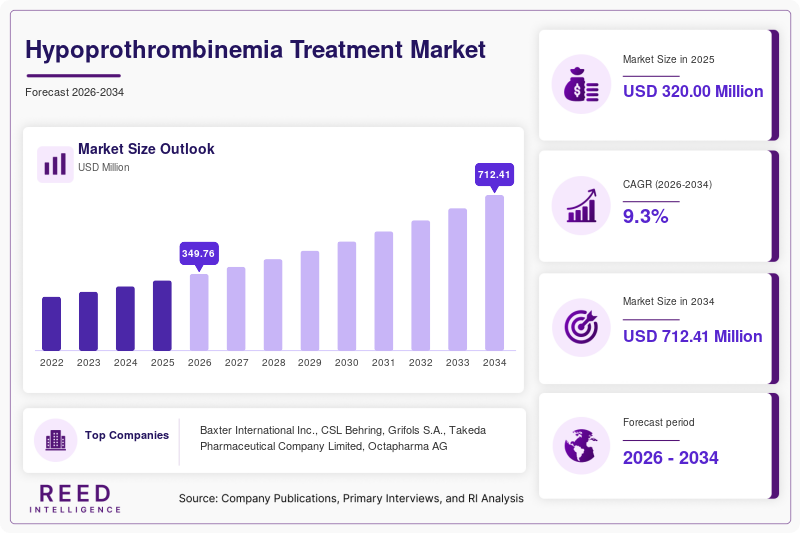
The Hypoprothrombinemia Treatment Market size was valued at approximately USD 320 million in 2025 and is projected to reach around USD 350 million in 2026. By 2034, the market is expected to grow to nearly USD 780 million, registering a compound annual growth rate (CAGR) of 9.3% during the forecast period (2025–2034).
Several factors are contributing to this market expansion. First, the rising prevalence of rare coagulation disorders and improved diagnostic capabilities are enabling earlier detection and treatment initiation. Second, advancements in recombinant coagulation factor therapies and plasma-derived products are enhancing treatment outcomes and safety profiles. Third, increasing healthcare expenditure and improved access to specialized treatments in emerging economies are expanding the patient pool receiving appropriate care.
Key Highlights
- Market size is estimated at USD 320 million in 2025 and is expected to reach USD 350 million in 2026, reflecting steady year-on-year growth. This increase is supported by improving diagnosis rates and expanding treatment accessibility.
- The market is forecasted to reach USD 780 million by 2034, driven by long-term advancements in therapeutic technologies. Growing investment in rare disease treatment is also contributing to this upward trajectory.
- The market is expected to register a CAGR of 9.3% from 2025 to 2034, indicating consistent expansion over the forecast period. This growth reflects rising demand for effective and safer treatment solutions.
Market Trends
Growing Adoption of Recombinant Therapies
The shift from plasma-derived treatments to recombinant therapies is a notable trend in the Hypoprothrombinemia Treatment Market. Recombinant products offer improved safety by eliminating the risk of pathogen transmission associated with blood-derived products. These therapies are increasingly preferred in developed regions due to their consistent quality and reduced immunogenicity. Moreover, advancements in biotechnology have enabled the development of more stable and long-acting recombinant coagulation factors. Healthcare providers are favoring these treatments for both acute management and prophylaxis, leading to increased adoption. As manufacturing processes become more efficient, the cost gap between plasma-derived and recombinant therapies is narrowing, further supporting market growth.
Expansion of Gene Therapy Research
Gene therapy is emerging as a transformative trend in the treatment of hypoprothrombinemia. Research efforts are focused on delivering functional copies of the defective gene responsible for Factor II deficiency, potentially offering a long-term or permanent solution. Clinical trials are showing promising outcomes in improving clotting factor levels and reducing bleeding episodes. Pharmaceutical companies are forming partnerships with biotechnology firms to accelerate the development of gene-based treatments. Regulatory agencies are also providing incentives for rare disease therapies, encouraging innovation. While still in early stages, gene therapy has the potential to reshape the treatment landscape and reduce dependency on lifelong medication.
Market Drivers
Increasing Diagnosis Rates of Rare Bleeding Disorders
Improved diagnostic technologies and growing awareness among healthcare professionals are significantly increasing the detection of hypoprothrombinemia cases. Advanced coagulation testing methods and genetic screening tools are enabling earlier and more accurate diagnosis. This is particularly important for rare conditions that were previously underdiagnosed or misdiagnosed. As awareness campaigns and medical education programs expand, more patients are being identified and treated appropriately. This rise in diagnosed cases is directly contributing to increased demand for treatment options. Additionally, healthcare systems are emphasizing early intervention to prevent complications, further supporting market growth.
Advancements in Treatment Technologies
Technological advancements in treatment development are a major driver of the Hypoprothrombinemia Treatment Market. Innovations in recombinant factor production, extended half-life therapies, and targeted drug delivery systems are improving treatment efficacy and patient outcomes. These advancements are reducing the frequency of administration and minimizing adverse effects, enhancing patient adherence. Furthermore, ongoing research into novel therapeutic approaches, including RNA-based treatments and gene editing technologies, is expanding the pipeline. Pharmaceutical companies are investing heavily in these innovations to gain a competitive edge, resulting in a dynamic and evolving market landscape.
Market Restraint
High Cost of Treatment and Limited Accessibility
One of the primary restraints in the Hypoprothrombinemia Treatment Market is the high cost associated with advanced therapies. Recombinant and gene-based treatments are expensive due to complex manufacturing processes and stringent regulatory requirements. This limits their accessibility, particularly in low- and middle-income countries where healthcare budgets are constrained. Patients often face financial barriers, even in developed regions, due to limited insurance coverage for rare disease treatments. Additionally, the lack of specialized healthcare infrastructure in certain regions further restricts access to proper diagnosis and treatment. This disparity in access can lead to delayed treatment and poorer health outcomes, ultimately impacting market growth. Efforts to improve affordability and expand reimbursement policies are critical to addressing this challenge.
Market Opportunities
Expansion in Emerging Markets
Emerging economies present significant growth opportunities for the Hypoprothrombinemia Treatment Market. Countries in Asia Pacific, Latin America, and parts of the Middle East are witnessing improvements in healthcare infrastructure and increased investment in rare disease management. Governments and private organizations are working to enhance diagnostic capabilities and expand access to specialized treatments. As awareness of rare bleeding disorders grows, more patients are being identified and treated. Pharmaceutical companies are also entering these markets through partnerships and distribution agreements, aiming to tap into the unmet medical needs. The expansion of healthcare insurance coverage in these regions is further supporting market penetration.
Development of Personalized Medicine Approaches
The growing focus on personalized medicine is creating new opportunities in the treatment of hypoprothrombinemia. Advances in genetic profiling and biomarker identification are enabling tailored treatment strategies based on individual patient characteristics. Personalized therapies can improve efficacy and reduce the risk of adverse reactions, leading to better patient outcomes. Pharmaceutical companies are investing in precision medicine research to develop targeted therapies that address specific genetic mutations. This approach is particularly relevant for rare diseases, where patient populations are small and heterogeneous. The integration of personalized medicine into clinical practice is expected to drive innovation and open new avenues for market growth.
Segmental Analysis
By Treatment Type
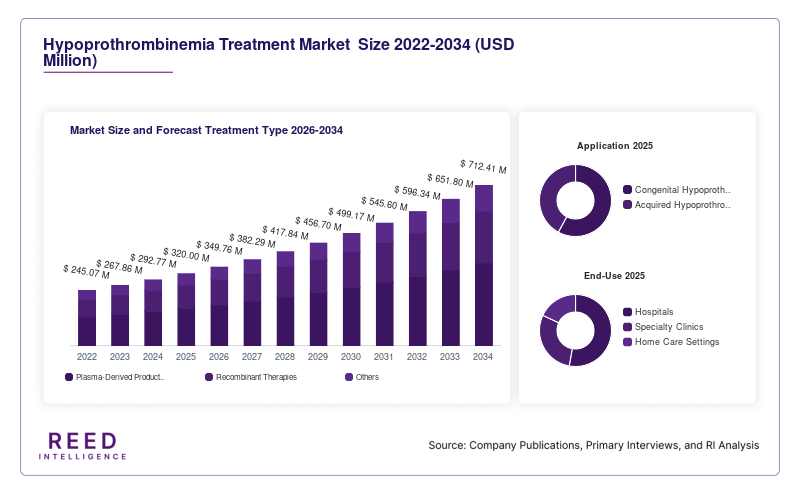
The treatment type segment includes plasma-derived prothrombin complex concentrates, recombinant therapies, and others. Plasma-derived products dominated the market in 2024, accounting for approximately 55% of the total share. These treatments have been widely used due to their established efficacy and availability. They are often the first-line therapy in many regions, particularly where access to advanced treatments is limited. Healthcare providers rely on these products for both acute bleeding management and prophylaxis. Their relatively lower cost compared to recombinant therapies also contributes to their dominance in the market.
Recombinant therapies are the fastest-growing subsegment, expected to register a CAGR of 10.8% during the forecast period. The growth is driven by their improved safety profile and reduced risk of pathogen transmission. Advances in biotechnology are enabling the development of more effective and longer-lasting recombinant products. Increasing adoption in developed regions and gradual expansion into emerging markets are further supporting growth. As production costs decrease, these therapies are becoming more accessible, contributing to their rapid uptake.
By Application
The application segment includes congenital hypoprothrombinemia and acquired hypoprothrombinemia. Congenital cases held the dominant share of around 60% in 2024, driven by the need for lifelong treatment and regular monitoring. Patients with congenital conditions require continuous therapy to prevent bleeding episodes, leading to consistent demand for treatment products. Healthcare providers focus on early diagnosis and long-term management strategies, which further supports this segment's dominance.
Acquired hypoprothrombinemia is the fastest-growing subsegment, with a projected CAGR of 9.7%. This growth is attributed to increasing cases associated with liver disease, vitamin K deficiency, and anticoagulant therapy. The rising prevalence of chronic diseases and the growing use of anticoagulants are contributing to the expansion of this segment. Improved diagnostic capabilities are also enabling better identification and treatment of acquired cases.
By End-Use
The end-use segment includes hospitals, specialty clinics, and home care settings. Hospitals dominated the market in 2024, accounting for approximately 50% of the total share. They serve as primary treatment centers for acute bleeding episodes and complex cases. Hospitals are equipped with advanced diagnostic tools and specialized healthcare professionals, making them the preferred choice for managing hypoprothrombinemia. The availability of emergency care and comprehensive treatment options further supports their dominance.
Home care settings are the fastest-growing subsegment, expected to grow at a CAGR of 10.2%. The shift towards home-based care is driven by the development of user-friendly treatment options and the need to reduce healthcare costs. Patients prefer home care for its convenience and reduced hospital visits. Advances in telemedicine and remote monitoring are also supporting this trend, enabling better management of the condition outside clinical settings.
Regional Analysis
North America
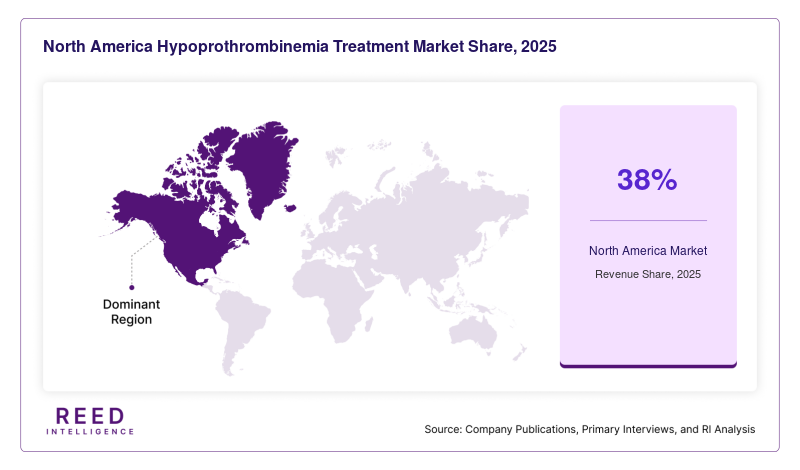
North America accounted for the largest market share in 2025, contributing approximately 38% of the global Hypoprothrombinemia Treatment Market. The region is expected to maintain a steady CAGR of around 8.7% during the forecast period. High healthcare spending, advanced diagnostic infrastructure, and strong presence of pharmaceutical companies are key factors supporting market growth. The availability of reimbursement policies for rare disease treatments further enhances patient access.
The United States dominates the regional market due to its well-established healthcare system and significant investment in research and development. A unique growth factor is the strong regulatory support for orphan drugs, which encourages innovation and accelerates the approval of new therapies.
Europe
Europe held a market share of approximately 27% in 2025 and is projected to grow at a CAGR of 8.9% through 2034. The region benefits from robust healthcare systems and increasing awareness of rare bleeding disorders. Government initiatives aimed at improving rare disease management are also contributing to market expansion.
Germany leads the European market, supported by advanced medical infrastructure and high adoption of innovative therapies. A unique growth factor is the presence of collaborative research networks that facilitate the development of new treatment options.
Asia Pacific
Asia Pacific accounted for around 20% of the market in 2025 and is expected to register the fastest CAGR of 10.5% during the forecast period. Rapid improvements in healthcare infrastructure and increasing awareness of rare diseases are driving growth in this region.
China is the dominant country in Asia Pacific, driven by its large population and expanding healthcare access. A unique growth factor is the increasing government investment in biotechnology and rare disease research, which is accelerating the development and adoption of advanced treatments.
Middle East & Africa
The Middle East & Africa region held a market share of about 8% in 2025 and is projected to grow at a CAGR of 9.1%. The market is gradually expanding due to improving healthcare infrastructure and rising awareness of rare conditions.
Saudi Arabia leads the regional market, supported by government initiatives to modernize healthcare systems. A unique growth factor is the increasing focus on medical tourism, which is attracting patients seeking specialized treatments.
Latin America
Latin America accounted for approximately 7% of the market in 2025 and is expected to grow at a CAGR of 9.4% during the forecast period. Economic development and improving healthcare access are key factors driving growth in this region.
Brazil dominates the Latin American market, benefiting from a growing healthcare sector and increasing investment in rare disease treatment programs. A unique growth factor is the expansion of public healthcare initiatives aimed at improving access to advanced therapies.
Competitive Landscape
The Hypoprothrombinemia Treatment Market is moderately competitive, with several key players focusing on innovation and strategic collaborations to strengthen their market position. Companies are investing in research and development to introduce advanced therapies and expand their product portfolios. The market is characterized by the presence of both established pharmaceutical firms and emerging biotechnology companies.
One of the leading players in the market is Baxter International Inc., which has a strong portfolio of plasma-derived and recombinant therapies. The company continues to invest in expanding its production capabilities and improving product quality. Other major players are focusing on partnerships and acquisitions to enhance their market presence. Recent developments include the introduction of extended half-life coagulation factors and ongoing clinical trials for gene therapies. These advancements are expected to intensify competition and drive innovation in the market.
Key Players List
- Baxter International Inc.
- CSL Behring
- Grifols S.A.
- Takeda Pharmaceutical Company Limited
- Octapharma AG
- Novo Nordisk A/S
- Pfizer Inc.
- Sanofi S.A.
- Bayer AG
- Kedrion Biopharma
- Bio Products Laboratory Ltd.
- LFB Group
- Emergent BioSolutions Inc.
- Aptevo Therapeutics
- Catalyst Biosciences
Recent Developments
- A leading pharmaceutical company launched an extended half-life recombinant prothrombin therapy to improve patient compliance and reduce dosing frequency.
- A biotechnology firm initiated a Phase II clinical trial for a gene therapy targeting Factor II deficiency, showing promising early results.
- Several companies expanded their manufacturing facilities to increase the production of plasma-derived coagulation factors and meet growing global demand.
Hypoprothrombinemia Treatment Market Segments
Treatment Type
- Plasma-Derived Products
- Recombinant Therapies
- Others
Application
- Congenital Hypoprothrombinemia
- Acquired Hypoprothrombinemia
End-Use
- Hospitals
- Specialty Clinics
- Home Care Settings
By Region
- North America
- Europe
- APAC
- Middle East and Africa
- LATAM