Ice Crusher Machine Market Size, Share & Demand Report By Product Type (Electric Ice Crusher Machines, Manual Ice Crusher Machines, Portable Ice Crusher Machines), By Application (Commercial Foodservice, Household, Beverage Processing, Hospitality and Catering), By Distribution Channel (Offline Retail, Online Retail), By Region & Segment Forecasts, 2026–2034
USD 3950
Market Overview
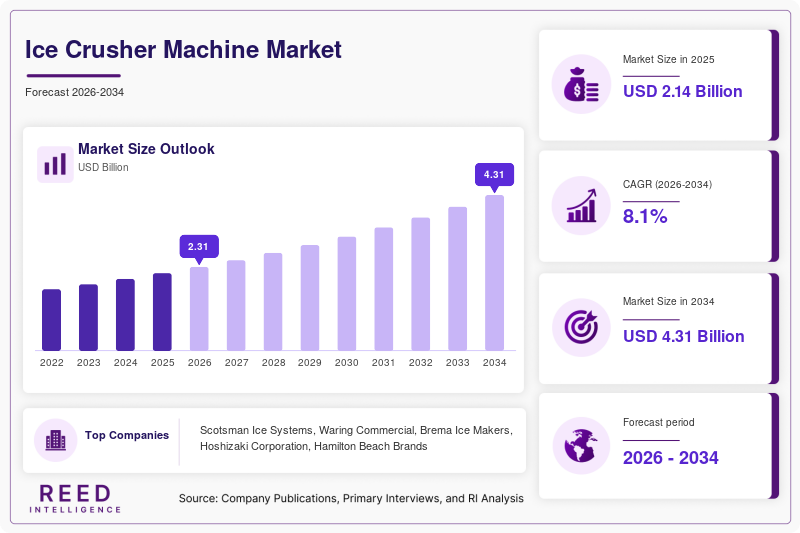
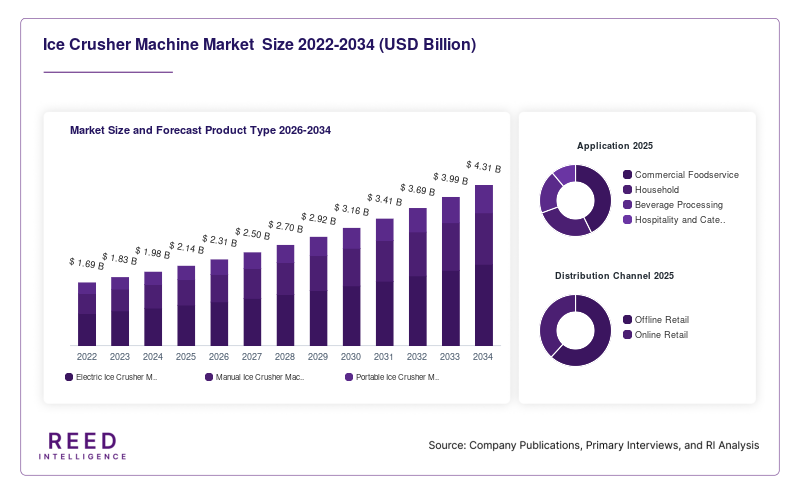
The global Ice Crusher Machine Market size was valued at USD 2.14 billion in 2026 and is projected to reach USD 3.98 billion by 2034, expanding at a CAGR of 8.1% during the forecast period from 2026 to 2034. The market continues to experience stable growth due to increasing demand from foodservice establishments, hospitality chains, quick-service restaurants, beverage processing facilities, and residential consumers seeking convenient kitchen appliances. Rising consumption of cold beverages, frozen cocktails, smoothies, and iced desserts across urban economies has significantly supported demand for efficient ice crushing equipment across commercial and household applications.
The expansion of hospitality infrastructure worldwide has created favorable conditions for the adoption of advanced ice crusher machines. Hotels, cafes, bars, and entertainment venues are increasingly investing in compact and automated crushing systems that improve operational efficiency and reduce preparation time. In addition, technological developments in stainless steel blade systems, noise reduction mechanisms, and energy-efficient motors are improving product performance and extending equipment lifespan. Manufacturers are also introducing multifunctional devices capable of crushing different ice textures for varied beverage applications, which is attracting broader end-user adoption.
Key Highlights
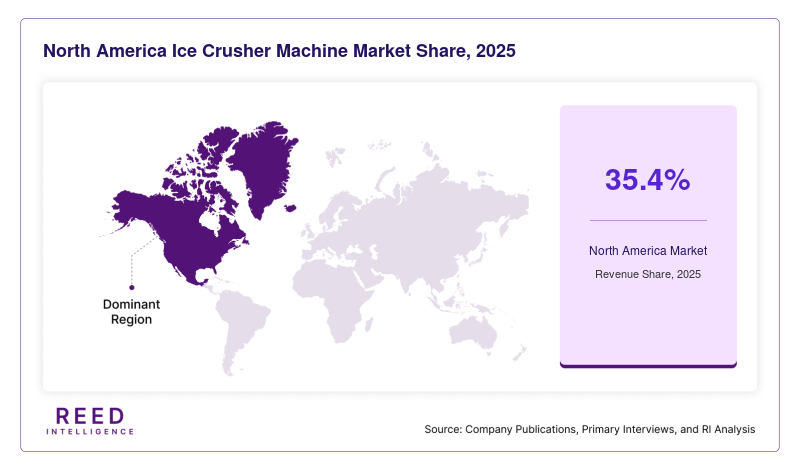
- North America dominated the market with a 35.4% share in 2025.
- Asia Pacific is expected to grow at the fastest CAGR of 9.6% during 2026–2034.
- By product type, electric ice crusher machines accounted for the largest share of 61.8%, while portable ice crusher machines are projected to grow at a CAGR of 10.1%.
- By application, commercial foodservice operations led with a 47.2% share, whereas household applications are expected to expand at a CAGR of 9.3%.
- The United States remained the dominant country, with market values of USD 486 million in 2024 and USD 528 million in 2025.
Market Trends
Smart and Automated Ice Crushing Equipment Gaining Industry Attention
The integration of automation and intelligent operating systems is emerging as a major trend in the Ice Crusher Machine Market. Manufacturers are increasingly introducing programmable crushing machines equipped with adjustable ice texture settings, automatic shutoff features, digital displays, and enhanced safety controls. Commercial foodservice operators prefer automated systems because they reduce labor dependency and improve consistency in beverage preparation. Smart appliances are also becoming popular among residential consumers seeking convenience and multifunctionality within compact kitchen spaces. As modern cafes and quick-service restaurants continue to prioritize operational speed and standardized output, demand for technologically advanced ice crushing systems is expected to increase steadily throughout the forecast period.
The adoption of connected kitchen appliances is also influencing product innovation. Several manufacturers are developing machines with energy-efficient motors and low-noise operation to align with sustainability and user comfort expectations. Compact countertop units with touch-control interfaces are becoming increasingly common in urban households and premium hospitality settings. The growing penetration of smart kitchens across developed countries is likely to encourage long-term investment in automated crushing technologies, supporting revenue growth across both commercial and residential sectors.
Expansion of Frozen Beverage Consumption Supporting Product Demand
The increasing global popularity of frozen beverages, smoothies, iced coffee products, cocktails, and flavored crushed ice drinks is significantly influencing market trends. Beverage retailers are expanding their cold drink menus to attract younger consumers, especially in urban and tourist-centric regions. This shift is increasing the need for reliable ice preparation equipment capable of producing fine and consistent crushed ice textures. Restaurants, bars, cafes, and convenience stores are therefore increasing procurement of commercial-grade ice crusher machines to improve customer service efficiency and beverage quality.
Consumer lifestyle changes are also contributing to this trend. Rising temperatures in many regions and growing preference for refreshing beverages during extended summer seasons have accelerated demand for ice-based drinks. Social media-driven food presentation trends have further encouraged cafes and beverage chains to invest in machines capable of producing visually appealing crushed ice products. Manufacturers are responding by offering versatile equipment designed for multiple beverage and dessert applications, which is strengthening product adoption across emerging and established markets alike.
Market Drivers
Growth of Hospitality and Foodservice Infrastructure Supporting Equipment Adoption
The rapid expansion of the global hospitality and foodservice industry is a major factor driving the Ice Crusher Machine Market. Hotels, resorts, restaurants, bars, and catering services require efficient ice preparation equipment to support large-scale beverage operations. Increasing international tourism and rising consumer spending on dining experiences are encouraging foodservice operators to modernize kitchen equipment and improve service efficiency. Ice crusher machines are becoming essential in commercial kitchens because they help reduce manual preparation time while maintaining consistent beverage quality.
Quick-service restaurant chains and beverage outlets are also contributing to market expansion. Many companies are introducing frozen beverages and specialty drinks that require finely crushed ice for preparation and presentation. Commercial operators prefer automated and durable machines capable of handling continuous operations during peak demand periods. Additionally, the growth of cloud kitchens and takeaway beverage services has increased investment in compact and energy-efficient equipment, supporting sustained market demand across urban commercial centers.
Rising Residential Appliance Adoption Expanding Consumer Base
The increasing adoption of modern kitchen appliances among residential consumers is another important growth driver for the market. Urban households are increasingly investing in convenience-oriented appliances that simplify food and beverage preparation. Ice crusher machines are gaining popularity among consumers who regularly prepare smoothies, iced beverages, desserts, and frozen cocktails at home. Rising disposable income and changing lifestyle preferences are encouraging households to purchase multifunctional kitchen devices with enhanced usability and compact designs.
E-commerce platforms are playing a major role in expanding product accessibility. Online retail channels provide consumers with access to a wide range of affordable and premium ice crusher models, allowing manufacturers to penetrate untapped markets more effectively. Product innovations such as lightweight portable units, low-noise operation, and easy-clean mechanisms are further attracting residential buyers. The growing trend of home entertainment and personalized beverage preparation is expected to continue supporting demand for household ice crusher machines over the forecast period.
Market Restraint
High Maintenance and Operational Challenges Limiting Market Penetration
Maintenance-related concerns and operational limitations remain significant restraints for the Ice Crusher Machine Market. Commercial-grade machines often require regular servicing to maintain blade sharpness, motor efficiency, and hygiene standards. Frequent exposure to moisture and continuous crushing operations can lead to mechanical wear, corrosion, and increased maintenance expenses, particularly in high-volume hospitality environments. Small foodservice businesses with limited budgets may hesitate to invest in premium equipment due to concerns regarding repair costs and long-term operational expenditure.
Noise generation and energy consumption also affect purchasing decisions in residential and commercial settings. Some traditional machines produce excessive vibration and operational noise, limiting their suitability for compact kitchens, cafes, and indoor hospitality spaces. In addition, low-cost products available in developing markets often face durability issues that reduce consumer confidence and increase replacement frequency. The presence of manual alternatives and multifunctional food processors capable of crushing ice also creates competition for dedicated ice crusher machines. These factors collectively slow product adoption in price-sensitive markets and create challenges for manufacturers seeking to maintain consistent profit margins.
Market Opportunities
Expansion of Emerging Food Retail Chains Creating New Revenue Potential
The rapid expansion of organized food retail and beverage chains across emerging economies presents strong growth opportunities for the Ice Crusher Machine Market. Developing countries are witnessing increasing investment in cafes, juice bars, dessert outlets, and fast-food franchises due to urbanization and changing consumer lifestyles. These businesses require efficient ice preparation systems to support growing demand for frozen beverages and cold desserts. As international food brands continue expanding into emerging regions, demand for commercial-grade ice crusher equipment is expected to rise considerably.
Manufacturers are increasingly targeting these markets by offering affordable yet durable equipment tailored to small and medium-sized businesses. Portable and energy-efficient machines are becoming particularly attractive for newly established beverage outlets operating within limited spaces. Furthermore, government initiatives supporting tourism and hospitality infrastructure development in several Asian and Middle Eastern countries are expected to create additional opportunities for equipment suppliers during the forecast period.
Product Innovation and Sustainable Design Supporting Future Market Expansion
The growing emphasis on energy efficiency and sustainable appliance manufacturing is opening new opportunities for market participants. Consumers and commercial operators are increasingly prioritizing environmentally responsible equipment that reduces electricity consumption and operational costs. Manufacturers are therefore investing in advanced motor technologies, recyclable materials, and improved insulation systems to create energy-efficient ice crusher machines suitable for long-term commercial usage.
There is also increasing demand for multifunctional appliances capable of performing several kitchen operations within a single unit. Companies introducing hybrid machines that combine ice crushing, blending, and beverage preparation functionalities are likely to gain competitive advantages in the market. Smart connectivity features and app-controlled operations may further attract technology-oriented consumers. These innovations are expected to expand application areas and improve product differentiation, enabling manufacturers to strengthen their market presence across both mature and developing economies.
Segmental Analysis
By Product Type
Electric ice crusher machines dominated the Ice Crusher Machine Market and accounted for approximately 61.8% of total revenue in 2024. Their strong market position is primarily linked to high operational efficiency, consistent crushing performance, and suitability for continuous commercial use. Restaurants, bars, hotels, and beverage chains prefer electric systems because they reduce manual effort and improve preparation speed during peak operating hours. These machines are widely used for producing different ice textures required for cocktails, smoothies, frozen desserts, and specialty beverages. Manufacturers are also introducing energy-efficient motors and stainless-steel blade systems that improve durability and operational reliability. Commercial foodservice establishments continue replacing traditional manual equipment with automated solutions to enhance productivity and maintain consistent beverage quality standards across multiple service locations.
Portable ice crusher machines are projected to record the fastest CAGR of 10.1% during the forecast period. Growth within this category is supported by rising demand for compact and lightweight appliances suitable for residential kitchens, outdoor catering services, and mobile beverage businesses. Consumers increasingly prefer portable units because they occupy less space and offer greater operational flexibility. Product manufacturers are focusing on battery-powered and low-noise designs to attract consumers seeking convenience-oriented kitchen appliances. The growing trend of outdoor recreational activities, home parties, and personalized beverage preparation is further supporting demand for portable devices. In addition, online retail channels are improving accessibility to affordable portable products, enabling manufacturers to expand their consumer reach across developing economies and urban households.
By Application
Commercial foodservice applications accounted for the largest share of the Ice Crusher Machine Market in 2024, representing nearly 47.2% of total revenue. The segment benefits from strong demand across hotels, restaurants, cafes, bars, and catering operations that require efficient ice preparation systems for large-scale beverage production. Increasing global tourism and rising consumer expenditure on dining experiences continue to support investments in modern kitchen appliances. Commercial operators prefer high-capacity machines capable of continuous operation and precise ice texture control to improve service efficiency. Beverage chains offering smoothies, iced coffee products, and frozen cocktails are significantly contributing to segment expansion. Manufacturers are introducing durable commercial systems with automated cleaning and enhanced safety features to meet the operational requirements of high-volume hospitality environments.
Household applications are anticipated to witness the fastest growth, registering a CAGR of 9.3% from 2026 to 2034. Rising urbanization and increasing adoption of smart kitchen appliances are major factors supporting segment expansion. Consumers are increasingly purchasing ice crusher machines for preparing homemade smoothies, cold beverages, desserts, and frozen cocktails. Compact appliance designs, affordable pricing, and user-friendly operation are encouraging product adoption among younger consumers and small households. The growing influence of social media food trends and home entertainment culture is also strengthening demand for residential ice crushing equipment. Manufacturers are focusing on multifunctional appliances with blending and crushing capabilities to increase product value and attract a broader customer base within the residential appliance market.
By Distribution Channel
Offline distribution channels held the dominant share of the Ice Crusher Machine Market in 2024, accounting for approximately 58.6% of total revenue. Specialty appliance stores, commercial kitchen equipment suppliers, supermarkets, and wholesale distributors continue to play an important role in product sales. Many commercial buyers prefer offline purchasing because it allows direct product inspection, equipment demonstrations, and access to after-sales service support. Hospitality operators often require customized machine specifications and installation assistance, which strengthens the importance of physical distribution networks. Retail stores also provide consumers with opportunities to compare product quality, durability, and operational features before purchasing. Strong relationships between commercial buyers and regional equipment distributors continue to support the dominance of offline sales channels across mature and developing markets.
Online distribution channels are projected to register the fastest CAGR of 10.4% during the forecast period due to the rapid expansion of e-commerce platforms and digital retail infrastructure. Consumers increasingly prefer online purchasing because of wider product availability, competitive pricing, and convenient delivery services. Manufacturers are strengthening direct-to-consumer sales strategies through company websites and online marketplaces to improve brand visibility and customer engagement. The availability of customer reviews, promotional discounts, and detailed product comparisons is also influencing consumer purchasing behavior. Growing internet penetration across emerging economies is expected to further accelerate online sales of residential and portable ice crusher machines. Digital marketing campaigns and social media promotions are additionally helping manufacturers reach younger consumer demographics more effectively.
Regional Analysis
North America
North America accounted for the largest share of the Ice Crusher Machine Market in 2025, representing approximately 35.4% of global revenue. The regional market is projected to expand at a CAGR of 7.4% during the forecast period due to strong demand from hospitality establishments, restaurants, and beverage chains. Commercial foodservice operators across the United States and Canada continue investing in high-capacity and automated equipment to improve operational productivity. The widespread popularity of frozen cocktails, iced coffee beverages, and specialty cold drinks is supporting sustained equipment demand across urban foodservice outlets.
The United States remains the dominant country within the region due to its extensive restaurant industry and high household appliance adoption rate. One unique growth factor supporting the market is the rapid expansion of premium beverage franchises offering customized frozen drinks and crushed ice-based menu items. Consumers increasingly prefer convenience-oriented kitchen appliances, encouraging manufacturers to introduce compact countertop machines designed for residential usage. Continuous innovation in smart kitchen technologies is expected to further strengthen regional market growth.
Europe
Europe represents a mature yet steadily expanding market for ice crusher machines, supported by growing beverage consumption and hospitality modernization. The region accounted for nearly 24.8% of global market revenue in 2025 and is anticipated to register a CAGR of 6.9% through 2034. Commercial kitchens across hotels, bars, and cafes are increasingly replacing conventional equipment with automated crushing systems to improve efficiency and maintain hygiene standards. Rising tourism activities across Southern and Western Europe are also contributing to equipment demand within the hospitality sector.
Germany remains the leading market within Europe due to its advanced food processing infrastructure and strong appliance manufacturing industry. A unique growth factor driving the German market is the increasing popularity of specialty cafes and premium beverage outlets offering crushed ice-based drinks. Sustainability regulations encouraging energy-efficient commercial appliances are also influencing purchasing decisions across the region. Manufacturers focusing on low-noise and environmentally efficient products are likely to benefit from favorable market conditions in Europe.
Asia Pacific
Asia Pacific is projected to record the fastest growth in the Ice Crusher Machine Market, with a forecast CAGR of 9.6% during 2026–2034. The region accounted for approximately 22.3% of market revenue in 2025 and continues to benefit from rapid urbanization, rising disposable income, and expanding foodservice industries. Increasing demand for cold beverages in densely populated countries such as China, India, and Japan is creating favorable conditions for product adoption. The growth of organized retail and international restaurant chains is further accelerating market expansion.
China remains the dominant country in the region due to its large manufacturing base and expanding hospitality sector. One distinctive growth factor is the increasing popularity of bubble tea, frozen desserts, and iced beverages among younger consumers. This trend has encouraged cafes and beverage chains to invest in efficient ice preparation equipment capable of handling high customer volumes. E-commerce growth across the region is also improving product accessibility for residential consumers, supporting long-term demand for household appliances.
Middle East & Africa
The Middle East & Africa market is experiencing stable growth driven by expanding tourism infrastructure and rising demand for premium hospitality services. The region accounted for nearly 9.1% of global market revenue in 2025 and is expected to grow at a CAGR of 7.8% over the forecast period. Hot climatic conditions across many Middle Eastern countries contribute significantly to the consumption of cold beverages and frozen desserts, increasing demand for commercial ice crusher machines. Hotels, resorts, and entertainment venues continue investing in advanced kitchen equipment to improve customer experiences.
The United Arab Emirates remains the leading market within the region due to its strong tourism industry and concentration of luxury hospitality establishments. A unique factor driving regional growth is the rapid development of large-scale entertainment destinations and international foodservice franchises. These businesses require efficient beverage preparation systems capable of supporting high visitor volumes. Growing urbanization and the expansion of shopping malls and cafes across African economies are also expected to support future market growth.
Latin America
Latin America continues to present moderate growth opportunities for the Ice Crusher Machine Market due to increasing urban consumption patterns and expansion of foodservice operations. The region accounted for approximately 8.4% of global revenue in 2025 and is projected to expand at a CAGR of 7.1% through 2034. Rising popularity of cold beverages, tropical frozen drinks, and iced desserts is encouraging cafes and restaurants to adopt advanced crushing equipment. Commercial operators are increasingly investing in compact and energy-efficient systems suitable for medium-scale operations.
Brazil dominates the regional market because of its extensive beverage culture and expanding hospitality industry. One important growth factor supporting the Brazilian market is the strong consumer demand for fruit-based frozen beverages and street food drinks requiring crushed ice preparation. Seasonal tourism activities and growing investments in restaurant infrastructure are also contributing to market expansion. Manufacturers offering durable and affordable products adapted to regional business requirements are expected to gain stronger market penetration across Latin America.
Competitive Landscape
The Ice Crusher Machine Market is characterized by the presence of established appliance manufacturers and regional commercial kitchen equipment suppliers competing through product innovation, pricing strategies, and distribution expansion. Companies are focusing on energy-efficient motors, compact designs, durable blade technologies, and multifunctional capabilities to strengthen market competitiveness. Strategic partnerships with hospitality chains and e-commerce platforms are also becoming increasingly important for market penetration.
Scotsman Ice Systems remains one of the leading participants in the market due to its extensive commercial product portfolio and strong presence across hospitality applications. The company continues investing in advanced ice preparation technologies and automated operating systems to improve equipment efficiency. Recent developments within the industry include the launch of low-noise crushing machines designed for premium cafes and compact urban kitchens. Other manufacturers are also expanding production capabilities and introducing portable appliance variants to address increasing residential demand. Competitive intensity is expected to rise further as companies focus on sustainability, smart connectivity features, and customized commercial equipment solutions.
Key Players
- Scotsman Ice Systems
- Waring Commercial
- Brema Ice Makers
- Santos
- Fujimarca
- Manitowoc Ice
- Hamilton Beach Brands
- Ceado
- VEVOR
- Hoshizaki Corporation
- KitchenAid
- Sirman
- Swan Products
- Zeny Products
- Costzon
Recent Developments
- In March 2026, Scotsman Ice Systems launched a compact low-noise ice crusher machine designed for premium cafes and small commercial kitchens.
- In October 2025, Hoshizaki Corporation introduced an energy-efficient commercial ice crushing system with automated safety controls for high-volume beverage operations.
- In December 2025, Hamilton Beach Brands expanded its residential appliance portfolio with a multifunctional blender and ice crusher combination unit for urban households.
- In January 2026, Electrolux Professional upgraded its commercial foodservice equipment range with stainless-steel ice crusher machines focused on durability and faster ice processing.
- In August 2025, Manitowoc Ice strengthened its distribution partnership network across Asia Pacific to improve product availability for hospitality and restaurant operators.
Ice Crusher Machine Market Segments
Product Type
- Electric Ice Crusher Machines
- Manual Ice Crusher Machines
- Portable Ice Crusher Machines
Application
- Commercial Foodservice
- Household
- Beverage Processing
- Hospitality and Catering
Distribution Channel
- Offline Retail
- Online Retail
By Region
- North America
- Europe
- APAC
- Middle East and Africa
- LATAM