Ice Maker Market Size, Share & Trends Analysis Report By Type (Self-Contained Ice Makers, Modular Ice Makers, Undercounter Ice Makers, Portable Ice Makers), By Ice Type (Cube Ice, Nugget Ice, Flake Ice, Others), By Application (Foodservice, Hospitality, Retail, Healthcare, Industrial) and By Region (North America, Europe, Asia Pacific, Latin America, Middle East & Africa) Forecasts, 2026–2034
USD 3950
Ice Maker Market Size
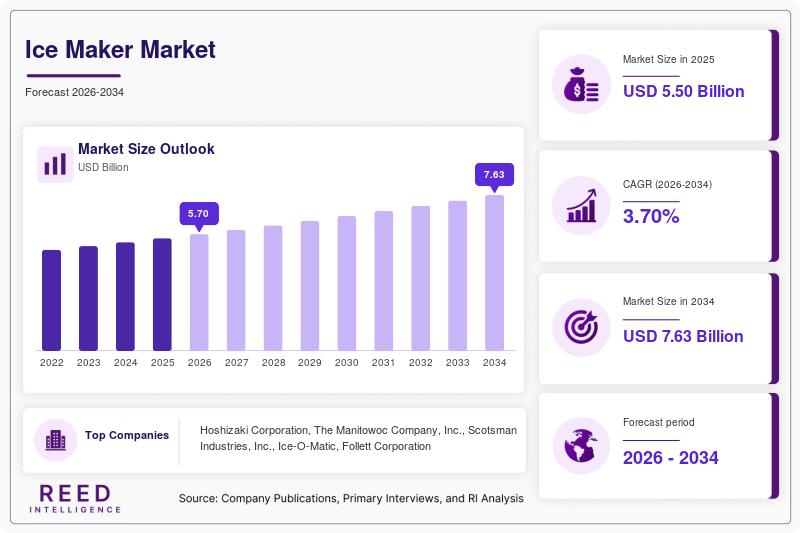
The global ice maker market was valued at USD 5.50 billion in 2025 and is projected to grow from USD 5.50 billion in 2026 to USD 7.63 billion by 2034, registering a CAGR of 3.70% during the forecast period from 2026 to 2034.
Ice makers are dedicated refrigeration appliances that freeze water and harvest ice in controlled shapes and quantities. Commercial systems are used across foodservice, hospitality, retail, healthcare, and industrial environments. The equipment can be configured as self-contained units, ice-making heads paired with storage bins, remote-condensing systems, undercounter machines, or specialized dispensing systems.
Ice format is a major product differentiator. Cube ice is commonly associated with beverages, while continuous systems produce flake or nugget ice for applications requiring rapid cooling, food display, or chewable ice. ENERGY STAR identifies flake ice as particularly relevant to food displays such as seafood and salad bars, while nugget ice is primarily used in beverage applications.
Ice Maker Market Drivers
Expansion of Foodservice and Hospitality Infrastructure
Restaurants, hotels, bars, catering operations, cafés, and other foodservice businesses require consistent ice availability for beverages, food preparation, presentation, storage, and customer service. ENERGY STAR specifically identifies restaurants, bars, hotels, hospitals, and commercial and industrial facilities as major environments for automatic commercial ice makers.
This creates a replacement as well as new-installation demand cycle. Businesses upgrading kitchens or increasing beverage-service capacity often require higher-output equipment, while established operators replace older machines to improve reliability, sanitation, energy performance, or operating economics.
Demand for Specialized Ice Formats
The market is moving beyond standardized cube production toward application-specific ice formats. Cube ice provides relatively slow melting characteristics for beverages, flake ice conforms to food products during display and cooling, and nugget ice is increasingly associated with beverage-service applications.
This differentiation allows manufacturers to address separate purchasing requirements within foodservice, retail, healthcare, and industrial environments. Operators can select machines according to the required ice hardness, shape, production volume, storage configuration, and intended application rather than treating ice production as a uniform equipment category.
Energy, Water and Refrigerant Efficiency
Resource consumption is becoming an increasingly visible component of commercial-equipment purchasing. ENERGY STAR certification establishes performance thresholds for energy and potable-water use, with requirements varying according to harvest rate and machine configuration.
Manufacturers are consequently integrating improved refrigeration systems, controls, insulation, natural refrigerants, and maintenance-oriented designs. Hoshizaki's upgraded cube machines incorporate natural refrigerants and front-access filter structures, while its product development also includes Wi-Fi connectivity through Hoshizaki Connect.
Ice Maker Market Restraints
Capital and Installation Requirements
Commercial ice makers require higher initial investment than basic household ice-producing appliances, particularly for modular and high-capacity systems. Installation may also require water connections, drainage, electrical infrastructure, ventilation, storage bins, and sufficient floor or counter space.
These requirements can constrain adoption among smaller restaurants, seasonal businesses, mobile operators, and facilities with limited infrastructure. Equipment selection therefore involves balancing production capacity with installation requirements, available space, utility costs, and expected utilization.
Maintenance, Sanitation and Utility Consumption
Ice-making equipment operates in environments where water quality, temperature, filtration, cleaning, and sanitation affect performance. Mineral accumulation can affect water circuits and ice quality, while refrigeration-system maintenance influences production consistency and energy consumption.
The resource requirement is also material. ENERGY STAR establishes potable-water-use limits alongside energy-consumption requirements, demonstrating that efficiency involves both electricity and water rather than energy alone.
Ice Maker Market Opportunities
Low-GWP Refrigerants and Efficient Equipment
Refrigerant transition provides manufacturers with an opportunity to redesign ice makers around lower environmental impact while simultaneously improving product efficiency. ENERGY STAR identifies R-290, R-450A, and R-513A among lower-GWP refrigerants applicable to commercial ice makers.
Hoshizaki's conversion program provides a concrete example. In November 2025, the company announced the conversion of 66 models across four product lines to natural refrigerants, including cubelet and flake ice makers. The company reported GWP reductions of more than 99% for the converted products.
Installation-Flexible and Portable Ice Production
Reducing installation barriers creates an opportunity to expand ice-making applications beyond conventional restaurant kitchens. In May 2026, Hoshizaki announced a cube ice maker compatible with separate water-tank and forced-drain units, eliminating the need for conventional water-supply and drainage installation. The initial lineup included six models with daily production capacities from 25 kg to 45 kg.
The configuration targets events, construction sites, sports tournaments, offices, factories, schools, and other environments where permanent plumbing is difficult. This expands the potential application base for commercial ice makers while creating demand for compact equipment that can be deployed seasonally or temporarily.
Ice Maker Market Segmental Analysis
By Type
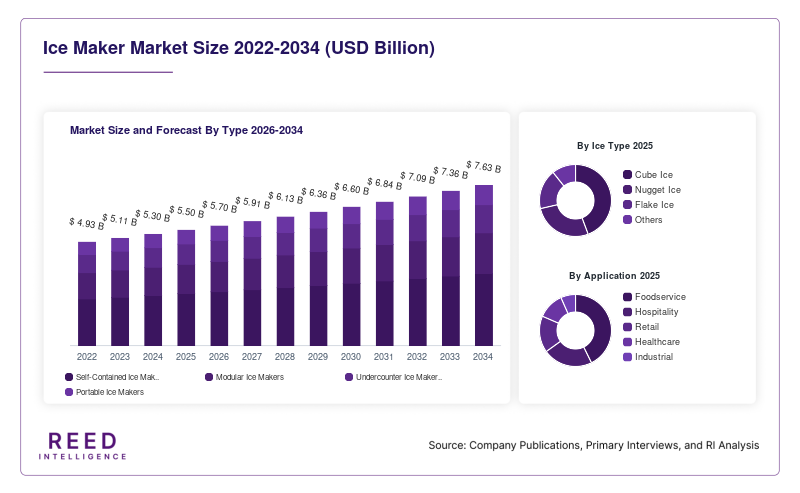
Self-Contained Ice Makers represented the dominant type with approximately 42% share. These systems integrate the ice-making mechanism and storage capacity into a single unit and are widely suited to restaurants, bars, cafés, convenience stores, and other locations where installation simplicity and moderate production capacity are important. ENERGY STAR recognizes self-contained units as one of the principal commercial ice-maker configurations.
Portable Ice Makers are projected to be the fastest-growing type at approximately 6.8% CAGR through 2034. Their relatively small footprint and lower installation requirements make them applicable to homes, offices, events, temporary facilities, recreational environments, and small commercial operations.
Modular Ice Makers accounted for approximately 31% share and are projected to grow at approximately 3.8% CAGR. Their ability to combine an ice-making head with separate storage capacity makes them suitable for high-volume commercial operations.
Undercounter Ice Makers represented approximately 17% share and are projected to grow at approximately 3.5% CAGR, supported by restaurants, bars, hospitality establishments, and compact commercial kitchens.
By Ice Type
Cube Ice accounted for approximately 48% share, making it the dominant ice format. Cube ice is widely used for beverages because of its relatively slow melting characteristics and compatibility with glasses, dispensers, and beverage-service operations. Hoshizaki describes cube ice as a core product category across multiple commercial configurations.
Nugget Ice is projected to be the fastest-growing format at approximately 5.1% CAGR. Its soft and chewable characteristics support applications in beverage service and consumer-facing foodservice environments. ENERGY STAR identifies nugget ice as a continuous-type ice format primarily associated with beverages.
Flake Ice represented approximately 20% share and is projected to grow at approximately 4.2% CAGR. Its irregular structure and ability to surround products make it suitable for seafood, produce, food displays, and cooling applications.
Other ice formats accounted for approximately 10% share and are projected to grow at approximately 3.1% CAGR, supported by specialized applications and regional preferences.
By Application
Foodservice represented the dominant application with approximately 34% share. Restaurants, cafés, bars, catering operations, and commercial kitchens require ice for beverages, preparation, presentation, and cooling.
Hospitality accounted for approximately 24% share and is projected to grow at approximately 4.1% CAGR. Hotels and resorts require ice throughout food-and-beverage operations, guest services, events, and food-storage processes.
Retail represented approximately 20% share and is projected to grow at approximately 4.3% CAGR. Supermarkets and convenience stores use ice for beverage operations, food displays, seafood presentation, and customer-facing applications.
Healthcare accounted for approximately 12% share and is projected to grow at approximately 3.6% CAGR. Healthcare facilities place additional emphasis on sanitation, reliability, controlled production, and equipment maintenance.
Industrial applications represented approximately 10% share and are projected to grow at approximately 3.0% CAGR, covering specialized cooling, processing, storage, and production requirements.
Ice Maker Market Regional Analysis
North America
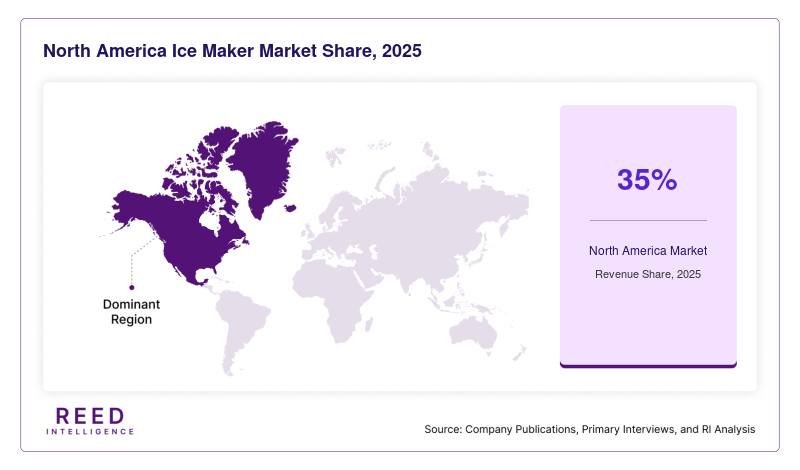
North America was the dominant regional market, accounting for approximately 35% share. The region benefits from extensive foodservice infrastructure, established commercial refrigeration channels, replacement demand, and widespread use of automated ice-making equipment.
The region is projected to grow at approximately 3.3% CAGR through 2034. U.S. DOE regulates automatic commercial ice makers through federal energy-conservation standards, while its current regulatory material includes proceedings concerning water-use standards.
Energy efficiency remains an important purchasing consideration. ENERGY STAR estimates that certified batch-type machines can save approximately 700 kWh annually, while certified continuous-type models can save approximately 1,350 kWh annually compared with standard equipment.
Europe
Europe represented approximately 27% share and is projected to expand at approximately 3.1% CAGR. Hospitality, restaurants, food retail, healthcare, and commercial beverage operations provide the principal application base.
Equipment manufacturers are increasingly emphasizing lower-GWP refrigerants and energy-efficient operation. These product characteristics are becoming relevant as commercial operators evaluate lifecycle operating costs alongside acquisition price.
Asia Pacific
Asia Pacific accounted for approximately 23% share and is projected to be the fastest-growing region at approximately 4.8% CAGR. Foodservice modernization, urbanization, convenience retail, hospitality development, and expansion of commercial kitchens support equipment demand.
Product manufacturers are also developing equipment suited to regional installation conditions. Hoshizaki's product portfolio emphasizes region-specific models and localized support across foodservice, retail, hospitality, and healthcare applications.
Latin America
Latin America represented approximately 8% share and is projected to grow at approximately 3.7% CAGR. Demand is linked to restaurants, hotels, beverage operations, supermarkets, and food-processing activities.
The regional market remains sensitive to equipment affordability, energy prices, service availability, import conditions, and access to replacement components. Compact equipment and systems with lower operating costs can address smaller commercial installations.
Middle East & Africa
Middle East & Africa accounted for approximately 7% share and is projected to expand at approximately 3.6% CAGR. Hotels, tourism infrastructure, restaurants, food retail, and beverage service represent important demand channels.
High ambient temperatures make refrigeration performance and equipment reliability particularly important. Manufacturers also need to account for water availability, electrical infrastructure, maintenance capabilities, and the operating conditions of individual markets.
Ice Maker Market Competitive Landscape
The ice maker market includes global foodservice-equipment manufacturers and specialized ice-machine producers competing through ice quality, production capacity, energy efficiency, water consumption, refrigerant technology, footprint, durability, maintenance requirements, and distribution networks.
Hoshizaki Corporation maintains a broad global ice-maker portfolio covering cube, flake, cubelet, and dispensing technologies. The company identifies ice makers as a core business and provides models across foodservice, retail, hospitality, and healthcare applications. Its product-development strategy increasingly combines efficiency, durability, localized specifications, natural refrigerants, and connected functionality.
Key Market Players
- Hoshizaki Corporation
- The Manitowoc Company, Inc.
- Scotsman Industries, Inc.
- Ice-O-Matic
- Follett Corporation
- Cornelius, Inc.
- Brema Group
- ITV Ice Makers
- MaxxIce
- Koller Refrigeration Equipment
- Snowsman
- Focusun Refrigeration Corporation
Recent Market Developments
May 2026 – Hoshizaki Corporation: Hoshizaki announced a new cube ice maker compatible with separate water-supply and drainage units, allowing deployment without conventional plumbing installation. The company said sales would begin in early July 2026, with six models offering daily production capacities of 25–45 kg.
August 2026 – Scotsman: Scotsman introduced new MC_PH1 and MC_PH2 R449A modular cube ice maker launch packages, expanding its modular cube-ice portfolio. The company’s commercial product resource center also lists a series of R290 launches across modular, undercounter, flake, nugget, and ice-and-water dispenser products from 2025–2026.
Ice Maker Market Segments
By Type
- Self-Contained Ice Makers
- Modular Ice Makers
- Undercounter Ice Makers
- Portable Ice Makers
By Ice Type
- Cube Ice
- Nugget Ice
- Flake Ice
- Others
By Application
- Foodservice
- Hospitality
- Retail
- Healthcare
- Industrial
By Region
- North America
- Europe
- APAC
- Middle East and Africa
- LATAM