ID Card Printer Market Size, Share & Demand Report By Printer Type (Direct-to-Card Printers, Retransfer Printers, Inkjet ID Card Printers, Laminating Card Printers), By Application (Enterprise Identification, Government and Public Sector, Educational Institutions, Healthcare Identification, Transportation and Transit, Banking and Financial Services), By End Use (Large Enterprises, Small and Medium Enterprises, Educational Institutions, Healthcare Organizations, Government Agencies, Hospitality a
USD 3950
Market Overview
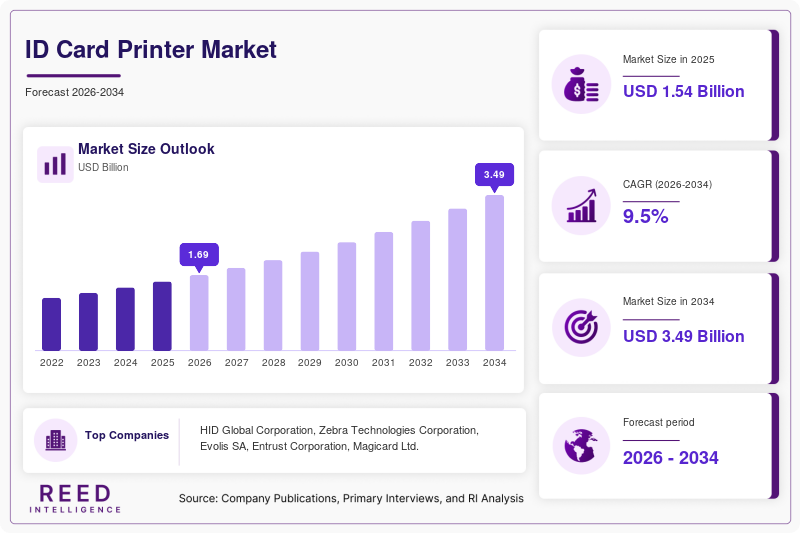
The global ID Card Printer Market size was valued at USD 1.54 billion in 2026 and is projected to reach USD 3.18 billion by 2034, expanding at a CAGR of 9.5% during the forecast period from 2026 to 2034. The market continues to witness stable expansion due to the increasing need for secure identification systems across corporate offices, educational institutions, healthcare facilities, transportation hubs, government agencies, and financial organizations. Organizations across developed and emerging economies are adopting advanced card printing solutions to improve access control, employee authentication, visitor management, and payment security. The integration of smart card technologies, RFID capabilities, and cloud-based card management systems is also accelerating product demand across multiple industries.
One of the primary global factors supporting market growth is the rising emphasis on identity security and fraud prevention. Governments and private enterprises are investing in secure identification infrastructure to minimize unauthorized access, identity theft, and data breaches. The growing use of multifunctional identification cards for attendance tracking, biometric verification, payment processing, and building access has increased the deployment of retransfer printers, direct-to-card printers, and laminating systems. In addition, organizations are increasingly upgrading from legacy card printing systems to high-resolution digital printing equipment capable of supporting mobile connectivity and remote management.
Key Highlights
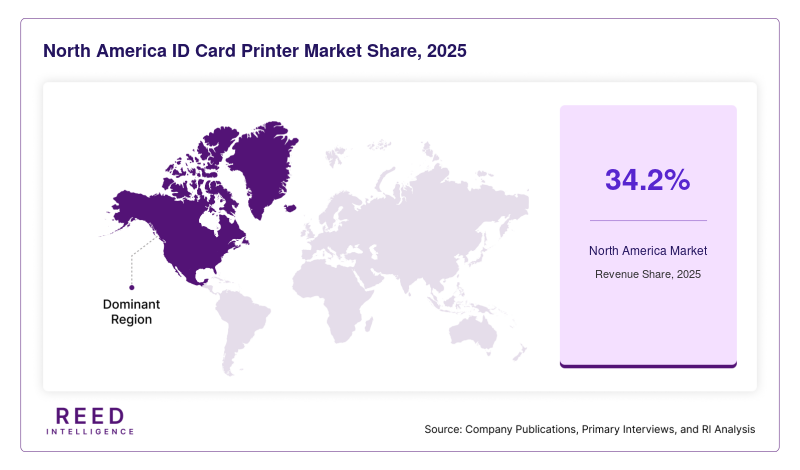
- North America dominated the market with a 34.2% share in 2025, while Asia Pacific is expected to grow at the fastest CAGR of 11.4% during 2026–2034.
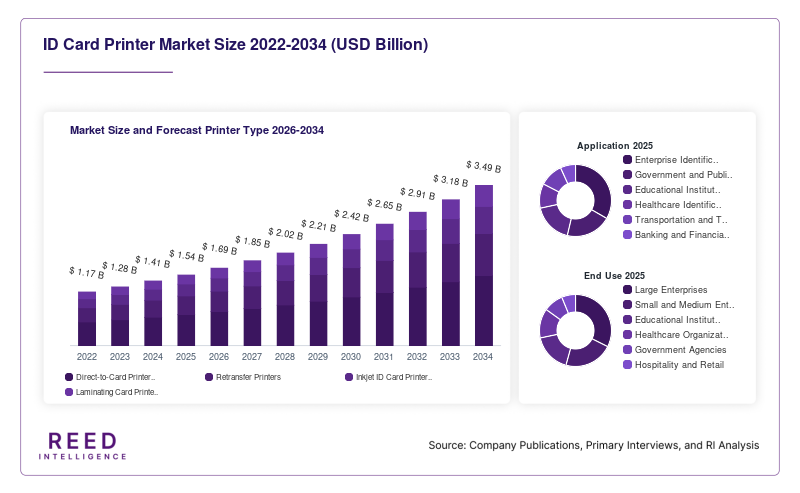
- By printer type, direct-to-card printers accounted for the largest share of 42.8%, while retransfer printers are projected to grow at a CAGR of 10.8%.
- By application, enterprise identification led with a 39.6% share, whereas government and public sector applications are expected to expand at a CAGR of 11.2%.
- By end use, large enterprises held the dominant share of 44.7%, while educational institutions are anticipated to register a CAGR of 10.9%.
- The United States remained the dominant country, with market values of USD 402 million in 2024 and USD 438 million in 2025.
Market Trends
Growing Integration of Smart Card and RFID Technologies
The ID Card Printer Market is witnessing significant momentum from the increasing adoption of smart card and RFID-enabled printing systems. Organizations are moving beyond conventional photo identification cards and integrating multifunctional capabilities such as contactless access control, attendance monitoring, digital payment support, and employee authentication. This transition is encouraging enterprises to invest in advanced printers capable of encoding RFID chips, magnetic stripes, and smart card data within a single printing cycle. Financial institutions, transportation operators, and healthcare facilities are particularly expanding the use of secure contactless cards to improve operational efficiency and user convenience. In addition, rising workplace digitization and smart office deployments are increasing demand for intelligent card personalization systems with cloud integration, automated encoding, and high-definition printing capabilities.
Rising Adoption of Sustainable and Compact Printing Solutions
Environmental sustainability and workspace optimization are becoming important purchasing considerations within the ID Card Printer Market. Manufacturers are increasingly introducing energy-efficient printers, recyclable ribbon materials, and compact desktop systems designed for low power consumption and reduced material waste. Small and medium-sized enterprises are adopting lightweight printers with modular designs that can fit into limited office environments without compromising productivity. At the same time, organizations are focusing on reducing plastic waste by implementing eco-friendly card materials and sustainable consumables. Vendors are also integrating remote monitoring software to minimize maintenance visits and operational downtime. These developments are supporting broader adoption among enterprises seeking cost-effective and environmentally responsible identification printing solutions.
Market Drivers
Increasing Demand for Secure Identity Verification Systems
The growing focus on identity verification and workplace security is a major factor driving the ID Card Printer Market. Businesses and public institutions are deploying advanced identification systems to strengthen access control, reduce unauthorized entry, and improve employee accountability. The increasing frequency of cybersecurity threats and identity fraud incidents has encouraged organizations to adopt secure ID card issuance systems integrated with biometric authentication and encrypted smart card technologies. Government offices, airports, financial institutions, and educational campuses are increasingly investing in durable and tamper-resistant identification cards to support high-security operations. In addition, companies operating across multiple facilities are implementing centralized card management systems that require high-volume and high-resolution printing infrastructure for efficient employee onboarding and credential management.
Expansion of Digital Governance and Smart Infrastructure Projects
Rapid urbanization and government-led digital transformation programs are supporting long-term growth in the ID Card Printer Market. Several countries are implementing national identification projects, smart transportation systems, and digital public service platforms that rely on secure identification cards. Municipal authorities are introducing smart cards for transportation ticketing, citizen services, healthcare access, and welfare distribution. These initiatives are increasing the requirement for industrial-grade ID card printers capable of large-scale production and secure data encoding. The rise of smart campuses and digitally connected workplaces is also encouraging enterprises to modernize identification infrastructure. Furthermore, the expansion of banking and fintech services in emerging economies is increasing the deployment of payment-enabled identification cards, creating additional demand for advanced printing technologies.
Market Restraint
High Initial Investment and Ongoing Maintenance Costs
The high upfront cost associated with advanced ID card printing systems remains a significant restraint for market expansion, particularly among small organizations and budget-sensitive institutions. Industrial-grade retransfer printers, laminating systems, and smart card encoding equipment often require substantial capital investment, which can limit adoption among educational institutes, local government offices, and small enterprises. In addition to hardware costs, organizations must also manage expenses related to specialized printing ribbons, maintenance contracts, software licensing, and security upgrades. Frequent replacement of consumables and periodic calibration requirements can increase operational expenditures over time. Smaller businesses often continue using outsourced card printing services instead of investing in dedicated infrastructure due to these financial challenges.
Market Opportunities
Rising Demand from Educational Institutions and Universities
Educational institutions are creating substantial growth opportunities for the ID Card Printer Market as schools, colleges, and universities increasingly adopt digital campus management systems. Modern educational campuses are using multifunctional student identification cards for attendance tracking, library access, cafeteria payments, hostel management, and transportation services. This growing dependency on integrated identification systems is encouraging institutions to invest in in-house card printing infrastructure capable of rapid personalization and secure credential management. Universities with large student populations are particularly adopting centralized ID issuance systems that can support high-volume printing and instant replacement services. In addition, the expansion of online enrollment systems and smart classroom technologies is driving the need for digitally connected identification platforms.
Expansion of Healthcare Identification and Patient Management Systems
Healthcare organizations are increasingly adopting advanced identification systems to improve patient safety, workforce management, and regulatory compliance, creating strong opportunities for the ID Card Printer Market. Hospitals and clinics are deploying secure identification cards for medical staff, patients, contractors, and visitors to improve operational control and minimize identity-related errors. The growing use of digital health records and connected healthcare infrastructure has increased the need for accurate patient identification systems integrated with barcodes, RFID technology, and biometric verification features. Healthcare facilities are also investing in durable and hygienic card printing materials capable of withstanding frequent handling and sanitation processes.
Segmental Analysis
By Printer Type
Direct-to-card printers represented the dominant subsegment within the ID Card Printer Market, accounting for 42.8% of the global share in 2024. These printers remain widely preferred across corporate offices, educational institutions, retail organizations, and healthcare facilities because of their cost efficiency and ease of operation. Direct-to-card printers provide fast printing speeds and are suitable for medium-volume identification card production, making them ideal for organizations with recurring employee or student credential requirements. Manufacturers are continuously enhancing print resolution, wireless connectivity, and ribbon efficiency to improve overall user experience. The increasing need for instant issuance of employee access cards and visitor identification badges continues to strengthen demand for this printer category across developed and emerging economies.
By Application
Enterprise identification applications held the largest share of the ID Card Printer Market in 2024, accounting for 39.6% of total revenue. Businesses across industries are deploying employee identification systems to improve workplace security, access management, and attendance monitoring. The increasing adoption of hybrid work environments and digitally connected office infrastructure is driving demand for multifunctional identification cards capable of supporting secure building access, cashless payments, and workforce authentication. Enterprises are also adopting centralized card issuance systems to streamline onboarding and improve administrative efficiency. The demand for durable and customizable employee credentials has encouraged organizations to upgrade from outsourced printing services to in-house printing infrastructure equipped with advanced security and encoding features.
By End Use
Large enterprises accounted for the dominant share of 44.7% in the ID Card Printer Market during 2024. Multinational corporations and large institutional organizations continue to invest heavily in advanced identification systems to support workforce management, physical security, and operational transparency. These enterprises often require centralized printing infrastructure capable of producing thousands of secure identification cards across multiple office locations. The growing integration of biometric authentication, cloud-based credential management, and encrypted smart card technologies has further increased demand for high-performance printers. Large enterprises are also prioritizing durable card materials and automated issuance systems to reduce administrative workload and improve long-term operational efficiency. This trend remains particularly strong across finance, healthcare, information technology, and manufacturing sectors.
Regional Analysis
North America
North America accounted for 34.2% of the global ID Card Printer Market share in 2025 and is expected to maintain a stable growth trajectory with a forecast CAGR of 8.7% during 2026–2034. The region benefits from widespread adoption of secure access management systems across corporate enterprises, educational campuses, financial institutions, and government agencies. Organizations in the United States and Canada continue to upgrade legacy identification systems with cloud-connected printing infrastructure and smart card encoding technologies. Strong investment in cybersecurity and workplace authentication solutions is also contributing to the steady expansion of advanced card printing deployments across both public and private sectors.
The United States remains the dominant country in the regional market due to its advanced enterprise security infrastructure and high adoption of digital identity technologies. Major corporations are implementing multifunctional identification cards that support contactless payments, building access, attendance tracking, and employee authentication. Healthcare organizations and universities are also increasing procurement of high-resolution printers for secure credential issuance. Another important growth factor is the growing demand for government-backed identification modernization projects, including transportation cards and municipal access credentials. These initiatives are encouraging vendors to introduce scalable printing systems with stronger encryption and remote management capabilities.
Europe
Europe represented 27.4% of the global ID Card Printer Market in 2025 and is anticipated to register a CAGR of 8.4% through 2034. The regional market is supported by strong data privacy regulations and increasing investment in secure identity management infrastructure. Organizations across the banking, transportation, and healthcare sectors are adopting advanced identification systems to comply with security standards and workforce authentication requirements. The adoption of eco-friendly printing technologies and recyclable card materials is also gaining traction among enterprises seeking sustainable operational practices. Several European businesses are transitioning toward digital access ecosystems supported by smart ID cards and centralized credential management platforms.
Germany continues to dominate the European market due to its advanced manufacturing sector and strong enterprise digitization initiatives. Large industrial facilities and logistics companies are deploying integrated employee identification systems to improve access control and operational monitoring. The country is also witnessing increased adoption of secure visitor management platforms in commercial offices and government institutions. A unique growth factor supporting the German market is the rapid expansion of Industry 4.0 environments, where secure identity verification plays a critical role in connected manufacturing operations. This trend is driving demand for durable smart cards and high-performance printing equipment.
Asia Pacific
Asia Pacific held 23.6% of the global ID Card Printer Market share in 2025 and is projected to expand at the fastest CAGR of 11.4% during the forecast period. The region is benefiting from rapid urbanization, rising enterprise digitization, and expanding government-backed identification programs. Countries across Asia Pacific are investing heavily in smart city infrastructure, digital governance platforms, and secure transportation systems that rely on advanced identification cards. Growing adoption of access management systems in corporate offices, universities, and healthcare facilities is also increasing demand for desktop and industrial-grade ID card printers. The expanding manufacturing sector further supports the deployment of workforce identification solutions.
China is the dominant country in the Asia Pacific market due to large-scale investments in smart infrastructure and public security modernization projects. The country is experiencing rising demand for secure identification systems across transportation, banking, and educational sectors. Enterprises are increasingly implementing contactless smart cards integrated with mobile authentication features to support digitally connected workplaces. Another important growth factor is the rapid expansion of technology parks and industrial zones, where workforce management and secure facility access are becoming operational priorities. These developments are encouraging both domestic and international manufacturers to expand regional production and distribution capabilities.
Middle East & Africa
The Middle East & Africa region accounted for 7.1% of the global ID Card Printer Market in 2025 and is expected to grow at a CAGR of 9.1% during 2026–2034. The market is witnessing gradual expansion due to increasing investments in airport infrastructure, government digitization programs, and corporate security modernization. Countries in the Gulf Cooperation Council are adopting smart identification systems for workforce management, transportation services, and hospitality applications. Rising awareness regarding access control and identity fraud prevention is also contributing to greater adoption of secure card issuance systems. In addition, international events and tourism-related infrastructure projects are increasing demand for visitor management solutions.
Saudi Arabia remains the leading country within the regional market due to extensive smart city initiatives and large-scale infrastructure development projects. Government agencies and private enterprises are investing in digital identity systems to support secure access management and public service delivery. The expansion of business parks, transportation hubs, and hospitality facilities is increasing demand for employee and visitor identification solutions. A unique growth factor is the implementation of digitally integrated tourism and entertainment projects, which require secure credential management for staff, contractors, and visitors. These initiatives are supporting greater deployment of high-capacity ID card printing systems.
Latin America
Latin America captured 7.7% of the global ID Card Printer Market share in 2025 and is projected to record a CAGR of 8.9% through 2034. The regional market is gradually expanding as enterprises and public institutions modernize identity management systems. Financial institutions, universities, and healthcare organizations are increasingly adopting secure card issuance solutions to improve operational transparency and user authentication. The growth of private security services and commercial office infrastructure is also supporting the demand for advanced identification technologies. Vendors are introducing cost-effective desktop printers and modular systems tailored to small and medium-sized organizations across the region.
Brazil dominates the Latin American market due to its large corporate sector and growing investment in digital public services. Enterprises are implementing integrated identification systems for workforce management, attendance monitoring, and access control applications. Educational institutions and hospitals are also upgrading to contactless identification solutions that support centralized data management. A significant growth factor in Brazil is the rapid expansion of financial inclusion programs and digital banking services, which are encouraging broader use of secure payment-enabled identification cards. This trend is generating consistent demand for reliable and scalable card printing equipment.
Competitive Landscape
The ID Card Printer Market remains moderately consolidated, with global and regional manufacturers competing through product innovation, strategic partnerships, and software integration capabilities. Leading companies are focusing on enhancing print resolution, security encoding features, and cloud-based card management solutions to strengthen their market position. Vendors are also introducing compact desktop printers and environmentally sustainable consumables to address evolving customer preferences across enterprise and institutional sectors.
HID Global continues to maintain a leading position in the market due to its strong product portfolio, advanced smart card technologies, and broad international distribution network. The company has expanded its secure credential issuance solutions by integrating cloud-enabled identity management features and enhanced encryption technologies. Zebra Technologies, Evolis, Entrust Corporation, and Magicard are also investing heavily in research and development activities to improve printing efficiency and card durability.
A recent market development involved Zebra Technologies launching a next-generation retransfer printer with enhanced wireless management capabilities and advanced RFID encoding support for high-security enterprise applications. Meanwhile, Evolis expanded its regional distribution partnerships in Asia Pacific to strengthen market penetration among educational institutions and small businesses. Competitive rivalry is expected to intensify further as manufacturers focus on automation, cybersecurity integration, and sustainable printing technologies.
Key Players
- HID Global Corporation
- Zebra Technologies Corporation
- Evolis SA
- Entrust Corporation
- Magicard Ltd.
- Matica Technologies Group
- Dascom Holdings Ltd.
- Nisca Corporation
- Swiftpro K30
- Unicard Systems Pty Ltd.
- IDP Corporation
- Fargo Electronics
- CIM USA Inc.
- Valid USA
- AlphaCard Systems LLC
Recent Developments
- In February 2026, HID Global introduced a cloud-connected ID card issuance platform designed to improve remote credential management for multinational enterprises.
- In August 2025, Evolis SA launched a compact desktop printer series featuring energy-efficient printing technology and advanced RFID encoding capabilities for educational institutions.
- In November 2025, Zebra Technologies Corporation expanded its industrial printer portfolio with a high-speed retransfer system developed for government identity and transportation card applications.
- In March 2026, Entrust Corporation partnered with a regional smart card software provider to strengthen secure credential issuance solutions across Asia Pacific markets.
- In January 2026, Magicard Ltd. announced the integration of enhanced cybersecurity encryption features into its latest enterprise card printer lineup to support high-security applications.
ID Card Printer Market Segments
Printer Type
- Direct-to-Card Printers
- Retransfer Printers
- Inkjet ID Card Printers
- Laminating Card Printers
Application
- Enterprise Identification
- Government and Public Sector
- Educational Institutions
- Healthcare Identification
- Transportation and Transit
- Banking and Financial Services
End Use
- Large Enterprises
- Small and Medium Enterprises
- Educational Institutions
- Healthcare Organizations
- Government Agencies
- Hospitality and Retail
By Region
- North America
- Europe
- APAC
- Middle East and Africa
- LATAM