Identity and Access Management Market Size, Share & Trends Analysis Report By Component (Solution, Services), By Deployment (Cloud-Based, On-Premise), By Application (Identity Governance & Administration, Access Management, Authentication & Single Sign-On, Privileged Access Management, Identity Verification), By Enterprise Size (Large Enterprises, SMEs), By End Use (BFSI, IT & Telecommunications, Healthcare, Government & Defense, Retail & E-Commerce, Manufacturing) Forecasts, 2026–2034
USD 3950
Identity and Access Management Market Size
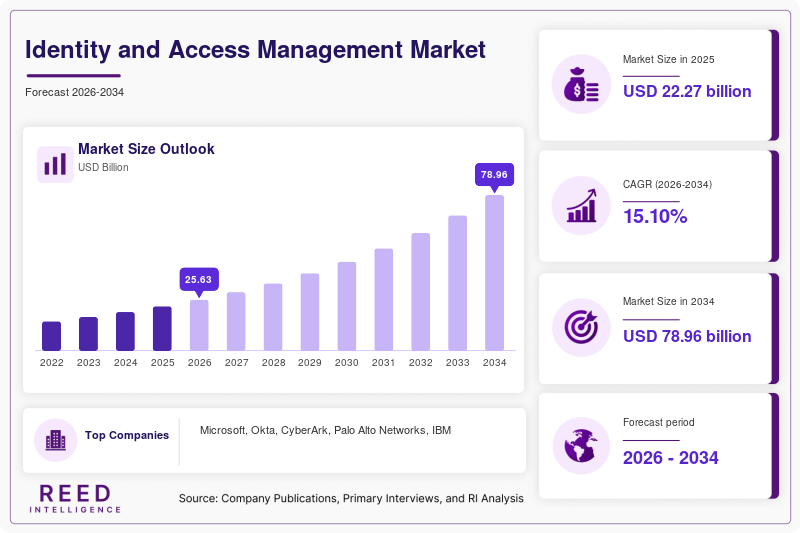
The global identity and access management market size was valued at USD 22.27 billion in 2025 and is projected to grow from USD 25.34 billion in 2026 to USD 78.96 billion by 2034, registering a CAGR of 15.10% during the forecast period from 2026 to 2034.
The market is moving beyond traditional employee login and directory management toward a broader identity-security architecture covering employees, customers, privileged users, applications, machines, APIs, workloads and AI agents. NIST describes IAM as a foundational cybersecurity capability for ensuring that the right people and things receive the right access to the right resources at the right time. Its updated Digital Identity Guidelines, SP 800-63 Revision 4, address identity proofing, authentication and federation in response to changes in the digital environment.
IAM spending is increasingly connected to three enterprise requirements: controlling access across hybrid environments, replacing vulnerable authentication methods, and governing rapidly expanding non-human identities. NIST's 2025 Zero Trust implementation guidance places identity governance and credential/access management within the broader architecture required to protect distributed enterprise resources, hybrid workforces and multi-cloud environments.
Authentication is undergoing a particularly visible transition. The FIDO Alliance reported in May 2026 that approximately 5 billion passkeys were in active use globally and that 68% of surveyed organizations were deploying, piloting or rolling out passkeys for employee sign-ins. At the same time, 57% of organizations still relied on phishable authentication for primary employee sign-in, leaving substantial migration work for IAM vendors and enterprise security teams.
Identity and Access Management Market Drivers
Zero-Trust Architecture Is Increasing the Importance of Identity Controls
Zero-trust security changes the role of IAM from a back-office directory function into a continuous access-control layer. NIST's SP 1800-35 implementation guide demonstrates zero-trust architectures across on-premises and multiple cloud environments and includes enhanced identity governance, software-defined perimeter, microsegmentation and SASE approaches.
The commercial mechanism is direct. As applications, users and workloads become distributed, organizations need centralized authentication, authorization, access reviews and policy enforcement rather than relying on network location as the primary trust signal. CISA guidance similarly recommends phishing-resistant MFA, centralized identity and access management, role-based access control and least-privilege practices.
This expands IAM purchasing beyond SSO and MFA into identity governance, privileged access, adaptive authentication and access analytics. Enterprises with hybrid infrastructure also require IAM platforms that can connect cloud applications with existing directories and on-premise systems. The result is a larger technology footprint per enterprise and greater integration requirements for vendors.
Passkey Adoption Is Replacing Vulnerable Authentication Methods
Passkeys are shifting authentication spending toward phishing-resistant credentials and passwordless workflows. FIDO's 2026 research found that 75% of consumers surveyed had enabled a passkey on at least one account and 68% of organizations surveyed were actively deploying or rolling out passkeys for employees.
Microsoft has accelerated this transition inside Entra ID. Beginning September 1, 2026, Microsoft began making passkeys the default authentication experience for users enabled for SMS or voice authentication, while Microsoft-provided SMS and voice authentication is scheduled for retirement beginning February 1, 2027.
This creates demand for IAM platforms capable of managing FIDO2 credentials, device-bound and synced passkeys, authentication policies, recovery processes and risk-based access. Microsoft Entra supports both synced passkeys and device-bound credentials such as FIDO2 security keys and Microsoft Authenticator.
AI Agents and Machine Identities Are Creating a New IAM Workload
The number and variety of non-human identities are expanding as enterprises deploy APIs, service accounts, automated workloads and AI agents. Okta's 2026 research identified a major gap between AI governance priorities and actual controls: 58% of surveyed executives cited AI governance and oversight as their top security concern related to AI agents, while only 32% secured AI agents with the same rigor as human employees.
Microsoft has responded by making Entra Agent ID generally available, providing identity and authorization capabilities specifically for AI agents. The platform supports agent identity management, access control, lifecycle governance, monitoring and human sponsorship.
This creates a new IAM spending category around machine and agent identity governance. Enterprises increasingly need to know which agent is accessing a resource, what permissions it has, who is accountable for it, how long the permission remains active and how access can be revoked. These requirements extend established IAM principles such as least privilege and lifecycle management to autonomous software.
Identity and Access Management Market Restraints
IAM Modernization Is Complex in Legacy and Hybrid Environments
Many organizations cannot replace existing directories, authentication systems and access-control processes at once. IAM deployments often need to connect legacy applications with cloud services, multiple identity providers, privileged accounts and third-party systems.
NIST's zero-trust implementation work reflects this complexity by demonstrating multiple commercially available technologies across distributed and hybrid environments rather than a single technology stack.
Implementation also requires policy redesign, identity cleanup, role mapping, application integration and employee training. FIDO research found that organizations without active passkey projects cited complexity, cost and uncertainty around implementation among their reasons for delaying deployment.
Identity Sprawl Increases Governance and Operational Costs
IAM itself is becoming more complicated as the number of identities rises. Organizations must manage employees, contractors, customers, service accounts, APIs, devices, workloads and AI agents, each with different lifecycle and authorization requirements.
Okta reported that average access requests per company had risen sharply over the preceding two years, illustrating the operational burden created by expanding identity populations.
Poorly governed access can also create excessive privileges and orphaned accounts. DORA's technical standards for financial entities explicitly require unique identities, lifecycle management, access reviews, least privilege and procedures to grant, modify and revoke access.
Identity and Access Management Market Opportunities
AI-Agent Identity Governance
AI-agent identity represents one of the newest addressable areas within IAM. Unlike traditional service accounts, agents can make decisions, invoke tools and interact with multiple applications dynamically. Microsoft Entra Agent ID provides dedicated agent identities, lifecycle controls, access packages, Conditional Access and identity-risk controls.
Okta is also expanding into this area. In July 2026, the company introduced Agent Gateway and agent-to-agent connection capabilities together with Resource Access Certifications for AI agents. These features address both runtime access and ongoing authorization review.
The opportunity extends across identity discovery, authorization, monitoring, access certification and automated deprovisioning. Vendors that can connect AI-agent governance to existing workforce IAM and privileged-access systems can address a broader enterprise security workflow.
Passwordless and Phishing-Resistant Authentication
The migration from passwords and SMS-based MFA toward passkeys creates a significant replacement market. FIDO's 2026 research indicates that workforce adoption is already mainstreaming, but 57% of organizations surveyed still use phishable authentication as their primary employee sign-in method.
IAM vendors can therefore monetize authentication modernization through passkey management, policy orchestration, device-bound credentials, identity verification, recovery and adaptive authentication.
The commercial opportunity also extends to consumer IAM. Organizations operating large customer-facing applications need authentication that reduces account takeover risk without introducing excessive login friction. NIST's revised digital identity guidance explicitly addresses identity proofing, authentication, federation, security and privacy requirements.
Segmental Analysis
By Component
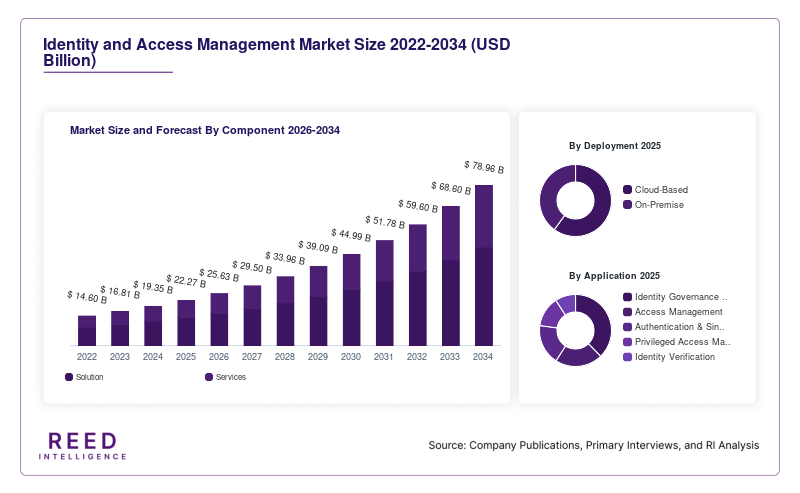
IAM Solutions represent approximately 73% of the global market in 2025, making them the dominant component. Enterprises increasingly require integrated platforms covering authentication, authorization, identity governance, privileged access and analytics rather than isolated point products. Microsoft's Entra portfolio illustrates this platform direction by combining authentication, Conditional Access, identity governance and newer agent-identity capabilities.
IAM Services are the fastest-growing component, registering approximately 16.8% CAGR. Complex migration programs, identity consolidation, cloud transformation, access-policy redesign and integration with legacy systems require professional and managed services. The services opportunity is particularly relevant for large organizations that operate multiple identity repositories and need continuous governance after deployment.
By Deployment
Cloud-Based IAM accounts for approximately 76% of the global market in 2025. Cloud deployment fits distributed applications, remote workforces and multi-cloud infrastructure while allowing identity policies to be centrally administered. NIST's zero-trust guidance explicitly addresses access to resources distributed across on-premises and multiple cloud environments.
Cloud-Based IAM is also the fastest-growing deployment segment, with approximately 17.0% CAGR. The mechanism is the continued movement of applications and workloads toward cloud platforms, combined with demand for centralized authentication and policy management.
On-Premise IAM remains relevant in government, regulated industries, critical infrastructure and organizations with legacy systems requiring local control. Hybrid architectures will therefore remain important even as cloud platforms capture a greater share of new deployments.
By Application
Access Management represents approximately 29% of the market in 2025, supported by SSO, authorization, adaptive access controls and MFA requirements across enterprise applications.
Identity Governance & Administration is the fastest-growing application, with approximately 17.4% CAGR. IGA demand is linked to the need to manage identity lifecycles, access reviews, role assignments and least-privilege controls across increasingly complex identity environments. DORA's requirements for unique identities, lifecycle management and access-right assignment illustrate how governance requirements translate into operational IAM capabilities.
Authentication & Single Sign-On remains a major application as enterprises migrate toward passwordless authentication. FIDO's 2026 data indicates that 68% of surveyed organizations are already deploying or rolling out passkeys, reinforcing the migration from conventional authentication systems.
Privileged Access Management remains strategically important because administrator credentials can provide broad access to critical systems. Identity Verification is increasingly connected with digital onboarding, fraud controls and customer-facing authentication.
By Enterprise Size
Large Enterprises account for approximately 68% of the market in 2025 because they typically manage larger identity populations, more applications, multiple geographic locations and more complex regulatory requirements.
SMEs are the faster-growing segment at approximately 17.1% CAGR as cloud-based IAM reduces the infrastructure and specialist-resource requirements associated with deploying enterprise-grade identity controls.
Cloud delivery is particularly relevant to SMEs because authentication, access policies and identity governance can be purchased as managed services rather than built around large on-premise identity teams.
By End Use
BFSI represents approximately 23% of the global market in 2025, reflecting high requirements for authentication, privileged access, transaction security, identity verification and regulatory controls. DORA's identity-management provisions specifically require financial entities to implement unique identification, lifecycle management and least-privilege access controls.
Healthcare is the fastest-growing end-use sector, with approximately 17.8% CAGR. Healthcare organizations operate large populations of employees, clinicians, contractors and third-party users while managing highly sensitive information across hospitals, cloud applications and connected systems.
IT & Telecommunications remains a major IAM customer because cloud infrastructure, SaaS applications, APIs, developers and service accounts create high identity volumes. Government & Defense continues to emphasize strong authentication, privileged access and identity assurance, while Retail & E-Commerce has substantial customer-identity requirements.
Regional Analysis
North America Identity and Access Management Market
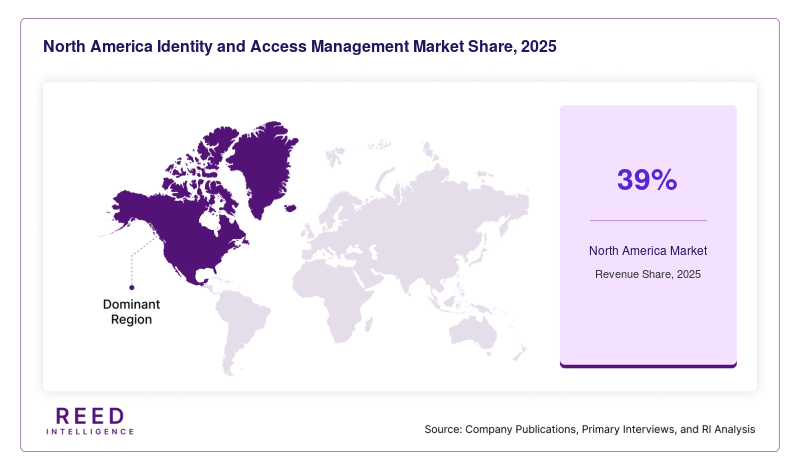
North America represents approximately 39% of the global identity and access management market in 2025, making it the largest regional market. The region benefits from a mature cybersecurity ecosystem, large cloud-service adoption, extensive enterprise SaaS use and strong demand for zero-trust architectures.
The U.S. government cybersecurity ecosystem has also established strong identity requirements. NIST's Digital Identity Guidelines Revision 4, published in 2025, updated requirements for identity proofing, authentication and federation. NIST's zero-trust guidance further integrates identity governance and access management into enterprise security architecture.
The U.S. is also a major market for passkey migration. Microsoft's September 2026 transition toward passkeys as the default Entra authentication experience creates an immediate technology migration signal for enterprises using the platform.
North America is projected to grow at approximately 14.2% CAGR. The region's future growth will increasingly come from identity governance, privileged access, machine identities and AI-agent security rather than basic SSO alone. The principal constraint is platform consolidation: large enterprises may seek to reduce the number of separate security products they operate.
Europe Identity and Access Management Market
Europe accounts for approximately 27% of the global market in 2025 and is projected to grow at approximately 14.5% CAGR. European demand is supported by strong data-protection requirements, cybersecurity regulation and enterprise modernization.
DORA requires financial institutions to maintain identity-management policies, unique identities, lifecycle processes, least-privilege access, segregation of duties and procedures for granting and revoking access.
The NIS2 Directive establishes cybersecurity risk-management and reporting requirements for covered entities across the European Union, reinforcing the broader need for security controls and governance.
European organizations are also participating actively in the passkey transition. FIDO's 2026 research included organizations and consumers from the U.K., France and Germany, alongside other major markets, and found broad global enterprise movement toward passkeys.
The region's purchasing behavior therefore places substantial weight on compliance, identity assurance, privacy, auditability and lifecycle governance. Regulatory fragmentation across countries can increase deployment complexity, but it also creates recurring demand for governance and reporting functions.
APAC Identity and Access Management Market
APAC represents approximately 22% of the global market in 2025 and is the fastest-growing region, with approximately 18.1% CAGR. The region combines rapid cloud adoption, expanding digital services, large technology sectors and increasing use of mobile and online authentication.
India, China, Japan, South Korea, Australia and Singapore are important contributors to regional IAM adoption, although their regulatory environments and enterprise architectures differ. FIDO's 2026 workforce and consumer research included all five major Asian markets of China, Japan, South Korea, India and Singapore, demonstrating the relevance of passkeys across the region.
India's regulatory environment is also developing. The Ministry of Electronics and Information Technology lists the Digital Personal Data Protection Rules, 2025, published in November 2025, alongside the DPDP Act framework.
APAC's growth mechanism is therefore a combination of cloud transformation, digital identity expansion, regulatory modernization and authentication upgrades. Large technology companies and digitally intensive enterprises are also important early adopters of machine-identity and AI-agent governance.
Middle East and Africa Identity and Access Management Market
Middle East and Africa account for approximately 6% of the global market in 2025 and are projected to grow at approximately 16.3% CAGR. Digital-government programs, financial-services modernization, cloud migration and cybersecurity investments are expanding the need for centralized authentication and identity governance.
The region's financial institutions and government organizations have particularly strong requirements around identity verification, access control and privileged-user management. Cloud deployment can also reduce the infrastructure burden associated with building large internal IAM environments.
The commercial opportunity is strongest in the Gulf states and major African financial and telecommunications markets, where digital services are expanding rapidly. IAM providers can address this market through cloud-based authentication, customer identity, privileged access and managed services.
The primary constraint is uneven enterprise maturity. IAM adoption varies substantially between digitally advanced organizations and smaller institutions with limited cybersecurity budgets and legacy infrastructure.
LATAM Identity and Access Management Market
LATAM represents approximately 6% of the global market in 2025 and is projected to grow at approximately 15.8% CAGR. Banking digitization, e-commerce, telecommunications and cloud adoption are increasing the number of digital identities that enterprises must authenticate and govern.
Financial services remain an important demand source because digital banking increases requirements for customer authentication, fraud controls, privileged access and identity verification. Retail and e-commerce create additional customer-identity requirements as organizations move more customer interactions online.
Cloud-based IAM is particularly relevant to LATAM because organizations can deploy authentication, SSO and governance capabilities without establishing extensive local infrastructure. However, varying levels of digital maturity, cybersecurity budgets and regulatory development across countries can produce uneven adoption.
Competitive Landscape
The IAM market is becoming more consolidated around broad identity-security platforms while specialized vendors continue to compete in identity governance, privileged access, authentication and customer identity.
Microsoft is expanding Entra beyond conventional workforce authentication. In April 2026, Microsoft made Entra Agent ID generally available, giving AI agents dedicated identities and authorization capabilities. It subsequently expanded governance features covering agent lifecycle, sponsorship, access packages, Conditional Access and monitoring.
Okta is broadening its platform toward human, machine and AI identity. Its 2026 research highlighted the increase in centrally managed service accounts, while its July 2026 product announcements added runtime AI-agent security and resource-access certification capabilities.
Palo Alto Networks' February 2026 acquisition of CyberArk is another major competitive signal. Palo Alto Networks said the acquisition establishes identity security as a core pillar of its platform strategy and combines protection for human, machine and agentic identities.
Key Market Players
Recent Market Developments
- September 2026 – Microsoft Entra began rolling out passkeys as the default authentication experience for users currently enabled for SMS or voice authentication. Microsoft-provided SMS and voice authentication is scheduled to end in February 2027, creating a major enterprise authentication migration cycle.
- July 2026 – Okta introduced Agent Gateway, agent-to-agent connection capabilities and Resource Access Certifications for AI agents. The developments extend IAM from human identities into runtime AI-agent authorization and continuing access review.
Identity and Access Management Market Segments
By Component
- Solution
- Services
By Deployment
- Cloud-Based
- On-Premise
By Application
- Identity Governance & Administration
- Access Management
- Authentication & Single Sign-On
- Privileged Access Management
- Identity Verification
By Enterprise Size
- Large Enterprises
- SMEs
By End Use
- BFSI
- IT & Telecommunications
- Healthcare
- Government & Defense
- Retail & E-Commerce
- Manufacturing
- Other Industries
By Region
- North America
- Europe
- APAC
- Middle East and Africa
- LATAM