Image Activated Cell Sorting Market Size, Share & Demand Report By Technology (Fluorescence-Based Sorting, Label-Free Sorting, AI-Enabled Sorting), By Application (Research Applications, Clinical Diagnostics), By End-Use (Academic & Research Institutes, Biopharmaceutical Companies, Hospitals & Diagnostic Laboratories), By Modality (Label-Based, Label-Free), By Region & Segment Forecasts, 2025–2034
USD 3950
Market Overview
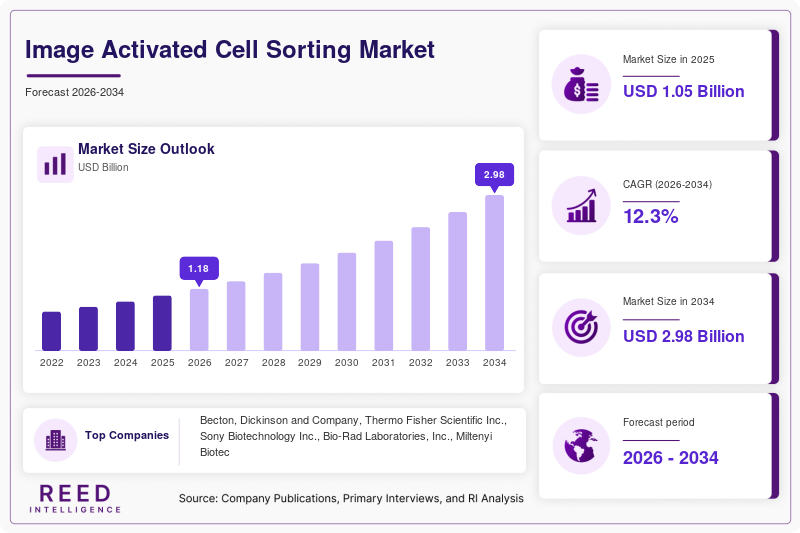
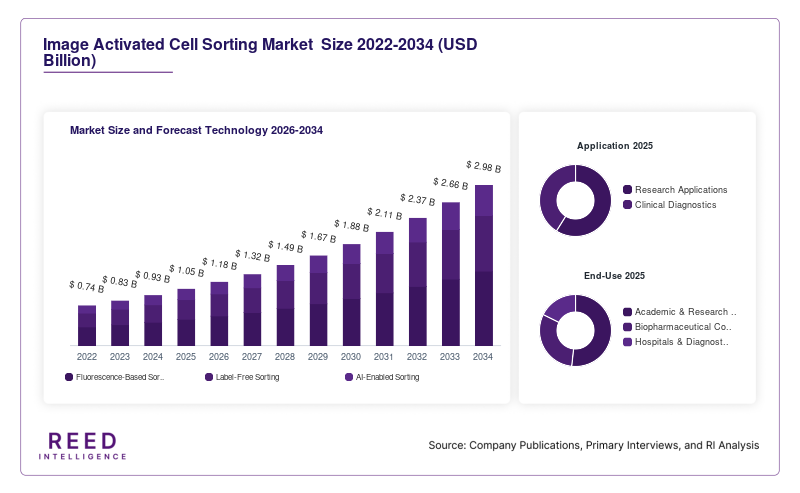
The global Image Activated Cell Sorting Market size was valued at approximately USD 1.05 billion in 2025 and is projected to reach USD 2.98 billion by 2034, expanding at a CAGR of 12.3% from 2025 to 2034. The market growth is being driven by the increasing adoption of advanced cell analysis technologies in biomedical research and clinical diagnostics. Image-based cell sorting enables high-resolution morphological and functional analysis, making it highly suitable for applications such as cancer research, immunology, and stem cell studies.
A major global factor supporting the expansion of the Image Activated Cell Sorting Market is the rapid growth in precision medicine initiatives. The need for accurate cell characterization and isolation has intensified due to the shift toward personalized therapies. This has encouraged research institutions and biotechnology firms to invest in imaging-enabled sorting technologies that provide deeper cellular insights compared to conventional flow cytometry.
Key Highlights:
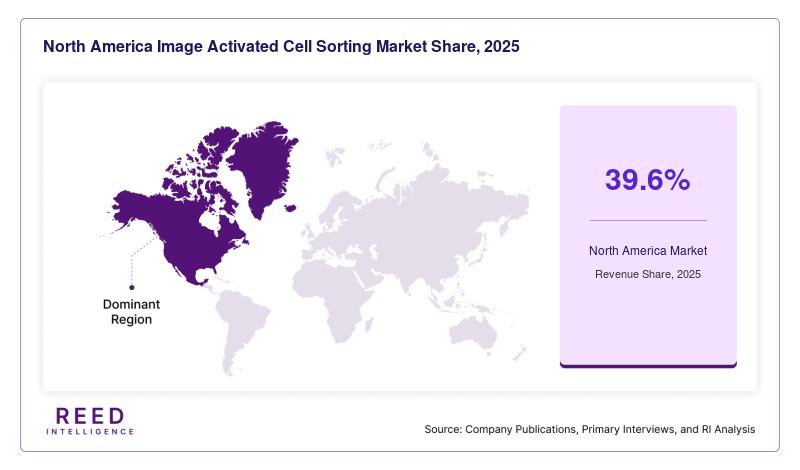
- North America dominated the market with 39.6% share in 2025, while Asia Pacific is expected to register the fastest CAGR of 14.1% through 2034.
- By technology, fluorescence-based image sorting led with a 46.8% share in 2024, whereas AI-enabled sorting systems are projected to grow at a CAGR of 15.2%.
- By application, research applications dominated with 58.3% share, while clinical diagnostics is anticipated to expand at 13.9% CAGR.
- The U.S. accounted for USD 362 million in 2024 and USD 398 million in 2025.
Market Trends
Integration of Artificial Intelligence in Cell Sorting
The incorporation of artificial intelligence into image activated cell sorting platforms is transforming the analytical capabilities of these systems. AI-driven algorithms allow real-time image processing and classification of cells based on complex morphological features. This enhances sorting accuracy and reduces manual intervention. Laboratories are increasingly adopting AI-integrated systems to handle large datasets and improve reproducibility, especially in high-throughput research environments.
Rising Demand for Label-Free Cell Sorting Technologies
There is a growing preference for label-free image-based sorting methods that eliminate the need for fluorescent markers or dyes. These techniques reduce sample preparation time and preserve cell integrity, which is essential for downstream applications such as regenerative medicine and live-cell imaging. As researchers focus on minimizing cellular alterations during sorting, label-free technologies are gaining traction across academic and industrial laboratories.
Market Drivers
Increasing Investment in Life Sciences Research
Rising funding from governments and private organizations for life sciences research is significantly driving the Image Activated Cell Sorting Market. Research institutions are increasingly investing in advanced analytical tools to study cellular behavior and disease mechanisms. This has led to higher demand for sophisticated sorting systems capable of delivering detailed cellular insights.
Growing Prevalence of Chronic Diseases
The increasing burden of chronic diseases such as cancer and autoimmune disorders has fueled the demand for precise diagnostic and therapeutic solutions. Image activated cell sorting plays a crucial role in identifying rare cell populations and understanding disease progression. This capability is essential for developing targeted treatments, thereby boosting market growth.
Market Restraint
High Cost of Advanced Sorting Systems
One of the primary challenges in the Image Activated Cell Sorting Market is the high cost associated with advanced imaging and sorting systems. These platforms require significant capital investment, making them less accessible to small and mid-sized research laboratories. In addition to the initial cost, maintenance expenses and the need for skilled personnel further increase the total cost of ownership.
The complexity of these systems also limits their adoption in resource-constrained settings. Training requirements and operational challenges can hinder widespread implementation, particularly in developing regions. As a result, cost-related constraints continue to restrict market expansion to some extent.
Market Opportunities
Expansion in Clinical Diagnostics Applications
The growing use of image activated cell sorting in clinical diagnostics presents a significant opportunity for market players. As healthcare systems increasingly adopt advanced diagnostic technologies, there is a rising need for precise cell analysis tools. Image-based sorting can improve disease detection and monitoring, especially in oncology and infectious diseases, creating new growth avenues.
Emerging Markets in Asia Pacific and Latin America
Developing economies are witnessing increased investments in healthcare infrastructure and research capabilities. Countries in Asia Pacific and Latin America are expanding their biotechnology sectors, which is expected to boost demand for advanced cell sorting technologies. Market players can capitalize on these regions by offering cost-effective and scalable solutions tailored to local needs.
Segmental Analysis
By Technology
Fluorescence-based image sorting dominated the market with a 46.8% share in 2024. This segment benefited from its ability to provide high specificity and sensitivity in cell identification. The widespread use of fluorescent markers in research applications contributed to its leading position.
AI-enabled sorting systems are expected to grow at the fastest CAGR of 15.2%. The integration of machine learning algorithms enhances sorting accuracy and efficiency. This technology enables real-time analysis and classification, making it suitable for complex research applications.
By Application
Research applications accounted for 58.3% share in 2024, making it the dominant segment. The extensive use of cell sorting in academic and industrial research drove this segment’s growth.
Clinical diagnostics is projected to grow at a CAGR of 13.9%. The increasing use of image-based sorting for disease diagnosis and monitoring is expected to drive this segment. Advancements in diagnostic technologies will further support growth.
By End-Use
Academic and research institutes held the largest share of 52.1% in 2024. These institutions are primary users of advanced cell sorting technologies for various research purposes.
Biopharmaceutical companies are expected to grow at a CAGR of 13.4%. The rising focus on drug development and personalized medicine is driving demand for advanced cell analysis tools.
By Modality
Label-based sorting dominated with a 61.5% share in 2024 due to its established use in research workflows.
Label-free sorting is anticipated to grow at a CAGR of 14.6%, driven by the need for preserving cell integrity and reducing preparation time.
Regional Analysis
North America
North America accounted for 39.6% of the Image Activated Cell Sorting Market share in 2025 and is expected to grow at a CAGR of 11.2% during the forecast period. The region benefited from strong research infrastructure and high adoption of advanced laboratory technologies.
The United States remained the dominant country due to extensive funding for biomedical research. The presence of leading biotechnology firms and academic institutions contributed to early adoption of image-based sorting systems. Additionally, strong collaboration between research and healthcare sectors supported market expansion.
Europe
Europe held 27.4% market share in 2025 and is projected to grow at a CAGR of 10.8% through 2034. The region demonstrated steady growth driven by increasing research activities and technological adoption.
Germany emerged as the leading country due to its advanced healthcare infrastructure and focus on innovation. Government support for life sciences research and the presence of specialized research institutes played a key role in driving market growth.
Asia Pacific
Asia Pacific represented 19.8% of the market share in 2025 and is anticipated to register the fastest CAGR of 14.1%. The region showed rapid expansion due to increasing investments in biotechnology and healthcare infrastructure.
China dominated the regional market owing to its growing research capabilities and expanding pharmaceutical industry. Government initiatives to promote scientific research and technological development further accelerated market growth.
Middle East & Africa
The Middle East & Africa accounted for 7.2% of the market share in 2025 and is expected to grow at a CAGR of 9.6%. The market experienced gradual growth due to improving healthcare infrastructure.
The United Arab Emirates led the region, driven by investments in advanced medical technologies and research facilities. Efforts to modernize healthcare systems contributed to increased adoption of innovative diagnostic tools.
Latin America
Latin America held 6.0% market share in 2025 and is projected to grow at a CAGR of 10.1%. The region showed moderate growth supported by expanding research activities.
Brazil dominated the market due to its growing biotechnology sector and increasing focus on healthcare innovation. Investments in research institutions and collaborations with global players supported market development.
Competitive Landscape
The Image Activated Cell Sorting Market is characterized by the presence of several established and emerging players focusing on innovation and strategic collaborations. Companies are investing in research and development to enhance system capabilities and expand their product portfolios.
A leading player in the market is Becton, Dickinson and Company, which has consistently focused on developing advanced flow cytometry and cell sorting solutions. The company recently introduced an upgraded imaging-based sorting platform with improved throughput and accuracy, strengthening its market position.
Other key players are emphasizing partnerships and acquisitions to expand their geographic presence and technological expertise. The competitive landscape remains dynamic, with continuous advancements in imaging and sorting technologies shaping the market.
Key Players
- Becton, Dickinson and Company
- Thermo Fisher Scientific Inc.
- Sony Biotechnology Inc.
- Bio-Rad Laboratories, Inc.
- Miltenyi Biotec
- Union Biometrica, Inc.
- Cytonome/ST, LLC
- On-Chip Biotechnologies Co., Ltd.
- NanoCellect Biomedical
- Berkeley Lights, Inc.
Recent Developments
- 2024: A major player launched an AI-powered image sorting platform to enhance real-time cell classification.
- 2023: Strategic collaboration between biotechnology firms to develop next-generation label-free sorting technologies.
- 2023: Expansion of manufacturing facilities to meet increasing global demand for advanced cell sorting systems.
- 2022: Introduction of compact and cost-efficient sorting systems targeting emerging markets.
Image Activated Cell Sorting Market Segments
Technology
- Fluorescence-Based Sorting
- Label-Free Sorting
- AI-Enabled Sorting
Application
- Research Applications
- Clinical Diagnostics
End-Use
- Academic & Research Institutes
- Biopharmaceutical Companies
- Hospitals & Diagnostic Laboratories
Modality
- Label-Based
- Label-Free
By Region
- North America
- Europe
- APAC
- Middle East and Africa
- LATAM