Image Based Barcode Reader Market Size, Share & Demand Report By Product Type (Handheld Barcode Readers, Fixed Mount Barcode Readers, Mobile Computer Readers, Presentation Barcode Readers), By Application (Logistics and Warehousing, Retail and E-Commerce, Healthcare, Manufacturing, Transportation and Logistics, Others), By End Use Industry (Retail, Manufacturing, Healthcare, Transportation, Automotive, Food and Beverage, Others), By Region & Segment Forecasts, 2026–2034
USD 3950
Market Overview
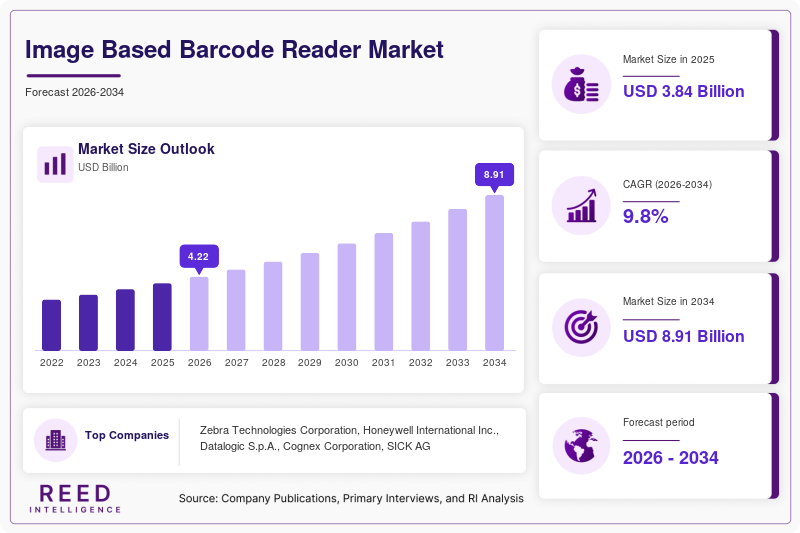
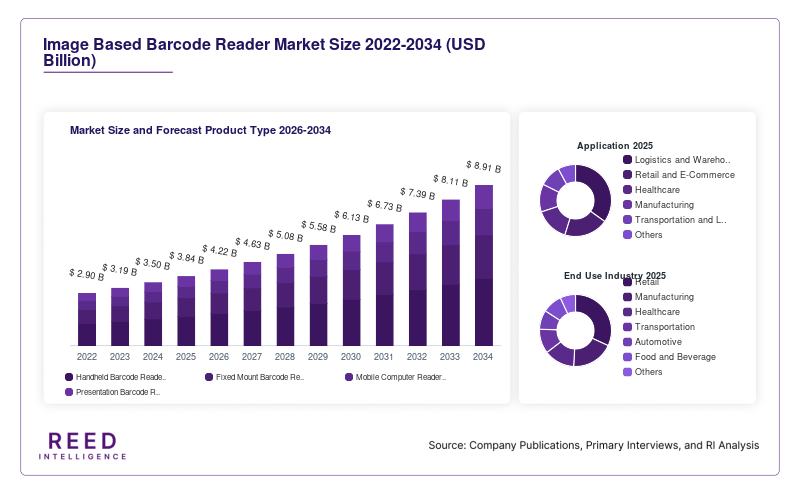
The global Image Based Barcode Reader Market size was valued at USD 3.84 billion in 2026 and is projected to reach USD 8.12 billion by 2034, expanding at a CAGR of 9.8% during the forecast period from 2026 to 2034. The market is experiencing stable growth due to the rapid expansion of industrial automation, smart logistics infrastructure, and digital inventory management systems across manufacturing, healthcare, retail, and transportation industries. Image based barcode readers are increasingly replacing laser-based systems because they offer improved accuracy, enhanced reading capability for damaged codes, and compatibility with both one-dimensional and two-dimensional barcodes.
The rising adoption of e-commerce and omnichannel retail systems has significantly supported market expansion worldwide. Warehouses and fulfillment centers are investing in automated tracking technologies to improve order accuracy and supply chain visibility. Companies are also deploying image based barcode readers in production facilities to reduce manual inspection time and improve operational efficiency. The increasing use of mobile computing devices and industrial handheld scanners has further accelerated demand across emerging economies.
Key Highlights
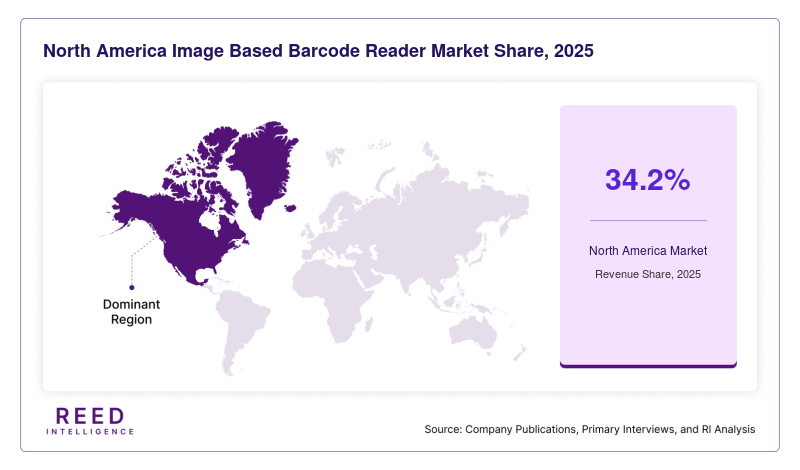
- North America dominated the market with a 34.2% share in 2025.
- Asia Pacific is expected to grow at the fastest CAGR of 11.6% during 2026–2034.
- By product type, handheld barcode readers accounted for the largest share of 39.8%, while fixed mount barcode readers are projected to grow at a CAGR of 12.1%.
- By application, logistics and warehousing led with a 36.4% share, whereas healthcare applications are expected to expand at a CAGR of 11.9%.
- The United States remained the dominant country, with market values of USD 690 million in 2024 and USD 758 million in 2025.
Market Trends
Growing Integration of Artificial Intelligence in Barcode Reading Systems
Artificial intelligence integration is becoming a significant trend in the Image Based Barcode Reader Market. Manufacturers are incorporating machine learning algorithms into barcode reading systems to improve decoding accuracy and operational efficiency. AI-powered barcode readers can identify partially damaged, blurred, or poorly printed codes with improved precision compared to traditional scanning technologies. These systems also support automated error detection and predictive maintenance functions, reducing downtime in industrial facilities.
The trend is gaining traction across manufacturing and logistics sectors where companies require high-speed scanning operations with minimal interruptions. AI-enabled barcode readers can process large volumes of data in real time and improve workflow management in distribution centers. Retailers are also adopting these systems for automated checkout applications and inventory optimization. As industries continue to focus on digital transformation and automation, the integration of AI technologies into barcode readers is expected to become increasingly common across global markets.
Expansion of Mobile and Wireless Barcode Reading Solutions
The adoption of wireless and mobile barcode reading solutions is increasing across industries due to the growing need for operational flexibility and real-time data access. Businesses are deploying portable image based barcode readers equipped with wireless communication technologies such as Wi-Fi, Bluetooth, and cloud synchronization features. These devices support field operations, warehouse management, and retail inventory tracking without dependence on fixed infrastructure.
The trend is particularly strong in transportation, healthcare, and retail environments where employees require mobility during daily operations. Mobile barcode readers are being integrated with enterprise resource planning systems and cloud-based inventory platforms to improve visibility throughout supply chains. Improvements in battery performance, lightweight device design, and durable industrial construction are further encouraging adoption. As organizations prioritize workforce productivity and connected operations, wireless barcode scanning solutions are expected to witness sustained demand over the forecast period.
Market Drivers
Rapid Growth of E-Commerce and Warehouse Automation
The rapid expansion of global e-commerce activities is driving substantial demand for image based barcode readers. Online retailers and logistics providers are investing heavily in warehouse automation systems to manage rising shipment volumes and customer expectations for faster deliveries. Barcode readers play a critical role in package tracking, inventory verification, and order fulfillment processes. Their ability to accurately scan damaged or small barcodes makes them highly suitable for fast-moving warehouse environments.
Automation technologies such as conveyor systems, robotic sorting equipment, and automated storage systems increasingly rely on advanced barcode reading capabilities. Businesses are implementing image based readers to reduce operational errors, improve inventory accuracy, and enhance productivity across supply chains. The continued expansion of regional fulfillment centers and same-day delivery services is expected to create long-term opportunities for market participants operating in warehouse automation ecosystems.
Increasing Adoption Across Healthcare and Pharmaceutical Industries
The healthcare and pharmaceutical sectors are becoming major users of image based barcode reader technologies. Hospitals, laboratories, and pharmaceutical companies are implementing barcode scanning systems to improve patient safety, medicine tracking, and regulatory compliance. Barcode readers help reduce medication errors by enabling accurate patient identification and verification of pharmaceutical products throughout healthcare supply chains.
Pharmaceutical manufacturers are also deploying image based barcode readers to comply with serialization and traceability regulations introduced by governments worldwide. These systems improve visibility across production and distribution processes while supporting anti-counterfeit measures. Healthcare providers increasingly rely on barcode technology for specimen tracking, laboratory automation, and electronic medical record management. Rising healthcare digitalization and growing investments in smart hospital infrastructure are expected to continue driving demand for advanced barcode reading solutions.
Market Restraint
High Initial Investment and Integration Complexity
The high initial cost associated with deploying advanced image based barcode readers remains a major restraint for market growth, particularly among small and medium-sized enterprises. Modern barcode reading systems often require investments in imaging hardware, software integration, machine vision infrastructure, and employee training programs. Companies operating with limited capital budgets may delay technology upgrades due to concerns regarding return on investment and implementation expenses.
Integration complexity also creates operational challenges for businesses transitioning from traditional scanning systems to advanced image based platforms. Organizations must ensure compatibility with warehouse management systems, enterprise software, and existing production infrastructure. In manufacturing environments, downtime during installation and system calibration can affect productivity levels and increase operational costs. Additionally, some industries continue to rely on legacy barcode systems that are difficult to replace due to long equipment life cycles. These factors may slow adoption rates in price-sensitive markets despite growing awareness regarding the operational benefits of image based barcode reader technologies.
Market Opportunities
Rising Demand for Smart Manufacturing and Industry 4.0 Solutions
The expansion of smart manufacturing initiatives is creating substantial opportunities for companies operating in the Image Based Barcode Reader Market. Industry 4.0 strategies emphasize automation, real-time monitoring, and connected production systems, all of which require accurate identification and data capture technologies. Image based barcode readers support automated quality inspection, production tracking, and inventory management functions in modern manufacturing facilities.
Manufacturers are increasingly adopting machine vision systems integrated with barcode readers to improve operational visibility and reduce human intervention across assembly lines. These solutions enable rapid product identification and traceability throughout production cycles. Automotive, electronics, and consumer goods industries are among the major adopters of smart manufacturing technologies. As governments and private organizations continue investing in industrial automation infrastructure, demand for advanced barcode reading systems is expected to accelerate across both developed and emerging economies.
Expanding Applications in Transportation and Smart Logistics
The growing focus on smart logistics and intelligent transportation systems presents new opportunities for image based barcode reader providers. Transportation companies are adopting automated cargo tracking and digital asset management technologies to improve operational efficiency and supply chain transparency. Barcode readers support package identification, shipment verification, and route optimization across transportation networks.
Airports, railway systems, and port operators are increasingly deploying image based barcode readers for baggage handling, ticket verification, and freight management applications. These technologies improve processing speed and reduce operational errors in high-volume transportation environments. The increasing use of connected logistics platforms and real-time shipment monitoring systems is further encouraging adoption. Emerging economies are also investing in logistics modernization programs to strengthen trade infrastructure, creating favorable conditions for barcode reader manufacturers targeting long-term market expansion opportunities.
Segmental Analysis
By Product Type
Handheld barcode readers dominated the Image Based Barcode Reader Market and accounted for 39.8% of the total market share in 2024. These devices are widely used across retail, warehousing, transportation, and healthcare environments because of their portability, operational flexibility, and cost efficiency. Handheld readers support rapid barcode scanning in dynamic work environments where employees require mobility and real-time data access. Retail stores and logistics providers increasingly deploy rugged handheld devices integrated with wireless communication technologies to improve inventory accuracy and order fulfillment processes.
The growing use of handheld barcode readers in healthcare facilities has further strengthened segment growth. Hospitals and laboratories use these devices for patient identification, medicine verification, and specimen tracking applications. Technological improvements in battery performance, ergonomic design, and imaging resolution are encouraging broader adoption across industrial sectors. Integration with cloud-based inventory systems and enterprise software platforms has also enhanced operational efficiency for businesses using handheld barcode readers.
By Application
Logistics and warehousing represented the largest application segment in the Image Based Barcode Reader Market, accounting for 36.4% of global revenue in 2024. The rapid expansion of e-commerce and third-party logistics operations has significantly increased demand for barcode scanning technologies across warehouses and fulfillment centers. Barcode readers support package identification, inventory verification, shipment tracking, and order processing activities. Their ability to accurately scan damaged or poorly printed labels improves operational efficiency in high-volume logistics environments.
Warehousing companies are increasingly implementing image based barcode readers alongside automated sorting systems and conveyor infrastructure to reduce operational delays and improve inventory visibility. The adoption of cloud-based warehouse management systems has also strengthened demand for advanced scanning solutions capable of real-time data synchronization. Rising customer expectations for same-day and next-day deliveries continue to encourage logistics providers to invest in high-performance barcode reading technologies.
By End Use Industry
The retail industry held the dominant share of 31.7% in the Image Based Barcode Reader Market in 2024 due to widespread adoption of barcode scanning technologies across supermarkets, hypermarkets, and specialty retail stores. Retailers rely on image based barcode readers for point-of-sale operations, inventory management, price verification, and supply chain monitoring. The increasing adoption of self-checkout systems and omnichannel retail strategies has accelerated deployment of advanced barcode readers capable of processing both one-dimensional and two-dimensional codes.
Retail businesses are also integrating barcode scanning technologies with cloud-based analytics platforms to improve customer experience and operational planning. Mobile barcode readers are widely used for shelf inventory management and in-store fulfillment operations. The expansion of digital commerce and contactless payment systems continues to strengthen demand for efficient scanning solutions across modern retail environments. Retailers are prioritizing investments in automated inventory technologies to improve efficiency and reduce stock management errors.
Regional Analysis
North America
North America accounted for 34.2% of the global Image Based Barcode Reader Market in 2025 and maintained a leading position due to high adoption of automation technologies across industrial sectors. The region is projected to expand at a CAGR of 8.9% during the forecast period. Strong investments in warehouse automation, advanced manufacturing systems, and digital healthcare infrastructure continue to support demand for barcode reading solutions. Retailers and logistics providers across the United States and Canada are implementing high-performance barcode systems to improve operational efficiency and inventory visibility.
The United States remained the dominant country in the regional market due to widespread deployment of automated supply chain technologies and strong e-commerce activity. Major logistics companies are integrating AI-enabled barcode readers into fulfillment centers to support real-time package tracking and order management. The healthcare industry is also contributing significantly to market expansion through increasing adoption of barcode-assisted patient identification systems. Rising investments in smart factories and industrial robotics continue to strengthen demand for advanced imaging and decoding technologies throughout the country.
Europe
Europe represented 27.1% of the global market in 2025 and is expected to grow at a CAGR of 8.4% during 2026–2034. The region benefits from a strong industrial manufacturing base and increasing adoption of Industry 4.0 technologies across Germany, France, Italy, and the United Kingdom. Manufacturing companies are implementing image based barcode readers to improve production traceability, quality assurance, and warehouse automation. Growing regulatory focus on product tracking and pharmaceutical serialization is also supporting market expansion.
Germany remained the leading contributor to the European market due to its advanced automotive and industrial manufacturing sectors. German manufacturers are deploying machine vision systems integrated with barcode readers to support smart production environments and automated assembly lines. The country is also witnessing growing investments in logistics modernization and digital inventory management solutions. Increasing demand for high-speed barcode scanning in electronics manufacturing and industrial packaging applications continues to create favorable conditions for market growth across the region.
Asia Pacific
Asia Pacific held 24.6% of the global Image Based Barcode Reader Market in 2025 and is anticipated to record the fastest CAGR of 11.6% during the forecast period. Rapid industrialization, expansion of e-commerce infrastructure, and rising automation investments are driving market growth across China, Japan, India, and South Korea. Regional manufacturers are adopting barcode reading technologies to improve operational efficiency and support export-oriented production activities. Growing penetration of organized retail and digital payment systems is also contributing to increasing demand.
China dominated the regional market due to its large manufacturing ecosystem and extensive logistics network. The country is investing heavily in automated warehouses, smart factories, and intelligent transportation infrastructure. Chinese e-commerce companies are deploying advanced barcode scanning technologies to manage rising parcel volumes and improve delivery efficiency. Government initiatives promoting industrial digitalization and domestic technology manufacturing are further supporting adoption of image based barcode readers across multiple industrial sectors.
Middle East & Africa
The Middle East & Africa region accounted for 7.2% of the global market in 2025 and is projected to grow at a CAGR of 9.1% during the forecast period. The market is expanding steadily due to increasing investments in logistics infrastructure, retail modernization, and healthcare digitalization initiatives. Countries across the Gulf Cooperation Council are implementing smart city projects and advanced warehousing systems that require efficient barcode identification technologies. Rising adoption of industrial automation in oil and gas operations is also supporting market growth.
Saudi Arabia emerged as the dominant country within the region due to ongoing economic diversification initiatives and logistics sector development programs. The country is investing in automated supply chain infrastructure to strengthen trade operations and support industrial expansion. Healthcare providers are increasingly implementing barcode scanning systems for patient management and pharmaceutical tracking applications. Growing development of retail malls, transportation hubs, and manufacturing facilities continues to create opportunities for barcode reader suppliers operating in the regional market.
Latin America
Latin America captured 6.9% of the global Image Based Barcode Reader Market in 2025 and is expected to expand at a CAGR of 8.3% during the forecast period. Increasing digital transformation initiatives across retail, transportation, and manufacturing industries are supporting market growth throughout the region. Companies are investing in inventory management systems and warehouse automation technologies to improve operational performance. Expanding e-commerce activity and rising demand for efficient package tracking solutions are also encouraging adoption of barcode reading technologies.
Brazil remained the leading country in the Latin American market due to the growth of organized retail networks and logistics modernization efforts. The country is witnessing increasing implementation of barcode readers in distribution centers, healthcare facilities, and manufacturing plants. Transportation companies are adopting image based scanning systems to improve cargo management and shipment visibility. Government support for industrial digitalization and growing investments in automation technologies are expected to strengthen long-term market development in Brazil and neighboring countries.
Competitive Landscape
The Image Based Barcode Reader Market is characterized by the presence of established global technology providers and specialized industrial automation companies competing on product innovation, imaging accuracy, software integration, and pricing strategies. Leading companies are focusing on artificial intelligence integration, machine vision capabilities, and wireless connectivity features to strengthen their market position. Strategic partnerships with logistics providers, manufacturing firms, and healthcare organizations are also supporting market expansion.
Zebra Technologies Corporation remained one of the leading companies in the market due to its broad portfolio of industrial barcode scanning solutions and strong global distribution network. The company continues to invest in advanced imaging technologies and cloud-based asset tracking platforms to improve operational efficiency for enterprise customers. Honeywell International Inc., Datalogic S.p.A., Cognex Corporation, and SICK AG also maintain significant market shares through continuous investments in automation technologies and industrial machine vision systems.
Key Players
- Zebra Technologies Corporation
- Honeywell International Inc.
- Datalogic S.p.A.
- Cognex Corporation
- SICK AG
- Omron Corporation
- Keyence Corporation
- Toshiba Tec Corporation
- Bluebird Inc.
- Opticon Sensors Europe B.V.
- Newland AIDC
- Unitech Electronics Co., Ltd.
- JADAK
- CipherLab Co., Ltd.
- Microscan Systems Inc.
Recent Developments
- In February 2026, Zebra Technologies Corporation introduced a new AI-enabled industrial barcode reader designed for automated warehouse operations and high-speed logistics applications.
- In September 2025, Honeywell International Inc. expanded its manufacturing facility in Southeast Asia to strengthen production capacity for image based barcode scanning devices.
- In January 2026, Cognex Corporation launched an advanced machine vision barcode reader capable of decoding damaged and low-contrast labels in automotive manufacturing environments.
- In November 2025, Datalogic S.p.A. partnered with a major European logistics provider to deploy wireless barcode reading systems across regional distribution centers.
- In March 2026, SICK AG introduced a cloud-integrated barcode analytics platform aimed at improving industrial traceability and predictive maintenance operations.
Image Based Barcode Reader Market Segments
Product Type
- Handheld Barcode Readers
- Fixed Mount Barcode Readers
- Mobile Computer Readers
- Presentation Barcode Readers
Application
- Logistics and Warehousing
- Retail and E-Commerce
- Healthcare
- Manufacturing
- Transportation and Logistics
- Others
End Use Industry
- Retail
- Manufacturing
- Healthcare
- Transportation
- Automotive
- Food and Beverage
- Others
By Region
- North America
- Europe
- APAC
- Middle East and Africa
- LATAM