Imaging Colorimeters & Photometers Market Size, Share, Demand Report by Product Type (Imaging Colorimeters, Imaging Photometers), Application (Display Testing, Automotive Lighting Analysis, Aerospace & Defense Displays, Medical Imaging Inspection, Industrial Machine Vision, Architectural Lighting Testing), End-Use Industry (Consumer Electronics, Automotive Manufacturing, Aerospace & Defense, Healthcare, Semiconductor Manufacturing, Industrial Automation), and Region Forecasts, 2026–2034
USD 3950
Market Overview
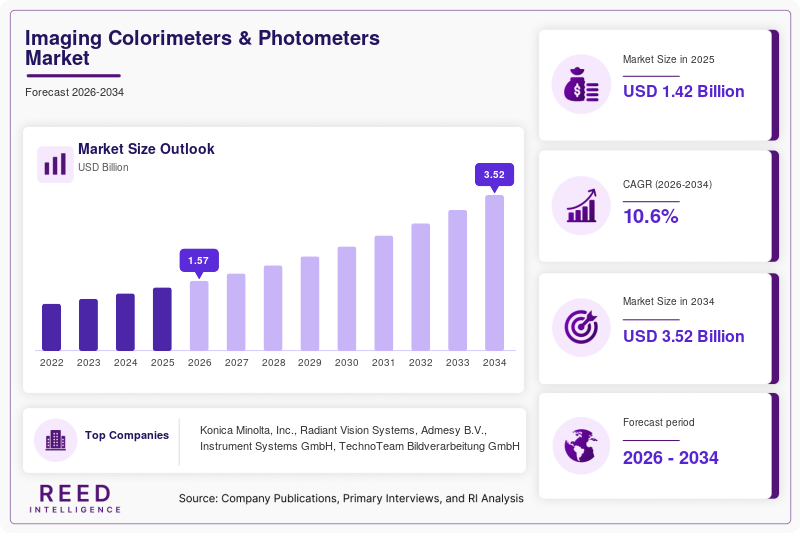
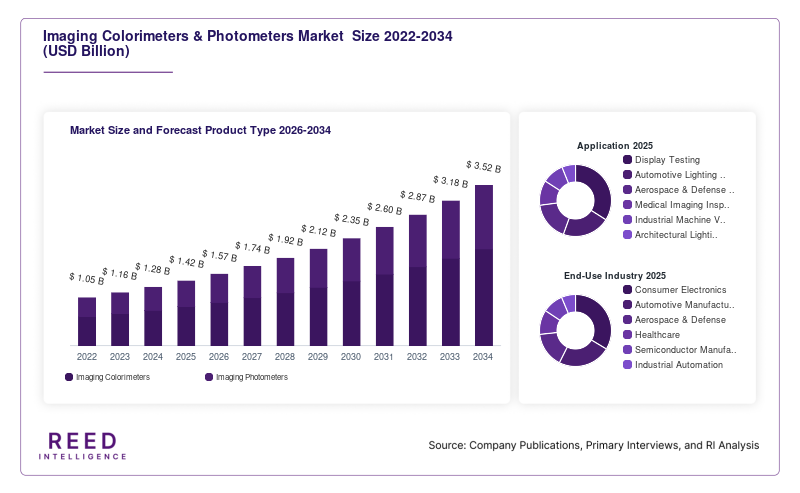
The global Imaging Colorimeters & Photometers Market size was valued at USD 1.42 billion in 2026 and is projected to reach USD 3.18 billion by 2034, expanding at a CAGR of 10.6% during the forecast period from 2026 to 2034. The market continues to witness steady adoption across electronics manufacturing, automotive lighting, aerospace displays, medical imaging systems, and industrial inspection applications. Increasing demand for high-precision optical testing technologies has accelerated investments in imaging-based measurement systems capable of delivering rapid and accurate luminance, chromaticity, and uniformity analysis.
A major global factor supporting market growth is the rising production of advanced display technologies, including OLED, MicroLED, MiniLED, and high-resolution LCD panels. Manufacturers are increasingly focusing on image quality consistency and production efficiency, creating strong demand for imaging colorimeters and photometers in quality control and calibration processes. The transition toward autonomous vehicles and digital cockpit systems has also increased the use of optical measurement instruments for dashboard displays, ambient lighting, and head-up displays. In addition, industrial automation and smart manufacturing initiatives are encouraging the deployment of machine vision-enabled optical testing solutions across production facilities.
Key Highlights
- North America dominated the market with a 35.1% share in 2025, while Asia Pacific is expected to grow at the fastest CAGR of 11.8% during 2026–2034.
- By product type, imaging colorimeters accounted for the largest share of 57.4%, while imaging photometers are projected to grow at a CAGR of 11.5%.
- By application, display testing led with a 43.6% share, whereas automotive lighting analysis is expected to expand at a CAGR of 12.1%.
- By end-use industry, consumer electronics held the dominant share of 39.8%, while automotive manufacturing is anticipated to grow at a CAGR of 11.9%.
- The United States remained the dominant country, with market values of USD 465 million in 2024 and USD 518 million in 2025.
Market Trends
Integration of AI-Based Image Processing in Optical Measurement Systems
The Imaging Colorimeters & Photometers Market is experiencing growing integration of artificial intelligence and machine learning technologies into optical inspection systems. Manufacturers are increasingly incorporating AI-enabled analytics to improve defect recognition, automate calibration processes, and reduce manual interpretation errors. Advanced software platforms now enable real-time luminance mapping, color consistency verification, and predictive maintenance analysis across display manufacturing lines. This trend is particularly significant in OLED and MicroLED production facilities where precision requirements are becoming stricter. AI-supported systems also improve operational efficiency by shortening inspection cycles and minimizing production downtime. As smart factories continue to expand globally, demand for intelligent imaging measurement solutions is expected to accelerate substantially during the forecast period.
Rising Adoption of Portable and High-Speed Measurement Devices
Another major trend shaping the market is the increasing demand for portable, lightweight, and high-speed imaging colorimeters and photometers. Industries such as automotive, aerospace, and medical devices require flexible testing equipment capable of operating in both laboratory and field environments. Manufacturers are introducing compact systems with enhanced sensor sensitivity, wireless connectivity, and cloud-based data storage capabilities. These portable solutions help organizations conduct rapid testing without interrupting production workflows. High-speed imaging technologies are also gaining traction for dynamic display evaluation and flicker measurement applications. The trend toward mobility and operational flexibility is encouraging greater adoption among mid-sized manufacturers and research institutions seeking cost-effective and efficient optical testing solutions.
Market Drivers
Expansion of Advanced Display Manufacturing Across Global Electronics Industries
Rapid expansion of advanced display manufacturing is one of the primary growth drivers for the Imaging Colorimeters & Photometers Market. The increasing production of OLED televisions, flexible smartphones, augmented reality devices, gaming monitors, and automotive displays has created strong demand for precise optical inspection systems. Display manufacturers require accurate luminance and chromaticity testing to maintain quality standards and minimize production defects. Imaging colorimeters and photometers help manufacturers achieve faster inspection cycles while ensuring display uniformity and compliance with industry specifications. The emergence of MicroLED and MiniLED technologies has further increased measurement complexity, encouraging investment in advanced testing instruments. As global consumer electronics demand continues to rise, the requirement for high-performance optical measurement systems is expected to strengthen considerably.
Growth of Automotive Digital Cockpit and Intelligent Lighting Systems
The automotive industry is becoming an increasingly important contributor to market growth due to rising adoption of digital cockpit technologies and intelligent lighting systems. Modern vehicles now incorporate advanced infotainment displays, digital instrument clusters, ambient lighting systems, and adaptive headlights that require strict optical performance testing. Imaging colorimeters and photometers are widely used for brightness consistency analysis, glare reduction evaluation, and color calibration of automotive displays and lighting components. Electric vehicles and autonomous driving technologies are further increasing the complexity of vehicle electronics, creating higher demand for sophisticated testing solutions. Automotive manufacturers are also focusing on passenger comfort and safety standards, which is driving investment in high-precision optical measurement equipment across production and R&D operations.
Market Restraint
High Equipment Costs and Technical Complexity Limiting Adoption Among Small Manufacturers
One of the major restraints affecting the Imaging Colorimeters & Photometers Market is the high cost associated with advanced optical testing equipment and software integration. High-resolution imaging systems, precision sensors, calibration tools, and AI-enabled analytical platforms require substantial capital investment, making adoption difficult for small and medium-sized manufacturers. In addition, maintenance costs and periodic calibration requirements further increase operational expenses. Many organizations in developing economies continue to rely on conventional spot measurement devices due to budget limitations and lack of technical expertise.
Technical complexity also creates implementation challenges across industries with limited experience in advanced optical inspection systems. Operating imaging colorimeters and photometers often requires specialized training, data interpretation skills, and integration with production-line automation software. Companies may face difficulties in integrating these systems into existing manufacturing infrastructure without causing workflow disruptions. Smaller firms involved in electronics assembly or industrial inspection may delay adoption because of concerns regarding return on investment and system compatibility. These challenges could moderately restrict market penetration in price-sensitive regions during the forecast period.
Market Opportunities
Increasing Demand for Optical Testing in AR and VR Device Manufacturing
The growing adoption of augmented reality and virtual reality devices presents significant opportunities for the Imaging Colorimeters & Photometers Market. AR and VR headsets require highly accurate display calibration, luminance consistency, and color uniformity to ensure immersive user experiences and reduce visual fatigue. Manufacturers are increasingly investing in advanced optical measurement technologies to maintain performance standards in wearable display devices. The rising use of AR and VR solutions in gaming, healthcare training, industrial simulation, and education is accelerating production volumes globally.
Imaging colorimeters are particularly useful for evaluating near-eye displays and microdisplay technologies used in next-generation wearable devices. Demand for compact and ultra-precise testing systems is expected to rise as manufacturers pursue lightweight and high-resolution headset designs. In addition, increasing investments in metaverse-related technologies and mixed-reality applications are likely to create long-term growth opportunities for optical testing equipment providers. The expanding ecosystem of immersive digital technologies is expected to support consistent market growth throughout the forecast period.
Expansion of Semiconductor Manufacturing and Precision Inspection Applications
Rapid growth in semiconductor manufacturing activities is creating favorable opportunities for imaging photometers and colorimeters across inspection and quality assurance applications. Semiconductor fabrication facilities increasingly require advanced optical testing systems to monitor wafer inspection, lithography alignment, and display driver performance. The rising complexity of semiconductor components and miniaturized electronics is increasing the need for highly accurate measurement technologies capable of detecting subtle visual defects and brightness inconsistencies.
Governments across Asia Pacific, North America, and Europe are investing heavily in semiconductor production capacity to strengthen domestic supply chains and reduce import dependence. These investments are driving demand for precision testing instruments integrated with automated manufacturing systems. Imaging photometers are also gaining traction in cleanroom monitoring and industrial machine vision applications. As chip manufacturers continue to improve production efficiency and quality control standards, the adoption of advanced optical inspection systems is expected to increase significantly over the coming years.
Segmental Analysis
By Product Type
Imaging colorimeters accounted for the dominant share of 57.4% in 2024 due to their extensive use in display calibration, luminance analysis, and chromaticity measurement applications. These systems are widely deployed in OLED, LCD, and MicroLED production facilities where accurate color reproduction and brightness consistency are critical quality parameters. Manufacturers prefer imaging colorimeters because they provide simultaneous two-dimensional measurement capabilities, enabling faster inspection processes compared to traditional spot measurement devices. The growing complexity of advanced displays used in smartphones, televisions, automotive dashboards, and wearable electronics has significantly increased the demand for high-resolution imaging colorimeters. Their integration with automated inspection systems and AI-based analysis platforms has further strengthened adoption across electronics manufacturing environments.
Imaging photometers are projected to expand at the fastest CAGR of 11.5% during the forecast period due to rising demand for luminance distribution analysis and light intensity measurement applications. These systems are increasingly used in automotive lighting evaluation, aerospace displays, architectural lighting analysis, and industrial inspection operations. The shift toward intelligent lighting systems and adaptive automotive headlights has created new opportunities for imaging photometer manufacturers. In addition, advancements in sensor sensitivity and software integration are improving measurement accuracy and operational flexibility. Portable imaging photometers are also gaining traction among field testing professionals and laboratory researchers seeking rapid and non-contact optical analysis solutions across multiple industrial applications.
By Application
Display testing represented the largest application segment with a 43.6% market share in 2024. Imaging colorimeters and photometers are extensively utilized in display panel manufacturing to evaluate brightness uniformity, pixel defects, contrast ratio, and color accuracy. Increasing production of OLED televisions, gaming monitors, smartphones, and wearable devices has strengthened demand for advanced display testing systems. Manufacturers rely on imaging-based measurement technologies to reduce production errors and ensure consistent product quality. The transition toward higher-resolution displays and foldable screen technologies has also increased the complexity of inspection requirements. As a result, electronics companies continue to invest heavily in high-speed and automated optical testing platforms capable of supporting large-scale production environments and stringent quality assurance standards.
Automotive lighting analysis is anticipated to witness the fastest CAGR of 12.1% during the forecast period due to rapid advancements in vehicle lighting technologies. Adaptive headlights, ambient lighting systems, digital dashboards, and head-up displays require precise optical performance evaluation to meet safety and comfort standards. Imaging photometers are increasingly used to measure luminance distribution, glare levels, and illumination consistency in modern vehicles. The growing adoption of electric vehicles and autonomous driving technologies is further increasing demand for advanced testing systems capable of supporting complex automotive electronics. Manufacturers are also focusing on energy-efficient lighting technologies and customized interior lighting solutions, creating additional growth opportunities for optical measurement equipment providers.
By End-Use Industry
Consumer electronics held the dominant share of 39.8% in 2024 due to widespread use of imaging colorimeters and photometers in smartphone, television, laptop, gaming console, and wearable device manufacturing. Rising consumer expectations for display quality and visual performance have encouraged manufacturers to adopt advanced optical inspection systems across production lines. The increasing popularity of OLED and MiniLED technologies has also strengthened demand for precise luminance and chromaticity measurement solutions. Consumer electronics manufacturers are continuously improving display resolution, brightness levels, and color accuracy, making imaging-based testing systems essential for quality assurance operations. Growing production volumes across Asia Pacific and North America continue to support steady segment growth.
Automotive manufacturing is expected to record the fastest CAGR of 11.9% during the forecast period due to increasing integration of digital displays and intelligent lighting systems in vehicles. Automotive manufacturers are adopting advanced imaging measurement systems to improve the performance and reliability of dashboard displays, infotainment systems, adaptive headlights, and ambient lighting components. The expansion of electric vehicle production and connected car technologies has accelerated the use of sophisticated optical testing equipment within automotive assembly plants. Regulatory focus on driver safety and visual ergonomics is also encouraging greater use of imaging photometers and colorimeters for glare analysis and display calibration. These factors are expected to contribute significantly to segment growth over the coming years.
Regional Analysis
North America
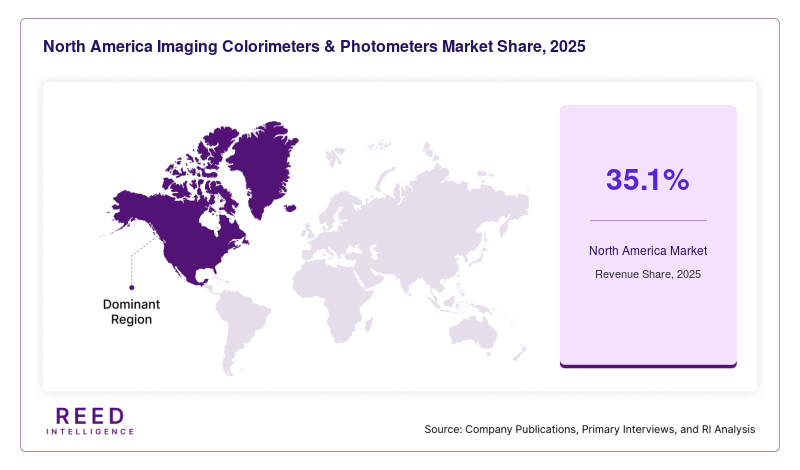
North America accounted for 35.1% of the global Imaging Colorimeters & Photometers Market share in 2025 and is expected to maintain a stable growth trajectory with a CAGR of 9.8% during the forecast period. The region benefits from strong adoption of advanced optical testing technologies across consumer electronics, aerospace, automotive, and medical device industries. The presence of established semiconductor manufacturers and display technology companies has supported demand for high-precision imaging measurement systems. In addition, increasing automation across manufacturing facilities is encouraging investments in integrated quality inspection solutions.
The United States remained the dominant contributor to regional revenue generation due to extensive R&D investments and strong demand for display calibration technologies. The country recorded market values of USD 465 million in 2024 and USD 518 million in 2025. A unique growth factor supporting the U.S. market is the rapid expansion of electric vehicle manufacturing and intelligent cockpit development. Automotive manufacturers are increasingly deploying imaging photometers for adaptive lighting analysis and digital dashboard inspection, creating sustained opportunities for market participants.
Europe
Europe represented 27.4% of the global market share in 2025 and is projected to expand at a CAGR of 9.6% during 2026–2034. The region has a strong industrial manufacturing base and significant adoption of optical inspection systems in automotive production and industrial automation applications. European companies continue to invest in advanced testing technologies to improve product quality and comply with stringent manufacturing standards. Growing use of OLED displays in automotive infotainment systems and industrial control panels is also contributing to market demand across the region.
Germany emerged as the leading country in Europe due to its strong automotive engineering sector and extensive industrial automation capabilities. One unique factor driving growth in Germany is the increasing integration of smart factory technologies within precision manufacturing facilities. German manufacturers are investing heavily in machine vision systems and automated optical inspection platforms to improve operational efficiency and maintain high-quality production standards. This trend is creating favorable demand for advanced imaging colorimeters and photometers.
Asia Pacific
Asia Pacific held a market share of 24.8% in 2025 and is expected to witness the fastest CAGR of 11.8% throughout the forecast period. Rapid industrialization, increasing electronics manufacturing activities, and expanding semiconductor production are major factors driving regional growth. Countries across Asia Pacific are investing significantly in advanced display manufacturing, particularly for OLED and MicroLED technologies. The growing presence of consumer electronics manufacturers and contract production facilities has accelerated adoption of optical testing systems for quality assurance and process optimization.
China dominated the regional market due to its extensive electronics manufacturing ecosystem and large-scale display panel production capabilities. A unique growth factor supporting the Chinese market is the government-backed expansion of domestic semiconductor and advanced display manufacturing industries. Public and private investments in high-tech manufacturing facilities are increasing demand for imaging photometers and colorimeters used in production-line inspection and calibration processes. Rising exports of electronic products are further strengthening regional market growth.
Middle East & Africa
The Middle East & Africa accounted for a smaller but steadily growing share of the Imaging Colorimeters & Photometers Market in 2025 and is projected to grow at a CAGR of 8.5% through 2034. Growth in the region is supported by increasing investments in industrial automation, healthcare infrastructure, and smart city development projects. The adoption of imaging measurement technologies remains comparatively lower than in developed markets; however, modernization initiatives across manufacturing sectors are encouraging gradual implementation of advanced optical inspection systems.
Saudi Arabia emerged as the dominant country within the region due to increasing investments in technology-driven industrial diversification programs. A unique growth factor supporting market expansion is the development of advanced manufacturing zones and electronics assembly operations under national industrial transformation initiatives. The country is also investing in smart infrastructure and digital healthcare projects that require precision display testing and calibration solutions. These initiatives are expected to contribute to steady market demand during the forecast period.
Latin America
Latin America represented a moderate share of the global market in 2025 and is expected to register a CAGR of 8.9% between 2026 and 2034. The region is witnessing gradual adoption of optical measurement technologies across automotive assembly, industrial inspection, and consumer electronics applications. Increasing demand for quality control solutions and modernization of manufacturing operations are contributing to market expansion. Companies operating in the region are also focusing on improving production efficiency and reducing defect rates through automated inspection technologies.
Brazil remained the dominant market within Latin America due to its expanding automotive and electronics manufacturing industries. A unique growth factor driving the Brazilian market is the increasing localization of consumer electronics assembly operations to support domestic demand and reduce import dependency. Manufacturers are investing in advanced testing and calibration systems to meet international quality standards and improve export competitiveness. Growing industrial automation initiatives are also expected to strengthen demand for imaging colorimeters and photometers in the country.
Competitive Landscape
The Imaging Colorimeters & Photometers Market is characterized by moderate competition with the presence of established optical instrumentation companies and specialized imaging solution providers. Market participants are focusing on product innovation, software integration, and high-speed imaging technologies to strengthen their competitive positioning. Companies are also investing in AI-based analytical platforms and automated inspection solutions to address evolving industrial requirements. Strategic collaborations with display manufacturers, automotive companies, and semiconductor producers remain common across the industry.
Konica Minolta, Inc. continues to maintain a leading position in the market due to its extensive portfolio of imaging colorimeters and advanced display measurement systems. The company recently introduced an upgraded high-speed imaging photometer platform designed for OLED and MicroLED inspection applications, improving measurement speed and production efficiency. Other major companies are also expanding their product offerings through acquisitions, regional distribution partnerships, and investments in precision sensor technologies. Increasing competition is encouraging continuous advancements in portable measurement devices, software analytics, and machine vision integration capabilities.
Key Players
- Konica Minolta, Inc.
- Radiant Vision Systems
- Admesy B.V.
- TechnoTeam Bildverarbeitung GmbH
- Instrument Systems GmbH
- Westboro Photonics Inc.
- Photo Research, Inc.
- Topcon Corporation
- Hamamatsu Photonics K.K.
- Jenoptik AG
- Optronik Line
- EVERFINE Corporation
- Shenzhen Chroma ATE Inc.
- Delta OHM S.r.l.
- Gamma Scientific
Recent Developments
- In February 2026, Konica Minolta, Inc. launched an advanced imaging photometer series designed for high-speed OLED display inspection applications in semiconductor manufacturing facilities.
- In September 2025, Radiant Vision Systems expanded its automated optical testing software capabilities by integrating AI-assisted defect recognition tools for MicroLED production environments.
- In November 2025, Instrument Systems GmbH introduced a compact portable imaging colorimeter platform optimized for automotive lighting analysis and field-based calibration applications.
- In January 2026, Admesy B.V. announced a strategic partnership with a leading Asian electronics manufacturer to develop integrated optical inspection solutions for MiniLED display production.
- In August 2025, TechnoTeam Bildverarbeitung GmbH expanded its European R&D center to accelerate innovation in machine vision-enabled photometric testing systems.
Imaging Colorimeters & Photometers Market Segments
Product Type
- Imaging Colorimeters
- Imaging Photometers
Application
- Display Testing
- Automotive Lighting Analysis
- Aerospace & Defense Displays
- Medical Imaging Inspection
- Industrial Machine Vision
- Architectural Lighting Testing
End-Use Industry
- Consumer Electronics
- Automotive Manufacturing
- Aerospace & Defense
- Healthcare
- Semiconductor Manufacturing
- Industrial Automation
By Region
- North America
- Europe
- APAC
- Middle East and Africa
- LATAM