Immunoassay Analyzers Market Size, Share Demand Report By Product Type (Automated Immunoassay Analyzers), By Technology (Enzyme-Linked Immunosorbent Assay (ELISA), Chemiluminescence Immunoassay (CLIA), Fluorescence Immunoassay (FIA)), By Application (Infectious Disease Testing, Oncology Testing, Cardiology Testing), By End Use (Hospitals, Diagnostic Laboratories), By Region & Segment Forecasts, 2026–2034
USD 3950
Market Overview
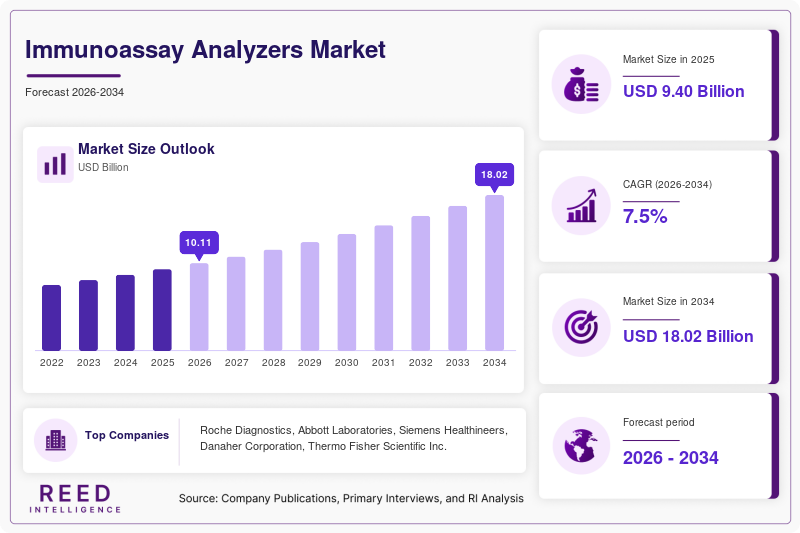
The Immunoassay Analyzers Market was valued at approximately USD 9.4 billion in 2026 and is projected to reach USD 16.8 billion by 2034, expanding at a CAGR of 7.5% during the forecast period (2026–2034). The market growth is being supported by the increasing reliance on automated diagnostic solutions that deliver high-throughput, accurate, and rapid test results across clinical laboratories and hospitals.
A key global factor contributing to market expansion is the rising burden of chronic and infectious diseases, which has driven demand for early detection and monitoring solutions. Immunoassay analyzers have become essential tools in clinical diagnostics due to their sensitivity and ability to detect biomarkers at low concentrations, supporting efficient disease management.
Healthcare systems across developed and emerging economies are investing in advanced diagnostic technologies to enhance patient outcomes and reduce diagnostic turnaround time. Additionally, the integration of digital technologies, including laboratory information systems and data analytics, has improved workflow efficiency and operational scalability, further strengthening the market outlook.
Key Highlights
- North America dominated the market with a 38.6% share in 2025, while Asia Pacific is projected to grow at the fastest CAGR of 9.1% (2026–2034).
- In terms of product type, automated immunoassay analyzers led the market with a 64.2% share in 2025, whereas chemiluminescence immunoassay analyzers are expected to register the fastest growth at a CAGR of 8.3%.
- By application, infectious disease testing was the leading segment with a 28.5% share in 2025, while oncology testing is anticipated to grow at a CAGR of 8.8%.
- The United States remained the dominant country, with market values of USD 3.1 billion in 2024 and USD 3.3 billion in 2025, driven by strong diagnostic infrastructure and high testing volumes.
Market Trends
Shift Toward Fully Automated Diagnostic Platforms
The Immunoassay Analyzers Market is witnessing a shift toward fully automated systems capable of handling large sample volumes with minimal manual intervention. These analyzers improve laboratory efficiency by reducing human error and ensuring consistent results. Automation is particularly critical in high-throughput laboratories where operational efficiency and accuracy are essential.
Laboratories are increasingly adopting integrated platforms that combine multiple testing capabilities within a single system. This trend is enhancing workflow optimization and reducing the need for multiple standalone instruments.
Growing Adoption of Chemiluminescence Immunoassay Technology
Chemiluminescence immunoassay (CLIA) technology is gaining traction due to its high sensitivity and specificity. It allows detection of low-abundance biomarkers, making it suitable for early-stage disease diagnosis. The technology also offers faster turnaround times compared to traditional methods.
The increasing preference for CLIA-based analyzers in hospitals and diagnostic laboratories is contributing to overall market growth, particularly in developed healthcare systems.
Market Drivers
Rising Demand for Early and Accurate Disease Diagnosis
The increasing prevalence of chronic conditions such as cardiovascular diseases, diabetes, and cancer has amplified the need for early and accurate diagnostic solutions. Immunoassay analyzers enable detection of disease-specific biomarkers, supporting timely intervention and treatment planning.
Healthcare providers are focusing on preventive care and early diagnosis, which is significantly driving the demand for advanced immunoassay systems across clinical settings.
Expansion of Diagnostic Laboratories and Healthcare Infrastructure
The growth of diagnostic laboratory networks and healthcare facilities, especially in emerging economies, is fueling the Immunoassay Analyzers Market. Governments and private organizations are investing in modern laboratory equipment to improve healthcare accessibility.
The expansion of laboratory services in rural and semi-urban areas is also contributing to increased adoption of immunoassay analyzers, as these systems provide reliable and scalable testing capabilities.
Market Restraints
High Cost of Advanced Immunoassay Systems
One of the major challenges in the Immunoassay Analyzers Market is the high cost associated with advanced automated systems. These instruments require significant capital investment, along with maintenance and operational costs.
This cost factor can limit adoption, particularly among small and mid-sized laboratories in developing regions, thereby restraining market growth to some extent.
Market Opportunities
Emergence of Point-of-Care Testing Solutions
The increasing demand for rapid diagnostic testing at the point of care is creating new opportunities for the Immunoassay Analyzers Market. Compact and portable analyzers are being developed to deliver quick results in outpatient settings, emergency rooms, and remote locations.
These solutions are expected to expand access to diagnostics and reduce dependence on centralized laboratories.
Integration of Artificial Intelligence in Diagnostics
The incorporation of artificial intelligence (AI) and machine learning in immunoassay systems is opening new growth avenues. AI-enabled analyzers can assist in data interpretation, pattern recognition, and predictive analytics.
This integration enhances diagnostic accuracy and supports clinical decision-making, making it a promising area for future innovation.
Segmental Analysis
By Product Type
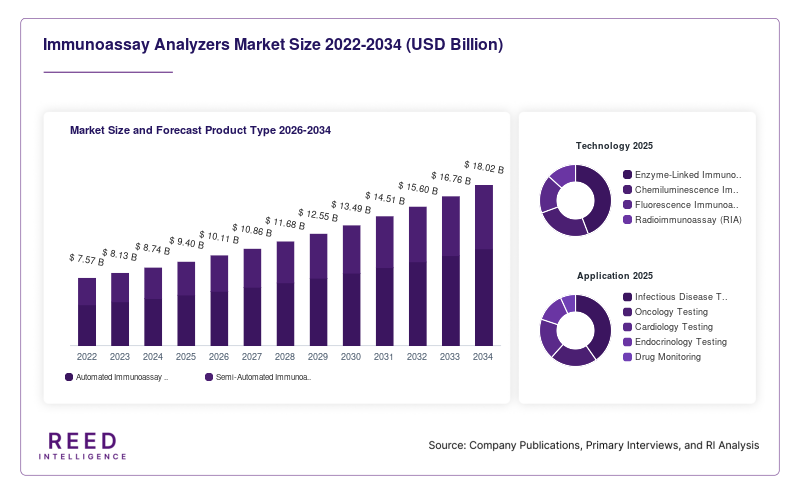
Automated immunoassay analyzers dominated the segment, accounting for 64.2% of the market share in 2025. Their ability to handle large sample volumes with minimal manual intervention made them highly preferred in clinical laboratories.
Chemiluminescence immunoassay analyzers are expected to be the fastest-growing subsegment, with a projected CAGR of 8.3%. Their superior sensitivity and ability to detect low-level biomarkers will drive their adoption in advanced diagnostics.
By Application
Infectious disease testing held the largest share at 28.5% in 2025, driven by the need for rapid and accurate detection of pathogens.
Oncology testing is anticipated to grow at the fastest rate, with a CAGR of 8.8%, owing to increasing demand for cancer biomarker detection and personalized treatment approaches.
By End-Use
Hospitals accounted for the dominant share of 46.7% in 2025, as they serve as primary centers for diagnostic testing and patient care.
Diagnostic laboratories are projected to witness the fastest growth, with a CAGR of 8.6%, supported by the expansion of independent lab chains and outsourcing of diagnostic services.
By Technology
Enzyme-linked immunosorbent assay (ELISA) technology held a significant share of 33.9% in 2025, due to its widespread use and cost-effectiveness.
Chemiluminescence technology is expected to grow at the fastest pace, registering a CAGR of 8.5%, driven by its enhanced sensitivity and automation compatibility.
Regional Analysis
North America
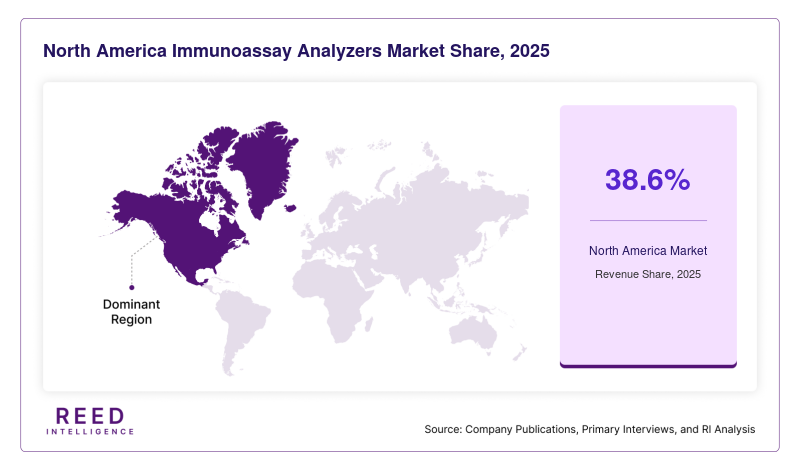
North America accounted for a 38.6% market share in 2025 and is expected to grow at a CAGR of 6.8% during the forecast period. The region's dominance was attributed to advanced healthcare infrastructure and high adoption of automated diagnostic technologies.
The United States led the region due to strong reimbursement frameworks and high diagnostic testing volumes. The presence of well-established laboratory networks further supported market growth.
Europe
Europe held a 27.4% share in 2025 and is projected to grow at a CAGR of 6.9% (2026–2034). The region benefited from increasing investments in healthcare modernization and diagnostic innovation.
Germany emerged as the dominant country, driven by its strong focus on precision diagnostics and robust healthcare system. The adoption of advanced laboratory technologies contributed significantly to market expansion.
Asia Pacific
Asia Pacific captured 21.8% of the market share in 2025 and is anticipated to grow at the fastest CAGR of 9.1%. Rapid urbanization and expanding healthcare infrastructure are key factors driving growth.
China dominated the region due to increasing healthcare expenditure and a large patient population. Government initiatives to improve diagnostic services have accelerated market adoption.
Middle East & Africa
The Middle East & Africa region accounted for 6.2% of the market share in 2025 and is expected to grow at a CAGR of 7.3%. Growth in this region was supported by improving healthcare access and infrastructure development.
Saudi Arabia led the market, driven by government investments in healthcare facilities and diagnostic capabilities.
Latin America
Latin America held a 6.0% share in 2025 and is projected to expand at a CAGR of 7.0%. The region experienced steady growth due to increasing awareness of diagnostic testing and healthcare improvements.
Brazil emerged as the dominant country, supported by expanding laboratory networks and rising demand for diagnostic services.
Competitive Landscape
The Immunoassay Analyzers Market is characterized by the presence of established global players and emerging companies focusing on technological advancements. Leading companies are investing in research and development to introduce innovative diagnostic solutions and expand their product portfolios.
A prominent market leader is Roche Diagnostics, which continues to maintain a strong position through its advanced immunoassay platforms and global distribution network. The company recently introduced upgraded analyzer systems with enhanced automation and data integration features, strengthening its competitive edge.
Other key players are focusing on strategic collaborations, product launches, and geographic expansion to increase market share. Companies are also emphasizing the development of compact and cost-effective analyzers to cater to emerging markets.
The competitive environment remains dynamic, with innovation and technological differentiation playing a critical role in shaping market positioning.
Key Players List
- Roche Diagnostics
- Abbott Laboratories
- Siemens Healthineers
- Danaher Corporation
- Thermo Fisher Scientific Inc.
- bioMérieux SA
- Ortho Clinical Diagnostics
- Sysmex Corporation
- Mindray Medical International Limited
- Beckman Coulter, Inc.
- Diasorin S.p.A.
- Becton, Dickinson and Company
- PerkinElmer, Inc.
- Agilent Technologies, Inc.
- Randox Laboratories Ltd.
Recent Developments
- In 2025, major companies introduced next-generation automated immunoassay analyzers with improved throughput and connectivity features.
- Several market players expanded their presence in Asia Pacific through partnerships with regional distributors and healthcare providers.
- New product launches focused on compact analyzers designed for point-of-care settings, enhancing accessibility in remote areas.
- Strategic collaborations between diagnostic companies and research institutions accelerated innovation in biomarker detection technologies.
- Investments in digital integration and AI-enabled diagnostics gained momentum, improving efficiency and data management in laboratories.
Immunoassay Analyzers Market Segments
Product Type
- Automated Immunoassay Analyzers
- Semi-Automated Immunoassay Analyzers
Technology
- Enzyme-Linked Immunosorbent Assay (ELISA)
- Chemiluminescence Immunoassay (CLIA)
- Fluorescence Immunoassay (FIA)
- Radioimmunoassay (RIA)
Application
- Infectious Disease Testing
- Oncology Testing
- Cardiology Testing
- Endocrinology Testing
- Drug Monitoring
End Use
- Hospitals
- Diagnostic Laboratories
- Research Institutes
By Region
- North America
- Europe
- APAC
- Middle East and Africa
- LATAM