Immunoassay Gamma Counter Market Size, Share & Demand Report By Product Type (Single Detector Gamma Counters, Multi-Detector Gamma Counters), By Application (Clinical Diagnostics, Pharmaceutical & Biotechnology Research), By End User (Pharmaceutical & Biotechnology Companies, Academic & Research Institutes, Contract Research Organizations), By Region & Segment Forecasts, 2026–2034
USD 3950
Market Overview
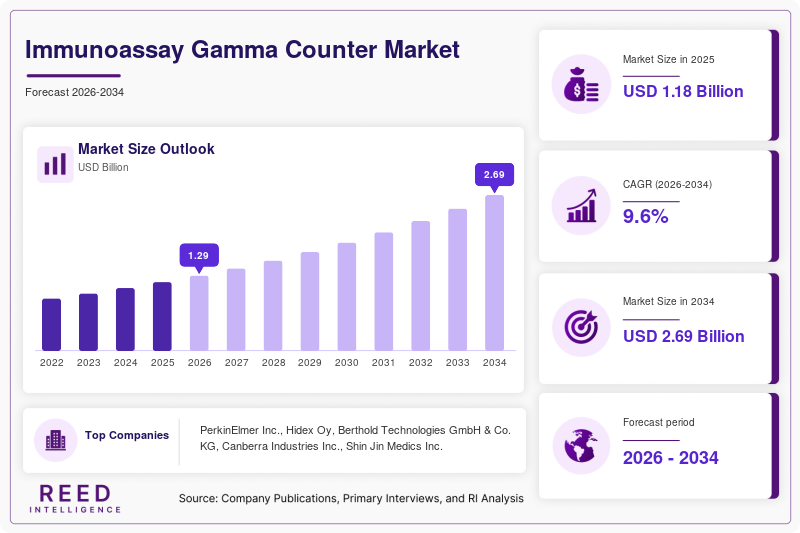
The global Immunoassay Gamma Counter Market size was valued at USD 1.18 billion in 2026 and is projected to reach USD 2.46 billion by 2034, expanding at a CAGR of 9.6% during the forecast period. The market continues to grow steadily due to increasing adoption of radioimmunoassay techniques across diagnostic laboratories, pharmaceutical research organizations, and academic institutions. Immunoassay gamma counters are widely used for detecting gamma radiation emitted from radioisotopes in clinical testing procedures, particularly in endocrinology, oncology, infectious disease diagnostics, and therapeutic drug monitoring. Rising healthcare expenditure and the growing focus on early disease diagnosis have contributed to broader implementation of advanced immunoassay systems in both developed and emerging economies.
The increasing prevalence of chronic diseases worldwide has created sustained demand for highly sensitive diagnostic technologies. Hospitals and diagnostic centers are investing in automated laboratory equipment that improves test accuracy, throughput, and workflow efficiency. In addition, pharmaceutical companies are increasing their use of immunoassay gamma counters in drug discovery and biomarker analysis. Technological improvements such as compact systems, automated sample handling, digital data management, and integrated software platforms are supporting broader market penetration. Demand has also increased due to rising clinical research activities and expanding applications of nuclear medicine.
Key Highlights
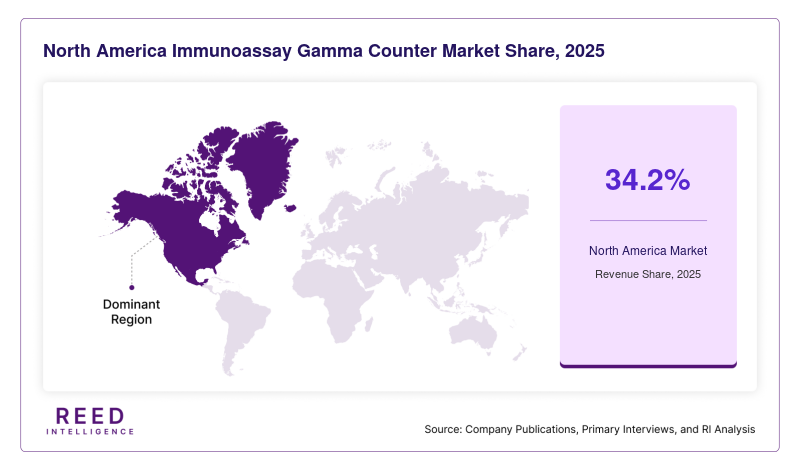
- North America dominated the market with a 34.2% share in 2025.
- Asia Pacific is expected to grow at the fastest CAGR of 11.2% during 2026–2034.
- By product type, automatic gamma counters accounted for the largest share of 44.8%.
- while multi-detector gamma counters are projected to grow at a CAGR of 10.8%.
- By application, clinical diagnostics led with a 47.1% share.
- whereas pharmaceutical and biotechnology research is expected to expand at a CAGR of 11.5%.
- The United States remained the dominant country, with market values of USD 402 million in 2024 and USD 438 million in 2025.
Market Trends
Integration of Automation and Digital Laboratory Infrastructure
Healthcare laboratories are increasingly adopting automated immunoassay gamma counter systems to improve operational efficiency and testing precision. Modern systems now include robotic sample handling, barcode scanning, integrated calibration tools, and cloud-based data management platforms. These technological improvements help laboratories reduce manual intervention and minimize testing errors during high-volume diagnostic procedures. Hospitals and clinical laboratories are facing rising demand for accurate diagnostic testing, particularly in oncology and endocrinology, which is accelerating the transition toward advanced automated platforms. Manufacturers are also developing compact systems that fit into space-constrained laboratories while maintaining high throughput capabilities.
The growing use of laboratory information management systems is another factor influencing market development. Immunoassay gamma counters are increasingly being integrated with centralized laboratory software that enables real-time monitoring and reporting. This integration supports workflow optimization and faster decision-making in clinical environments. Research institutions are also using automated systems to handle larger sample volumes in biomarker analysis and pharmaceutical testing. As laboratories continue to modernize their infrastructure, demand for digitally connected and automated gamma counting solutions is expected to rise steadily across both developed and emerging healthcare markets.
Rising Adoption of Precision Medicine and Specialized Diagnostics
The increasing emphasis on precision medicine is influencing demand for highly sensitive immunoassay technologies. Healthcare providers are focusing on personalized treatment approaches that rely on accurate biomarker identification and targeted disease monitoring. Immunoassay gamma counters support these applications by enabling precise measurement of radioactively labeled substances used in advanced diagnostic testing. The growing prevalence of cancer, hormonal disorders, autoimmune diseases, and infectious conditions has encouraged healthcare systems to invest in specialized diagnostic platforms capable of supporting individualized patient care.
Pharmaceutical and biotechnology companies are also increasing their investments in precision medicine research programs. Immunoassay gamma counters are widely used in clinical trials and drug development processes to evaluate biological responses and therapeutic effectiveness. Academic research centers are expanding studies involving molecular biology and radioimmunoassay techniques, further strengthening equipment demand. In addition, healthcare authorities are supporting early disease detection initiatives, which has accelerated the use of specialized laboratory testing procedures. These developments are contributing to broader adoption of immunoassay gamma counter systems in diagnostic laboratories and research facilities worldwide.
Market Drivers
Growing Demand for Advanced Clinical Diagnostic Testing
The increasing incidence of chronic and infectious diseases worldwide has significantly increased demand for advanced clinical diagnostic solutions. Immunoassay gamma counters are widely used in hormone testing, cancer diagnostics, allergy screening, and infectious disease monitoring due to their high sensitivity and accuracy. Healthcare providers are placing greater emphasis on early disease detection to improve treatment outcomes and reduce long-term healthcare costs. As a result, hospitals and diagnostic laboratories are expanding investments in sophisticated laboratory technologies that can deliver precise and reliable test results.
Population aging is another factor supporting diagnostic testing volumes globally. Elderly populations are more susceptible to chronic conditions that require regular laboratory evaluation and monitoring. Immunoassay gamma counters play an important role in endocrine testing and therapeutic drug monitoring, which are essential in long-term disease management. In addition, public health agencies are increasing laboratory testing capabilities to strengthen disease surveillance programs. The combination of rising patient volumes, increased healthcare spending, and growing awareness regarding preventive diagnostics continues to support expansion of the Immunoassay Gamma Counter Market.
Expansion of Pharmaceutical Research and Nuclear Medicine Applications
The pharmaceutical and biotechnology industries are increasingly relying on immunoassay technologies during drug discovery, clinical trials, and biomarker analysis. Immunoassay gamma counters provide accurate quantification of radiolabeled compounds used in pharmaceutical research processes. Growing investments in biologics, targeted therapies, and personalized medicine are encouraging research organizations to adopt advanced gamma counting equipment. Contract research organizations and academic laboratories are also expanding their use of immunoassay systems for molecular biology studies and therapeutic evaluation.
The rapid development of nuclear medicine has further accelerated demand for gamma counting systems. Nuclear medicine procedures require reliable radiation detection technologies for diagnostic and research applications. Healthcare institutions are increasingly using radioisotopes in oncology imaging and therapeutic monitoring, creating additional demand for specialized laboratory equipment. Technological advancements in radiation detection systems have improved sensitivity, operational safety, and testing throughput. These improvements are supporting broader adoption of immunoassay gamma counters across pharmaceutical companies, research institutes, and healthcare facilities worldwide.
Market Restraint
High Equipment Costs and Regulatory Compliance Challenges
The high initial cost associated with immunoassay gamma counter systems remains a significant challenge for market expansion, particularly in low-income and developing healthcare markets. Advanced gamma counters require sophisticated radiation detection components, automated sample handling systems, calibration mechanisms, and integrated software platforms, all of which increase overall equipment pricing. Smaller diagnostic laboratories and regional hospitals often face budget limitations that restrict investments in advanced nuclear diagnostic technologies. In addition to equipment acquisition costs, healthcare providers must allocate resources for maintenance, staff training, radiation safety infrastructure, and compliance monitoring.
Regulatory requirements related to radioactive material handling also create operational complexity for healthcare facilities and research laboratories. Government authorities impose strict regulations regarding storage, disposal, transportation, and usage of radioactive substances to ensure environmental and occupational safety. Compliance with these standards can increase administrative and operational costs for laboratories using immunoassay gamma counters. Delays in regulatory approvals may also affect product launches and market expansion strategies for manufacturers. For example, smaller research laboratories in emerging economies may avoid adopting gamma counting systems due to the complexity of obtaining radiation handling certifications and maintaining long-term compliance with nuclear safety guidelines.
Market Opportunities
Increasing Healthcare Investments in Emerging Economies
Emerging economies across Asia Pacific, Latin America, and the Middle East are significantly increasing investments in healthcare infrastructure and diagnostic laboratory modernization. Governments are expanding public healthcare programs and improving access to advanced medical technologies in urban and semi-urban regions. Diagnostic centers are adopting modern laboratory equipment to address rising demand for chronic disease screening and infectious disease testing. These developments are creating favorable opportunities for manufacturers of immunoassay gamma counter systems.
Private healthcare providers are also increasing investments in specialized diagnostic services as healthcare awareness rises among middle-income populations. Many emerging countries are focusing on improving laboratory quality standards and reducing dependency on imported diagnostic testing services. International healthcare companies are entering these markets through partnerships and distribution agreements to strengthen regional presence. The growing number of hospitals, diagnostic laboratories, and research institutes in emerging economies is expected to create sustained demand for gamma counting technologies during the forecast period.
Development of Compact and Multi-Functional Gamma Counter Systems
Manufacturers are increasingly focusing on developing compact, user-friendly, and multi-functional immunoassay gamma counter systems to meet evolving laboratory requirements. Modern laboratories prefer equipment that can support multiple testing applications while occupying minimal operational space. Compact systems with automated calibration, touchscreen interfaces, and digital connectivity are attracting strong interest from hospitals and research institutions seeking efficient laboratory workflows.
The growing demand for decentralized diagnostic services is also supporting development of portable and flexible laboratory equipment. Companies are integrating artificial intelligence-based analytics and advanced software tools into gamma counter systems to improve data interpretation and operational efficiency. Multi-detector systems capable of handling higher sample volumes are becoming increasingly popular in pharmaceutical research and large clinical laboratories. These innovations are expected to expand market opportunities by improving accessibility, reducing operational complexity, and supporting broader adoption across small and medium-sized healthcare facilities.
Segmental Analysis
By Product Type
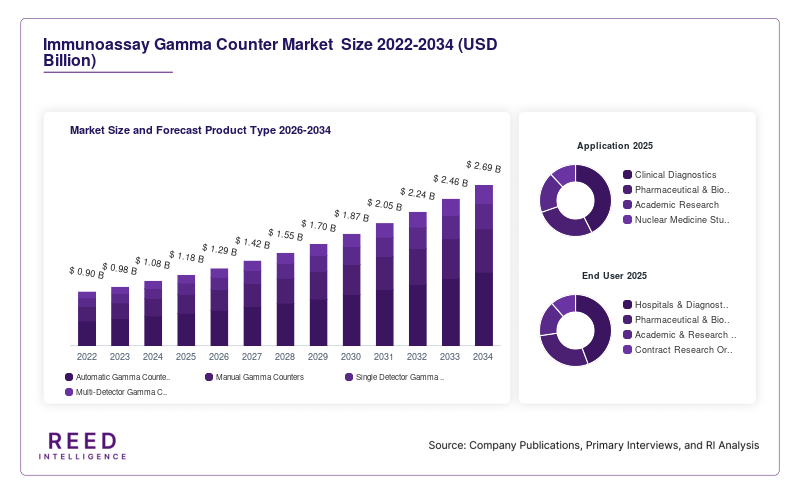
Automatic gamma counters accounted for the largest market share of 44.8% in 2024 due to their widespread adoption across hospitals, diagnostic laboratories, and pharmaceutical research facilities. These systems provide high throughput capabilities, automated sample handling, and reduced operational errors, making them highly suitable for large-scale laboratory operations. Healthcare providers increasingly prefer automated systems because they improve workflow efficiency and reduce turnaround time for diagnostic testing. The growing need for accurate hormone testing, cancer biomarker analysis, and infectious disease diagnostics has further accelerated adoption of automatic gamma counters globally.
Automatic systems also support integration with laboratory information management systems, enabling digital data storage and real-time reporting capabilities. Research laboratories benefit from enhanced precision and reproducibility offered by automated platforms, particularly during high-volume clinical studies. The expansion of centralized diagnostic laboratories in developed healthcare markets has additionally strengthened the dominance of this segment.
By Application
Clinical diagnostics represented the largest market share of 47.1% in 2024 due to increasing use of immunoassay gamma counters in hormone testing, oncology diagnostics, infectious disease detection, and therapeutic drug monitoring. Hospitals and diagnostic centers continue to rely on gamma counting technologies because of their high sensitivity and accuracy in detecting radiolabeled substances. Rising global prevalence of chronic diseases has increased the demand for advanced laboratory testing procedures capable of supporting early disease detection and long-term patient monitoring.
The growing aging population has also contributed significantly to the dominance of the clinical diagnostics segment. Elderly patients often require regular endocrine and metabolic testing, which increases demand for immunoassay technologies in healthcare settings. Public healthcare agencies are expanding disease surveillance and preventive screening programs, further supporting laboratory testing volumes. Diagnostic laboratories are increasingly adopting automated gamma counter systems to improve operational efficiency and reduce testing errors while managing rising patient demand.
By End User
Hospitals and diagnostic laboratories held the largest market share of 52.6% in 2024 because they represent the primary users of immunoassay gamma counter systems for routine clinical testing. These facilities conduct large volumes of diagnostic procedures related to endocrinology, oncology, infectious diseases, and therapeutic drug monitoring. Rising patient admissions and increasing demand for preventive healthcare services have encouraged hospitals to invest in advanced laboratory infrastructure. Automated gamma counter systems help healthcare facilities improve testing efficiency, reduce human error, and enhance overall diagnostic accuracy.
The expansion of centralized diagnostic laboratory networks has also strengthened the dominance of this segment. Many healthcare providers are modernizing laboratory operations through adoption of digital systems and automated testing technologies. Government initiatives supporting early disease detection and chronic disease management are further increasing laboratory testing demand. Hospitals and diagnostic laboratories continue to prioritize investments in high-performance immunoassay systems to improve patient outcomes and streamline clinical workflows.
Regional Analysis
North America
North America accounted for 34.2% of the global Immunoassay Gamma Counter Market share in 2025 and is expected to maintain steady growth at a CAGR of 8.7% during the forecast period. The region benefits from advanced healthcare infrastructure, high diagnostic testing volumes, and strong adoption of automated laboratory technologies. Hospitals and clinical laboratories in the United States and Canada continue to invest in high-performance immunoassay systems to improve disease detection accuracy. Pharmaceutical companies and academic research organizations are also contributing to demand through increasing biomarker research and clinical trial activities.
The United States remains the dominant country in North America due to strong healthcare spending and a large network of diagnostic laboratories. The country recorded market values of USD 402 million in 2024 and USD 438 million in 2025. One unique growth factor supporting the U.S. market is the increasing use of precision medicine programs in oncology and endocrinology diagnostics. Research institutions are actively integrating advanced gamma counting technologies into personalized treatment studies, while hospitals continue to modernize laboratory operations with automated diagnostic systems.
Europe
Europe represented 27.6% of the global market share in 2025 and is projected to expand at a CAGR of 8.4% between 2026 and 2034. The region has a well-established healthcare system and strong regulatory framework supporting laboratory quality standards. Countries across Western Europe are increasingly investing in advanced diagnostic technologies to strengthen chronic disease management and preventive healthcare services. Rising cancer incidence and growing demand for hormone testing have encouraged hospitals and diagnostic centers to adopt sophisticated immunoassay gamma counter systems.
Germany remains the leading country within the European market due to its strong pharmaceutical manufacturing base and extensive research infrastructure. German healthcare institutions continue to invest in nuclear medicine and clinical diagnostics to support advanced patient care services. A unique factor driving growth in Germany is the increasing collaboration between academic research centers and biotechnology companies in radiopharmaceutical development. These partnerships are supporting higher adoption of gamma counters for molecular biology research and radioimmunoassay applications.
Asia Pacific
Asia Pacific held 22.4% of the global Immunoassay Gamma Counter Market share in 2025 and is expected to register the fastest CAGR of 11.2% during the forecast period. Rapid healthcare infrastructure development and rising healthcare expenditure are major factors driving regional market growth. Countries such as China, India, Japan, and South Korea are increasing investments in laboratory modernization and advanced diagnostic services. Expanding patient populations and growing awareness regarding early disease detection are also contributing to rising demand for immunoassay technologies.
China dominates the Asia Pacific market due to strong government support for healthcare expansion and increasing domestic diagnostic manufacturing capabilities. The country is experiencing rising demand for laboratory testing related to chronic diseases, infectious conditions, and cancer diagnostics. One unique growth factor supporting the Chinese market is the rapid expansion of hospital laboratory networks in secondary and tertiary cities. Healthcare reforms and increased adoption of digital healthcare systems are encouraging laboratories to integrate automated immunoassay gamma counter technologies into routine diagnostic operations.
Middle East & Africa
The Middle East & Africa accounted for 8.1% of the global market share in 2025 and is anticipated to grow at a CAGR of 7.9% through 2034. The region is gradually improving healthcare infrastructure and expanding access to specialized diagnostic services. Governments in Gulf Cooperation Council countries are investing heavily in healthcare modernization projects and laboratory expansion initiatives. Rising awareness regarding cancer screening and endocrine disorders is encouraging healthcare providers to adopt advanced immunoassay technologies.
Saudi Arabia remains the dominant country within the regional market due to increasing healthcare investments and expansion of private diagnostic centers. The country is focusing on improving healthcare quality standards and reducing dependency on overseas medical services. A unique factor driving market growth in Saudi Arabia is the implementation of national healthcare transformation programs aimed at strengthening diagnostic infrastructure. Public and private healthcare institutions are increasing procurement of laboratory equipment to support broader disease screening and preventive healthcare initiatives.
Latin America
Latin America captured 7.7% of the global Immunoassay Gamma Counter Market share in 2025 and is projected to grow at a CAGR of 8.1% during the forecast period. Regional market growth is supported by increasing healthcare spending and rising adoption of advanced diagnostic technologies in urban healthcare centers. Countries across the region are expanding access to laboratory testing services to improve chronic disease management and infectious disease surveillance. Private diagnostic chains are also investing in automated laboratory equipment to improve operational efficiency and testing accuracy.
Brazil remains the leading country in the Latin American market due to its large healthcare system and expanding pharmaceutical research sector. The country has experienced growing demand for specialized diagnostic testing in oncology and endocrinology applications. One unique growth factor supporting the Brazilian market is the increasing participation of private healthcare providers in laboratory modernization programs. Diagnostic laboratories are adopting advanced gamma counter systems to enhance testing capabilities and support rising patient volumes across metropolitan healthcare facilities.
Competitive Landscape
The Immunoassay Gamma Counter Market is moderately consolidated, with several global and regional companies competing through product innovation, automation capabilities, and strategic partnerships. Leading manufacturers are focusing on improving system sensitivity, software integration, and workflow automation to strengthen their competitive positions. Companies are also expanding their geographic presence through distribution agreements and collaborations with healthcare institutions and research organizations.
PerkinElmer Inc. remains one of the leading companies in the market due to its broad portfolio of laboratory diagnostic solutions and strong presence across pharmaceutical and clinical research sectors. The company recently introduced enhanced digital integration features for its gamma counting systems to improve laboratory efficiency and data management capabilities. Other major players are increasing investments in compact system development and multi-detector technologies to address evolving laboratory requirements.
Competition is further influenced by increasing demand for customized laboratory solutions and expanding research applications in precision medicine. Companies are focusing on strategic acquisitions and partnerships to strengthen product portfolios and improve regional market penetration. Growing healthcare investments in emerging economies are also encouraging manufacturers to expand local distribution and service networks.
Key Players
- PerkinElmer Inc.
- Hidex Oy
- Berthold Technologies GmbH & Co. KG
- Canberra Industries Inc.
- Shin Jin Medics Inc.
- DRG International Inc.
- LabLogic Systems Ltd.
- Eurodiagnostica AB
- Nuvia Instruments GmbH
- Universal Medical Inc.
- Capintec Inc.
- LND Inc.
- Bio-Rad Laboratories Inc.
- Thermo Fisher Scientific Inc.
- DiaSorin S.p.A.
Recent Developments
- In February 2026, PerkinElmer Inc. launched an upgraded automated immunoassay gamma counter platform featuring cloud-based laboratory data integration and enhanced multi-sample processing capabilities.
- In September 2025, Berthold Technologies GmbH & Co. KG expanded its diagnostic instrumentation distribution network across Southeast Asia to strengthen its presence in emerging healthcare markets.
- In June 2025, Hidex Oy introduced a compact multi-detector gamma counter system designed for high-throughput pharmaceutical research and biomarker analysis applications.
- In January 2026, Thermo Fisher Scientific Inc. announced a collaboration with regional diagnostic laboratories to support laboratory automation initiatives and improve advanced diagnostic testing infrastructure.
Immunoassay Gamma Counter Market Segments
Product Type
- Automatic Gamma Counters
- Manual Gamma Counters
- Single Detector Gamma Counters
- Multi-Detector Gamma Counters
Application
- Clinical Diagnostics
- Pharmaceutical & Biotechnology Research
- Academic Research
- Nuclear Medicine Studies
End User
- Hospitals & Diagnostic Laboratories
- Pharmaceutical & Biotechnology Companies
- Academic & Research Institutes
- Contract Research Organizations
By Region
- North America
- Europe
- APAC
- Middle East and Africa
- LATAM