Independent Software Vendors Market Size, Share & Trends Analysis Report By Software Delivery Model (SaaS, Cloud-Native, On-Premises & Hybrid), By Application (Enterprise Applications, Cybersecurity, Data & Analytics, Productivity & Collaboration, Industry-Specific Software), By Enterprise Size (Large Enterprises, SMEs) and By Region (North America, Europe, Asia-Pacific, Middle East and Africa, Latin America) Forecasts, 2026–2034
USD 3950
Independent Software Vendors Market Size
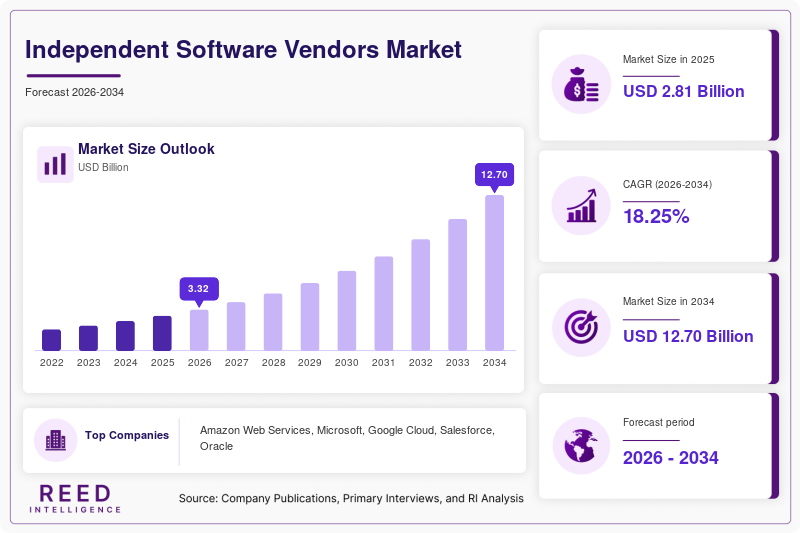
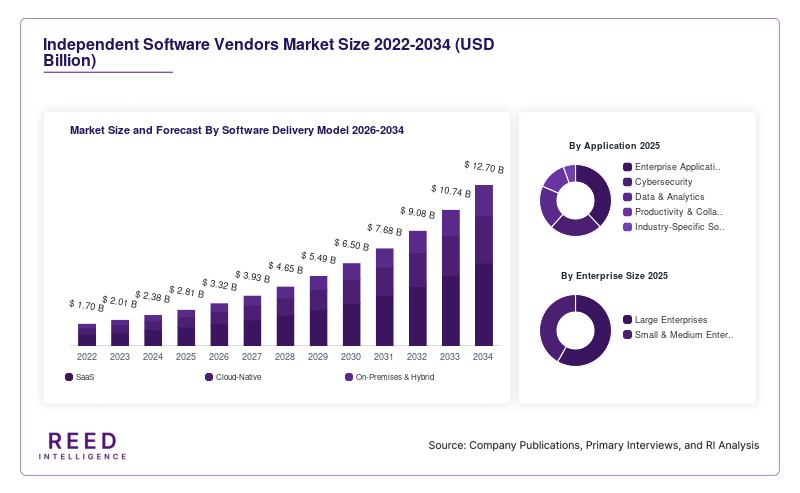
The independent software vendors market was valued at USD 2.81 billion in 2025 and is projected to grow from USD 3.32 billion in 2026 to USD 12.70 billion by 2034, registering a CAGR of 18.25% during the forecast period from 2026 to 2034.
The Independent Software Vendors (ISV) market is shifting from a predominantly standalone software-selling model toward ecosystem-based distribution, cloud marketplaces, SaaS delivery, embedded applications and AI-enabled software. ISVs increasingly use hyperscaler and enterprise-platform ecosystems to reach customers, simplify procurement and integrate their products directly into existing technology environments. AWS Marketplace, Microsoft Marketplace and Google Cloud Marketplace all provide mechanisms for ISVs to publish and sell software through established cloud procurement channels.
The commercial mechanism is important because software procurement is becoming more closely connected to cloud spending and existing enterprise contracts. Microsoft allows eligible Marketplace purchases to count toward Azure consumption commitments, while AWS and Google Cloud provide marketplace-based billing and procurement mechanisms.
Independent Software Vendors Market Drivers
Cloud Marketplaces Are Turning Enterprise Procurement Into a Scalable Distribution Channel for ISVs
Cloud marketplaces are increasingly functioning as procurement infrastructure rather than simple software catalogs. AWS allows ISVs to offer SaaS, AMIs, containers and other software formats while handling metering, billing, collections and payment disbursement.
Microsoft Marketplace similarly enables SaaS, Azure applications, containers and other software offers, while supporting private offers and customized commercial terms.
The market mechanism is direct: an ISV can reach customers through an established procurement environment instead of building every transaction, billing and channel relationship independently. This particularly benefits cybersecurity, data, infrastructure and enterprise application vendors whose buyers already operate within major cloud ecosystems.
The counterbalance is platform dependency. ISVs must comply with marketplace technical, security and commercial requirements and compete for visibility against a large ecosystem of vendors.
AI Applications and Agents Are Expanding the Addressable Product Base for Independent Vendors
AI is creating new categories of software that can be developed and commercialized by ISVs, including AI agents, industry-specific copilots, data applications and AI-enabled enterprise workflows. Microsoft explicitly positions ISV Success around building and publishing applications and agents through Microsoft Marketplace, while Google Cloud has created an AI Agent Marketplace category for partner solutions.
This creates a market mechanism beyond simply replacing legacy software. Independent vendors can add AI functionality to established applications or create specialized products for individual business processes.
The strongest commercial effect is likely to occur in enterprise applications, cybersecurity, analytics and industry-specific software, where customers require specialized workflows rather than generic AI capabilities.
However, AI also lowers some software-development barriers and can increase competitive intensity. Larger cloud platforms and established software companies can replicate features quickly, while customers may consolidate vendors if AI capabilities become embedded directly into existing platforms.
Partner Ecosystems Are Reducing the Go-to-Market Barrier for Specialized Software Vendors
ISVs increasingly use resellers, systems integrators, cloud providers and enterprise application ecosystems to extend their distribution. Google Cloud Marketplace allows channel partners to resell ISV products through private offers, while AWS provides marketplace channel mechanisms through which ISVs can authorize partners to resell their software.
The commercial mechanism is particularly important for specialized software vendors that may have strong technology but limited direct sales coverage. Channel partners can provide implementation capabilities, customer relationships and regional access.
Microsoft also supports CSP partners in selling ISV solutions through Marketplace, allowing software to be bundled with other Microsoft solutions.
The limitation is margin sharing and reduced control over customer relationships. ISVs must balance direct sales with ecosystem distribution to retain economics and customer ownership.
Independent Software Vendors Market Restraints
Platform Dependency Can Increase Commercial and Technical Switching Costs for ISVs
Cloud marketplaces create distribution advantages but also make ISVs increasingly dependent on platform rules, APIs, technical standards and commercial structures. AWS, Microsoft, Google Cloud and Oracle each operate their own marketplace and partner requirements, creating multiple ecosystem-specific integration and certification considerations.
The economic effect is that an ISV pursuing multi-cloud distribution may need to maintain multiple integrations, commercial workflows and support arrangements. This can increase development and operational costs.
The constraint is strongest for smaller vendors with limited engineering and partner-management resources. Multi-cloud architectures and standardized APIs can reduce this burden, but deeper platform-native integration may simultaneously increase customer stickiness and technical dependency.
Security, Compliance and Marketplace Qualification Increase the Cost of Scaling Software Distribution
Enterprise software buyers increasingly require vendors to demonstrate security, compliance and operational reliability before procurement. Marketplace platforms also impose publishing, validation and technical requirements. Google Cloud describes Marketplace products as validated solutions, while Salesforce requires ISV partners to complete security review and publishing processes before distributing applications through its ecosystem.
These requirements can delay commercialization for smaller vendors and increase spending on security engineering, documentation, compliance and customer support.
The constraint is not necessarily negative for established vendors because qualification can strengthen buyer confidence and reduce procurement friction. However, it raises the minimum operational capability required for an ISV to compete effectively in enterprise software markets.
Independent Software Vendors Market Opportunities
AI-Native Vertical Software Creates Space for ISVs to Monetize Specialized Workflows
The expansion of AI agents creates an opportunity for independent vendors to build software around specific business processes rather than competing directly with broad productivity platforms. Google Cloud's Marketplace now supports discovery and deployment of partner-built AI agents, while Microsoft is explicitly developing its ISV ecosystem around AI applications and agents.
The commercial opportunity is strongest where customers require domain-specific data, workflows, integrations or governance. Examples include industry-specific compliance, cybersecurity, financial operations, healthcare administration and enterprise service management.
The mechanism is a combination of specialized software functionality and AI automation. ISVs can monetize recurring subscriptions while using cloud marketplaces to reduce procurement friction.
Adoption could be constrained by AI reliability, data governance, security requirements and customer concerns about handing business processes to automated agents.
Marketplace-Native Channel Models Can Expand International Distribution Without Equivalent Direct-Sales Expansion
Cloud marketplaces allow ISVs to combine direct selling with resellers, private offers and ecosystem-based distribution. Google Cloud's channel private-offer model allows customers to purchase ISV solutions through selected channel partners, while AWS provides selling authorization mechanisms for ISVs and channel partners.
This creates an opportunity for smaller software vendors to enter markets where building a direct sales organization would require substantial investment.
The mechanism is particularly relevant to cybersecurity, data, infrastructure and specialized enterprise applications that require implementation partners.
The main adoption barrier is channel economics. ISVs must provide sufficient margin and partner incentives while maintaining control over product positioning, pricing and customer experience.
Software Delivery Model Analysis
By Software Delivery Model
SaaS accounts for approximately 54% of the global ISV market in 2025. Subscription-based delivery provides ISVs with recurring monetization while allowing customers to consume software without managing the full underlying infrastructure. AWS Marketplace supports SaaS listings and billing mechanisms, while Microsoft Marketplace provides transactable SaaS offers and private commercial arrangements.
The model is particularly relevant to cybersecurity, collaboration, analytics and business applications, where customers increasingly expect frequent software updates and scalable deployment.
Cloud-Native software accounts for approximately 31% of the 2025 market and is the fastest-growing delivery model, with a projected CAGR of approximately 20.35% through 2034. Its expansion is associated with applications designed specifically for cloud architectures, containers, managed services and AI workloads.
On-Premises & Hybrid software represents approximately 15% of the market and is projected to grow at approximately 14.00% CAGR. Hybrid deployment remains relevant where customers require control over sensitive data, legacy systems or regulated workloads.
Application Analysis
By Application
Enterprise Applications account for approximately 30% of the global market in 2025. These products include business applications supporting finance, human resources, customer management, operations and other organizational processes.
Their demand is supported by the need for specialized functionality that can extend existing enterprise platforms. Microsoft Marketplace, Oracle Marketplace and Salesforce's partner ecosystem all provide routes for independent vendors to extend broader enterprise technology environments.
Cybersecurity accounts for approximately 24% of the 2025 market and represents the fastest-growing application segment, with a projected CAGR of approximately 21.20% through 2034. Security requirements are increasingly integrated into cloud and AI adoption, creating demand for independent tools covering identity, threat detection, data protection and application security.
Data & Analytics accounts for approximately 19% and is projected to grow at approximately 18.60% CAGR.
Productivity & Collaboration represents approximately 15% and is projected to grow at approximately 16.80% CAGR.
Industry-Specific Software accounts for approximately 12% and is projected to grow at approximately 17.70% CAGR, supported by specialized workflows and vertical requirements.
Enterprise Size Analysis
By Enterprise Size
Large Enterprises Hold the Largest Share Because Complex IT Environments Require Specialized Software
Large enterprises account for approximately 68% of the ISV market in 2025. Their larger technology estates create demand for specialized applications that integrate with cloud infrastructure, enterprise databases, security systems and business platforms.
Enterprise procurement also increasingly uses private offers and structured marketplace purchasing. Microsoft supports private offers for customized pricing and terms, while AWS and Google Cloud provide similar mechanisms for enterprise transactions.
SMEs account for approximately 32% of the 2025 market and are projected to grow at approximately 20.10% CAGR, making them the fastest-growing enterprise-size segment. SaaS reduces infrastructure requirements and allows smaller organizations to adopt specialized software through subscription models.
Cost sensitivity and limited internal IT resources remain constraints, but simplified cloud deployment and marketplace procurement can reduce adoption friction.
Independent Software Vendors Market Regional Analysis
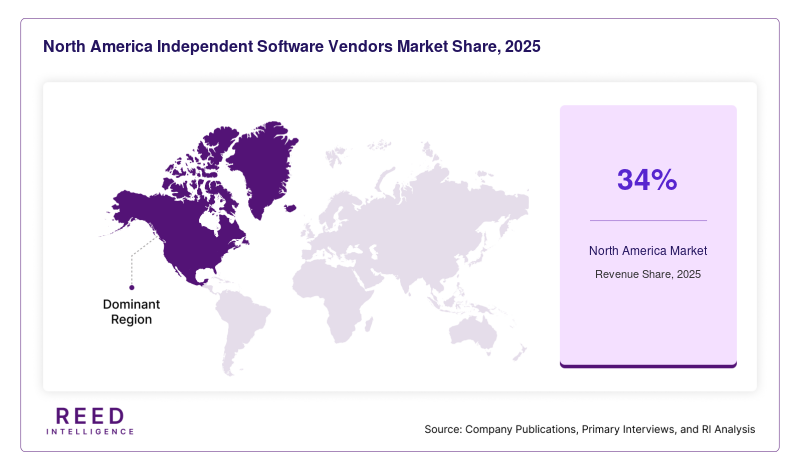
North America Holds the Largest Regional Share Because Its Enterprise Software Ecosystem Supports High ISV Adoption
North America accounts for approximately 34% of the global ISV market in 2025 and is projected to grow at approximately 17.60% CAGR through 2034. The region benefits from a mature enterprise software ecosystem, extensive cloud adoption and strong presence of hyperscalers and platform companies.
Marketplace infrastructure is particularly developed across the region. Microsoft Marketplace, AWS Marketplace and Salesforce's AppExchange/AgentExchange ecosystems provide ISVs with established mechanisms for product distribution, procurement and integration.
The region's growth mechanism increasingly centers on SaaS, cybersecurity, AI applications and enterprise workflow software. Private offers also allow ISVs to accommodate enterprise procurement requirements rather than relying exclusively on standardized pricing.
The principal constraints are intense competition, customer vendor consolidation and high expectations around security and integration.
Europe Maintains a Strong ISV Base as Cloud Procurement and Enterprise Modernization Expand
Europe accounts for approximately 27% of the market in 2025 and is projected to grow at approximately 17.20% CAGR through 2034. European customers increasingly use cloud and marketplace-based procurement to acquire enterprise applications, cybersecurity solutions and data technologies.
Google Cloud, Microsoft and other ecosystem providers support marketplace procurement and partner distribution in European markets. The European market also places substantial emphasis on data governance, security and regulatory compliance, creating demand for software vendors that can demonstrate appropriate controls.
The opportunity is strongest for cybersecurity, compliance technology, enterprise applications and industry-specific software. However, fragmented national markets, language requirements and differing procurement practices can increase the cost of regional expansion.
Asia-Pacific Represents the Fastest-Growing Regional Market as Cloud Adoption and Local Software Ecosystems Expand
Asia-Pacific accounts for approximately 23% of the global market in 2025 and is projected to grow at approximately 22.00% CAGR through 2034, making it the fastest-growing region. The market is supported by increasing cloud adoption, enterprise digitization and the development of locally specialized software products.
AWS expanded marketplace transaction capabilities for India-based sellers in 2025, allowing local ISVs to sell paid offerings to Indian buyers with local-currency invoicing and tax-compliance mechanisms.
This development demonstrates a broader market mechanism: simplifying local procurement can make marketplace distribution more practical for regional ISVs and their customers.
China, India, Japan, South Korea, Australia and Southeast Asia represent important demand centers, although market structures differ considerably. Localization, regulatory requirements, cloud preferences and channel relationships remain key constraints.
Middle East and Africa Represent a Smaller Market With Cloud and Specialized Enterprise Software Creating Expansion Paths
Middle East and Africa account for approximately 8% of the market in 2025 and are projected to grow at approximately 17.50% CAGR through 2034. Demand is linked to enterprise digitization, cloud adoption, cybersecurity requirements and modernization of business applications.
Cloud marketplaces can reduce some of the distribution barriers associated with entering geographically dispersed markets because customers can discover and procure software through established technology platforms. Google Cloud, AWS and Microsoft all provide marketplace mechanisms supporting third-party software procurement.
Growth is likely to concentrate in major business and technology hubs. Constraints include uneven digital infrastructure, limited local implementation capacity and differences in procurement and data requirements.
Latin America Develops Through SaaS Adoption and Partner-Led Software Distribution
Latin America accounts for approximately 8% of the market in 2025 and is projected to grow at approximately 17.10% CAGR through 2034. SaaS provides an important route to adoption because customers can obtain specialized applications without building equivalent infrastructure internally.
Channel partnerships are particularly relevant because local resellers and systems integrators can provide implementation and customer support. AWS and Google Cloud both support channel-based mechanisms for ISV distribution.
The main constraints are currency volatility, enterprise IT budgets, local compliance requirements and limited availability of specialized implementation resources in some markets.
Independent Software Vendors Market Competitive Landscape
Competition in the ISV market is increasingly determined by distribution access, integration depth, recurring revenue models and ecosystem positioning, rather than software functionality alone.
Cloud marketplaces have become an important competitive layer. Amazon Web Services provides AWS Marketplace mechanisms for ISVs to sell SaaS, AMIs, containers and other products, while its channel program allows ISVs to authorize partners to resell their offerings. AWS Marketplace
Microsoft is positioning Microsoft Marketplace and ISV Success around application development, AI agents, publishing and enterprise sales. Its private-offer infrastructure also gives ISVs greater flexibility in structuring enterprise transactions. Microsoft ISV Success
Key Market Players
- Amazon Web Services
- Microsoft
- Google Cloud
- Salesforce
- Oracle
- SAP
- ServiceNow
- IBM
- Adobe
- Atlassian
Independent Software Vendors Market Recent Developments
- June 2026 – AWS Marketplace Storefront became generally available. AWS introduced branded storefronts that allow ISVs and channel partners to present AWS Marketplace solutions through their own websites or applications while retaining AWS Marketplace billing infrastructure. The development can reduce the separation between an ISV's direct digital presence and marketplace procurement, giving vendors greater control over customer discovery while preserving marketplace transaction infrastructure.
- 2025 – Microsoft expanded ISV Success around AI applications and agents. Microsoft positioned ISV Success as a program for developing, publishing and commercializing software through Microsoft Marketplace, including AI applications and agents. The development strengthens Microsoft's marketplace as a route from software development to enterprise distribution.
Independent Software Vendors Market Segments
By Software Delivery Model
- SaaS
- Cloud-Native
- On-Premises & Hybrid
By Application
- Enterprise Applications
- Cybersecurity
- Data & Analytics
- Productivity & Collaboration
- Industry-Specific Software
By Enterprise Size
- Large Enterprises
- Small & Medium Enterprises
By Region
- North America
- Europe
- APAC
- Middle East and Africa
- LATAM