Indirect Calorimeter Market Size, Share & Demand Report By Product Type (Portable Indirect Calorimeters, Desktop Indirect Calorimeters, Wearable Calorimeters), By Application (Clinical Nutrition, Critical Care, Sports & Fitness, Research), By End-Use (Hospitals, Clinics, Home Care Settings, Research Institutes), By Technology (Breath-by-Breath, Mixing Chamber), By Region & Segment Forecasts, 2025–2034
USD 3950
Market Overview
The Indirect Calorimeter Market size was valued at approximately USD 620 million in 2025 and is projected to reach USD 1.28 billion by 2034, expanding at a compound annual growth rate (CAGR) of 8.4% during the forecast period (2025–2034). The market growth is driven by increasing adoption of metabolic measurement technologies across clinical nutrition, critical care, and sports performance monitoring.
A key global factor supporting the expansion of the Indirect Calorimeter Market is the rising prevalence of metabolic disorders such as obesity, diabetes, and respiratory diseases. Healthcare providers are increasingly utilizing indirect calorimetry for precise measurement of resting energy expenditure (REE), enabling personalized nutritional interventions and improved patient outcomes. Additionally, advancements in portable and user-friendly calorimetry devices are facilitating broader adoption across hospitals and outpatient settings.
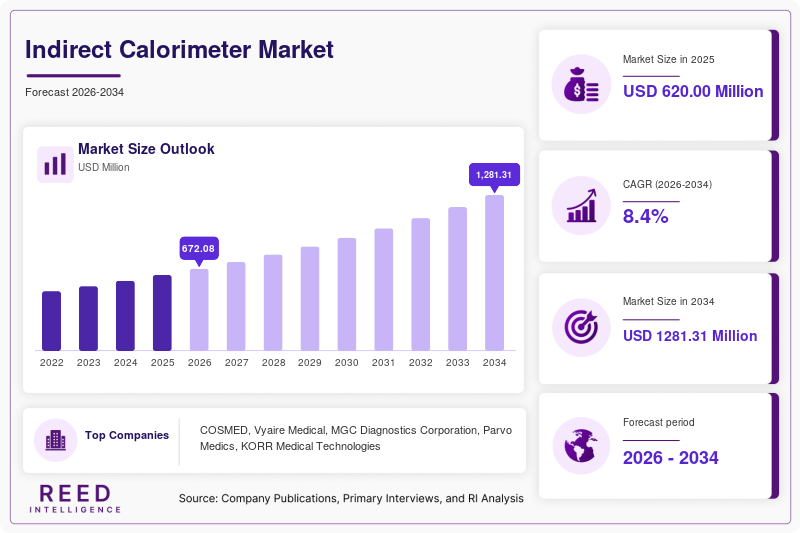
Key Highlights:
- North America dominated the Indirect Calorimeter Market with 38% share in 2025, while Asia Pacific is expected to register the fastest CAGR of 10.2%
- Among segments, portable indirect calorimeters led with 54% share, while wearable calorimeters are projected to grow at a CAGR of 11.5%
- The United States remained the dominant country, with market values of USD 210 million in 2024 and USD 225 million in 2025
Market Trends
Shift Toward Portable and Point-of-Care Devices
The Indirect Calorimeter Market is witnessing a strong shift toward portable and compact devices designed for point-of-care use. Healthcare facilities are increasingly prioritizing mobility and efficiency, particularly in intensive care units and outpatient clinics. Portable indirect calorimeters offer faster setup times, simplified calibration, and real-time metabolic data, making them suitable for dynamic clinical environments. This trend is also expanding usage beyond hospitals into rehabilitation centers and home care settings, thereby broadening the market scope.
Integration with Digital Health Ecosystems
Another notable trend shaping the Indirect Calorimeter Market is the integration of calorimetry systems with digital health platforms. Devices are increasingly equipped with cloud connectivity, enabling seamless data storage, analysis, and sharing. This integration supports longitudinal tracking of patient metabolism and enhances clinical decision-making. Additionally, compatibility with electronic health records (EHRs) and telehealth systems is improving workflow efficiency and enabling remote patient monitoring. As healthcare systems move toward data-driven models, this trend is expected to significantly influence market growth and innovation.
Market Drivers
Rising Demand for Personalized Nutrition Therapy
The growing emphasis on personalized healthcare is a major driver of the Indirect Calorimeter Market. Indirect calorimetry enables accurate measurement of individual energy expenditure, allowing clinicians to tailor nutritional interventions for patients. This is particularly critical in managing critically ill patients, where underfeeding or overfeeding can lead to adverse outcomes. Increasing awareness among healthcare professionals about the benefits of precision nutrition is boosting demand for indirect calorimeters across clinical settings.
Expanding Applications in Sports and Fitness Industry
The adoption of indirect calorimetry in sports science and fitness is also contributing to market growth. Athletes and fitness professionals are utilizing metabolic testing to optimize performance, track energy expenditure, and design customized training programs. The growing popularity of performance analytics and fitness tracking technologies is encouraging the use of indirect calorimeters in gyms, sports institutes, and wellness centers. This diversification of applications beyond traditional healthcare settings is strengthening the overall market outlook.
Market Restraints
High Cost and Limited Accessibility
One of the primary challenges facing the Indirect Calorimeter Market is the high cost associated with advanced calorimetry systems. These devices often require significant initial investment, along with ongoing maintenance and calibration expenses. As a result, smaller healthcare facilities and clinics may find it difficult to adopt such technologies, particularly in cost-sensitive regions.
Additionally, the need for trained personnel to operate and interpret results further limits widespread adoption. In many developing regions, lack of awareness and technical expertise acts as a barrier to market penetration. While technological advancements are gradually reducing device complexity, affordability remains a critical concern.
This restraint is expected to moderate the pace of growth, especially in emerging economies, unless manufacturers focus on cost-effective solutions and training initiatives to improve accessibility.
Market Opportunities
Growth in Home Healthcare and Remote Monitoring
The expansion of home healthcare services presents a significant opportunity for the Indirect Calorimeter Market. With increasing preference for at-home treatment and monitoring, there is growing demand for compact and easy-to-use metabolic measurement devices. Manufacturers are focusing on developing user-friendly calorimeters that can be operated by patients or caregivers. This trend is expected to open new revenue streams and expand the market beyond traditional healthcare facilities.
Emerging Markets in Asia and Latin America
Untapped markets in Asia Pacific and Latin America offer substantial growth opportunities. Improving healthcare infrastructure, rising healthcare expenditure, and increasing awareness of metabolic health are driving demand for advanced diagnostic tools. Governments and private organizations are investing in modern medical technologies, creating favorable conditions for market expansion. Companies that strategically enter these regions with affordable and scalable solutions are likely to gain a competitive advantage.
Segmental Analysis
By Product Type
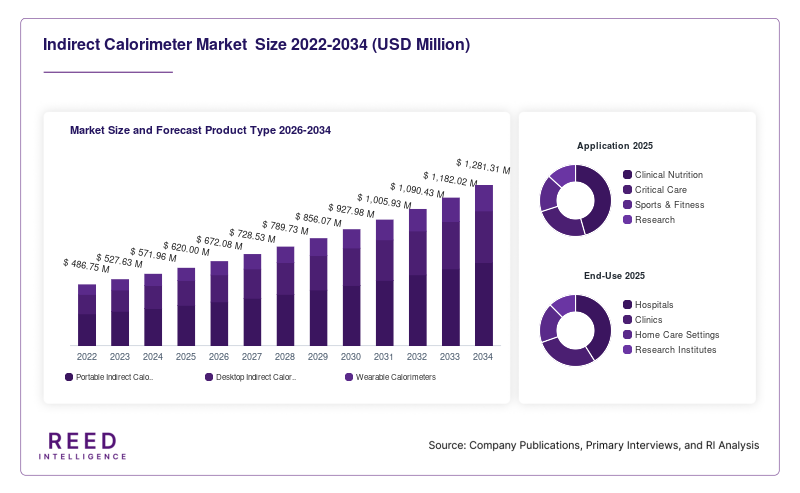
Portable indirect calorimeters dominated the Indirect Calorimeter Market, accounting for 54% share in 2024. Their compact design, ease of use, and suitability for multiple clinical settings contributed to widespread adoption.
Wearable calorimeters are projected to be the fastest-growing segment, with a CAGR of 11.5%. These devices will gain traction due to increasing demand for continuous metabolic monitoring and integration with fitness tracking technologies.
By Application
Clinical nutrition emerged as the leading application segment, holding 46% share in 2024. The use of indirect calorimetry in determining patient-specific energy requirements supported its dominance.
Sports and fitness applications are expected to grow at a CAGR of 10.8%, driven by rising interest in performance optimization and personalized training programs.
By End-Use
Hospitals accounted for the largest share of 52% in 2024, owing to high utilization in intensive care units and metabolic assessment procedures.
Home care settings are anticipated to witness the fastest growth, with a CAGR of 10.6%, supported by increasing adoption of remote monitoring solutions and patient-centric healthcare models.
By Technology
Breath-by-breath analysis technology dominated the market with 48% share in 2024, due to its accuracy and real-time data capabilities.
Mixing chamber technology is expected to grow at a CAGR of 9.7%, driven by improvements in measurement consistency and cost efficiency.
Regional Analysis
North America
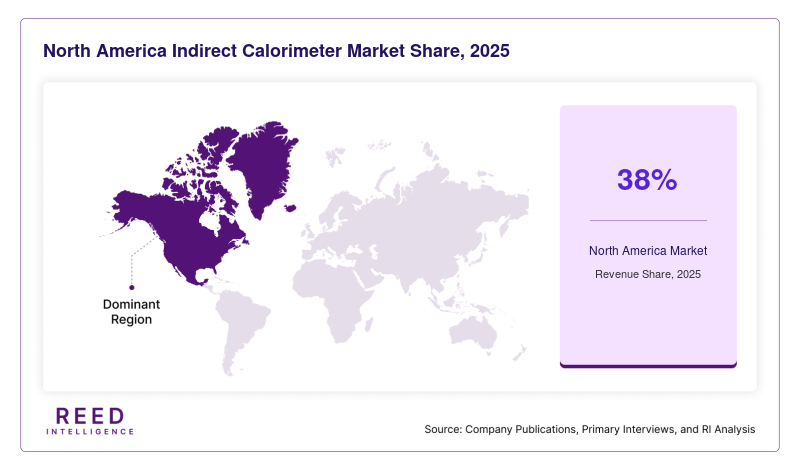
North America accounted for 38% of the Indirect Calorimeter Market share in 2025 and is expected to grow at a CAGR of 7.6% during the forecast period. The region benefited from advanced healthcare infrastructure and high adoption of metabolic monitoring technologies.
The United States dominated the regional market due to strong clinical research activities and widespread use of indirect calorimetry in critical care. The presence of well-established healthcare institutions and early adoption of innovative medical devices supported sustained growth.
Europe
Europe held approximately 27% share of the Indirect Calorimeter Market in 2025 and is projected to expand at a CAGR of 7.9% through 2034. Growth in the region was supported by increasing focus on clinical nutrition and metabolic disease management.
Germany emerged as the leading country, driven by its robust healthcare system and emphasis on medical technology innovation. The integration of calorimetry into hospital nutrition protocols contributed to market expansion.
Asia Pacific
Asia Pacific captured 20% of the Indirect Calorimeter Market share in 2025 and is expected to register the fastest CAGR of 10.2% during the forecast period. Rapid urbanization and rising healthcare investments played a key role in market growth.
China dominated the region due to expanding healthcare infrastructure and increasing prevalence of lifestyle-related diseases. Government initiatives to modernize hospitals and improve diagnostic capabilities supported the adoption of indirect calorimeters.
Middle East & Africa
The Middle East & Africa accounted for 8% of the Indirect Calorimeter Market in 2025 and is anticipated to grow at a CAGR of 8.1%. Growth in this region was supported by gradual improvements in healthcare facilities.
The United Arab Emirates led the market due to investments in advanced healthcare technologies and increasing focus on specialized medical services. The adoption of indirect calorimetry in premium healthcare institutions contributed to regional growth.
Latin America
Latin America held around 7% share of the Indirect Calorimeter Market in 2025 and is expected to grow at a CAGR of 8.5%. Increasing awareness of metabolic health and improving access to healthcare services supported market development.
Brazil dominated the region due to its large population base and expanding private healthcare sector. Growing demand for advanced diagnostic tools in urban healthcare centers fueled market growth.
Competitive Landscape
The Indirect Calorimeter Market is moderately competitive, with several established players focusing on product innovation and geographic expansion. Leading companies are investing in research and development to enhance device accuracy and usability.
The market leader, COSMED, has maintained its position through continuous innovation and a strong global distribution network. The company recently introduced an advanced portable calorimeter with enhanced digital integration capabilities, strengthening its market presence.
Other key players are adopting strategies such as partnerships, product launches, and acquisitions to expand their portfolios and enter emerging markets. The competitive environment is expected to intensify as new entrants introduce cost-effective solutions.
Key Players
- COSMED
- Vyaire Medical
- MGC Diagnostics Corporation
- Parvo Medics
- Microlife Medical
- GE Healthcare
- KORR Medical Technologies
- Maastricht Instruments
- Geratherm Medical AG
- Schiller AG
Recent Developments
- In 2025, leading manufacturers introduced AI-enabled indirect calorimeters for improved metabolic analysis.
- Several companies expanded their presence in Asia Pacific through distribution partnerships.
- New portable devices with enhanced battery life and wireless connectivity were launched.
- Strategic collaborations between healthcare providers and device manufacturers increased adoption in clinical settings.
Indirect Calorimeter Market Segments
Product Type
- Portable Indirect Calorimeters
- Desktop Indirect Calorimeters
- Wearable Calorimeters
Application
- Clinical Nutrition
- Critical Care
- Sports & Fitness
- Research
End-Use
- Hospitals
- Clinics
- Home Care Settings
- Research Institutes
Technology
- Breath-by-Breath
- Mixing Chamber
By Region
- North America
- Europe
- APAC
- Middle East and Africa
- LATAM