Indirect Procurement BPO Market Size, Share & Trends Analysis Report By Type (Marketing, IT, Human Resources, Facility Management, Others), By Application (CPG & Retail, BFSI, Manufacturing, Energy & Utilities, Hi-Tech & Telecom, Healthcare & Pharma, Others) and By Region (North America, Europe, APAC, Middle East and Africa, LATAM) Forecasts, 2026–2034
USD 3950
Indirect Procurement BPO Market Size
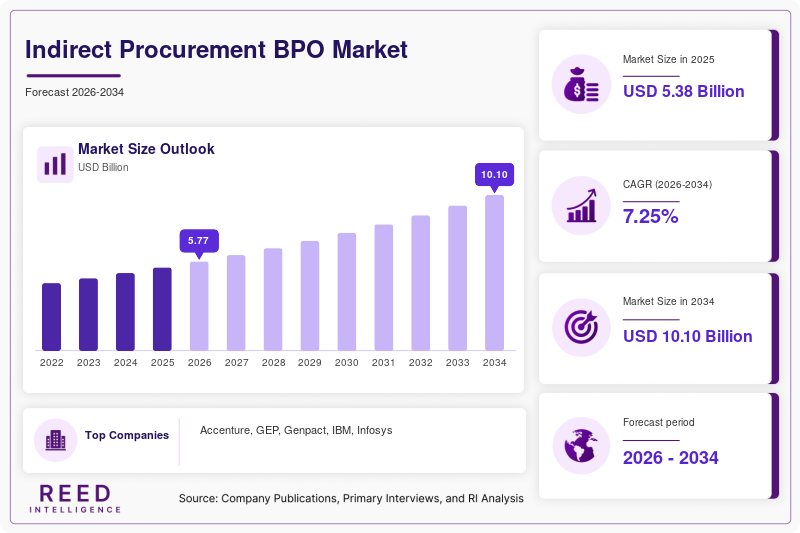
The global Indirect Procurement BPO Market is valued at USD 5.38 billion in 2025 and is estimated at USD 5.77 billion in 2026. The market is projected to reach USD 10.10 billion by 2034, registering the supplied 7.25% CAGR during the forecast period.
The indirect procurement BPO market is shifting from transaction processing toward outsourced management of complex, fragmented enterprise spend. Indirect categories include IT, professional services, marketing, facilities, travel, logistics, maintenance, repair and operations, and other purchases that support the business but do not generally become part of the finished product. Deloitte describes indirect spending as a less-visible area of enterprise expenditure that often requires stronger governance and behavioral compliance to realize sourcing benefits.
This structure creates a natural outsourcing opportunity because indirect procurement requires category expertise, supplier intelligence, spend analytics, contract governance, buying-channel compliance, and continuous supplier management across many categories. GEP, for example, separates procurement outsourcing into transactional, tactical, and strategic services, spanning purchase-order activity, tail-spend management, sourcing, and category management.
Indirect Procurement BPO Market Drivers
Enterprises are outsourcing fragmented indirect spend to improve control and sourcing economics
Indirect procurement is structurally harder to govern than concentrated direct procurement because purchases are distributed across departments, locations, suppliers, and low-value transactions. Deloitte identifies categories such as IT, travel, logistics, facilities, and MRO as examples of indirect expenditure that can remain less visible to centralized procurement teams and can be affected by off-contract or non-compliant buying behavior.
BPO providers address this fragmentation by combining category expertise with standardized workflows, supplier consolidation, contract monitoring, buying-channel enforcement, and spend analytics. GEP explicitly provides transactional, tactical, and strategic procurement outsourcing, while Deloitte's managed-procurement model has been used to establish standardized requisition-to-purchase-order workflows, KPIs, reporting, and flexible outsourced capacity.
The commercial mechanism is therefore broader than labor arbitrage. Providers can increase spend under management, reduce leakage from preferred-supplier agreements, improve sourcing discipline, and allow internal procurement staff to concentrate on strategic categories and business priorities.
AI and automation are increasing the value proposition of procurement outsourcing
Procurement BPO is becoming increasingly technology-intensive as providers integrate AI with sourcing, intake, contract review, supplier discovery, analytics, and purchasing workflows. Genpact's procurement platform is designed around a unified sourcing workspace, intelligent intake and extraction, workflow orchestration, and agentic AI, while the company positions procurement as a combination of process expertise, data, technology, and AI.
The technology shift also changes the economics of outsourcing. Providers can automate repetitive sourcing and purchasing tasks, standardize work across global delivery centers, and use analytics to identify spend that would otherwise remain outside category-management processes. IBM's 2026 research on indirect sourcing similarly highlights the fragmentation of IT, professional services, marketing, facilities, MRO, and travel categories and the role of AI and analytics in improving visibility and decision-making.
Deloitte reported in 2025 that leading procurement organizations were allocating substantially more of their budgets toward procurement technology, underscoring the transition from conventional outsourced processing toward digitally enabled managed procurement.
Procurement has become a strategic response to cost, supply and third-party risk
Procurement organizations are increasingly expected to contribute to profitability, working-capital management, resilience, supplier innovation, and risk reduction rather than simply process purchase orders. Deloitte's 2025 CPO research identifies cost pressure, regulatory requirements, supply-chain disruption, risk management, and talent development among the key issues affecting procurement leaders.
This increases the relevance of external providers with established category expertise, global supplier databases, procurement platforms, and flexible delivery models. GEP states that procurement outsourcing allows organizations to access external expertise without building equivalent in-house capabilities, while Genpact emphasizes procurement transformation, supplier-risk management, and source-to-pay optimization.
The result is a wider addressable service scope: sourcing and category management can be combined with transactional procurement, analytics, supplier management, contract administration, and procurement technology operations within a single managed-services relationship.
Indirect Procurement BPO Market Restraints
Integration, data quality and governance complexity can slow outsourcing transitions
Indirect procurement operates across ERP systems, financial platforms, purchasing cards, supplier databases, contracts, expense systems, and business-unit workflows. Fragmented data can make baseline spend analysis difficult and can complicate implementation of standardized purchasing processes. GEP and IBM both emphasize the importance of unified source-to-pay data and visibility, while GEP's client examples illustrate how fragmented invoices, purchase-card transactions, and travel-and-expense data can limit spend transparency.
For enterprises with decentralized procurement structures, the transition to a managed BPO model can therefore require substantial ERP integration, data cleansing, process redesign, supplier rationalization, and stakeholder adoption before savings or control improvements become visible.
Sensitive supplier data and organizational reluctance can limit outsourcing scope
Procurement outsourcing places supplier information, contracts, pricing arrangements, spend data, and purchasing processes with an external service provider. As procurement becomes more strategic, organizations may also be cautious about transferring supplier relationships, category knowledge, or negotiation activities outside the enterprise.
The issue becomes more complex as AI is introduced because organizations must also manage data governance, model controls, security, explainability, and human oversight. Deloitte identifies risk management and talent as continuing procurement priorities, while IBM's procurement work highlights the need for responsible AI and governance alongside automation.
Indirect Procurement BPO Market Opportunities
Agentic AI-enabled procurement managed services
The next development opportunity is the conversion of procurement BPO from workflow outsourcing into AI-enabled decision and execution support. Genpact's procurement suite is designed to automate sourcing and tactical purchasing while retaining human-aware workflows, and Wipro's 2026 expansion with ServiceNow explicitly covers procurement workflows through agentic AI and its SmartProcure offering.
This creates room for contracts priced around business outcomes such as spend visibility, cycle-time reduction, sourcing throughput, compliance, supplier onboarding, and savings realization rather than solely around transaction volumes or employee capacity.
Expansion into mid-sized enterprises and regionally distributed businesses
Large enterprises have historically been the natural customers for procurement BPO because they generate sufficient transaction volumes and operate across multiple categories and locations. However, cloud source-to-pay systems and modular managed services are reducing the technology and implementation burden associated with outsourcing.
Type Segment Analysis
IT accounts for the largest share and maintains the strongest expansion among major procurement categories
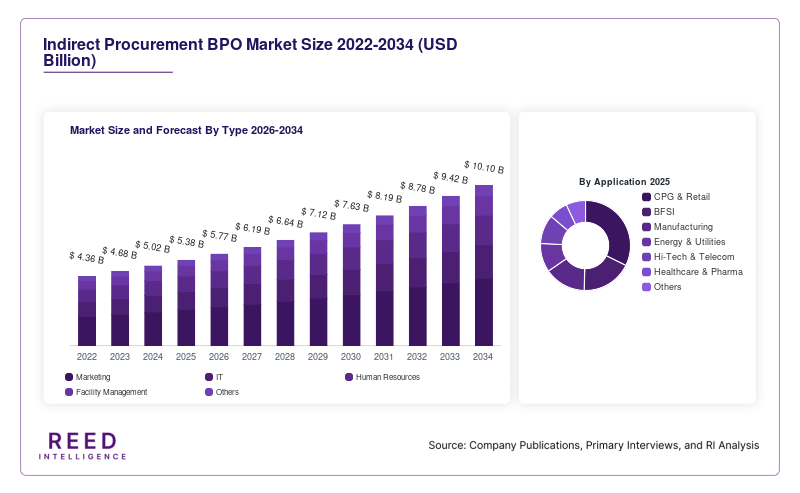
The IT segment accounts for 28% of the 2025 market, representing USD 1.51 billion, and is projected to reach a 31% share by 2034, equivalent to USD 2.92 billion. The segment is estimated to expand at a 7.62% CAGR during 2026–2034.
IT procurement is the largest type segment because enterprises increasingly purchase cloud services, software, telecommunications, cybersecurity, hardware, consulting and managed technology services from large external supplier ecosystems. IBM explicitly identifies IT as a major indirect sourcing category affected by fragmentation and changing supplier economics.
Facility Management remains an important recurring category
The Facility Management segment accounts for 22% of the 2025 market, equal to USD 1.18 billion, and reaches 22.5% by 2034, equal to USD 2.12 billion. The segment is projected to grow at a 6.68% CAGR.
Facility management encompasses maintenance, workplace services, security-related services, building operations and other location-based expenditures. The category involves multiple suppliers and recurring contracts, making centralized sourcing and supplier-performance management particularly relevant.
Application Analysis
The CPG & Retail segment represents 20% of the 2025 market, equivalent to USD 1.08 billion, and reaches 19% by 2034, equivalent to USD 1.79 billion. The segment is projected to grow at a 5.80% CAGR.
CPG and retail companies maintain extensive indirect requirements across marketing, logistics, technology, stores, facilities, professional services and corporate operations. These businesses benefit from centralized sourcing because purchasing is often distributed across numerous business units and locations.
The BFSI segment represents 18% of the 2025 market, or USD 0.97 billion, and reaches 17% in 2034, or USD 1.60 billion. The segment is projected to grow at a 5.74% CAGR.
Banks, insurers and financial institutions use substantial volumes of IT, consulting, professional services, facilities, cybersecurity and workplace services. Strong governance requirements make procurement standardization particularly relevant.
The Manufacturing segment represents 20% of the 2025 market, equal to USD 1.08 billion, and reaches 19% by 2034, equal to USD 1.79 billion. The segment is projected to grow at a 5.80% CAGR.
Manufacturing organizations require indirect procurement across plant services, maintenance, IT, logistics, facilities, consulting and administrative functions. Multi-site organizations particularly benefit from consolidated supplier management and standardized procurement workflows.
The Energy & Utilities segment accounts for 10% of the 2025 market, representing USD 0.54 billion, and reaches 10% in 2034, representing USD 0.94 billion. The segment is projected to grow at a 6.41% CAGR.
Energy and utility companies have complex procurement requirements covering field operations, engineering, maintenance, professional services, IT and facilities. Their distributed operations increase the need for centralized supplier governance.
The Hi-Tech & Telecom segment represents 15% of the 2025 market, or USD 0.81 billion, and increases to 18% by 2034, or USD 1.69 billion. The segment is projected to register an 8.59% CAGR.
Hi-Tech & Telecom has significant procurement requirements across software, cloud infrastructure, network services, professional services, hardware, cybersecurity and specialized technology suppliers. Rapid technology cycles also increase the need for continuous supplier evaluation and contract management.
The Healthcare & Pharma segment represents 9% of the 2025 market, equal to USD 0.48 billion, and reaches 10% in 2034, equal to USD 0.94 billion. The segment is projected to grow at a 7.66% CAGR.
Healthcare and pharmaceutical companies manage indirect purchasing across facilities, technology, consulting, laboratory services, administrative operations and specialist suppliers. Regulatory requirements further strengthen the need for controlled procurement processes.
Regional Analysis
North America Indirect Procurement BPO Market
North America is internally allocated 34% of the 2025 global market, equivalent to approximately USD 1.83 billion, and 32.5% in 2034, equivalent to approximately USD 3.06 billion. This allocation generates a modeled 5.88% CAGR.
North America is modeled as the largest regional market because of the concentration of large enterprises, mature shared-services structures, established procurement outsourcing practices, and high adoption of enterprise source-to-pay technology. Accenture, GEP, IBM, Genpact, and other large providers have extensive procurement service portfolios serving North American enterprises.
Europe Indirect Procurement BPO Market
Europe is internally modeled at 28% of the 2025 market, approximately USD 1.51 billion, declining to 25.5% in 2034, approximately USD 2.40 billion, corresponding to a modeled 5.31% CAGR.
Europe has a strong outsourcing base supported by multinational enterprises, mature procurement functions, supplier governance requirements, and increasing digitalization of source-to-pay operations. GEP's acquisition of OpusCapita in 2024 expanded its procurement, e-invoicing, and accounts-payable capabilities across Nordic and Northern European markets, illustrating continued investment in the region's procurement technology ecosystem.
APAC Indirect Procurement BPO Market
APAC is internally allocated 23% of the 2025 market, approximately USD 1.24 billion, rising to 28% in 2034, approximately USD 2.63 billion. The resulting modeled CAGR is 8.76%, the highest among the five regions.
APAC is modeled as the fastest-growing regional market because procurement outsourcing is increasingly intersecting with digital transformation, shared services, manufacturing expansion, and enterprise modernization across India and other Asian economies. GEP and Infosys have both expanded AI-enabled procurement and managed-service activity in Asian markets, while IBM and other providers continue to develop technology-led procurement operations.
Middle East and Africa Indirect Procurement BPO Market
The region is modeled at 8% of the 2025 market, approximately USD 0.43 billion, increasing to 8% in 2034, approximately USD 0.75 billion. This corresponds to a modeled 6.41% CAGR.
The Middle East and Africa market is developing through enterprise digitization, infrastructure investment, shared services, and increasing adoption of structured procurement technology. GEP's 2026 procurement transformation engagement with Dubai-based Arada illustrates how large regional enterprises are deploying integrated source-to-pay systems across geographically distributed operations.
LATAM Indirect Procurement BPO Market
LATAM is internally allocated 7% of the 2025 market, approximately USD 0.38 billion, and 6% in 2034, approximately USD 0.56 billion, resulting in a modeled 4.60% CAGR.
Latin America remains a smaller but relevant market where procurement centralization can help enterprises manage fragmented supplier bases, improve compliance, and gain better control over indirect spend. The region's growth is supported by increasing use of cloud procurement and outsourced operational models.
Competitive Landscape
The indirect procurement BPO market is transitioning toward a competition model built around four capabilities: procurement domain depth, global delivery, technology ownership or integration, and the ability to manage both strategic and transactional procurement. Everest Group's 2025 Procurement Outsourcing Services assessment identifies a broad provider landscape spanning Accenture, GEP, Genpact, IBM, Infosys, TCS, Capgemini, WNS, Cognizant, Wipro, HCLTech, Corcentric, EXL and other specialists.
Accenture has expanded its sourcing and procurement capabilities through acquisitions, including Insight Sourcing and Impendi, adding strategic sourcing expertise, procurement analytics, technology tools, and private-equity-focused procurement capabilities.
Key Market Players
- Accenture
- GEP
- Genpact
- IBM
- Infosys
- Tata Consultancy Services (TCS)
- Wipro
- Capgemini
- Cognizant
- HCLTech
- WNS
- Corcentric
- EXL
- ProcureAbility
- Chain IQ
Recent Developments
- June 2026 – GEP expanded its AI-native procurement footprint in India through The Akshaya Patra Foundation. GEP announced that Akshaya Patra selected GEP Quantum Intelligence to unify source-to-pay operations across its nationwide kitchen network. The deployment illustrates the expansion of AI-enabled procurement platforms beyond conventional corporate procurement into large distributed operating networks where supplier visibility, standardization, and scalable purchasing controls are important.
- May 2026 – Wipro expanded its partnership with ServiceNow to deploy agentic AI across procurement and other enterprise functions. Wipro announced that its Wipro Intelligence portfolio would integrate with the ServiceNow AI Platform, including SmartProcure for standardized procurement intake, approvals, and execution. The development strengthens the movement from conventional procurement outsourcing toward AI-orchestrated managed workflows.
Indirect Procurement BPO Market Segments
By Type
- Marketing
- IT
- Human Resources
- Facility Management
- Others
By Application
- CPG & Retail
- BFSI
- Manufacturing
- Energy & Utilities
- Hi-Tech & Telecom
- Healthcare & Pharma
- Others
By Region
- North America
- Europe
- APAC
- Middle East and Africa
- LATAM