Inductive Loop Vehicle Detector Market Size, Share & Demand Report By Type (Single-Channel Loop Detectors, Multi-Channel Loop Detectors), By Application (Traffic Signal Control, Toll Collection Systems, Parking Management Systems, Access Control Systems), By Installation Type (In-Road Installation, Above-Ground Installation), By End-Use (Municipal Traffic Authorities, Highway & Transportation Agencies, Private Infrastructure Operators), By Region & Segment Forecasts, 2026–2034
USD 3950
Market Overview
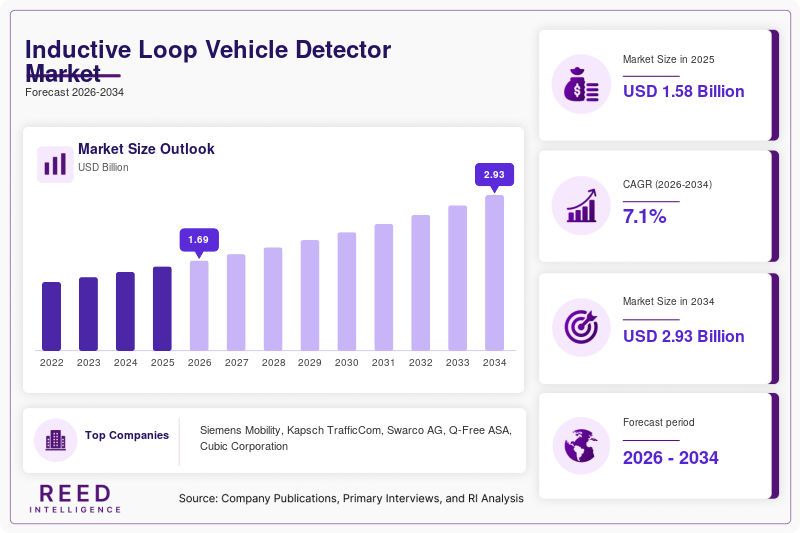
The Inductive Loop Vehicle Detector Market size was valued at approximately USD 1.58 billion in 2026 and is projected to reach USD 2.74 billion by 2034, expanding at a CAGR of 7.1% during 2026–2034. This steady growth reflects the increasing integration of traffic management systems with intelligent transportation infrastructure worldwide.
A major global factor supporting market expansion is the rising adoption of smart city initiatives. Governments and municipal authorities are investing in advanced traffic control systems to reduce congestion, improve road safety, and enhance urban mobility. Inductive loop vehicle detectors, known for their reliability and accuracy in vehicle detection, play a critical role in traffic signal control, tolling, and parking management applications.
Key Highlights
- North America dominated the market with 34.2% share, while Asia Pacific is projected to register the fastest CAGR of 8.4%.
- In type segmentation, single-channel loop detectors led with 41.6% share, while multi-channel detectors are expected to grow at a CAGR of 7.9%.
- By application, traffic signal control systems dominated with 38.5% share, whereas parking management systems will grow at 8.1% CAGR.
- The United States remained the dominant country with market values of USD 420 million in 2024 and USD 445 million in 2025.
Market Trends
Integration with Smart Traffic Systems
The Inductive Loop Vehicle Detector Market is witnessing increased integration with smart traffic management platforms. Modern systems combine loop detectors with IoT sensors and AI-based analytics to optimize traffic flow in real time. This trend is particularly visible in urban areas where congestion management is critical. Enhanced connectivity enables data sharing across control centers, improving response times and reducing delays.
Shift Toward Durable and Preformed Loop Solutions
Another emerging trend is the growing preference for preformed and durable loop detectors. These solutions reduce installation time and maintenance costs, making them attractive for large-scale infrastructure projects. Preformed loops are especially beneficial in high-traffic environments where downtime must be minimized. Manufacturers are focusing on improving insulation materials and loop longevity, which is supporting wider adoption across highways and toll systems.
Market Drivers
Expansion of Urban Infrastructure
Rapid urbanization across developing economies is driving demand for efficient traffic management solutions. As cities expand, the need for reliable vehicle detection systems increases. Inductive loop detectors provide accurate vehicle presence and count data, making them essential for signal control and congestion management. This driver continues to influence the growth trajectory of the Inductive Loop Vehicle Detector Market.
Increasing Road Safety Regulations
Governments worldwide are implementing stricter road safety regulations, which is boosting the adoption of advanced detection technologies. Inductive loop systems help in reducing accidents by ensuring efficient traffic signal operations and vehicle monitoring. Their ability to function under various environmental conditions makes them a preferred choice for regulatory compliance in traffic systems.
Market Restraint
High Installation and Maintenance Costs
One of the key challenges in the Inductive Loop Vehicle Detector Market is the high installation and maintenance cost associated with these systems. Installation requires cutting into road surfaces, which can disrupt traffic and increase project costs. Additionally, loops are susceptible to damage from road wear and environmental factors, leading to frequent maintenance requirements.
The cost factor becomes particularly significant in developing regions where budget constraints limit infrastructure investments. While technological advancements have improved durability, the overall lifecycle cost of inductive loop systems remains higher compared to some alternative detection technologies such as video or radar-based systems. This restraint may slow adoption in cost-sensitive markets.
Market Opportunities
Growth in Smart Parking Solutions
The increasing demand for smart parking systems presents a significant opportunity for the Inductive Loop Vehicle Detector Market. Urban areas are facing parking challenges, and loop detectors offer an effective solution for vehicle presence detection in parking spaces. Integration with mobile applications and automated payment systems enhances their utility, creating new growth avenues.
Infrastructure Development in Emerging Economies
Emerging economies are investing heavily in transportation infrastructure, including highways, toll roads, and urban transit systems. These projects require efficient vehicle detection systems, providing a strong opportunity for market expansion. As governments prioritize digital infrastructure, the adoption of inductive loop detectors is expected to increase significantly in these regions.
Segmental Analysis
By Type
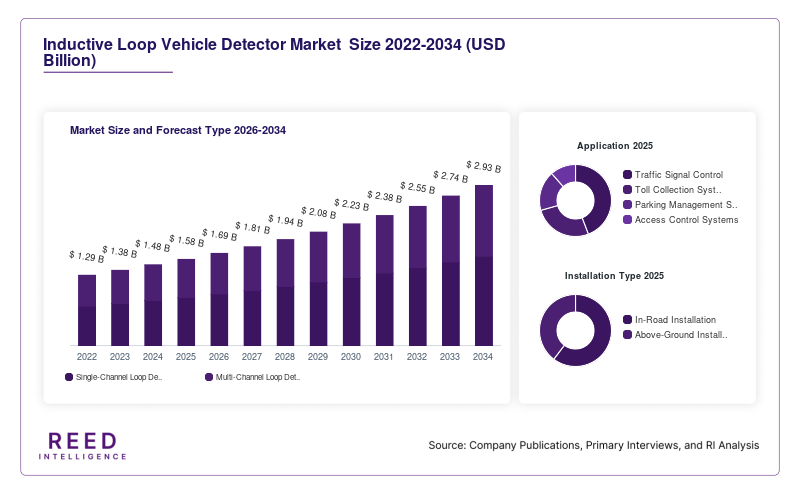
Single-channel loop detectors dominated the market in 2025, accounting for approximately 41.6% share. Their widespread use in basic traffic signal applications and cost-effectiveness contributed to their leading position. These detectors are commonly deployed in standard traffic systems where simple vehicle detection is sufficient.
Multi-channel loop detectors are expected to grow at a CAGR of 7.9% during the forecast period. Their ability to handle multiple loops simultaneously and provide enhanced data accuracy will drive their adoption. These systems are increasingly used in complex traffic environments such as highways and toll plazas.
By Application
Traffic signal control systems held the largest share of 38.5% in 2025. The widespread use of inductive loop detectors in managing traffic signals and reducing congestion supported this dominance.
Parking management systems are projected to grow at a CAGR of 8.1%. Increasing demand for efficient parking solutions and integration with smart city technologies will boost this segment.
By Installation Type
In-road installation dominated the market with a share of 63.4% in 2025. These systems are embedded directly into road surfaces, providing accurate vehicle detection.
Above-ground installation is expected to grow at a CAGR of 7.6%, driven by easier installation and reduced maintenance requirements.
By End-Use
Municipal traffic management agencies accounted for 46.2% share in 2025, as they are primary users of inductive loop detectors for traffic control.
Private infrastructure operators are anticipated to grow at a CAGR of 7.8%, driven by increasing investments in toll roads and parking facilities.
Regional Analysis
North America
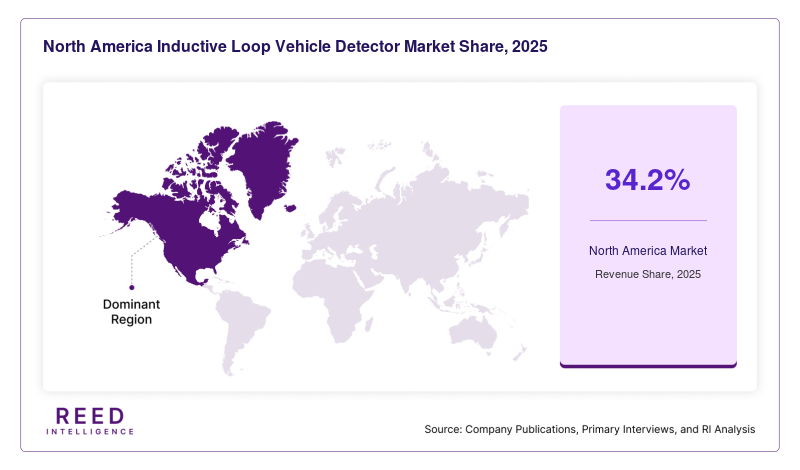
North America accounted for approximately 34.2% of the Inductive Loop Vehicle Detector Market share in 2025 and is expected to grow at a CAGR of 6.5% during 2026–2034. The region’s established infrastructure and early adoption of intelligent transportation systems contributed to its dominant position. The presence of advanced traffic management frameworks and consistent investment in road safety systems supported market growth.
The United States remained the dominant country due to its extensive highway network and continuous upgrades in traffic control systems. A key growth factor is the integration of loop detectors with adaptive traffic signal systems, which enhances traffic flow efficiency and reduces congestion.
Europe
Europe held around 26.8% market share in 2025 and will grow at a CAGR of 6.8% through 2034. The region’s focus on sustainable transportation and traffic efficiency drove the adoption of inductive loop detectors. Strict regulatory frameworks and emphasis on road safety supported deployment across urban and highway networks.
Germany led the regional market, supported by its advanced transportation infrastructure and emphasis on smart mobility solutions. Investments in intelligent traffic systems have contributed significantly to the country’s growth.
Asia Pacific
Asia Pacific captured approximately 22.5% share in 2025 and is projected to grow at the fastest CAGR of 8.4% during the forecast period. Rapid urbanization and increasing vehicle ownership are driving demand for traffic management systems in the region.
China emerged as the dominant country due to large-scale infrastructure projects and smart city initiatives. Government investments in urban mobility solutions and expansion of highway networks are key growth factors.
Middle East & Africa
The Middle East & Africa region accounted for about 9.3% share in 2025 and is expected to grow at a CAGR of 7.3%. Infrastructure development and smart city projects in the region supported market expansion.
The United Arab Emirates led the region, driven by investments in advanced transportation systems and urban planning initiatives. The adoption of intelligent traffic management solutions has been a major growth factor.
Latin America
Latin America held nearly 7.2% market share in 2025 and is forecast to grow at a CAGR of 6.9%. Increasing urbanization and the need for efficient traffic systems are driving demand in the region.
Brazil dominated the regional market, supported by infrastructure upgrades and growing investments in transportation systems. The expansion of urban road networks is a key growth driver.
Competitive Landscape
The Inductive Loop Vehicle Detector Market is moderately competitive, with several established players focusing on technological advancements and strategic partnerships. Companies are investing in product innovation to enhance durability and integration capabilities.
The market leader is Siemens Mobility, which continues to strengthen its position through advanced traffic management solutions. A recent development includes the launch of upgraded loop detector systems integrated with AI-based traffic analytics.
Other key players such as Kapsch TrafficCom, Swarco AG, and Q-Free ASA are expanding their product portfolios to cater to evolving market demands. These companies focus on improving detection accuracy and reducing maintenance requirements.
Key Players List
- Siemens Mobility
- Kapsch TrafficCom
- Swarco AG
- Q-Free ASA
- Cubic Corporation
- Iteris Inc.
- Sensys Networks
- Eberle Design Inc.
- Reno A&E
- Trafficware (Cubic)
- Peek Traffic Corporation
- Inductive Loop Technology Ltd
- Procon Electronics
- Diamond Traffic Products
- Jutai Electronic Co., Ltd.
Recent Developments
- Siemens Mobility introduced advanced loop detection systems integrated with AI-based analytics.
- Kapsch TrafficCom expanded its intelligent traffic solutions portfolio with enhanced loop detectors.
- Swarco AG launched durable preformed loop systems for high-traffic applications.
- Q-Free ASA developed integrated traffic monitoring systems combining loop detectors and IoT technologies.
- Iteris Inc. enhanced its traffic management solutions with improved detection accuracy features.
Inductive Loop Vehicle Detector Market Segments
Type
- Single-Channel Loop Detectors
- Multi-Channel Loop Detectors
Application
- Traffic Signal Control
- Toll Collection Systems
- Parking Management Systems
- Access Control Systems
Installation Type
- In-Road Installation
- Above-Ground Installation
End-Use
- Municipal Traffic Authorities
- Highway & Transportation Agencies
- Private Infrastructure Operators
By Region
- North America
- Europe
- APAC
- Middle East and Africa
- LATAM