Industrial Aerators Market Size, Share & Demand Report By Product Type (Diffused Aerators, Surface Aerators, Jet Aerators, Turbine Aerators, Others), By Application (Wastewater Treatment, Aquaculture, Industrial Processing, Water Reuse Systems, Others), By End-Use Industry (Chemical, Food & Beverage, Mining, Power Generation, Pulp & Paper, Pharmaceuticals, Others) By Region & Segment Forecasts, 2026–2034
USD 3950
Market Overview
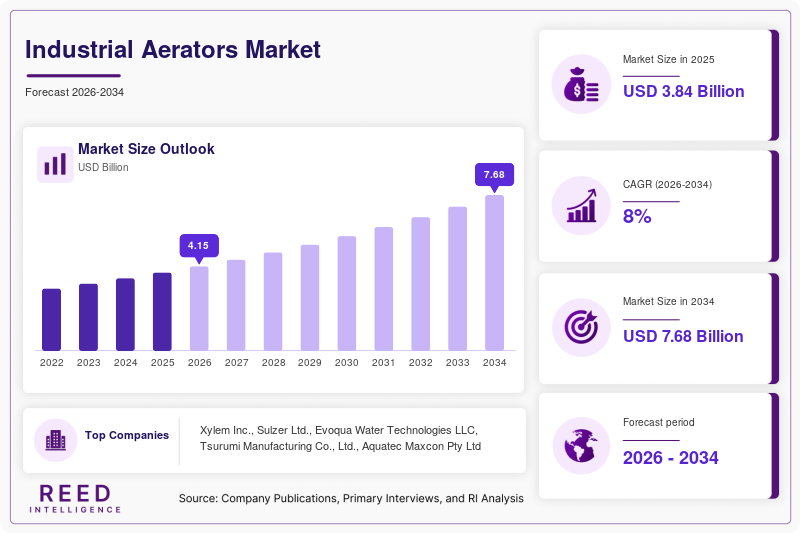
The global Industrial Aerators Market size was valued at USD 3.84 billion in 2026 and is projected to reach USD 7.12 billion by 2034, expanding at a CAGR of 8.0% during the forecast period from 2026 to 2034. Industrial aerators are widely used in wastewater treatment plants, food processing facilities, chemical manufacturing units, mining operations, and power generation plants to maintain oxygen transfer efficiency and improve water quality. The growing need for industrial wastewater management and stricter environmental regulations are supporting the expansion of the market across developed and emerging economies.
A major global factor supporting Industrial Aerators Market growth is the increasing investment in industrial water recycling infrastructure. Governments and private industries are focusing on sustainable wastewater treatment systems to reduce freshwater dependency and meet environmental discharge standards. Industries are integrating energy-efficient aeration systems that lower operational costs while improving treatment performance. In addition, rising urbanization and industrial production in Asia Pacific, Latin America, and the Middle East are creating higher demand for wastewater treatment facilities, further strengthening market expansion.
Key Highlights
- North America dominated the market with a 34.2% share in 2025.
- Asia Pacific is expected to grow at the fastest CAGR of 10.9% during 2026–2034. By product type, diffused aerators accounted for the largest share of 39.1%, while jet aerators are projected to grow at a CAGR of 11.4%.
- By application, wastewater treatment led with a 46.8% share, whereas aquaculture is expected to expand at a CAGR of 10.8%.
- The United States remained the dominant country, with market values of USD 780 million in 2024 and USD 845 million in 2025.
Market Trends
Integration of Smart Monitoring Technologies in Aeration Systems
The Industrial Aerators Market is witnessing rising adoption of smart monitoring technologies across industrial wastewater treatment facilities. Industrial operators are increasingly integrating sensors, automation platforms, and artificial intelligence-enabled systems into aeration equipment to optimize oxygen transfer efficiency and reduce energy consumption. Aeration systems account for a substantial portion of electricity usage in wastewater treatment plants, encouraging industries to adopt digital monitoring tools that improve operational efficiency. Real-time dissolved oxygen monitoring allows operators to adjust airflow levels based on wastewater load conditions, minimizing unnecessary energy usage. The demand for predictive maintenance solutions is also increasing, as industries seek to reduce equipment downtime and maintenance costs. Smart aeration systems provide detailed analytics that help plant managers monitor aerator performance and extend equipment lifespan. The trend is particularly visible in North America and Europe, where industrial facilities are upgrading aging water treatment infrastructure with automated and digitally connected aeration systems.
Rising Preference for Energy-Efficient Fine Bubble Diffusion Systems
Energy-efficient fine bubble diffusion systems are gaining significant traction in the Industrial Aerators Market due to their high oxygen transfer efficiency and lower operational costs. Industrial facilities are replacing conventional coarse bubble systems with fine bubble diffusers to reduce power consumption and improve treatment efficiency. Fine bubble aerators generate smaller bubbles that remain in water for longer periods, increasing oxygen transfer rates and reducing the need for additional energy input. The technology is widely adopted in municipal and industrial wastewater treatment applications where continuous aeration is required. Manufacturers are focusing on advanced membrane materials and corrosion-resistant designs to improve product durability and performance. Demand for these systems is growing rapidly in food processing, chemical manufacturing, and pulp and paper industries, where strict wastewater treatment regulations are driving infrastructure modernization. Asia Pacific is emerging as a major market for fine bubble diffusion systems due to rapid industrialization and increasing investments in wastewater treatment projects.
Market Drivers
Expansion of Industrial Wastewater Treatment Infrastructure
The expansion of industrial wastewater treatment infrastructure is a primary driver supporting the Industrial Aerators Market. Rapid industrialization in developing economies has significantly increased wastewater generation from manufacturing plants, chemical processing facilities, mining operations, and food production units. Governments are implementing stricter environmental discharge regulations to control water pollution and protect natural water resources. As a result, industries are investing heavily in advanced wastewater treatment systems that require efficient aeration technologies. Aerators play a critical role in biological treatment processes by supplying oxygen to microorganisms that break down organic waste. The increasing number of industrial wastewater recycling projects across Asia Pacific and the Middle East is contributing to higher demand for mechanical and diffused aerators. Additionally, public-private partnerships supporting industrial water management projects are accelerating market growth and encouraging the adoption of energy-efficient aeration systems.
Growing Focus on Energy Optimization in Industrial Operations
Industries are increasingly prioritizing energy optimization strategies to reduce operating costs and improve sustainability performance, which is driving the adoption of advanced industrial aerators. Aeration systems can account for a large share of total energy consumption in wastewater treatment facilities, encouraging operators to deploy high-efficiency equipment. Manufacturers are introducing aerators with improved motor efficiency, variable speed drives, and intelligent airflow control systems that reduce power usage without affecting oxygen transfer performance. Energy-efficient aerators help industries achieve sustainability targets while lowering long-term operational expenses. Rising electricity prices in many industrial economies are also encouraging facilities to modernize aging aeration infrastructure. In sectors such as chemicals, pharmaceuticals, and pulp and paper, companies are investing in automated aeration technologies to improve productivity and maintain compliance with environmental standards. This growing focus on operational efficiency is expected to continue supporting market demand during the forecast period.
Market Restraint
High Installation and Maintenance Costs of Advanced Aeration Systems
The high installation and maintenance costs associated with advanced aeration systems remain a major challenge for the Industrial Aerators Market. Industrial facilities often require significant capital investment to install large-scale aeration equipment, particularly in wastewater treatment plants with high processing capacity. Advanced systems integrated with automation software, sensors, and energy optimization technologies involve higher upfront expenses compared to conventional aerators. Small and medium-sized enterprises in developing economies may face financial limitations that restrict adoption of technologically advanced systems.
Maintenance costs also affect purchasing decisions, as industrial aerators operate continuously in demanding environments that can lead to component wear, corrosion, and equipment failure. Regular maintenance, membrane replacement, motor servicing, and cleaning activities increase operational expenses for plant operators. In industries with fluctuating production levels, businesses may postpone equipment upgrades due to uncertain return on investment. For example, mining and metal processing facilities operating in remote regions often face additional maintenance and transportation costs related to aeration equipment servicing. These financial barriers can slow market penetration in cost-sensitive industries and emerging markets despite growing awareness regarding efficient wastewater treatment technologies.
Market Opportunities
Rising Adoption of Aeration Systems in Aquaculture Operations
The growing aquaculture industry is creating significant opportunities for the Industrial Aerators Market. Fish farming and commercial aquaculture facilities require efficient oxygenation systems to maintain water quality and improve aquatic species productivity. Industrial aerators help increase dissolved oxygen levels, prevent fish mortality, and support healthy aquatic ecosystems in intensive aquaculture operations. The rising global demand for seafood and protein-rich food products is encouraging investments in large-scale aquaculture farms, particularly in Asia Pacific and Latin America. Governments in countries such as India, Vietnam, and Indonesia are supporting aquaculture infrastructure development through financial incentives and modernization programs.
Manufacturers are introducing specialized aerators designed for aquaculture applications, including paddle wheel aerators and jet aeration systems that improve oxygen distribution in ponds and tanks. Energy-efficient aerators are gaining popularity among commercial aquaculture operators due to lower operating expenses and improved productivity. The increasing adoption of recirculating aquaculture systems is also expected to create long-term growth opportunities for advanced aeration technologies across global markets.
Increasing Investments in Industrial Water Reuse Projects
Growing investments in industrial water reuse and recycling projects are creating new expansion opportunities for aerator manufacturers. Water scarcity concerns and rising industrial water consumption are encouraging companies to implement water recycling systems that reduce dependence on freshwater resources. Industrial water reuse facilities require advanced aeration technologies to treat wastewater effectively before reuse in manufacturing operations. Governments in regions facing water stress, including the Middle East and parts of Asia Pacific, are promoting wastewater recycling through infrastructure development initiatives and environmental regulations.
Industries such as power generation, petrochemicals, textiles, and food processing are increasingly adopting closed-loop water management systems to improve sustainability performance. Aerators play a critical role in biological treatment stages by supporting microbial activity and maintaining water quality standards. Manufacturers are developing modular and energy-efficient aeration systems that can be integrated into compact industrial recycling plants. The expansion of smart water infrastructure and industrial sustainability programs is expected to create favorable opportunities for market participants during the forecast period.
Segmental Analysis
By Product Type
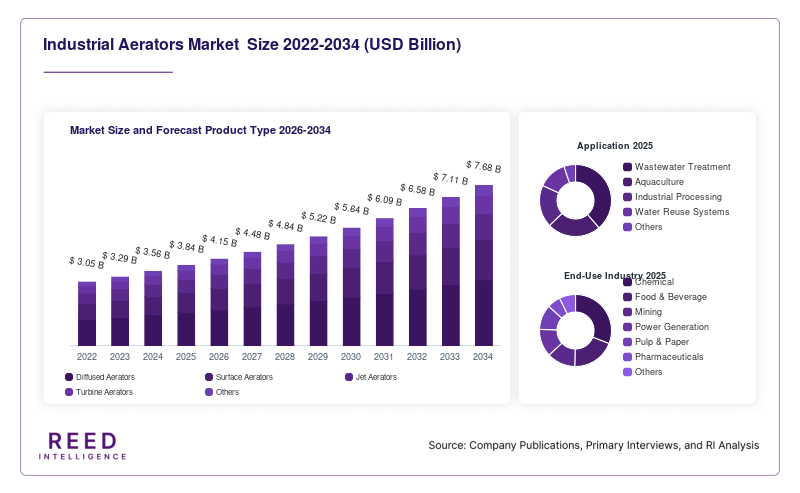
Diffused aerators held the dominant share of the Industrial Aerators Market in 2024, accounting for 39.1% of global revenue. These systems are widely used in industrial wastewater treatment facilities because they provide high oxygen transfer efficiency while maintaining relatively low operating costs. Fine bubble and coarse bubble diffused aerators are commonly installed in chemical manufacturing plants, food processing facilities, and municipal treatment systems. Industries prefer diffused aerators because they offer consistent oxygen distribution and support efficient biological treatment processes. Increasing environmental regulations regarding wastewater discharge are encouraging industries to upgrade existing infrastructure with advanced diffusion systems. Manufacturers are also developing corrosion-resistant materials and durable membrane technologies to improve system lifespan and operational performance. The ability of diffused aerators to reduce energy consumption compared to conventional systems further contributes to their strong market position.
By Application
Wastewater treatment represented the largest application segment in the Industrial Aerators Market in 2024, accounting for 46.8% of total market share. Industrial aerators are extensively used in biological treatment processes to maintain dissolved oxygen levels required for microbial decomposition of organic waste. Industries such as chemicals, pharmaceuticals, pulp and paper, and food processing generate large volumes of wastewater that require efficient treatment before discharge or reuse. Government regulations related to industrial effluent management are compelling manufacturers to invest in advanced wastewater treatment systems integrated with high-performance aerators. Mechanical surface aerators and diffused aeration systems are widely used in activated sludge processes because they improve oxygen transfer and support efficient biological activity. Continuous expansion of industrial production activities in developing economies is also increasing demand for industrial wastewater treatment infrastructure.
By End-Use Industry
The chemical industry accounted for the largest share of the Industrial Aerators Market in 2024 due to its high wastewater generation and strict environmental compliance requirements. Chemical manufacturing facilities produce wastewater containing organic compounds, suspended solids, and toxic substances that require effective biological treatment processes. Industrial aerators play a critical role in maintaining oxygen levels necessary for microbial activity during wastewater treatment operations. Increasing global demand for specialty chemicals, fertilizers, and industrial chemicals is encouraging manufacturers to expand production capacity, thereby increasing the need for advanced water treatment infrastructure. Chemical processing plants are increasingly investing in energy-efficient aeration technologies to reduce operational expenses and improve sustainability performance. The adoption of automated aeration systems integrated with real-time monitoring solutions is also gaining momentum across large chemical manufacturing facilities.
Regional Analysis
North America
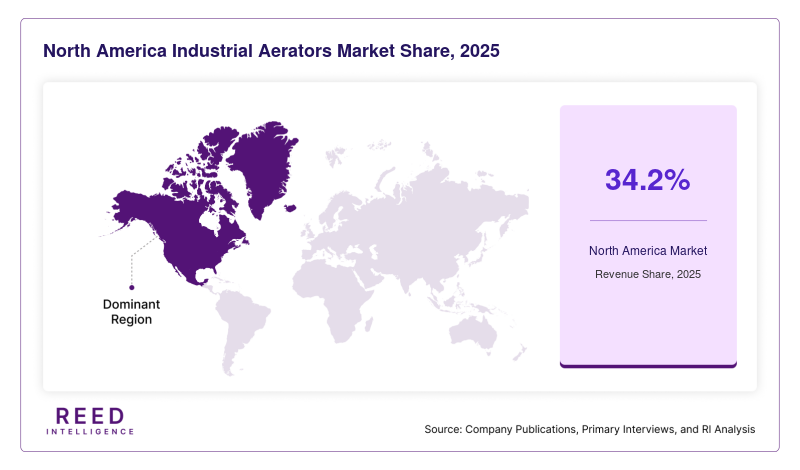
North America accounted for 34.2% of the global Industrial Aerators Market share in 2025 and is expected to maintain a stable growth trajectory during the forecast period. The region is projected to expand at a CAGR of 7.1% from 2026 to 2034 due to increasing modernization of wastewater treatment infrastructure and rising environmental compliance requirements. Industrial facilities across the United States and Canada are investing in advanced aeration systems to improve energy efficiency and reduce emissions associated with wastewater treatment operations. The presence of established water treatment equipment manufacturers further supports regional market growth.
The United States remained the dominant country in North America due to its extensive industrial base and high investment in wastewater management infrastructure. One unique growth factor supporting the U.S. market is the increasing adoption of smart water treatment technologies integrated with industrial automation systems. Food processing plants, pharmaceutical manufacturers, and chemical facilities are deploying digitally connected aeration systems to improve process efficiency and reduce maintenance costs. Federal funding programs supporting water infrastructure modernization are also contributing to long-term market expansion.
Europe
Europe represented a significant share of the Industrial Aerators Market in 2025 and is expected to register a CAGR of 6.8% during the forecast period. The region benefits from stringent environmental policies related to industrial wastewater discharge and water conservation. Countries across Western Europe are emphasizing sustainable manufacturing practices, encouraging industries to adopt energy-efficient aeration technologies. Industrial facilities are increasingly replacing conventional wastewater treatment equipment with advanced fine bubble diffusion systems that improve oxygen transfer efficiency while reducing operational costs.
Germany emerged as the dominant country in the European market due to its strong manufacturing sector and advanced environmental engineering industry. A unique growth factor supporting the German market is the integration of industrial aerators into circular economy initiatives focused on wastewater recycling and resource recovery. Industrial operators are investing in high-performance treatment systems that enable water reuse in production processes. Growing adoption of Industry 4.0 technologies across wastewater treatment plants is also contributing to increasing demand for automated aeration systems in the country.
Asia Pacific
Asia Pacific is expected to witness the fastest growth in the Industrial Aerators Market, expanding at a CAGR of 10.9% from 2026 to 2034. The region accounted for a substantial market share in 2025 due to rapid industrialization, urban population growth, and increasing investment in wastewater treatment infrastructure. Governments across China, India, Japan, and Southeast Asia are implementing stricter water pollution regulations, encouraging industries to modernize wastewater treatment facilities. Rising manufacturing activities in chemicals, textiles, electronics, and food processing industries are significantly increasing demand for industrial aeration systems.
China remained the dominant country in Asia Pacific because of its large industrial sector and extensive investment in environmental infrastructure projects. One unique growth factor supporting the Chinese market is the expansion of industrial water recycling initiatives in water-stressed manufacturing regions. Local authorities are encouraging factories to reduce freshwater consumption through wastewater reuse programs, increasing demand for advanced aeration technologies. Domestic manufacturers are also expanding production capacity for energy-efficient aerators, making industrial treatment solutions more accessible across the region.
Middle East & Africa
The Middle East & Africa Industrial Aerators Market is projected to grow at a CAGR of 8.2% during the forecast period due to increasing investment in desalination, industrial wastewater treatment, and water reuse projects. Countries in the Gulf region are focusing on sustainable water management strategies to address freshwater scarcity and support industrial expansion. Industrial aerators are widely used in petrochemical facilities, power generation plants, and municipal wastewater treatment systems across the region. Rising infrastructure spending and government-led environmental initiatives are contributing to market development.
Saudi Arabia emerged as the dominant country within the Middle East & Africa market due to its large-scale industrial development and growing wastewater recycling investments. A unique growth factor supporting the Saudi Arabian market is the expansion of industrial cities and special economic zones requiring integrated water treatment infrastructure. Petrochemical and refinery operators are increasingly investing in advanced aeration systems to improve water treatment efficiency and comply with environmental regulations. The country's long-term industrial diversification strategy is expected to create sustained demand for industrial aerators.
Latin America
Latin America accounted for a moderate share of the Industrial Aerators Market in 2025 and is expected to grow at a CAGR of 7.6% during the forecast period. Industrial expansion in food processing, mining, and pulp and paper sectors is increasing the need for efficient wastewater treatment technologies across the region. Governments are implementing stricter industrial discharge regulations to improve water quality and environmental sustainability. Investments in municipal and industrial wastewater treatment projects are supporting demand for mechanical surface aerators and diffused aeration systems.
Brazil remained the dominant country in the Latin American market due to its extensive industrial activities and growing focus on water treatment modernization. One unique growth factor supporting the Brazilian market is the increasing investment in agribusiness wastewater treatment infrastructure. Food processing and agricultural industries are adopting advanced aeration systems to manage wastewater generated during production operations. Rising awareness regarding industrial sustainability practices and expanding public-private water management projects are expected to support long-term market growth across the country.
Competitive Landscape
The Industrial Aerators Market is moderately fragmented, with global and regional manufacturers competing on the basis of energy efficiency, product durability, technological innovation, and pricing strategies. Leading companies are focusing on expanding their product portfolios through advanced aeration technologies designed for industrial wastewater treatment and water reuse applications. Strategic partnerships, mergers, and facility expansions are commonly adopted to strengthen regional market presence and improve manufacturing capabilities.
Xylem Inc. remains one of the leading participants in the Industrial Aerators Market due to its broad wastewater treatment portfolio and strong global distribution network. The company has expanded its smart aeration solutions integrated with digital monitoring platforms to improve energy optimization and operational performance. Evoqua Water Technologies, Sulzer Ltd., Tsurumi Manufacturing Co., Ltd., and Aquatec Maxcon Pty Ltd are also prominent market participants investing in product innovation and regional expansion strategies.
Recent industry developments include the launch of energy-efficient fine bubble diffuser systems, expansion of wastewater treatment equipment manufacturing facilities, and increased investment in automation-enabled aeration technologies. Companies are also focusing on customized solutions for aquaculture, chemical processing, and food manufacturing industries. The growing emphasis on industrial sustainability and water recycling initiatives is expected to intensify competition among major market players during the forecast period.
Key Players
- Xylem Inc.
- Sulzer Ltd.
- Evoqua Water Technologies LLC
- Tsurumi Manufacturing Co., Ltd.
- Aquatec Maxcon Pty Ltd
- Eimco Water Technologies
- Aqua-Aerobic Systems, Inc.
- Napier-Reid Ltd.
- Otterbine Barebo, Inc.
- Parkson Corporation
- Kaeser Kompressoren
- SUEZ Water Technologies & Solutions
- Fluence Corporation Limited
- KLa Systems
- Newterra Ltd.
Recent Developments
- In February 2026, Xylem Inc. introduced a next-generation smart aeration platform equipped with real-time oxygen optimization technology for industrial wastewater treatment facilities.
- In August 2025, Sulzer Ltd. expanded its wastewater treatment equipment manufacturing capacity in Asia Pacific to meet growing demand for industrial aeration systems.
- In November 2025, Evoqua Water Technologies launched an energy-efficient fine bubble diffuser system designed for food processing and chemical manufacturing applications.
- In March 2026, Fluence Corporation Limited partnered with regional infrastructure developers in the Middle East to deploy modular industrial wastewater treatment systems integrated with advanced aerators.
- In January 2026, Aqua-Aerobic Systems, Inc. introduced upgraded surface aerators with reduced energy consumption and enhanced corrosion resistance for heavy industrial operations.
Industrial Aerators Market Segments
Product Type
- Diffused Aerators
- Surface Aerators
- Jet Aerators
- Turbine Aerators
- Others
Application
- Wastewater Treatment
- Aquaculture
- Industrial Processing
- Water Reuse Systems
- Others
End-Use Industry
- Chemical
- Food & Beverage
- Mining
- Power Generation
- Pulp & Paper
- Pharmaceuticals
- Others
By Region
- North America
- Europe
- APAC
- Middle East and Africa
- LATAM