Industrial Agitator Market Size, Share Demand Report By Product Type (Top-Entry Agitators, Side-Entry Agitators, Bottom-Entry Agitators, Portable Agitators, Magnetic Agitators), By Application (Chemical Processing, Water and Wastewater Treatment, Food and Beverage Processing, Pharmaceutical Manufacturing, Mining and Minerals, Oil and Gas Processing), By End-Use Industry (Chemical Industry, Pharmaceutical Industry, Food and Beverage Industry, Energy and Utilities, Mining Industry, Water Treatment
USD 3950
Market Overview
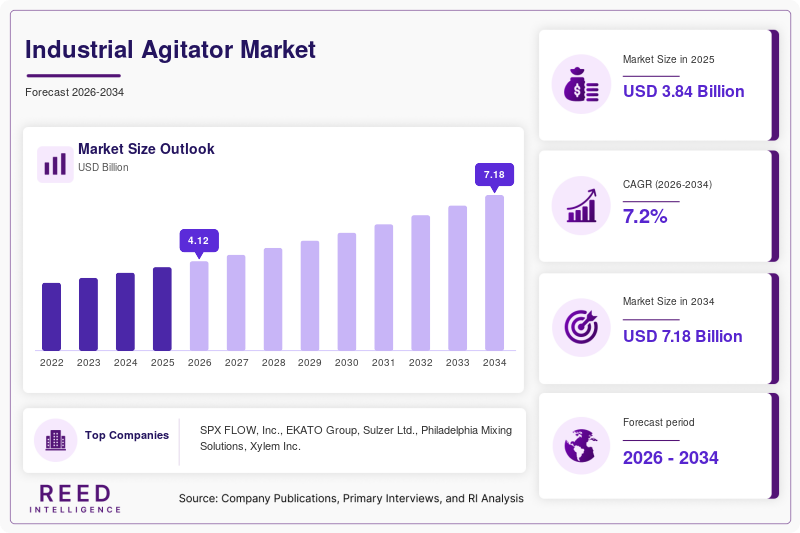
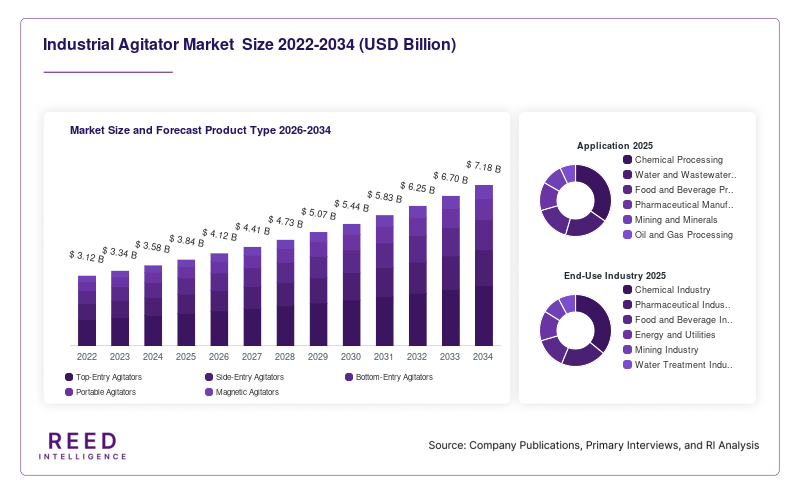
The global Industrial Agitator Market size was valued at approximately USD 3.84 billion in 2026 and is projected to reach USD 6.71 billion by 2034, expanding at a CAGR of 7.2% during the forecast period from 2026 to 2034. Industrial agitators are widely used across industries such as chemicals, water treatment, pharmaceuticals, food and beverages, mining, and energy for blending, mixing, suspending, and homogenizing liquids and semi-solid materials. Rising industrial automation and the increasing need for efficient fluid processing systems are supporting market expansion across both developed and emerging economies. Manufacturers are increasingly investing in advanced mixing technologies to improve operational efficiency, reduce energy consumption, and maintain process consistency in high-volume production facilities.
The growing adoption of wastewater treatment infrastructure across industrial and municipal sectors has emerged as a major global factor supporting market growth. Governments and industrial operators are focusing on water reuse and environmental compliance, which has accelerated the installation of agitators in treatment tanks, sludge processing units, and chemical dosing systems. In addition, rapid expansion in specialty chemical manufacturing and pharmaceutical production is contributing to sustained demand for high-performance agitation equipment with precision control systems and corrosion-resistant materials.
Industrial facilities are also integrating smart monitoring technologies into mixing systems to optimize production efficiency and minimize maintenance downtime. The increasing deployment of variable-speed agitators and automated control units is further reshaping the competitive landscape. Demand for customized agitation systems tailored to specific viscosity levels and production environments is expected to remain strong throughout the forecast period.
Key Highlights
- North America dominated the market with a 33.8% share in 2025.
- Asia Pacific is expected to grow at the fastest CAGR of 8.9% during 2026–2034.
- By product type, top-entry agitators accounted for the largest share of 39.4%, while magnetic agitators are projected to grow at a CAGR of 9.4%.
- By application, chemical processing led with a 36.1% share, whereas wastewater treatment is expected to expand at a CAGR of 9.1%.
- The United States remained the dominant country, with market values of USD 790 million in 2024 and USD 846 million in 2025.
Market Trends
Integration of Smart Automation and Process Monitoring
Industrial facilities are increasingly adopting automated agitation systems equipped with digital sensors, variable frequency drives, and real-time monitoring capabilities. These technologies help manufacturers optimize mixing consistency, monitor torque levels, and reduce unnecessary energy usage. Industries such as pharmaceuticals and specialty chemicals require precise process control to maintain product quality and regulatory compliance, which is driving the adoption of intelligent agitator systems. Modern industrial agitators are now integrated with centralized plant automation platforms that allow operators to remotely control speed, mixing intensity, and operational timing. This trend is helping companies reduce maintenance costs and improve equipment reliability. The use of predictive maintenance software and data analytics is also improving equipment lifespan by identifying mechanical issues before failures occur. As Industry 4.0 adoption expands globally, demand for digitally connected agitation systems is expected to increase steadily.
Rising Demand for Energy-Efficient Mixing Equipment
Manufacturers across multiple industries are focusing on reducing energy consumption and operational costs, creating strong demand for energy-efficient industrial agitators. Traditional mixing systems often consume significant power due to inefficient blade design and outdated motor technologies. New-generation agitators are being designed with optimized impeller geometries, energy-saving motors, and advanced flow dynamics that improve mixing performance while minimizing electricity usage. Chemical and water treatment facilities are especially investing in low-energy agitators to meet sustainability targets and environmental regulations. Companies are also replacing aging equipment with compact and lightweight systems that offer better productivity with reduced maintenance requirements. The increasing use of corrosion-resistant materials and modular agitator configurations is supporting operational flexibility in industrial plants. This trend is expected to strengthen further as industrial operators seek cost-efficient production systems while maintaining environmental compliance and production consistency.
Market Drivers
Expansion of Wastewater Treatment Infrastructure
The rapid expansion of industrial and municipal wastewater treatment infrastructure is significantly driving the Industrial Agitator Market. Industrial agitators play a critical role in mixing chemicals, maintaining sludge suspension, and improving aeration efficiency in treatment plants. Governments across developed and developing countries are increasing investments in water recycling projects and wastewater management systems to address water scarcity and environmental concerns. Industries such as chemicals, mining, food processing, and oil and gas are under pressure to comply with stricter wastewater discharge standards, which is boosting the installation of advanced agitation systems. In addition, urban population growth is increasing municipal wastewater generation, creating further demand for efficient mixing equipment. Agitator manufacturers are responding by developing systems with enhanced durability and lower energy consumption suitable for continuous operation in harsh treatment environments. This factor is expected to remain one of the strongest contributors to long-term market growth.
Growth in Chemical and Pharmaceutical Manufacturing
The continuous expansion of chemical and pharmaceutical manufacturing facilities worldwide is supporting substantial demand for industrial agitators. Mixing systems are essential in these industries for blending active ingredients, dissolving solids, maintaining uniform compositions, and controlling reaction processes. Pharmaceutical companies are increasingly investing in high-precision agitators capable of operating in sterile environments and meeting strict hygiene requirements. Similarly, specialty chemical manufacturers require customized mixing systems that can handle high-viscosity fluids and corrosive substances. Emerging economies in Asia Pacific and Latin America are witnessing rapid industrialization and increasing investments in chemical processing infrastructure, further accelerating market growth. Manufacturers are also introducing agitators with advanced impeller designs and automated speed controls to improve process efficiency and product consistency. As global production capacity for pharmaceuticals, industrial chemicals, and specialty materials continues to rise, the need for reliable and efficient agitation systems is expected to increase steadily.
Market Restraint
High Initial Installation and Maintenance Costs
The high capital investment associated with industrial agitator systems remains a significant restraint for market expansion, particularly among small and medium-sized enterprises. Advanced agitators equipped with automated controls, corrosion-resistant materials, and energy-efficient motors often require substantial upfront spending. In addition to equipment costs, installation expenses related to structural modifications, electrical integration, and system calibration can further increase total project expenditure. Maintenance requirements also create operational challenges, especially in industries handling abrasive or corrosive materials that accelerate equipment wear. Unexpected agitator failures can lead to production downtime, resulting in revenue losses and increased maintenance costs for industrial operators. In sectors such as mining and wastewater treatment, agitators are frequently exposed to demanding operating conditions that require regular inspection and replacement of critical components. Smaller manufacturers in emerging economies may delay modernization projects due to budget constraints, limiting the adoption of technologically advanced mixing systems. Although long-term efficiency benefits are substantial, the initial financial burden continues to restrict market penetration in cost-sensitive industrial environments.
Market Opportunities
Increasing Adoption of Customized Mixing Solutions
The growing requirement for application-specific mixing systems is creating substantial opportunities within the Industrial Agitator Market. Different industries require unique agitation performance based on fluid viscosity, tank geometry, temperature sensitivity, and production scale. As a result, manufacturers are increasingly developing customized agitators designed for specialized industrial processes. Food processing facilities require hygienic agitators with stainless steel construction, while chemical manufacturers demand corrosion-resistant systems capable of handling aggressive substances. Pharmaceutical producers are also seeking precision-controlled agitators that support sterile production environments and batch consistency. The ability to provide tailored mixing solutions is becoming a key competitive advantage for equipment manufacturers. Companies offering engineering consultation, impeller customization, and modular designs are attracting greater demand from industrial clients. This opportunity is expected to expand as industries prioritize process optimization and production efficiency across increasingly complex manufacturing environments.
Expansion of Renewable Energy and Biofuel Industries
The rapid growth of renewable energy and biofuel production facilities is opening new growth opportunities for industrial agitator manufacturers. Biofuel production processes such as ethanol fermentation, biodiesel blending, and biomass processing require reliable mixing systems for maintaining process stability and improving production yields. Governments worldwide are promoting renewable energy investments to reduce carbon emissions and improve energy security, which is increasing the construction of biofuel plants and waste-to-energy facilities. Industrial agitators are also gaining importance in battery material processing and green hydrogen production applications. Manufacturers are introducing specialized agitation systems designed for high-temperature environments and chemically sensitive processes associated with renewable energy production. Emerging investments in sustainable industrial infrastructure are expected to create long-term demand for advanced mixing technologies. As the global transition toward cleaner energy sources accelerates, the Industrial Agitator Market is likely to benefit from rising adoption across renewable energy applications.
Segmental Analysis
By Product Type
Top-entry agitators accounted for the largest share of the Industrial Agitator Market in 2024, representing approximately 39.4% of total revenue. These agitators are widely used in large industrial tanks because they provide efficient mixing performance across a broad range of viscosities and processing conditions. Industries such as chemicals, wastewater treatment, mining, and food processing extensively utilize top-entry systems due to their operational flexibility and cost efficiency. The ability of these agitators to handle high-volume applications while maintaining consistent fluid circulation contributes significantly to their dominant position. Manufacturers are also introducing advanced impeller designs and variable-speed configurations that improve mixing accuracy and energy efficiency. The growing preference for durable and low-maintenance equipment in continuous industrial operations is further strengthening the demand for top-entry agitators across global manufacturing sectors.
Magnetic agitators are expected to register the fastest CAGR of 9.4% during the forecast period due to rising demand from pharmaceutical, biotechnology, and high-purity chemical industries. These agitators eliminate shaft seals and reduce contamination risks, making them highly suitable for sterile and hygienic production environments. Pharmaceutical companies are increasingly adopting magnetic agitation systems for vaccine production, bioprocessing, and laboratory-scale manufacturing activities. The growing focus on contamination-free processing and strict regulatory compliance is supporting rapid adoption of these systems. In addition, advancements in magnetic drive technology are improving operational reliability and reducing maintenance requirements. As industries prioritize product purity and process precision, demand for magnetic agitators is expected to increase significantly across both developed and emerging markets.
By Application
Chemical processing represented the dominant application segment in 2024, accounting for nearly 36.1% of the global Industrial Agitator Market share. Industrial agitators are essential in chemical manufacturing for blending raw materials, maintaining reaction consistency, and improving heat transfer efficiency. The increasing production of specialty chemicals, petrochemicals, adhesives, and industrial coatings is supporting sustained demand for advanced mixing systems. Chemical manufacturers require agitators capable of handling corrosive materials, varying viscosities, and temperature-sensitive processes, which has encouraged innovation in impeller designs and material construction. The segment also benefits from rising investments in industrial automation and process optimization technologies. As global demand for industrial chemicals continues to expand across construction, automotive, and consumer goods sectors, the need for reliable and efficient agitation equipment is expected to remain strong.
Wastewater treatment is projected to witness the fastest CAGR of 9.1% during the forecast period due to increasing environmental regulations and rising investment in water reuse infrastructure. Industrial agitators play a crucial role in maintaining sludge suspension, chemical mixing, and biological treatment efficiency in wastewater facilities. Governments worldwide are implementing stricter wastewater discharge standards, encouraging industrial operators to upgrade treatment systems with advanced mixing technologies. Rapid urbanization and population growth are also increasing municipal wastewater generation, particularly in emerging economies. Agitator manufacturers are developing energy-efficient systems specifically designed for continuous operation in treatment plants. The growing emphasis on sustainable water management and industrial environmental compliance is expected to drive substantial demand for wastewater treatment agitators over the coming years.
By End-Use Industry
The chemical industry emerged as the leading end-use segment in 2024, contributing approximately 31.8% of the total Industrial Agitator Market revenue. Chemical production facilities rely heavily on industrial agitators for material blending, suspension, reaction control, and crystallization processes. The increasing global demand for specialty chemicals, polymers, and industrial solvents is supporting the expansion of chemical manufacturing capacity across multiple regions. Industrial agitators used in this sector are designed to withstand harsh processing environments involving high temperatures, corrosive substances, and varying pressure conditions. Manufacturers are increasingly introducing customized mixing systems with advanced corrosion-resistant coatings and automated process controls. Continuous investments in industrial process efficiency and production scalability are expected to sustain strong demand for agitators within the chemical industry throughout the forecast period.
The pharmaceutical industry is expected to record the fastest CAGR of 8.8% during the forecast period due to rising investments in drug manufacturing and biotechnology research. Pharmaceutical production processes require highly precise and contamination-free mixing systems to ensure product consistency and regulatory compliance. The growing production of biologics, vaccines, and sterile injectable drugs is increasing demand for hygienic agitators equipped with clean-in-place and sterilize-in-place capabilities. In addition, pharmaceutical companies are increasingly investing in automated mixing technologies that improve batch consistency and reduce human intervention during production. Emerging economies are also expanding pharmaceutical manufacturing infrastructure to strengthen domestic healthcare capabilities. These factors are expected to drive strong growth in industrial agitator demand across the pharmaceutical sector.
Regional Analysis
North America
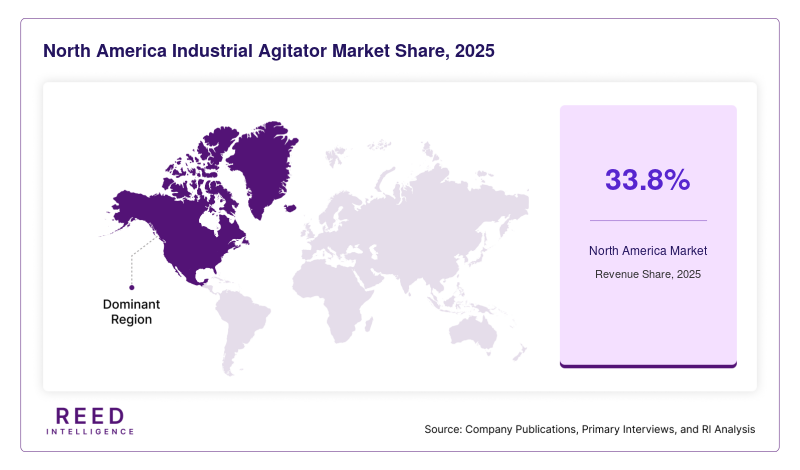
North America accounted for approximately 33.8% of the global Industrial Agitator Market share in 2025 and maintained its position as the leading regional market. The region is projected to expand at a CAGR of 6.4% during the forecast period. Strong demand from chemical manufacturing, pharmaceuticals, and wastewater treatment industries continues to support market growth across the United States and Canada. Industrial automation adoption remains high in the region, encouraging the installation of advanced agitator systems with smart monitoring technologies. Increasing investments in sustainable water management infrastructure are also strengthening demand for efficient mixing equipment across municipal and industrial treatment facilities.
The United States remained the dominant country in the North American market due to its extensive industrial manufacturing base and strong investment in process optimization technologies. One unique growth factor in the country is the modernization of aging wastewater treatment infrastructure. Federal and state-level funding programs are encouraging municipalities and industrial operators to upgrade treatment systems with energy-efficient agitators and automation technologies. Additionally, the presence of major chemical processing companies and pharmaceutical manufacturers continues to generate stable demand for customized mixing systems.
Europe
Europe represented nearly 27.4% of the global Industrial Agitator Market share in 2025 and is anticipated to grow at a CAGR of 6.7% through 2034. The region benefits from established industrial infrastructure and strong environmental regulations promoting efficient manufacturing operations. Countries across Europe are increasingly focusing on energy-efficient industrial equipment to reduce carbon emissions and improve operational sustainability. Demand for industrial agitators is particularly strong in chemical production, food processing, and water treatment sectors. The replacement of older industrial mixing systems with technologically advanced solutions is also supporting market growth across the region.
Germany dominated the European market due to its large-scale chemical manufacturing sector and advanced industrial automation capabilities. One unique growth factor supporting the German market is the rapid integration of smart factory technologies within process industries. Industrial operators are increasingly investing in digitally connected agitator systems that improve process efficiency and reduce maintenance downtime. Furthermore, rising investment in specialty chemical production and industrial research facilities continues to create demand for precision mixing technologies across the country.
Asia Pacific
Asia Pacific held approximately 24.1% of the global Industrial Agitator Market share in 2025 and is expected to register the fastest CAGR of 8.9% during the forecast period. Rapid industrialization, urbanization, and infrastructure development are driving substantial demand for industrial mixing systems across the region. Countries such as China, India, Japan, and South Korea are witnessing strong growth in chemical manufacturing, pharmaceuticals, mining, and wastewater treatment industries. Increasing government investment in industrial production and environmental sustainability projects is also supporting the adoption of advanced agitation equipment across manufacturing facilities.
China remained the dominant country within the Asia Pacific market due to its extensive manufacturing sector and large-scale industrial production capacity. One unique growth factor in China is the expansion of domestic specialty chemical and battery material production facilities. The country's increasing focus on electric vehicle manufacturing and renewable energy technologies is creating demand for specialized agitation systems capable of handling complex material processing applications. Additionally, industrial automation investments are encouraging factories to adopt energy-efficient and digitally controlled agitator technologies.
Middle East & Africa
The Middle East & Africa region accounted for nearly 7.2% of the global Industrial Agitator Market share in 2025 and is forecast to grow at a CAGR of 6.9% through 2034. Growth in the region is supported by rising investments in oil and gas processing, desalination projects, and industrial wastewater treatment infrastructure. Industrial agitators are increasingly used in petrochemical production and water treatment applications due to the region’s focus on sustainable resource management. Expanding mining activities and industrial diversification programs are also contributing to market development in several Middle Eastern and African economies.
Saudi Arabia emerged as the dominant country in the regional market because of its significant investments in petrochemical manufacturing and industrial infrastructure projects. One unique growth factor driving the Saudi Arabian market is the expansion of desalination plants to address water scarcity challenges. These facilities require advanced agitation systems for chemical dosing, sludge processing, and water treatment operations. Government-backed industrial diversification initiatives are also encouraging investments in manufacturing and energy projects that support demand for industrial mixing equipment.
Latin America
Latin America captured approximately 7.5% of the global Industrial Agitator Market share in 2025 and is expected to grow at a CAGR of 7.1% during the forecast period. The market is benefiting from expanding mining operations, food processing industries, and wastewater treatment investments across the region. Industrial operators are increasingly replacing outdated processing equipment with modern agitation systems to improve operational efficiency and comply with environmental standards. Growth in agricultural chemical production and beverage manufacturing is also contributing to rising demand for industrial agitators in Latin American countries.
Brazil dominated the Latin American market due to its extensive industrial manufacturing base and expanding food and beverage sector. One unique growth factor supporting the Brazilian market is the rapid growth of ethanol and biofuel production facilities. These operations require advanced mixing systems for fermentation, blending, and biomass processing activities. Increasing investment in renewable energy infrastructure and industrial modernization programs is expected to further support the adoption of industrial agitators across the country during the forecast period.
Competitive Landscape
The Industrial Agitator Market remains moderately fragmented, with global and regional manufacturers competing through product innovation, customization capabilities, and strategic partnerships. Major companies are focusing on developing energy-efficient agitators with advanced automation features to strengthen their market presence. Competitive strategies include mergers, product launches, capacity expansion, and investment in smart manufacturing technologies. Companies are also emphasizing corrosion-resistant materials and application-specific designs to address evolving industrial requirements across chemical processing, pharmaceuticals, and wastewater treatment industries.
SPX FLOW is considered one of the leading participants in the market due to its broad industrial mixing portfolio and extensive global distribution network. The company has recently expanded its process solutions segment by introducing digitally monitored mixing systems designed for chemical and water treatment applications. Other major companies are strengthening their competitive position by investing in predictive maintenance technologies and high-efficiency impeller systems. Market participants are also increasingly targeting emerging economies where industrialization and infrastructure development are accelerating demand for industrial processing equipment.
Key Players
- SPX FLOW, Inc.
- EKATO Group
- Sulzer Ltd.
- Philadelphia Mixing Solutions
- Xylem Inc.
- Alfa Laval AB
- Dynamix Agitators Inc.
- National Oilwell Varco
- Shenyin Intelligent Technology Co., Ltd.
- Chemineer Inc.
- Mixer Direct Inc.
- Statiflo International Ltd.
- Inoxpa S.A.
- Hayward Gordon Group
- Jongia Mixing Technology
Recent Developments
- In February 2026, SPX FLOW expanded its smart industrial mixing solutions portfolio by introducing AI-enabled monitoring systems for chemical and wastewater treatment applications to improve process efficiency and predictive maintenance capabilities.
- In August 2025, EKATO Group launched advanced energy-efficient agitator systems designed for high-viscosity chemical processing operations to reduce operational energy consumption in industrial facilities.
- In November 2025, Sulzer Ltd. partnered with industrial automation providers to integrate digital control technologies into large-scale agitation systems used in pharmaceutical and specialty chemical manufacturing.
- In January 2026, Alfa Laval AB introduced hygienic agitator solutions with enhanced clean-in-place capabilities to support rising demand from pharmaceutical and food processing industries.
- In October 2025, Philadelphia Mixing Solutions expanded its industrial wastewater treatment equipment division to address increasing infrastructure investments across municipal and industrial water treatment facilities.
Industrial Agitator Market Segments
Product Type
- Top-Entry Agitators
- Side-Entry Agitators
- Bottom-Entry Agitators
- Portable Agitators
- Magnetic Agitators
Application
- Chemical Processing
- Water and Wastewater Treatment
- Food and Beverage Processing
- Pharmaceutical Manufacturing
- Mining and Minerals
- Oil and Gas Processing
End-Use Industry
- Chemical Industry
- Pharmaceutical Industry
- Food and Beverage Industry
- Energy and Utilities
- Mining Industry
- Water Treatment Industry
By Region
- North America
- Europe
- APAC
- Middle East and Africa
- LATAM