Industrial Belt Tensioner Market Size, Share & Demand Report By Type (Manual Belt Tensioners, Automatic Belt Tensioners, Smart Electronic Belt Tensioners), By Application (Automotive Manufacturing, Industrial Machinery, Heavy Machinery, Agricultural Equipment, Energy & Power Systems), By End-Use Industry (Manufacturing, Transportation, Construction, Mining & Resources, Renewable Energy) & Regional Forecasts, 2026–2034
USD 3950
Market Overview
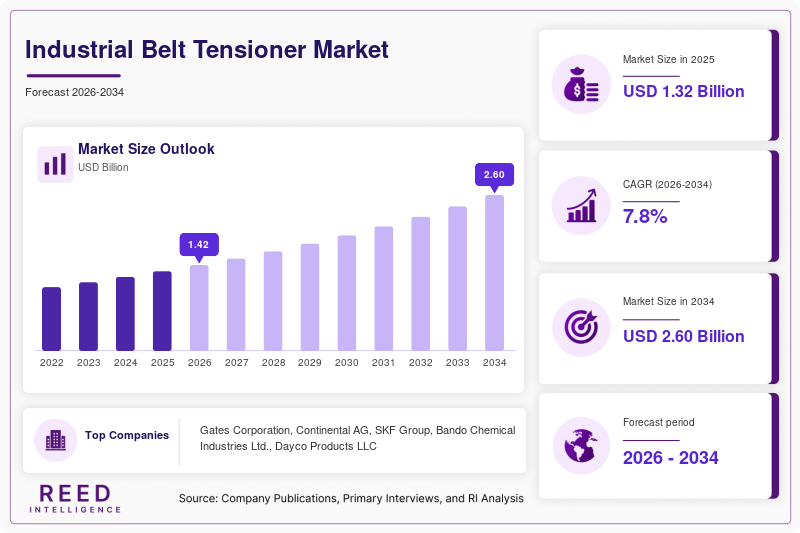
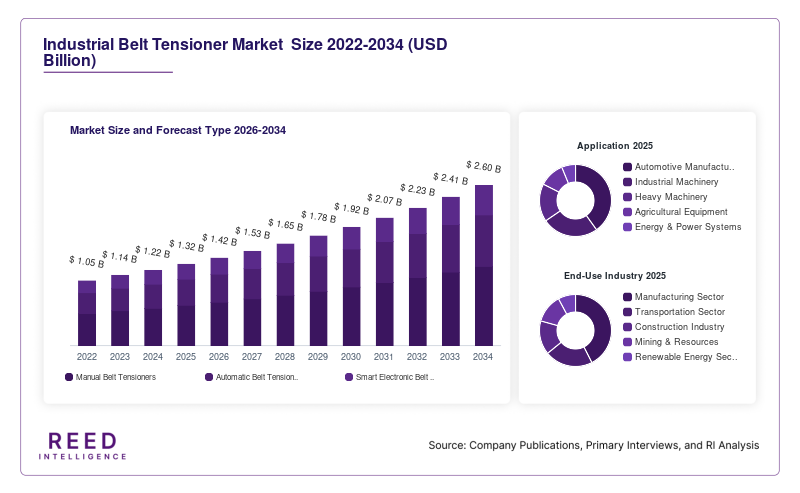
The Industrial Belt Tensioner Market size is estimated at approximately USD 1.42 billion, and it is expected to reach around USD 2.61 billion by 2034, registering a CAGR of 7.8% from 2026 to 2034. The growth trajectory is primarily driven by the rapid modernization of industrial machinery, where belt tensioners play a critical role in improving operational efficiency, reducing wear and tear, and extending equipment lifespan.
Additionally, increasing adoption of predictive maintenance practices across automotive, mining, and heavy machinery sectors has significantly supported demand for advanced belt tensioning solutions. One global factor contributing strongly to market expansion is the widespread shift toward Industry 4.0 technologies, which emphasize automated monitoring and optimized mechanical performance across industrial systems.
Key Highlights
- North America dominated the market with a 34.2% share in 2025.
- Asia Pacific is expected to grow at the fastest CAGR of 11.2% during 2026–2034.
- By equipment type, automatic tensioners accounted for the largest share of 38.5%.
- while smart electronic tensioning systems are projected to grow at a CAGR of 12.4%.
- By application, automotive manufacturing led with a 41.7% share, whereas heavy industrial machinery applications are expected to expand at a CAGR of 11.8%.
- The United States remained the dominant country, with market values of USD 510 million in 2024 and USD 560 million in 2025.
Market Trends
Integration of Smart Monitoring Technologies in Tensioning Systems
The Industrial Belt Tensioner Market is experiencing a significant shift toward smart monitoring-enabled systems integrated with IoT and sensor-based technologies. These advanced tensioners allow real-time monitoring of belt alignment, tension force, and wear conditions, reducing unexpected machine downtime. Manufacturers are increasingly embedding sensors that communicate directly with centralized control systems, enabling predictive maintenance and improving operational efficiency. This trend is particularly strong in automotive production lines and high-speed manufacturing facilities, where even minor belt misalignment can lead to substantial productivity losses. As industrial ecosystems become more digitally connected, demand for intelligent belt tensioners is expected to grow steadily, especially in regions adopting smart factory initiatives.
Increasing Adoption in Electric and Hybrid Vehicle Manufacturing
Another prominent trend shaping the Industrial Belt Tensioner Market is the rising use of advanced tensioning systems in electric and hybrid vehicle production. Unlike conventional vehicles, EV platforms require highly efficient and low-noise belt systems to optimize energy transmission and reduce mechanical losses. Belt tensioners are increasingly being engineered with lightweight materials such as aluminum composites and high-strength polymers to meet EV efficiency standards. Automotive OEMs are integrating precision-engineered tensioners to ensure longer service intervals and enhanced drivetrain performance. With global EV production expanding rapidly, this trend is expected to significantly influence product innovation and drive demand for high-performance tensioning solutions.
Market Drivers
Expansion of Industrial Automation and Manufacturing Output
The increasing adoption of industrial automation across sectors such as automotive, packaging, textiles, and food processing is a key driver for the Industrial Belt Tensioner Market. Automated production systems rely heavily on continuous and efficient mechanical operations, where belt tensioners ensure smooth torque transmission and reduced system failure risks. As manufacturers transition toward fully automated production lines, the need for precision-engineered components has intensified. Belt tensioners help maintain optimal belt performance, reduce maintenance frequency, and enhance machine productivity. Additionally, the growing number of manufacturing facilities in emerging economies is further accelerating demand, making automation a central growth catalyst for the market.
Rising Demand for Predictive Maintenance Systems
The growing emphasis on predictive maintenance is another major driver fueling the Industrial Belt Tensioner Market. Industries are increasingly deploying condition-monitoring technologies to predict mechanical failures before they occur, minimizing downtime and repair costs. Belt tensioners equipped with smart diagnostic capabilities enable operators to monitor real-time stress levels and wear patterns. This proactive maintenance approach is widely adopted in mining, power generation, and heavy machinery sectors where operational disruptions can result in significant financial losses. The integration of data analytics and machine learning with mechanical systems is further strengthening the adoption of advanced belt tensioning solutions globally.
Market Restraint
High Maintenance Complexity in Advanced Tensioning Systems
Despite technological advancements, the Industrial Belt Tensioner Market faces a notable restraint in the form of high maintenance complexity associated with advanced systems. Smart and automatic tensioners often require specialized technical knowledge for installation, calibration, and repair. This increases dependency on skilled labor and raises operational costs for end users, particularly in small and medium-sized enterprises. Additionally, improper calibration can lead to system inefficiencies or premature wear of belts and pulleys. In developing regions, limited access to trained technicians further restricts adoption of advanced tensioning technologies, slowing down overall market penetration.
Market Opportunities
Expansion of Renewable Energy Infrastructure
The increasing deployment of renewable energy systems presents a strong opportunity for the Industrial Belt Tensioner Market. Wind turbines and hydroelectric systems rely on belt-driven mechanisms for auxiliary operations such as cooling, lubrication, and control systems. As global investments in renewable energy infrastructure continue to rise, demand for durable and low-maintenance belt tensioners is expected to grow. Manufacturers are focusing on developing corrosion-resistant and high-load-bearing tensioners suitable for harsh environmental conditions. This expansion into renewable energy applications is expected to open new revenue streams for market participants.
Growth in Smart Manufacturing Ecosystems
The rise of smart manufacturing ecosystems offers another significant opportunity for the Industrial Belt Tensioner Market. Smart factories utilize interconnected machinery, AI-based monitoring, and automated maintenance systems, all of which require precision mechanical components. Belt tensioners integrated with digital sensors and cloud-based monitoring platforms are becoming essential in such environments. These systems help reduce downtime, improve efficiency, and extend equipment lifespan. As countries invest in industrial digitalization programs, demand for intelligent belt tensioning solutions is expected to increase substantially across multiple manufacturing industries.
Segmental Analysis
By Type
Manual belt tensioners accounted for approximately 36.2% market share in 2024, driven by their widespread use in low-complexity machinery and cost-sensitive applications. Their simplicity and ease of installation make them a preferred choice in small-scale industries and traditional manufacturing setups.
Automatic belt tensioners are expected to register a CAGR of 8.6%, driven by increasing automation in industrial operations. These systems provide consistent tension control, reduce maintenance frequency, and improve machine efficiency, making them highly suitable for modern production environments.
By Application
Automotive manufacturing dominated with a 40.8% share in 2024, supported by extensive use of belt-driven systems in engines, assembly lines, and conveyor systems. The sector relies heavily on precision tensioning for operational efficiency.
Heavy machinery applications are projected to grow at a CAGR of 9.4%, driven by mining, construction, and industrial equipment expansion. These industries require durable and high-load-capacity tensioners to withstand extreme operating conditions.
By End-Use Industry
Manufacturing industries held the largest share of 42.1% in 2024, due to widespread automation and production line integration. Belt tensioners are critical in maintaining continuous workflow efficiency.
The renewable energy sector is expected to grow at a CAGR of 10.2%, supported by increasing wind and hydro energy installations requiring reliable mechanical support systems.
Regional Analysis
North America
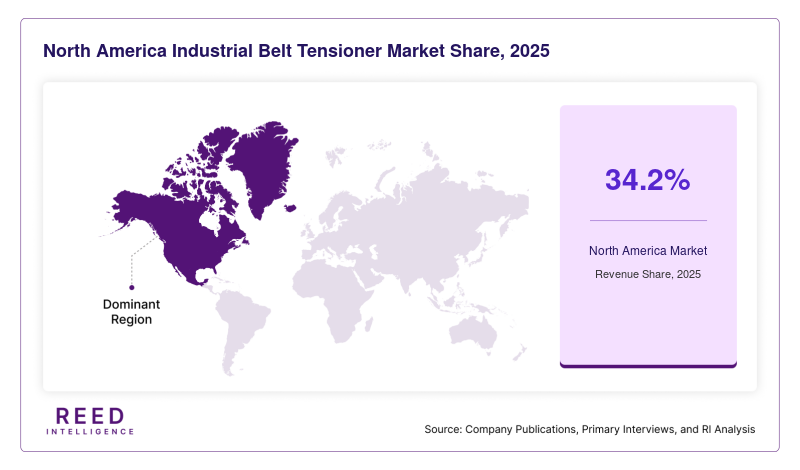
North America accounted for approximately 34.2% market share in 2025, with a projected CAGR of 7.2% during 2026–2034. The region benefits from advanced manufacturing infrastructure and early adoption of automation technologies, which significantly drive demand for industrial belt tensioners across automotive and aerospace sectors.
The United States dominates the regional market, supported by strong industrial output and high investment in predictive maintenance systems. Growth is further influenced by the presence of major automotive manufacturers and increasing deployment of smart factory solutions across production facilities.
Europe
Europe held around 27.6% market share in 2025, with a forecast CAGR of 6.9% during the same period. The region’s strong engineering base and focus on energy-efficient manufacturing systems contribute to steady demand for belt tensioners.
Germany leads the European market due to its robust automotive and machinery manufacturing sector. The country’s emphasis on precision engineering and Industry 4.0 adoption continues to support consistent market expansion.
Asia Pacific
Asia Pacific represented 22.4% market share in 2025, and is expected to register the fastest CAGR of 11.2%. Rapid industrialization and expanding manufacturing hubs in China, India, and Southeast Asia are key growth drivers.
China dominates the region, supported by large-scale industrial production and government initiatives promoting smart manufacturing and automation infrastructure development.
Middle East & Africa
The Middle East & Africa accounted for 8.3% market share in 2025, with a CAGR of 7.5% projected through 2034. Growth is driven by increasing industrial diversification and infrastructure development projects.
Saudi Arabia leads the region, supported by industrial expansion initiatives under economic diversification programs and rising investment in non-oil manufacturing sectors.
Latin America
Latin America held 7.5% market share in 2025, with an expected CAGR of 6.8%. Growth is supported by increasing automotive production and mining activities across the region.
Brazil dominates the market due to its strong automotive manufacturing base and growing investments in industrial modernization initiatives.
Competitive Landscape
The Industrial Belt Tensioner Market is moderately consolidated, with key players focusing on product innovation, durability enhancement, and integration of smart technologies. Leading companies include Gates Corporation, Continental AG, SKF Group, Bando Chemical Industries, and Dayco Products LLC. These companies are investing in advanced materials and sensor-enabled systems to strengthen their market position. Recent developments include SKF’s expansion of its smart maintenance portfolio, integrating condition-monitoring capabilities into belt-driven systems to improve industrial efficiency and reduce downtime.
Key Players
- Gates Corporation
- Continental AG
- SKF Group
- Bando Chemical Industries Ltd.
- Dayco Products LLC
- Mitsuboshi Belting Ltd.
- Optibelt GmbH
- INA (Schaeffler Group)
- Hutchinson SA
- Goodyear Belts
- Megadyne Group
- Fenner Drives
- SKF Motion Technologies
- Jason Industrial Inc.
- PIX Transmissions Ltd.
Recent Developments
- SKF Group introduced AI-enabled belt monitoring solutions to enhance predictive maintenance capabilities in industrial systems.
- Continental AG expanded its production facility in Asia Pacific to meet rising demand for advanced belt drive systems.
- Gates Corporation launched a new range of lightweight composite belt tensioners designed for electric vehicle platforms.
Industrial Belt Tensioner Market Segments
Type
- Manual Belt Tensioners
- Automatic Belt Tensioners
- Smart Electronic Belt Tensioners
Application
- Automotive Manufacturing
- Industrial Machinery
- Heavy Machinery
- Agricultural Equipment
- Energy & Power Systems
End-Use Industry
- Manufacturing Sector
- Transportation Sector
- Construction Industry
- Mining & Resources
- Renewable Energy Sector
By Region
- North America
- Europe
- APAC
- Middle East and Africa
- LATAM