Industrial Cabinet Air Conditioner Market Size, Share & Demand Report By Mounting Type (Wall-Mounted, Rooftop-Mounted, Side-Mounted, Door-Mounted), By Application (Manufacturing Automation, Renewable Energy Systems, Telecommunications Infrastructure, Power Distribution, Transportation Systems, Oil & Gas Facilities), By End-Use Industry (Manufacturing, Energy & Utilities, Telecommunications, Transportation, Oil & Gas, Mining, Others), By Region & Segment Forecasts, 2026–2034
USD 3950
Market Overview
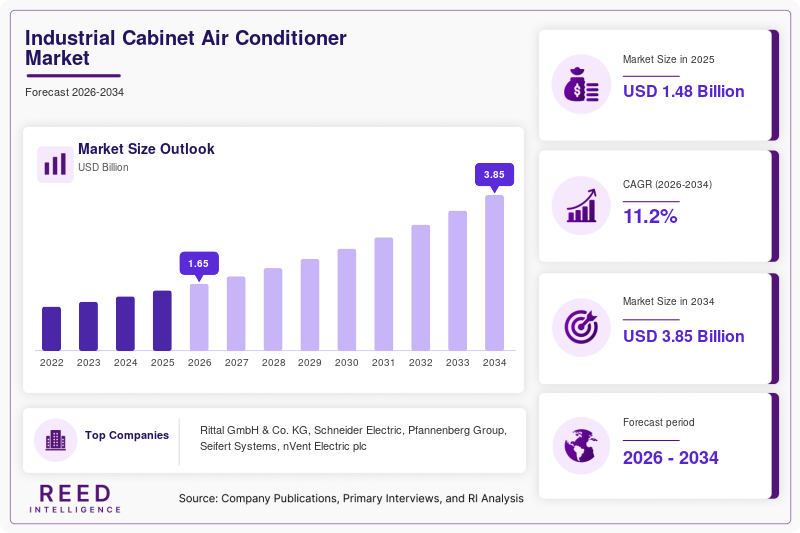
The Industrial Cabinet Air Conditioner Market size was valued at approximately USD 1.48 billion in 2026 and is projected to reach USD 3.46 billion by 2034, expanding at a CAGR of 11.2% during the forecast period from 2026 to 2034. Industrial cabinet air conditioners are specialized cooling systems designed to maintain optimal operating temperatures inside electrical enclosures, control panels, automation cabinets, and industrial equipment housings. These systems play a critical role in protecting sensitive electronic components from overheating, moisture, dust contamination, and operational failures.
Growing industrial automation across manufacturing, energy, telecommunications, transportation, and process industries has significantly contributed to market expansion. As factories continue integrating advanced control systems, programmable logic controllers, industrial computers, and communication equipment, maintaining stable enclosure temperatures has become increasingly important. Industrial cabinet air conditioners help ensure equipment reliability, reduce downtime, and extend component lifespan, making them an essential element of modern industrial infrastructure.
Key Highlights
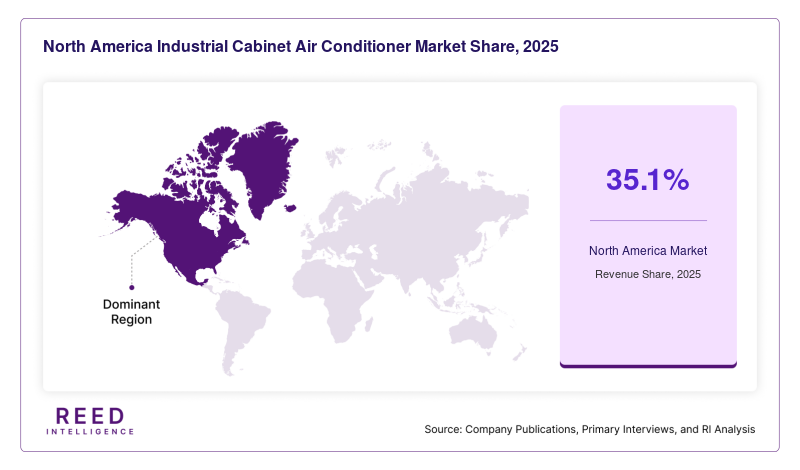
- North America dominated the market with a 35.1% share in 2025, while Asia Pacific is expected to grow at the fastest CAGR of 12.8% during 2026–2034.
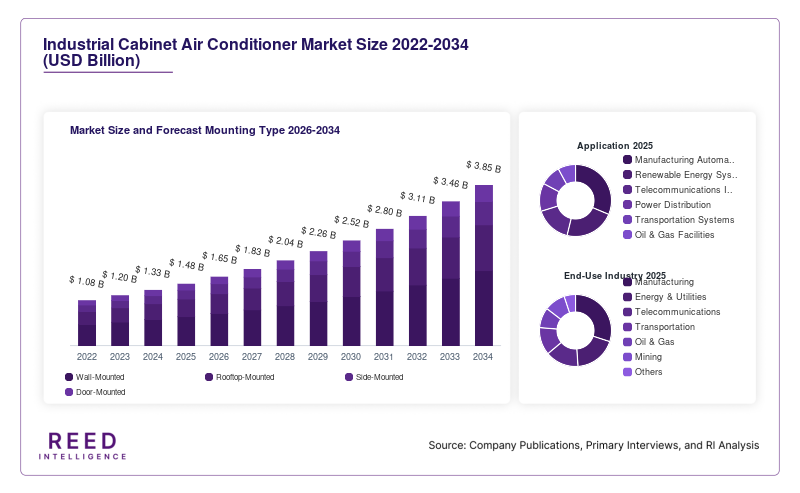
- By mounting type, wall-mounted cabinet air conditioners accounted for the largest share of 43.7%, while rooftop-mounted systems are projected to grow at a CAGR of 13.4%.
- By application, manufacturing automation led with a 39.8% share, whereas renewable energy systems are expected to expand at a CAGR of 13.9%.
- By end-use industry, manufacturing represented the largest share of 36.4%, while telecommunications is projected to grow at a CAGR of 13.1%.
- The United States remained the dominant country, with market values of USD 415 million in 2024 and USD 462 million in 2025.
Market Trends
Integration of Smart Monitoring and Remote Diagnostics
Industrial users are increasingly adopting intelligent cabinet air conditioning systems equipped with sensors, IoT connectivity, and cloud-based monitoring platforms. These advanced solutions provide real-time information regarding temperature, humidity, compressor performance, energy consumption, and maintenance requirements. Facility managers can remotely monitor enclosure conditions and receive alerts before equipment failures occur. This trend aligns with broader industrial digitalization initiatives focused on predictive maintenance and operational efficiency.
Manufacturers are responding by developing cabinet cooling systems capable of integrating with plant-wide automation networks. Smart cooling solutions reduce unexpected downtime and enable more efficient maintenance planning. In sectors such as power generation, manufacturing automation, and telecommunications, operators are prioritizing intelligent thermal management systems that improve reliability while minimizing service costs. The growing emphasis on connected industrial infrastructure continues to accelerate the adoption of digitally enabled cabinet air conditioners.
Rising Demand for Energy-Efficient Cooling Solutions
Energy efficiency has become a central purchasing criterion across industrial facilities seeking to reduce operating expenses and comply with sustainability objectives. Industrial cabinet air conditioner manufacturers are introducing high-efficiency compressors, variable-speed fans, environmentally friendly refrigerants, and advanced heat exchange technologies to improve cooling performance while lowering power consumption.
The trend is particularly noticeable in regions implementing stricter energy regulations and carbon reduction initiatives. Industrial operators are replacing older cooling units with modern systems capable of delivering higher efficiency and reduced lifecycle costs. As electricity prices continue to rise globally, businesses are increasingly investing in energy-efficient thermal management technologies. This shift is creating opportunities for premium cooling products that balance performance, reliability, and environmental responsibility while supporting long-term operational sustainability goals.
Market Drivers
Expansion of Industrial Automation and Smart Manufacturing
The rapid deployment of industrial automation systems is a major factor supporting growth in the Industrial Cabinet Air Conditioner Market. Modern manufacturing facilities increasingly rely on programmable logic controllers, human-machine interfaces, industrial computers, robotics, and advanced control systems. These components generate heat and require stable operating environments to function effectively. Industrial cabinet air conditioners provide precise temperature regulation and protect sensitive electronics from thermal stress.
As manufacturers continue implementing smart factory initiatives, the number of electronic control cabinets is growing substantially. Industrial operators are investing in advanced cooling systems to prevent overheating, improve equipment reliability, and maintain production continuity. The transition toward highly automated manufacturing environments across automotive, electronics, pharmaceuticals, and food processing industries is expected to sustain strong demand for cabinet cooling solutions throughout the forecast period.
Growth of Renewable Energy and Power Infrastructure
Investments in renewable energy projects and electrical infrastructure modernization are creating substantial demand for industrial cabinet air conditioners. Solar farms, wind power installations, battery energy storage systems, and electrical substations contain numerous control cabinets housing critical electronic equipment. These systems often operate in outdoor environments exposed to extreme temperatures and environmental conditions.
Reliable cooling is essential for maintaining performance and preventing equipment degradation. As governments and private organizations increase investments in clean energy infrastructure, demand for enclosure cooling solutions is expanding accordingly. Industrial cabinet air conditioners help protect power electronics, communication devices, and monitoring equipment from thermal damage. The continuous development of renewable energy projects worldwide is expected to generate consistent market growth opportunities for cooling equipment manufacturers over the coming years.
Market Restraint
High Installation and Lifecycle Costs Affect Adoption
The relatively high acquisition, installation, and maintenance costs associated with industrial cabinet air conditioning systems remain a significant challenge for market expansion. Advanced cooling units often require specialized installation procedures, electrical modifications, routine maintenance, refrigerant management, and periodic component replacement. These expenses can become substantial, particularly for small and medium-sized enterprises operating under budget constraints.
Many organizations evaluate alternative enclosure cooling technologies such as heat exchangers, ventilation systems, and thermoelectric cooling solutions before investing in dedicated cabinet air conditioners. Cost sensitivity is especially pronounced in developing regions where industrial modernization budgets may be limited. Additionally, fluctuations in raw material prices and electronic component costs can increase product pricing, affecting purchasing decisions. While industrial cabinet air conditioners provide long-term operational benefits through improved equipment reliability and reduced downtime, the initial investment requirement continues to act as a restraint for some potential customers. Manufacturers are addressing this challenge by introducing energy-efficient products with lower lifecycle costs and enhanced durability, but pricing considerations remain an important factor influencing market adoption across various end-user industries.
Market Opportunities
Growing Deployment of Telecommunications Infrastructure
The expansion of telecommunications networks presents significant opportunities for the Industrial Cabinet Air Conditioner Market. Rapid deployment of 5G infrastructure, fiber optic networks, edge computing facilities, and communication towers is increasing the need for reliable cooling systems. Telecommunications equipment generates substantial heat and often operates continuously in outdoor environments where temperature fluctuations can affect performance and reliability.
Industrial cabinet air conditioners provide effective thermal management for communication enclosures and network infrastructure. As telecom operators continue expanding coverage and upgrading network capabilities, demand for advanced enclosure cooling solutions is expected to increase. Emerging economies are particularly attractive markets due to large-scale investments in digital connectivity projects. Manufacturers capable of delivering compact, energy-efficient, and remotely monitored cooling solutions are well positioned to benefit from this expanding application segment.
Increasing Industrial Investments in Emerging Economies
Industrialization across Asia Pacific, Latin America, the Middle East, and parts of Africa is creating substantial opportunities for cabinet cooling equipment suppliers. Governments and private investors are funding manufacturing facilities, industrial parks, logistics centers, energy projects, and infrastructure developments that require advanced automation systems and electronic controls.
As industrial operations become more technologically sophisticated, demand for thermal management solutions rises accordingly. Emerging markets are increasingly adopting international standards related to equipment reliability and operational efficiency. This transition is encouraging investment in industrial cabinet air conditioners capable of supporting modern automation environments. Local manufacturing expansion, favorable government policies, and rising foreign direct investment are expected to create strong demand for enclosure cooling systems throughout the forecast period. Companies expanding distribution networks and localized production capabilities can capitalize on these emerging growth opportunities.
Segmental Analysis
By Mounting Type
Wall-mounted industrial cabinet air conditioners represented the dominant subsegment and accounted for approximately 43.7% of total market revenue in 2024. Their popularity stems from installation flexibility, compact design, and suitability for a wide range of industrial enclosure configurations. Wall-mounted systems are commonly deployed across manufacturing plants, telecommunications facilities, utility infrastructure, and automation environments. They provide efficient cooling performance while minimizing space requirements inside control cabinets. Many operators prefer wall-mounted solutions because they are easier to install and maintain compared with larger alternatives. Their ability to support both indoor and outdoor applications has further strengthened market demand. Continuous product innovation focused on energy efficiency and reliability has reinforced the leadership position of wall-mounted cabinet air conditioners across diverse industrial applications.
Rooftop-mounted industrial cabinet air conditioners are projected to register the fastest CAGR of 13.4% through 2034. Growth is driven by increasing demand for higher-capacity cooling solutions capable of supporting advanced industrial automation systems. Rooftop configurations maximize enclosure space utilization by positioning cooling equipment above cabinets rather than on side panels. This design advantage is particularly valuable in facilities where floor space optimization is important. Manufacturers are introducing compact rooftop units featuring improved airflow management, intelligent controls, and energy-efficient operation. Rising deployment within large electrical enclosures, renewable energy systems, and process automation installations is accelerating adoption. As industrial facilities continue expanding equipment density within cabinets, rooftop-mounted cooling solutions are expected to experience strong demand growth throughout the forecast period.
By Application
Manufacturing automation emerged as the largest application segment, accounting for approximately 39.8% of global market revenue in 2024. Industrial automation systems depend heavily on electronic controls, robotics, programmable logic controllers, and industrial communication devices that generate substantial heat during operation. Cabinet air conditioners play an essential role in maintaining stable operating conditions and preventing equipment failures. Manufacturers increasingly recognize the importance of thermal management in achieving production reliability and minimizing costly downtime. The continued transition toward smart factories and digitally connected production environments has significantly increased the number of control cabinets requiring dedicated cooling systems. Consequently, manufacturing automation remains the primary application area supporting market demand across both developed and emerging economies.
Renewable energy systems are anticipated to record the fastest CAGR of 13.9% during the forecast period. Solar power installations, wind farms, battery energy storage facilities, and grid modernization projects require sophisticated electronic controls housed within protective enclosures. These systems often operate in demanding environmental conditions where thermal management is critical for performance and longevity. Governments worldwide continue expanding renewable energy investments as part of sustainability initiatives and energy transition strategies. The resulting increase in control cabinets, power electronics, and monitoring equipment is driving demand for industrial cabinet air conditioners. Manufacturers are developing specialized cooling solutions designed to withstand harsh outdoor environments, further supporting adoption within renewable energy applications.
By End-Use Industry
The manufacturing industry accounted for the largest market share of approximately 36.4% in 2024. Industrial manufacturers increasingly rely on automated production systems, machine controls, quality monitoring equipment, and digital communication networks that require effective cooling. Cabinet air conditioners help maintain optimal temperatures, reduce component wear, and improve operational efficiency. Industries including automotive, electronics, pharmaceuticals, packaging, and food processing represent major consumers of enclosure cooling solutions. The growing complexity of manufacturing operations has increased dependence on reliable thermal management technologies. As production facilities continue implementing advanced automation and data-driven operational strategies, demand for industrial cabinet air conditioners within the manufacturing sector remains strong and sustainable.
Telecommunications is expected to emerge as the fastest-growing end-use industry, recording a CAGR of 13.1% through 2034. Expansion of mobile communication networks, 5G infrastructure, edge computing facilities, and broadband connectivity projects is driving substantial demand for enclosure cooling equipment. Telecommunications operators require reliable thermal management solutions to protect sensitive electronic devices operating continuously in outdoor environments. Network performance and service reliability depend on maintaining stable equipment temperatures under varying climatic conditions. The rapid growth of digital connectivity initiatives, particularly in emerging markets, is creating new opportunities for cabinet cooling manufacturers. Continued investments in communication infrastructure are expected to support robust segment growth throughout the forecast period.
Regional Analysis
North America
North America accounted for approximately 35.1% of the global Industrial Cabinet Air Conditioner Market in 2025, making it the leading regional market. The region is expected to register a CAGR of 10.4% through 2034. Growth is supported by extensive industrial automation adoption, strong manufacturing activity, and continuous investments in digital infrastructure. Industries increasingly depend on advanced electronic control systems that require reliable enclosure cooling solutions. Demand remains particularly strong across automotive manufacturing, aerospace production, data communications, and energy infrastructure applications.
The United States dominates the regional market and represents the largest contributor to revenue generation. A major growth factor is the widespread implementation of smart manufacturing technologies across industrial facilities. Manufacturers continue investing in automation upgrades and predictive maintenance systems that require effective thermal management. The presence of established cooling equipment manufacturers and advanced industrial infrastructure further strengthens market development across the country.
Europe
Europe represented approximately 27.4% of the global market in 2025 and is anticipated to expand at a CAGR of 10.1% during the forecast period. The region benefits from strong industrial engineering capabilities, advanced manufacturing ecosystems, and growing emphasis on energy-efficient technologies. Industrial facilities increasingly adopt high-performance cooling systems to support automation equipment and comply with stringent operational reliability requirements. Demand remains consistent across automotive, machinery, chemicals, and food processing industries.
Germany serves as the dominant country within the European market. A unique growth factor is the country's leadership in industrial digitalization and Industry 4.0 implementation. German manufacturers continue investing in smart production systems that rely on sensitive electronic controls. The need to maintain optimal operating conditions for these systems is encouraging widespread adoption of industrial cabinet air conditioners across production facilities and infrastructure projects.
Asia Pacific
Asia Pacific held approximately 23.8% of the global market in 2025 and is projected to achieve the fastest CAGR of 12.8% through 2034. Rapid industrialization, expanding manufacturing output, and increasing infrastructure investments are supporting strong regional growth. Countries throughout the region are developing advanced production capabilities while adopting automation technologies to improve competitiveness. Rising demand for enclosure cooling systems is closely linked to this ongoing industrial transformation.
China remains the dominant market within Asia Pacific. A key growth factor is the country's large-scale investment in industrial automation and electronics manufacturing. Thousands of factories are modernizing production processes and integrating sophisticated control systems. These developments create substantial demand for cabinet cooling equipment capable of protecting critical electronics from heat-related performance issues and operational disruptions.
Middle East & Africa
The Middle East & Africa region accounted for approximately 7.2% of the global market in 2025 and is expected to grow at a CAGR of 10.7% through 2034. Industrial diversification programs, energy sector investments, and infrastructure development projects are creating favorable market conditions. Demand for industrial cabinet air conditioners is increasing as industries deploy advanced electrical and automation systems in challenging environmental conditions characterized by high ambient temperatures.
Saudi Arabia is the leading country within the region. One distinctive growth factor is the ongoing expansion of industrial and energy megaprojects associated with economic diversification initiatives. These projects require extensive deployment of electrical enclosures and control systems operating in harsh outdoor environments. Industrial cabinet air conditioners help maintain system reliability and operational continuity under extreme climatic conditions.
Latin America
Latin America captured approximately 6.5% of the global market in 2025 and is forecast to grow at a CAGR of 10.5% during the study period. Industrial modernization efforts, increasing automation adoption, and investments in energy infrastructure are supporting market development. Companies across manufacturing, mining, and utilities sectors are upgrading facilities to improve productivity and operational performance. These upgrades often involve installation of advanced electronic control systems requiring dedicated cooling solutions.
Brazil dominates the Latin American market due to its extensive industrial base and growing automation investments. A unique growth factor is the modernization of mining and processing operations that rely heavily on electronic monitoring and control equipment. Industrial cabinet air conditioners are increasingly used to protect these systems from temperature fluctuations, dust exposure, and challenging operating conditions commonly encountered across industrial sites.
Competitive Landscape
The Industrial Cabinet Air Conditioner Market remains moderately consolidated, with several global and regional manufacturers competing through product innovation, energy efficiency improvements, and geographic expansion strategies. Market participants are increasingly focused on integrating intelligent monitoring capabilities, environmentally friendly refrigerants, and predictive maintenance features into their product portfolios.
Rittal GmbH & Co. KG remains a leading market participant due to its broad industrial cooling portfolio, strong global distribution network, and extensive presence across automation-intensive industries. The company recently expanded its smart enclosure cooling solutions with enhanced remote monitoring capabilities designed for Industry 4.0 environments.
Key Players
- Rittal GmbH & Co. KG
- Schneider Electric
- Pfannenberg Group
- Seifert Systems
- nVent Electric plc
- Delta Electronics
- Kooltronic Inc.
- EXAIR Corporation
- Hammond Manufacturing
- EIC Solutions Inc.
- STULZ GmbH
- Cosmotec S.r.l.
- Pelco Inc.
- Ice Qube Inc.
- Dantherm Group
Recent Developments
- In 2025, a leading industrial cooling manufacturer launched an IoT-enabled cabinet air conditioner platform featuring predictive maintenance analytics and cloud-based performance monitoring.
- In 2025, several market participants expanded production capacity across Asia Pacific to address rising demand from industrial automation and renewable energy projects.
- In 2024, a major enclosure cooling supplier introduced a new energy-efficient cabinet air conditioner series utilizing low-global-warming-potential refrigerants and advanced compressor technology.
- In 2024, manufacturers increased investment in smart thermal management solutions designed for Industry 4.0 environments and remote industrial facilities.
- In 2025, multiple companies established strategic partnerships with automation system providers to integrate intelligent cooling controls into connected factory ecosystems.
Industrial Cabinet Air Conditioner Market Segments
Mounting Type
- Wall-Mounted
- Rooftop-Mounted
- Side-Mounted
- Door-Mounted
Application
- Manufacturing Automation
- Renewable Energy Systems
- Telecommunications Infrastructure
- Power Distribution
- Transportation Systems
- Oil & Gas Facilities
End-Use Industry
- Manufacturing
- Energy & Utilities
- Telecommunications
- Transportation
- Oil & Gas
- Mining
- Others
By Region
- North America
- Europe
- APAC
- Middle East and Africa
- LATAM