Industrial Cable Reels Market Size, Share & Trends Analysis Report By Type (Spring-Driven Cable Reels, Motor-Driven Cable Reels, Manual Cable Reels), By Mounting Type (Wall-Mounted, Ceiling-Mounted, Floor-Mounted), By Application (Industrial Equipment, Material Handling, Construction, Mining, Marine, Others), and By Region (North America, Europe, Asia Pacific, Latin America, Middle East & Africa) Forecasts, 2026–2034
USD 3950
Industrial Cable Reels Market Size
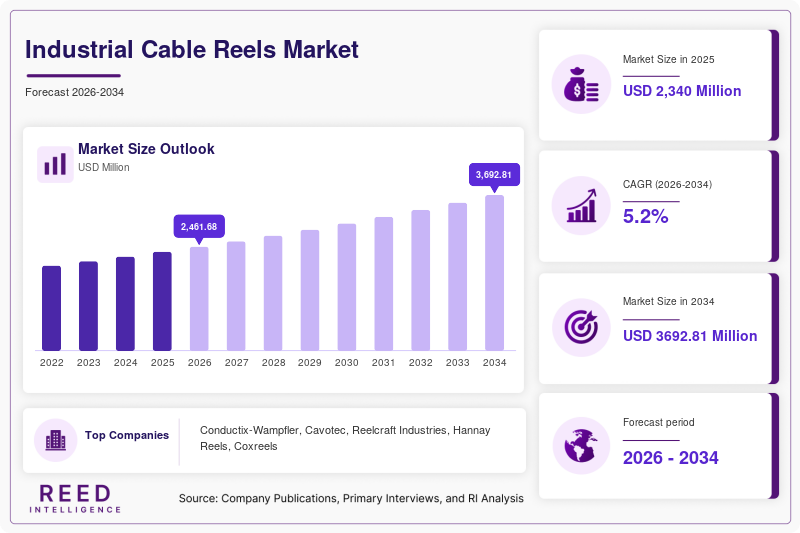
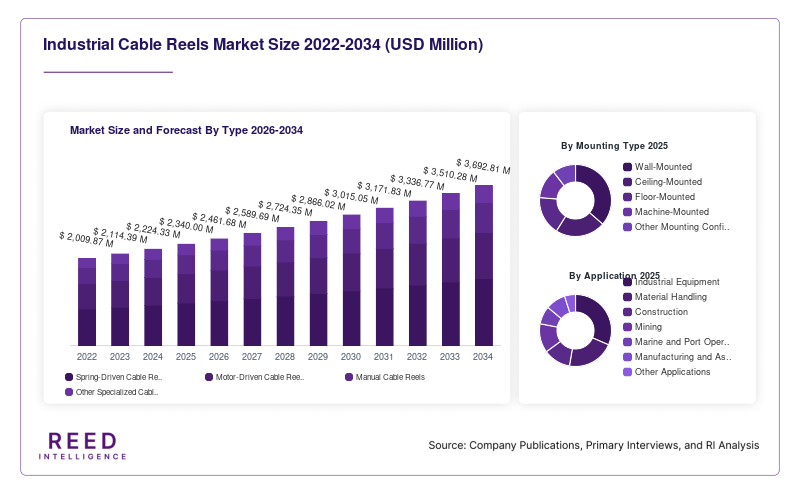
The global industrial cable reels market size was valued at USD 2,340 million in 2025 and is projected to grow from USD 2,462 million in 2026 to USD 3,692.81 million by 2034, registering a CAGR of 5.2% during the forecast period from 2026 to 2034.
The Industrial Cable Reels Market encompasses equipment designed to store, deploy, retract, and protect electrical cables, power cables, control cables, and data transmission cables in industrial and commercial environments. These reels support reliable power delivery and cable management in manufacturing plants, warehouses, construction sites, mining operations, ports, shipyards, and material-handling facilities. Depending on their operating mechanism and application, industrial cable reels may be spring-driven, motor-driven, or manually operated, with mounting configurations adapted to different equipment and workspaces.
Demand is influenced by industrial automation, expansion of manufacturing infrastructure, material-handling activities, and the need to improve workplace safety and equipment reliability. Industrial cable reels help reduce cable tangling, abrasion, accidental damage, and obstructions around machinery and mobile equipment. They are used with cranes, hoists, automated production systems, welding equipment, conveyors, service vehicles, and other equipment requiring controlled cable movement.
Industrial Cable Reels Market Drivers
Expansion of Industrial Automation and Manufacturing Infrastructure
The increasing adoption of automated manufacturing systems is supporting demand for industrial cable reels. Production lines, robotic workstations, automated inspection systems, and mobile industrial machinery require organized cable routing to maintain continuous power and control-signal transmission. Cable reels help accommodate equipment movement while limiting cable wear, entanglement, and exposure to mechanical damage. As manufacturers modernize facilities and introduce more automated equipment, demand for reliable cable management solutions is expected to increase.
Growing Demand from Ports, Mining, and Material Handling
Ports, mines, warehouses, and bulk-material handling facilities use cable reels to supply electricity and control signals to cranes, stackers, reclaimers, excavators, and other mobile equipment. Motor-driven reels are particularly relevant where long cable lengths, heavy loads, high travel speeds, and demanding operating conditions require controlled winding and unwinding. Infrastructure upgrades and equipment electrification are creating opportunities for heavy-duty reel manufacturers that can deliver application-specific systems.
Increasing Focus on Workplace Safety and Cable Protection
Industrial facilities are placing greater emphasis on reducing workplace hazards and improving equipment reliability. Loose cables can create trip hazards, become entangled with moving machinery, or suffer damage from abrasion, crushing, heat, and contamination. Properly specified cable reels help organize cable deployment and retrieval, protect cables during use, and simplify maintenance. Demand is also supported by the need to reduce downtime and extend the service life of cables used in high-utilization industrial environments.
Industrial Cable Reels Market Restraints
High Initial Costs of Motor-Driven and Customized Systems
Heavy-duty motor-driven cable reels can require substantial initial investment because of their motors, gearboxes, drums, slip rings, control systems, and application-specific engineering. Systems designed for mining, ports, and large industrial machinery may also require specialized installation and commissioning. These costs can discourage smaller industrial operators from adopting advanced reels and encourage the continued use of simpler manual or spring-driven alternatives where operating conditions permit.
Maintenance Requirements and Technical Compatibility
Industrial cable reels must be matched to cable weight, length, bending radius, voltage, current, operating speed, travel distance, and environmental conditions. Incorrect sizing or unsuitable cable selection can contribute to overheating, excessive mechanical stress, premature wear, and operational interruptions. Motorized reels may require periodic inspection of drive components, electrical connections, slip rings, and cable-guiding mechanisms. These technical requirements can increase maintenance costs and complicate procurement for operators managing multiple types of machinery.
Industrial Cable Reels Market Opportunities
Development of Smart and Automated Cable Reeling Systems
Manufacturers have opportunities to incorporate variable-frequency drives, automated tension management, condition monitoring, and improved control systems into industrial cable reels. Such capabilities can help operators manage cable movement more precisely and support integration with automated cranes, production equipment, and material-handling systems. Predictive maintenance capabilities could also help identify abnormal operating conditions before they cause equipment failures, creating opportunities for suppliers that combine reel hardware with monitoring and service solutions.
Industrial Electrification and Infrastructure Modernization
The electrification of heavy machinery, material-handling equipment, and industrial transport systems is creating demand for reliable power-delivery infrastructure. Ports, mines, steel plants, logistics facilities, and construction projects may require cable reels capable of handling higher power loads, longer travel distances, and demanding operating conditions. Suppliers offering customized systems, durable cable protection, and integrated power and data transmission solutions can address these evolving requirements.
Industrial Cable Reels Market Segmental Analysis
By Type
Spring-driven cable reels are used in workshops, assembly lines, maintenance areas, and other applications requiring convenient cable extension and automatic retraction. Their relatively simple operating mechanisms make them suitable for handheld tools, portable equipment, and light- to medium-duty cable management. Demand depends on cable specifications, retraction frequency, workplace safety requirements, and the level of mechanical protection required.
Motor-driven cable reels serve heavy-duty applications that require controlled cable deployment over long distances or during continuous equipment movement. They are used in ports, mining operations, cranes, industrial machinery, and bulk-material handling systems. Their suitability for demanding operating conditions supports demand for engineered solutions, although higher initial investment and maintenance requirements influence purchasing decisions.
Manual cable reels remain relevant where cable movement is infrequent, operating loads are limited, and automated retraction is unnecessary. Their straightforward design can be suitable for smaller facilities, temporary work areas, and selected maintenance applications. Other specialized reels address particular cable dimensions, environmental conditions, and equipment configurations.
A reliable, independently verified breakdown of market share by reel type is not established in the supplied market data. Accordingly, a precise dominant-type share or type-specific CAGR cannot be confirmed without a dedicated market-share dataset.
By Mounting Type
Wall-mounted reels are used where floor space is limited and cable access is required near workstations, service areas, and production equipment. They can help keep cables organized and away from walkways. Their adoption depends on available mounting structures, cable reach, equipment layout, and the loads that the installation must support.
Ceiling-mounted reels are relevant to workshops, industrial maintenance areas, manufacturing facilities, and service bays where cables need to be suspended above the working area. This arrangement can reduce floor-level obstructions and provide convenient access to electrical tools and equipment.
Floor-mounted and machine-mounted reels are important for heavy machinery, mobile industrial systems, and applications requiring reels to be integrated with equipment. Mounting decisions depend on vibration, available space, cable routing, travel direction, and the mechanical loads generated during operation. Other configurations are designed around specialized equipment requirements.
Comparable verified share and growth figures for each mounting configuration are not available in the supplied data. Segment rankings and numerical shares should therefore be treated as unconfirmed.
By Application
Industrial equipment represents an important application area because manufacturing machinery, cranes, hoists, and mobile equipment require dependable power and control-cable management. Cable reels help accommodate equipment movement and protect cables against mechanical stress. The need for reliable operation in high-utilization environments supports demand for robust reel systems.
Material handling applications include overhead cranes, container-handling systems, conveyors, stacker-reclaimers, and other equipment that moves materials through industrial facilities. These systems may require motor-driven reels capable of handling substantial cable lengths and frequent movement.
Mining applications involve challenging operating environments in which reels supply power to excavators, drilling equipment, tunnel-boring machinery, and other mobile equipment. Rugged construction, suitable cable guidance, and resistance to dust, vibration, and mechanical impact are important purchasing considerations.
Construction and marine applications require cable reels for selected mobile machinery, maintenance equipment, vessels, and port infrastructure. Product requirements vary according to exposure to moisture, corrosion, weather, impact, and repeated cable movement. Manufacturing and assembly facilities also use cable reels to support production equipment, tools, and service operations.
A verified application-level market-share dataset was not supplied. Although industrial equipment, material handling, and mining are significant use cases, their relative market shares and individual CAGRs cannot be stated as established market facts.
By End-User Industry
Manufacturing demand is associated with production automation, machine maintenance, assembly operations, and the need for organized cable routing. Reels are selected according to duty cycle, cable specifications, workplace layout, and equipment movement.
Mining and metals operations require robust cable-handling equipment for mobile machinery, processing facilities, cranes, and high-load industrial applications. Cable protection and reliable power transmission are important because equipment interruptions can affect productivity and maintenance schedules.
Ports and logistics facilities use cable reels in container cranes, yard equipment, and other electrically powered material-handling systems. Equipment electrification and automation can increase the need for engineered reel assemblies.
Construction, automotive, energy and utilities, and marine industries use industrial cable reels across selected equipment, service operations, and infrastructure applications. Demand varies according to capital investment, operating conditions, electrical requirements, and the type of machinery deployed.
No independently verified end-user market-share figures are established by the supplied market inputs. Industry-level share and CAGR comparisons require additional validated data.
Industrial Cable Reels Market Regional Analysis
Asia Pacific Industrial Cable Reels Market
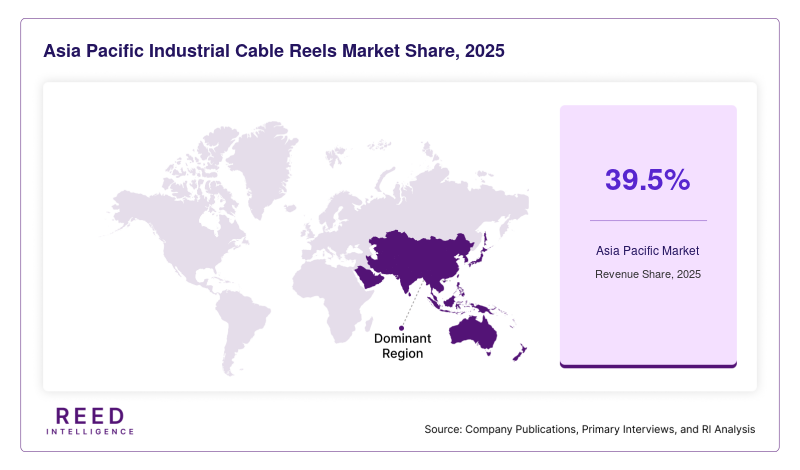
Asia Pacific is identified as the dominant region in several related cable-reel and industrial-reel market studies. One 2025 cable-reelers market analysis estimates that the region accounted for 39.54% of global market share, supported by industrial manufacturing, port infrastructure, mining, and equipment electrification. This figure is an indicative benchmark from a related market definition, not a verified share calculated from the USD 2,340 million global market baseline used in this report. A separate industrial-reels forecast identifies Asia Pacific as the fastest-growing region, with a projected CAGR of 5.8% from 2025 to 2030. Because these sources use different market scopes and forecast periods, the figures should not be treated as directly comparable with the report's global forecast.
Europe Industrial Cable Reels Market
Europe's market is supported by advanced manufacturing, industrial automation, engineering equipment, ports, and machinery modernization. Industrial cable reels are used in factory equipment, cranes, production lines, and specialized mobile machinery. Demand is influenced by equipment reliability, workplace safety, industrial energy efficiency, and the technical requirements of automated operations. A verified regional share and comparative CAGR are not available from the supplied data.
Germany, France, Italy, and the United Kingdom contribute through manufacturing, machinery production, logistics, and industrial maintenance. Germany's engineering and automotive industries require cable management across production and material-handling systems, while other European markets support demand through ports, construction equipment, energy infrastructure, and industrial service activities. Procurement decisions are shaped by application-specific specifications, durability, compliance requirements, and total operating costs.
North America Industrial Cable Reels Market
North America is supported by established manufacturing facilities, industrial maintenance requirements, mining operations, and demand for material-handling equipment. Cable reels are used in manufacturing plants, workshops, warehouses, ports, and heavy industrial environments. The region also has an established supplier base serving spring-driven, motor-driven, welding, and specialized cable-reeling applications. A verified regional market-share percentage is not available from the supplied data, so North America's exact share and ranking cannot be confirmed.
Latin America Industrial Cable Reels Market
Latin America's demand for industrial cable reels is associated with mining, metals, manufacturing, construction, ports, and energy-related industrial activities. Cable reels support power delivery to mobile equipment and help manage cables in facilities where machinery operates over fixed or variable travel distances. The scale of demand varies with industrial investment, infrastructure projects, and the maintenance requirements of existing equipment. A verified regional share and CAGR are not available from the supplied data.
Brazil and Mexico are relevant markets because of their manufacturing, logistics, and industrial equipment requirements. Chile and Peru provide demand opportunities linked to mining operations, while other countries contribute through ports, construction, and energy infrastructure. Industrial investment cycles, imported equipment costs, currency movements, and access to technical maintenance services influence procurement across the region.
Middle East & Africa Industrial Cable Reels Market
The Middle East & Africa market is supported by industrial infrastructure, mining, ports, construction, energy projects, and material-handling operations. Cable reels are used where equipment requires controlled cable deployment, including selected cranes, processing systems, and mobile industrial machinery. Harsh environmental conditions can increase the importance of corrosion resistance, temperature suitability, and robust mechanical design. A verified regional share and CAGR are not available from the supplied data.
Countries such as Saudi Arabia and the United Arab Emirates contribute through industrial development, logistics, ports, and infrastructure projects. South Africa and other mining-oriented markets generate demand from mining, metals, and heavy industrial operations. Across the region, market development depends on project investment, equipment imports, local technical support, operating environments, and the expansion of industrial and logistics infrastructure.
Industrial Cable Reels Market Competitive Landscape
The industrial cable reels market includes manufacturers of spring-driven reels, motor-driven cable reeling systems, heavy-duty reels, and application-specific cable management equipment. Competition depends on product reliability, cable capacity, operating speed, engineering capabilities, customization, installation support, and after-sales service.
Manufacturers serving ports, mining, and heavy industry compete through engineered systems designed for long cable travel distances, demanding mechanical loads, and challenging environmental conditions. Companies supplying workshops, production lines, and maintenance departments compete across reel configurations, cable compatibility, ease of installation, and product durability.
Key Market Players
- Conductix-Wampfler
- Cavotec
- Reelcraft Industries
- Hannay Reels
- Coxreels
- Hubbell Incorporated
- Nederman Holding AB
- Schneider Electric
- Eaton Corporation
- Emerson Electric Co.
Recent Market Developments
- January 2026 - Nanjing Hengjin Machinery Manufacturing delivers custom cable reels for a port crane project: The company reported delivery of custom motor-driven cable reels for a ship-to-shore crane upgrade at a container terminal. The project illustrates demand for application-specific cable-reeling systems in port electrification and material-handling infrastructure.
- April 2026 - Cavotec secures an order for motorised cable and hose reels in India: Cavotec announced an order for 14 motorised cable and hose reels for ship unloaders at bulk-material-handling facilities in India. The order reflects demand for cable-reeling systems in port infrastructure and industrial material handling.
Industrial Cable Reels Market Segments
By Type
- Spring-Driven Cable Reels
- Motor-Driven Cable Reels
- Manual Cable Reels
- Other Specialized Cable Reels
By Mounting Type
- Wall-Mounted
- Ceiling-Mounted
- Floor-Mounted
- Machine-Mounted
- Other Mounting Configurations
By Application
- Industrial Equipment
- Material Handling
- Construction
- Mining
- Marine and Port Operations
- Manufacturing and Assembly
- Other Applications
By End-User Industry
- Manufacturing
- Mining and Metals
- Ports and Logistics
- Construction
- Automotive
- Energy and Utilities
- Marine
- Other Industries
By Region
- North America
- Europe
- APAC
- Middle East and Africa
- LATAM