Industrial Carousel System Market Size, Share & Demand Report By Equipment Type (Vertical Carousel Systems, Horizontal Carousel Systems, Software-Integrated Carousel Systems), By Application (Warehousing & Order Fulfillment, Healthcare Inventory Management, Manufacturing Storage Operations, Retail Distribution Centers), By End-Use Industry (Logistics & Distribution, Healthcare & Life Sciences, Automotive Manufacturing, Electronics & Semiconductor Industry), By Region & Segment Forecasts, 2026–20
USD 3950
Market Overview
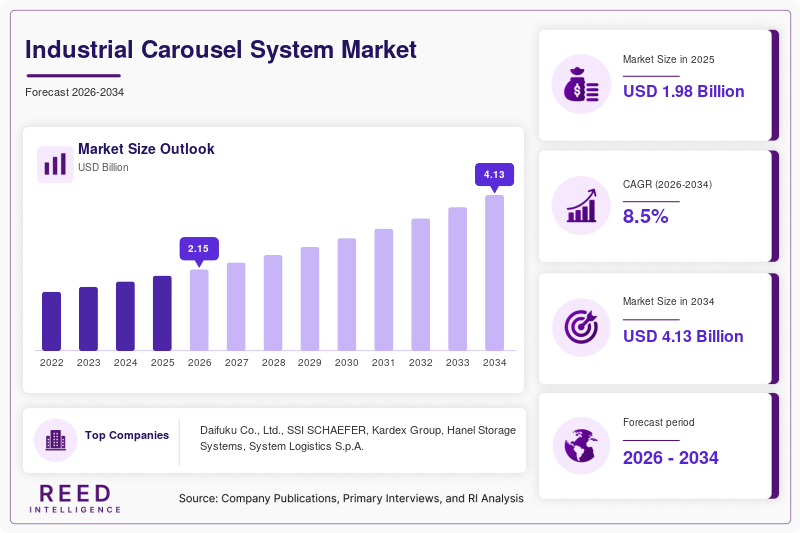
The Industrial Carousel System Market size is expected to witness steady expansion during the forecast period, supported by increasing automation in warehousing, manufacturing, and intralogistics environments. In 2026, the global market size is estimated at approximately USD 2.15 billion, and it is projected to reach around USD 4.10 billion by 2034, registering a CAGR of about 8.5% between 2026 and 2034. The growth trajectory reflects rising demand for high-density storage systems that optimize vertical and horizontal space utilization while improving operational efficiency across industrial facilities.
One of the primary global factors supporting market expansion is the rapid adoption of smart warehousing solutions driven by e-commerce growth and Industry 4.0 transformation. As companies increasingly focus on reducing order fulfillment time and improving inventory accuracy, industrial carousel systems are being integrated with automated retrieval technologies and warehouse management software. These systems offer enhanced ergonomics, reduced labor dependency, and improved picking accuracy, which are critical in high-volume distribution environments.
Key Highlights
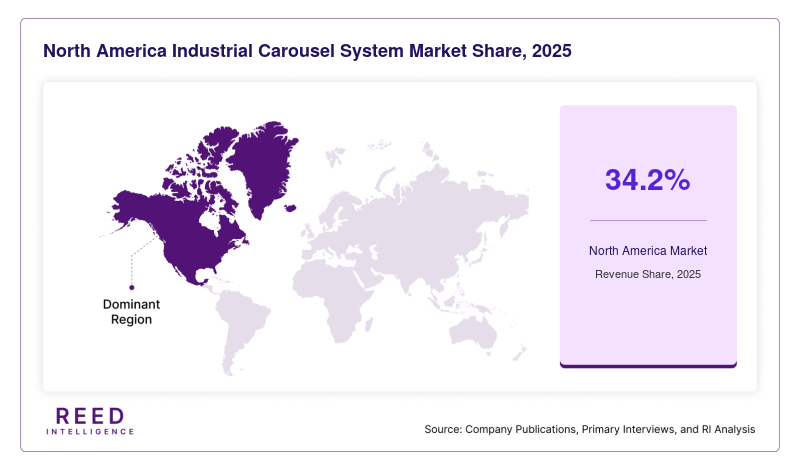
- North America dominated the market with a 34.2% share in 2025.
- Asia Pacific is expected to grow at the fastest CAGR of 11.2% during 2026–2034.
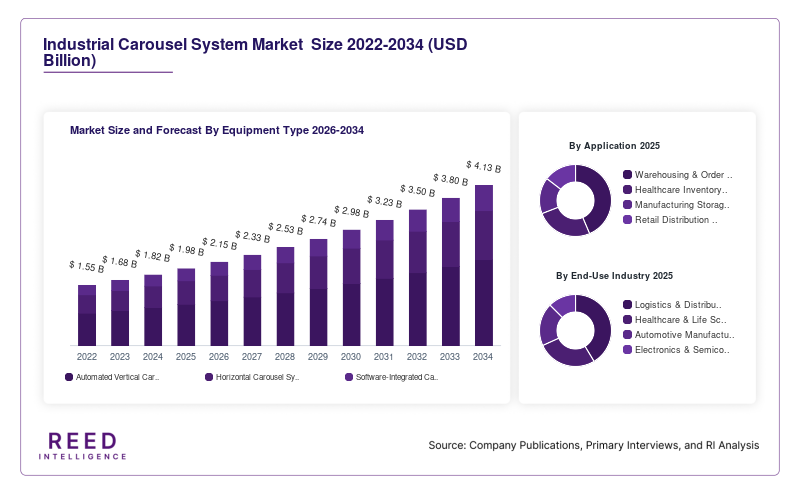
- By equipment type, automated vertical carousels accounted for the largest share of 38.5%, while software-integrated carousel systems are projected to grow at a CAGR of 12.4%.
- By application, warehousing and order fulfillment led with a 41.7% share, whereas healthcare inventory management is expected to expand at a CAGR of 11.8%.
- The United States remained the dominant country, with market values of USD 610 million in 2024 and USD 660 million in 2025.
Market Trends
Integration of Smart Automation and IoT Connectivity
The Industrial Carousel System Market is increasingly influenced by the integration of smart automation technologies and IoT-based connectivity solutions. Modern carousel systems are being equipped with sensors, RFID tracking modules, and cloud-based monitoring platforms that enable real-time visibility of inventory movement. This trend is driven by the need for accurate stock management and reduced manual intervention in warehouse operations. Industrial facilities are leveraging predictive analytics to optimize carousel rotation cycles and minimize downtime. The shift toward connected warehouse ecosystems allows operators to synchronize carousel systems with warehouse management software, improving throughput efficiency and reducing order picking errors in high-volume distribution centers.
Expansion of Ergonomic and Space Optimization Solutions
Another key trend shaping the market is the growing emphasis on ergonomic design and space optimization in industrial environments. Companies are increasingly adopting vertical carousel systems to maximize floor space utilization in compact warehouses and manufacturing units. These systems reduce worker strain by bringing stored items directly to the operator at an optimal height, improving workplace safety and productivity. The trend is particularly strong in industries such as healthcare, automotive, and electronics, where rapid access to small components is critical. Manufacturers are also introducing modular carousel configurations that can be scaled based on operational requirements, supporting flexible warehouse layouts.
Market Drivers
Rising Demand for Efficient Warehousing and Inventory Management
A major driver of the Industrial Carousel System Market is the increasing demand for efficient warehousing and inventory management solutions. With the rapid expansion of global e-commerce and omnichannel retailing, companies are under pressure to process large volumes of orders with speed and accuracy. Industrial carousel systems help streamline storage and retrieval processes by automating item movement and reducing manual picking time. This improves operational efficiency and reduces labor costs. Additionally, businesses are focusing on reducing warehouse footprint costs, which further encourages the adoption of high-density storage systems such as vertical and horizontal carousels across logistics and distribution centers.
Growth of Manufacturing Automation and Industry 4.0 Adoption
The adoption of Industry 4.0 technologies in manufacturing is another significant driver fueling market growth. Smart factories are integrating automated storage and retrieval systems, including industrial carousels, to enhance production line efficiency and minimize material handling delays. These systems enable real-time synchronization between production planning and inventory availability, reducing downtime and improving workflow continuity. The increasing use of robotics and AI-driven warehouse management systems is also accelerating the deployment of carousel systems. Manufacturers are investing in automated solutions that support lean manufacturing practices and improve overall equipment utilization across industrial operations.
Market Restraint
High Initial Investment and Integration Complexity
One of the key restraints affecting the Industrial Carousel System Market is the high initial investment required for installation and integration. Industrial carousel systems involve significant capital expenditure, particularly when combined with automation software, sensors, and warehouse management systems. Small and medium-sized enterprises often face challenges in adopting these systems due to budget limitations. Additionally, integrating carousel systems into existing warehouse infrastructure can be complex and time-consuming, requiring customization and technical expertise. This can lead to operational disruptions during installation and increase the overall implementation cost, limiting adoption in cost-sensitive industries and developing regions.
Market Opportunities
Expansion in Emerging Economies and Industrialization Growth
Emerging economies present a significant opportunity for the Industrial Carousel System Market due to rapid industrialization and infrastructure development. Countries in Asia Pacific, Latin America, and parts of the Middle East are investing heavily in modernizing their logistics and manufacturing capabilities. The rise of organized warehousing and third-party logistics providers is creating demand for advanced storage systems. Industrial carousel systems are increasingly being adopted to improve storage density and operational efficiency in growing industrial hubs. Government initiatives supporting smart manufacturing and digital supply chain transformation further enhance market potential in these regions.
Increasing Adoption in Healthcare and Pharmaceutical Logistics
The healthcare and pharmaceutical sectors offer another promising opportunity for market expansion. Hospitals, laboratories, and pharmaceutical distribution centers require precise inventory management systems to handle medical supplies, surgical instruments, and sensitive materials. Industrial carousel systems provide secure, organized, and traceable storage solutions that enhance operational efficiency and compliance with regulatory standards. The growing demand for temperature-sensitive and high-value medical storage is encouraging healthcare facilities to adopt automated carousel systems. This trend is further supported by increasing investments in healthcare infrastructure and digital inventory tracking technologies.
Segmental Analysis
By Equipment Type
Automated vertical carousel systems dominated the market in 2025 with approximately 38.5% share due to their ability to maximize vertical storage space and improve operational efficiency in compact warehouse environments. These systems are widely adopted in industries requiring frequent access to small and medium-sized components, such as automotive parts, electronics, and industrial manufacturing. Their ability to reduce walking time for operators and enhance picking accuracy makes them highly suitable for high-density storage applications. Additionally, increasing demand for labor-saving warehouse technologies continues to strengthen their adoption across developed markets.
Software-integrated carousel systems are expected to grow at the fastest CAGR of 12.4% during the forecast period, driven by rising demand for intelligent warehouse automation solutions. These systems combine mechanical storage units with advanced software platforms that enable real-time inventory tracking, predictive maintenance, and automated workflow optimization. The growth of Industry 4.0 and cloud-based warehouse management systems is further accelerating adoption. Companies are increasingly investing in digital transformation strategies, where carousel systems are integrated into broader smart factory ecosystems to enhance operational transparency and reduce inventory management errors.
By Application
Warehousing and order fulfillment held the largest share of 41.7% in 2025, driven by the rapid expansion of e-commerce platforms and third-party logistics providers. Industrial carousel systems play a crucial role in improving order picking efficiency, reducing fulfillment time, and enhancing storage density in large-scale distribution centers. The increasing consumer expectation for fast delivery services, including same-day and next-day shipping, is further pushing warehouses to adopt automated storage solutions that can handle high order volumes with accuracy and speed.
Healthcare inventory management is projected to grow at the fastest CAGR of 11.8%, supported by increasing adoption in hospitals, laboratories, and pharmaceutical distribution centers. These systems ensure secure, organized, and traceable storage of medical supplies, surgical instruments, and pharmaceuticals. The need for strict inventory control, regulatory compliance, and contamination-free storage environments is driving adoption in the healthcare sector. Additionally, the growing demand for automated systems in healthcare logistics is enhancing operational efficiency and reducing human error in inventory handling.
By End-Use Industry
Logistics and distribution centers dominated the market with a 39.2% share in 2025, as these facilities increasingly rely on automation to manage high-volume storage and rapid order processing requirements. Industrial carousel systems help optimize warehouse layout, reduce manual handling, and improve overall throughput efficiency. The continued expansion of global e-commerce and cross-border trade has significantly increased the need for advanced storage technologies in logistics hubs worldwide.
The healthcare and life sciences segment is expected to grow at the fastest CAGR of 11.5% during the forecast period. This growth is driven by increasing investments in hospital infrastructure, pharmaceutical distribution networks, and laboratory automation systems. Industrial carousel systems are particularly valuable in this sector due to their ability to ensure precise inventory tracking, reduce contamination risk, and support compliance with strict regulatory standards governing medical storage and handling.
Regional Analysis
North America
North America accounted for approximately 34.2% share of the Industrial Carousel System Market in 2025 and is projected to expand at a steady CAGR of 7.9% during the forecast period. The region maintains strong dominance due to early adoption of warehouse automation technologies, high labor costs, and the widespread presence of large-scale logistics and e-commerce companies. Industrial carousel systems are increasingly deployed in distribution centers to improve order accuracy, reduce picking time, and enhance space utilization in both retail and industrial warehousing environments.
The United States leads the North American market due to its highly advanced supply chain infrastructure and strong penetration of smart warehousing solutions. A major growth factor in the country is the rapid expansion of omnichannel retail operations, which require highly efficient storage and retrieval systems to manage fluctuating inventory demand. Additionally, growing investment in AI-driven warehouse optimization platforms is further strengthening the adoption of automated carousel systems across manufacturing and logistics facilities.
Europe
Europe held nearly 27.6% share in 2025 and is expected to grow at a CAGR of 7.4% during the forecast period. The market is driven by strong industrial automation adoption, strict workplace safety regulations, and increasing demand for efficient storage solutions in manufacturing and distribution sectors. Industrial carousel systems are widely implemented in automotive, aerospace, and pharmaceutical industries across Europe due to their ability to optimize space utilization and improve operational accuracy.
Germany dominates the European market, supported by its strong manufacturing base and leadership in industrial engineering innovation. A key growth factor in Germany is the rapid integration of Industry 4.0 technologies in production and logistics operations, where carousel systems are being connected with digital twin platforms and smart factory ecosystems to enhance productivity and reduce operational inefficiencies.
Asia Pacific
Asia Pacific accounted for approximately 25.1% share in 2025 and is projected to register the fastest CAGR of 11.2% during the forecast period. The region’s growth is fueled by rapid industrialization, expansion of e-commerce logistics networks, and increasing investments in automated warehouse infrastructure. Industrial carousel systems are gaining traction in manufacturing hubs due to rising demand for efficient material handling and high-density storage solutions.
China leads the Asia Pacific market, driven by its large-scale manufacturing ecosystem and government initiatives supporting smart factory development. A major growth factor in China is the rapid expansion of automated fulfillment centers in Tier 1 and Tier 2 cities, supported by growing domestic consumption and cross-border e-commerce activities that require advanced inventory management systems.
Middle East & Africa
Middle East & Africa held approximately 7.2% share in 2025 and is projected to grow at a CAGR of 8.1% during the forecast period. The region is witnessing gradual adoption of industrial carousel systems due to increasing investments in logistics infrastructure, industrial diversification programs, and smart city initiatives. Warehousing modernization is becoming a key priority in countries aiming to reduce dependency on traditional storage methods.
The United Arab Emirates dominates the region due to its strategic position as a global logistics hub and strong investment in automated distribution centers. A significant growth factor is the development of free trade zones and smart logistics corridors that encourage the adoption of advanced storage technologies, including carousel systems, to enhance supply chain efficiency and global trade connectivity.
Latin America
Latin America accounted for nearly 5.9% share in 2025 and is expected to grow at a CAGR of 7.8% during the forecast period. The region’s market growth is supported by increasing industrial automation in retail, manufacturing, and third-party logistics sectors. Companies are adopting carousel systems to improve warehouse efficiency, reduce operational bottlenecks, and enhance inventory accuracy in growing urban distribution networks.
Brazil leads the Latin American market due to its expanding industrial base and ongoing logistics modernization initiatives. A key growth factor is the increasing investment in automated warehousing systems by large retail chains and manufacturing firms aiming to improve supply chain reliability and reduce dependency on manual storage operations.
Competitive Landscape
The Industrial Carousel System Market is moderately consolidated, with key players focusing on automation integration, modular system design, and software-enabled inventory management solutions. Companies are investing in R&D to enhance system efficiency and expand application areas across healthcare, logistics, and manufacturing industries.
Prominent players include companies such as Daifuku Co., Ltd., SSI SCHAEFER, Kardex Group, Hanel Storage Systems, and System Logistics S.p.A. Kardex Group remains a leading player due to its strong portfolio of automated storage and retrieval systems. A recent development includes the expansion of its smart warehouse automation solutions integrated with cloud-based inventory management platforms to improve operational efficiency.
Key Players
- Daifuku Co., Ltd.
- SSI SCHAEFER
- Kardex Group
- Hanel Storage Systems
- System Logistics S.p.A.
- Murata Machinery Ltd.
- Swisslog Holding AG
- BEUMER Group
- Modula Inc.
- Constructor Group AS
- Ferretto Group
- Automation Logistics Corporation
- White Systems
- Wesco Storage Solutions
- Rotomat Systems
Recent Developments
- In 2025, Daifuku Co., Ltd. expanded its industrial automation portfolio by enhancing its vertical carousel systems with advanced AI-based inventory tracking and predictive maintenance capabilities, improving warehouse efficiency and reducing operational downtime.
- In 2025, Kardex Group introduced next-generation modular carousel solutions integrated with cloud-enabled warehouse management software, enabling real-time inventory visibility and improved multi-site synchronization for large-scale logistics operators.
- In 2024, SSI SCHAEFER implemented upgraded automated storage and retrieval carousel systems featuring energy-efficient drive mechanisms and improved ergonomic picking interfaces to support high-throughput distribution centers.
- In 2024, Murata Machinery Ltd. strengthened its industrial storage systems division by launching compact carousel configurations designed specifically for electronics and precision manufacturing industries requiring high-density small-parts storage.
Industrial Carousel System Market Segments
By Equipment Type
- Automated Vertical Carousel Systems
- Horizontal Carousel Systems
- Software-Integrated Carousel Systems
By Application
- Warehousing & Order Fulfillment
- Healthcare Inventory Management
- Manufacturing Storage Operations
- Retail Distribution Centers
By End-Use Industry
- Logistics & Distribution
- Healthcare & Life Sciences
- Automotive Manufacturing
- Electronics & Semiconductor Industry
By Region
- North America
- Europe
- APAC
- Middle East and Africa
- LATAM