Industrial Casters Market Size, Share & Trends Analysis Report By Type (Swivel Casters, Rigid Casters), By Load Capacity (Light-Duty, Medium-Duty, Heavy-Duty), By Wheel Material (Polyurethane, Rubber, Steel, Nylon), By Application (Machinery & Equipment, Material Handling & Logistics, Medical Devices, Aerospace & Defense, Food Processing) and By Region (North America, Europe, Asia Pacific, Middle East & Africa, Latin America) Forecasts, 2026–2034
USD 3950
Industrial Casters Market Size
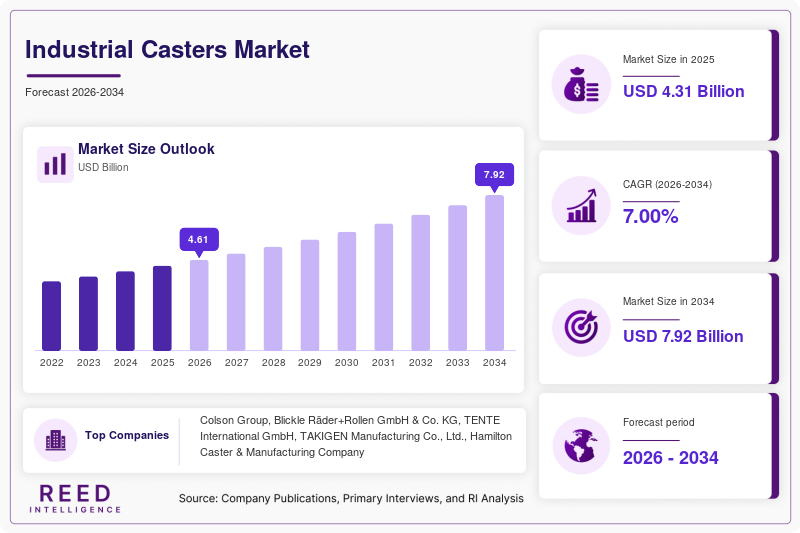
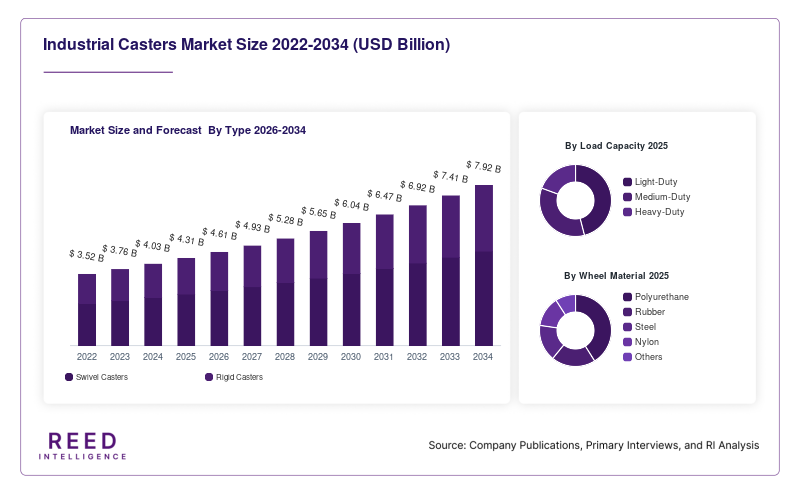
The global Industrial casters market is valued at USD 4.31 Billion in 2025 and USD 4.61 Billion in 2026. The market is projected to reach USD 7.92 Billion by 2034, registering a 7.00% CAGR during the forecast period.
The Industrial casters market is expanding alongside manufacturing automation, warehouse modernization, material-handling infrastructure, healthcare equipment mobility, and industrial workplace safety requirements. Industrial casters are increasingly selected according to load capacity, rolling resistance, floor protection, corrosion resistance, braking requirements, operating temperature, and service life rather than solely on purchase price. Global caster industry data indicates that Asia Pacific represented approximately 36.8% of broader caster-market revenue in 2025 and is projected to grow at around 5.7% CAGR through 2035, while industrial applications represented approximately 41.6% of broader caster demand. The industrial segment is supported by the increasing deployment of mobile workstations, carts, racks, platform trucks, automated equipment, and logistics systems.
Industrial Casters Market Drivers
Expansion of Manufacturing and Material Handling
Industrial manufacturing remains a major demand generator for casters used on equipment, platforms, carts, tooling systems, racks, and mobile workstations. Manufacturing and industrial applications require caster systems capable of supporting loads from below 100 kg to more than 1,000 kg per caster depending on equipment configuration. The broader caster industry identifies industrial and commercial applications at approximately 41.6% share, with this segment growing at about 5.7% CAGR.
Growth of Warehouse Automation and Logistics
The rapid expansion of distribution centers, fulfillment facilities, automated warehouses, AGVs, AMRs, and mobile material-handling equipment is increasing demand for low-resistance and high-durability caster systems. Automation places greater emphasis on dimensional consistency, rolling efficiency, controlled swivel behavior, and predictable load performance. Global logistics expansion therefore supports both OEM caster demand and recurring replacement demand across high-utilization facilities.
Increasing Focus on Ergonomics and Workplace Safety
Industrial facilities are increasingly evaluating push and pull forces, operator fatigue, noise, vibration, and equipment maneuverability. Ergonomic caster designs, electric-drive systems, optimized polyurethane treads, braking mechanisms, and low-friction bearing systems can reduce physical effort and improve handling efficiency. The increasing emphasis on worker safety is particularly relevant in manufacturing, healthcare, warehousing, and institutional environments where equipment is moved repeatedly throughout a working day.
Industrial Casters Market Restraints
Volatility in Steel and Polymer Costs
Industrial casters depend on steel, stainless steel, polyurethane, rubber, nylon, bearings, and other engineered materials. Changes in steel and polymer prices can directly affect production costs and selling prices. High-grade materials used in heavy-duty, corrosion-resistant, food-processing, and high-temperature casters can create additional cost pressure, particularly when buyers operate under fixed procurement budgets.
Wear, Maintenance, and Application-Specific Requirements
Casters operating on uneven floors, under shock loads, around chemicals, at high temperatures, or in continuous-duty environments experience tread degradation, bearing contamination, swivel wear, and mounting fatigue. Replacement cycles can therefore vary substantially by application. Customers may also postpone replacement where casters are treated as low-cost maintenance components, creating pressure on suppliers to demonstrate lifecycle benefits.
Industrial Casters Market Opportunities
Development of Smart and Ergonomic Casters
The integration of load monitoring, optimized bearings, braking systems, electric drive technology, and ergonomic engineering creates opportunities for higher-value caster solutions. Automated equipment manufacturers increasingly require predictable rolling performance and dimensional consistency, while logistics operators seek solutions that reduce manual pushing forces and improve equipment availability.
Advanced Polyurethane and Specialized Wheel Compounds
Polyurethane casters offer a combination of abrasion resistance, floor protection, chemical resistance, noise reduction, and load-bearing performance. Newer polyurethane compounds are being developed for high torque, continuous operation, high speeds, and extreme loads. This creates opportunities in warehouses, manufacturing plants, food-processing facilities, and automated material-flow environments.
Rising AGV and AMR Deployment
AGVs and AMRs require caster assemblies that support precise movement, compact installation dimensions, controlled steering, and reliable load distribution. As industrial facilities adopt autonomous material movement, suppliers can develop dedicated caster configurations for robotic platforms, mobile conveyors, production carts, and automated warehouse equipment.
Type Analysis
Swivel Casters
Swivel casters accounted for approximately 41.7% of broader global caster revenue in 2025 and are projected to expand at approximately 5.8% CAGR through 2035. Their 360-degree directional movement makes them suitable for industrial carts, material-handling platforms, mobile workstations, hospital equipment, and warehouse equipment requiring frequent directional changes. Within the Industrial casters market, swivel configurations benefit from the increasing requirement for maneuverability and ergonomic movement under medium and heavy loads.
Rigid Casters
Rigid casters provide straight-line movement and stable load transfer and are commonly combined with swivel casters on industrial carts and platforms. Their demand is linked closely to manufacturing equipment, heavy-duty material handling, warehouse platforms, and machinery requiring controlled directional movement. Available industry data does not specify a separate current market share and CAGR for rigid industrial casters on the same basis as the swivel category.
Dominant Type: Swivel Casters, based on the available broader caster-market share data.
Fastest-Growing Type: Swivel Casters, at approximately 5.8% CAGR in the available comparable dataset.
Load Capacity Analysis
Light-Duty Casters
Light-duty casters are used for smaller carts, office and industrial equipment, retail fixtures, compact machinery, and low-load mobile systems. Demand is influenced by cost efficiency, compact dimensions, quiet movement, and ease of installation. A separate comparable market share and CAGR for light-duty industrial casters is not specified in the available data.
Medium-Duty Casters
Medium-duty casters address a broad range of manufacturing, warehouse, commercial, institutional, and general industrial applications. In industrial caster wheels data, medium-duty products represented approximately 44.3% share in 2025, making them a major load-capacity category. A directly comparable CAGR for this subsegment is not specified in the available dataset.
Heavy-Duty Casters
Heavy-duty casters are designed for machinery, industrial platforms, manufacturing equipment, logistics systems, mobile tooling, and high-load material handling. Their performance depends on wheel diameter, tread compound, bearing design, mounting strength, floor conditions, shock loading, and operating speed. A separate market share and CAGR for heavy-duty industrial casters is not consistently specified across available sources.
Dominant Load Capacity: Medium-Duty, with approximately 44.3% share in the available industrial caster wheels dataset.
Fastest-Growing Load Capacity: The available comparable source does not specify a definitive subsegment CAGR.
Wheel Material Analysis
Polyurethane
Polyurethane is a high-value wheel material because it balances abrasion resistance, floor protection, chemical tolerance, load capacity, and reduced operating noise. Industrial caster wheels data indicates that polyurethane represented approximately 48.4% of material demand in 2025, supporting its position as a major material category. Recent product development is increasingly focused on polyurethane compounds for high-speed, high-torque, continuous-duty, and extreme-load applications.
Rubber
Rubber casters provide cushioning, lower noise, and floor-friendly operation and are used across material handling, medical, commercial, and industrial environments. Their performance is particularly useful where vibration absorption and quiet movement are more important than maximum load capacity. A directly comparable global share and CAGR for rubber industrial casters is not specified in the available dataset.
Steel
Steel casters are used where high structural strength, impact resistance, temperature tolerance, and heavy load capacity are required. Applications include industrial machinery, foundries, manufacturing equipment, heavy-duty platforms, and demanding material-handling environments. A separate global share and CAGR for steel-wheel industrial casters is not specified.
Nylon
Nylon casters provide low weight, corrosion resistance, and relatively low maintenance requirements. They are suitable for selected industrial, food-processing, laboratory, and institutional environments where moisture resistance and ease of cleaning are important. The available data does not provide a directly comparable global share and CAGR.
Application Analysis
Machinery & Equipment
Machinery and equipment represent a major industrial caster application because manufacturing equipment, mobile tooling, production carts, maintenance platforms, and industrial workstations require dependable mobility. Available industrial caster market data identifies machinery and equipment as a leading application, supported by manufacturing modernization and increasing equipment mobility requirements.
Material Handling & Logistics
Material handling and logistics remain central demand areas for industrial casters. Carts, racks, platform trucks, picking equipment, conveyors, warehouse systems, and mobile workstations all require caster assemblies. Warehouse automation and e-commerce fulfillment further increase demand for durable, low-resistance casters capable of repeated movement and high utilization.
Medical Devices
Medical devices and healthcare equipment require quiet, cleanable, floor-friendly, and reliable caster systems. Hospital beds, diagnostic equipment, medication carts, mobile workstations, and clinical equipment use casters where braking performance and maneuverability are critical. Broader caster-market data places healthcare at approximately 19.8% of 2025 demand.
Aerospace & Defense
Aerospace and defense applications require high-reliability casters for aircraft manufacturing, maintenance equipment, ground-support systems, mobile containers, tooling, and specialized transport equipment. Product specifications often emphasize load capacity, durability, reliability, corrosion resistance, and application-specific engineering.
Industrial Casters Market Regional Analysis
Asia Pacific Industrial Casters Market
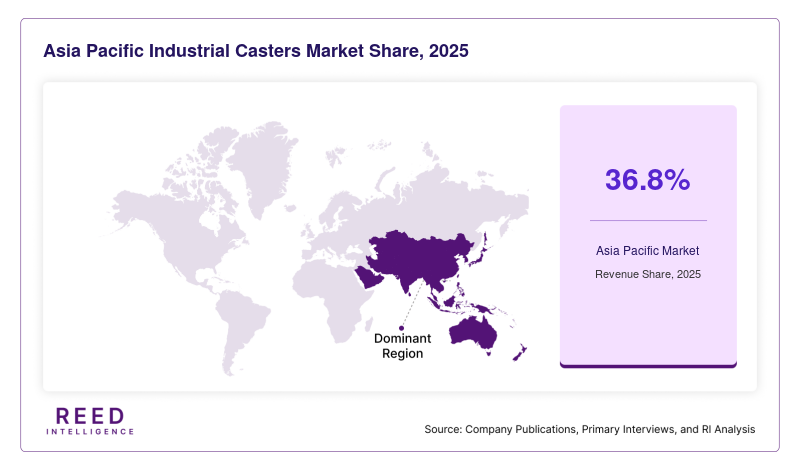
Asia Pacific is the dominant region by market share, accounting for approximately 36.8% of the broader global casters market in 2025, with a projected 5.7% CAGR through 2035. Industrial caster wheels data places the region at approximately 42.2% share, reinforcing its leadership across the industrial-wheel segment. Manufacturing expansion, warehouse construction, automation, and logistics infrastructure continue to support regional demand.
North America Industrial Casters Market
North America represented approximately 30.8% of the broader global casters market in 2025 based on available regional revenue data and is projected to grow at a 5.4% CAGR through 2035. The region benefits from manufacturing investment, warehouse automation, aerospace production, healthcare infrastructure, and replacement demand. The United States accounts for approximately 76.3% of North American caster-market revenue in the cited broader dataset.
Europe Industrial Casters Market
Europe accounted for approximately 19.2% of the broader global casters market in 2025 and is projected to expand at a 4.4% CAGR through 2035. The region has a mature manufacturing ecosystem, strong engineering capabilities, industrial safety requirements, and demand for ergonomic, floor-protective, corrosion-resistant, and sustainable caster solutions. Germany remains an important industrial caster market.
Latin America Industrial Casters Market
Latin America represented approximately 8.4% of the broader global casters market in 2025 based on the available regional dataset and is projected to grow at approximately 3.1% CAGR through 2035. Brazil, Mexico, and Argentina are important demand centers, supported by manufacturing, food processing, logistics, healthcare, and retail infrastructure.
Middle East & Africa Industrial Casters Market
Middle East & Africa represented approximately 4.7% of the broader global casters market in 2025 based on available regional data. The region is projected to expand from USD 0.45 billion in 2025 to USD 0.63 billion by 2035, implying an approximate 3.4% CAGR. Saudi Arabia, the UAE, and South Africa are important markets, with logistics hubs, industrial parks, healthcare investment, and infrastructure development supporting caster demand.
Dominant Region: Asia Pacific, with approximately 36.8% share in the broader global casters market.
Fastest-Growing Region: Asia Pacific, at approximately 5.7% CAGR.
Regional CAGR: Asia Pacific 5.7%, North America 5.4%, Europe 4.4%, Latin America 3.1%, and Middle East & Africa approximately 3.4% in the available comparable regional dataset.
Industrial Casters Market Competitive Landscape
The Industrial casters market is characterized by global manufacturers, specialist engineering companies, regional producers, and industrial distributors competing across product breadth, material technology, manufacturing capacity, customization, delivery speed, and application engineering. Broader global caster data indicates that COLSON GROUP, Blickle, TENTE, Takigen, and Hexpol collectively represented approximately 42% of 2025 revenue, while COLSON GROUP held more than 18% share in that broader market.
Competition is increasingly shifting toward specialized polyurethane compounds, ergonomic movement solutions, automated equipment casters, heavy-duty configurations, corrosion-resistant designs, and integrated mobility systems. OEM relationships and technical support remain important because caster specifications often depend on load, mounting configuration, wheel material, operating environment, braking requirements, and expected service life.
Key Market Players
- Colson Group
- Blickle Räder+Rollen GmbH & Co. KG
- TENTE International GmbH
- TAKIGEN Manufacturing Co., Ltd.
- Hamilton Caster & Manufacturing Company
- Caster Concepts, Inc.
- RWM Casters
- Darcor Limited
- ER Wagner
- Tellure Rôta
- Shepherd Hardware Products
- Albion Industries
- Payson Casters
- Samsong Caster
- Flywheel Metalwork
Recent Developments
Blickle Introduces Aviation and Defense Caster Solutions
In March 2026, Blickle released new application brochures covering wheels and casters for aviation and defense applications. The solutions address aircraft manufacturing, maintenance and repair, airport baggage conveyor systems, material transport, mobile containers, tugger trains, and other demanding applications.
Colson Group Highlights Ergonomics in 2026
In July 2026, Colson Group published new material addressing ergonomic design and push/pull forces in material handling. The company highlighted the operational costs associated with poor ergonomic design and emphasized the relationship between material-movement equipment, worker strain, productivity, and workplace safety.
Industrial Casters Market Segments
By Type
- Swivel Casters
- Rigid Casters
By Load Capacity
- Light-Duty
- Medium-Duty
- Heavy-Duty
By Wheel Material
- Polyurethane
- Rubber
- Steel
- Nylon
- Others
By Application
- Machinery & Equipment
- Material Handling & Logistics
- Medical Devices
- Aerospace & Defense
- Food Processing & Other Industrial Applications
By Region
- North America
- Europe
- APAC
- Middle East and Africa
- LATAM