Industrial Crystallizer Market Size, Share & Demand Report By Type (Evaporative Crystallizers, Draft Tube Baffle Crystallizers, Oslo Crystallizers, Vacuum Crystallizers), By Application (Chemical Processing, Pharmaceutical Manufacturing, Food & Beverage Processing, Wastewater Treatment, Mining & Mineral Recovery), By End-Use Industry (Chemicals, Pharmaceuticals, Food & Beverage) By Region & Segment Forecasts, 2026–2034
USD 3950
Market Overview
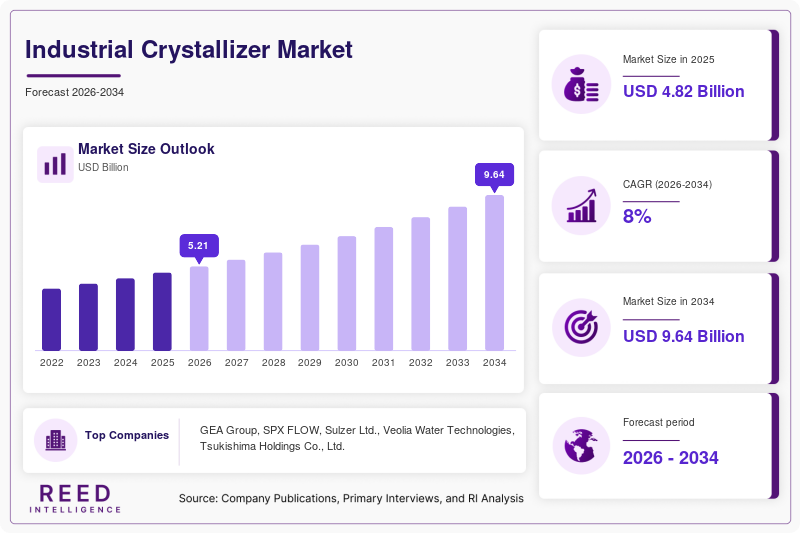
The global Industrial Crystallizer Market size was valued at USD 4.82 billion in 2026 and is projected to reach USD 8.91 billion by 2034, expanding at a CAGR of 8.0% during the forecast period from 2026 to 2034. The market continues to witness stable expansion due to increasing demand for high-purity chemical processing, growing pharmaceutical production capacities, and rising investments in wastewater treatment infrastructure. Industrial crystallizers are widely used in chemical manufacturing, food processing, mining, fertilizers, and pharmaceutical applications where controlled crystal formation and separation are essential for product quality and operational efficiency.
One of the primary global factors supporting market growth is the rising emphasis on sustainable industrial processing and resource recovery. Manufacturers across industries are adopting advanced crystallization technologies to improve product yield, reduce energy consumption, and minimize waste discharge. Increasing environmental regulations regarding industrial effluent treatment have also encouraged industries to deploy evaporative and cooling crystallization systems for salt recovery and water reuse applications. In addition, expanding production of specialty chemicals and active pharmaceutical ingredients has accelerated the need for precision crystallization equipment capable of maintaining particle uniformity and purity standards.
Key Highlights
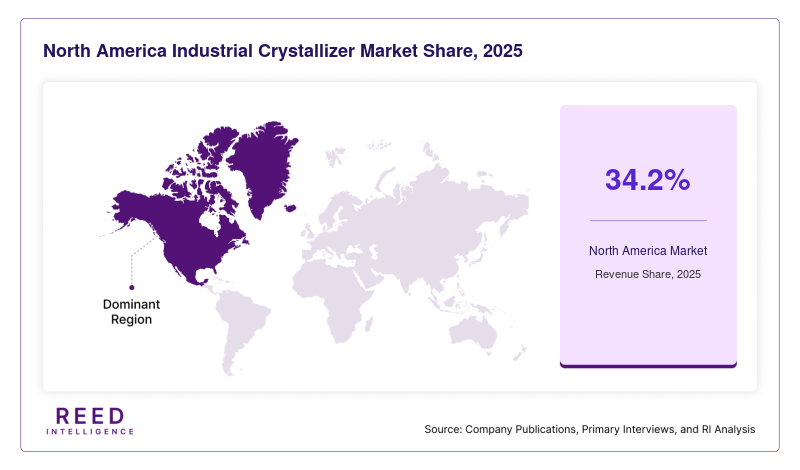
- North America dominated the market with a 34.2% share in 2025.
- Asia Pacific is expected to grow at the fastest CAGR of 10.9% during 2026–2034.
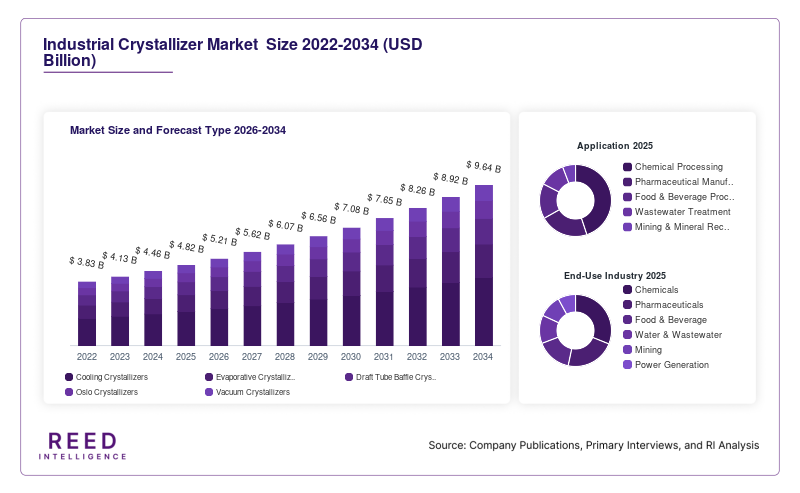
- By type, cooling crystallizers accounted for the largest share of 39.1%.
- while evaporative crystallizers are projected to grow at a CAGR of 10.7%.
- By application, chemical processing led with a 42.8% share.
- whereas pharmaceutical manufacturing is expected to expand at a CAGR of 11.4%.
- By end-use industry, chemicals held the dominant share of 37.6%.
- while wastewater treatment is anticipated to register a CAGR of 12.1% during the forecast period.
- The United States remained the dominant country, with market values of USD 1.42 billion in 2024 and USD 1.53 billion in 2025.
Market Trends
Integration of Automation and Smart Monitoring Systems
Industrial facilities are increasingly integrating automation technologies into crystallization systems to improve operational consistency and process visibility. Modern industrial crystallizers now include automated temperature control, predictive maintenance software, digital sensors, and remote monitoring systems that help operators maintain precise crystal growth conditions. These technologies reduce manual intervention and lower the risk of contamination or inconsistent particle sizes. Industries such as pharmaceuticals and specialty chemicals are adopting advanced control systems to comply with strict production standards and maintain high product purity. In addition, automated systems improve production throughput and reduce downtime, making them attractive for high-capacity industrial plants. Vendors are also investing in artificial intelligence-based analytics platforms that provide real-time operational insights and optimize crystallization cycles for energy efficiency and reduced material loss.
Rising Adoption of Zero Liquid Discharge Solutions
The increasing implementation of zero liquid discharge systems across manufacturing industries has become a major trend supporting the Industrial Crystallizer Market. Governments and environmental agencies are imposing stricter wastewater disposal regulations, especially in chemical, textile, mining, and power generation sectors. Industrial crystallizers play a critical role in separating dissolved solids and enabling water reuse within industrial facilities. As companies seek sustainable water management practices, demand for crystallizers integrated with evaporation and filtration systems is growing rapidly. Industries in water-stressed regions are particularly focused on resource recovery and wastewater minimization strategies. The trend is also driving innovation in energy-efficient crystallization technologies designed to reduce operating costs while maximizing recovery rates. Continuous crystallization systems with advanced thermal integration are gaining attention for their ability to support long-term sustainability objectives.
Market Drivers
Expansion of Pharmaceutical and Specialty Chemical Manufacturing
The rapid expansion of pharmaceutical manufacturing and specialty chemical production is significantly driving demand for industrial crystallizers worldwide. Crystallization is a critical purification and separation process used in the production of active pharmaceutical ingredients, antibiotics, and fine chemicals. Pharmaceutical manufacturers require highly controlled crystallization systems to achieve consistent particle size distribution, purity levels, and product stability. Rising global healthcare expenditure and increasing production of generic medicines are contributing to the installation of new pharmaceutical processing facilities. Specialty chemical manufacturers are also adopting advanced crystallization technologies to improve product quality and process efficiency. Continuous crystallizers are gaining traction because they enable higher production capacity and reduced operational variability. The increasing focus on precision manufacturing and stringent quality standards across pharmaceutical applications continues to support long-term market growth.
Increasing Demand for Industrial Wastewater Treatment
Industrial wastewater treatment requirements are becoming more complex due to rising environmental regulations and growing concerns about water scarcity. Industrial crystallizers are widely used in wastewater treatment plants to recover salts, separate contaminants, and reduce liquid waste discharge. Industries such as mining, power generation, textiles, and petrochemicals are investing heavily in advanced water recovery systems to comply with sustainability goals and regulatory frameworks. Crystallization technology enables efficient treatment of high-salinity wastewater streams while supporting water reuse initiatives. The growing adoption of zero liquid discharge systems in emerging economies is also creating strong demand for evaporative crystallizers and related processing equipment. Furthermore, industrial operators are increasingly focusing on reducing environmental impact and improving resource recovery, which is encouraging the deployment of integrated crystallization solutions in large-scale wastewater management projects.
Market Restraint
High Installation and Operational Costs Limiting Adoption
The high capital investment associated with industrial crystallizer systems remains a significant challenge for market expansion, particularly among small and medium-sized manufacturers. Industrial crystallization equipment requires specialized materials, advanced thermal systems, and complex process controls to ensure operational stability and product consistency. Initial installation costs can be substantial, especially for large-scale evaporative and continuous crystallization systems used in chemical processing and wastewater treatment applications. In addition to capital expenditure, operational costs related to energy consumption, maintenance, and skilled labor can impact overall profitability. Industries operating with limited budgets may delay modernization projects or continue using traditional separation technologies instead of adopting advanced crystallizers. Energy-intensive processes also increase operating expenses in regions with volatile electricity prices. These cost-related barriers can slow technology adoption in developing markets where industrial infrastructure investments are still evolving and financial constraints remain a concern.
Market Opportunities
Growing Investments in Sustainable Water Recovery Infrastructure
Increasing investments in sustainable water recovery infrastructure are creating strong opportunities for industrial crystallizer manufacturers. Governments and industrial operators are focusing on water conservation strategies due to rising freshwater scarcity and expanding industrial activity. Industrial crystallizers are becoming essential components in advanced wastewater treatment facilities because they enable salt recovery and water reuse while reducing environmental discharge. Industries such as mining, power generation, and petrochemicals are deploying large-scale zero liquid discharge systems to meet regulatory compliance requirements. This trend is expected to create long-term opportunities for suppliers offering energy-efficient crystallization technologies. Emerging economies are also investing in industrial water treatment modernization projects to support sustainable manufacturing growth. As environmental standards become stricter, demand for integrated crystallization systems with improved recovery efficiency and lower operating costs is expected to increase substantially across global markets.
Rising Demand for Continuous Crystallization Technologies
The growing shift toward continuous manufacturing processes is opening new growth avenues for the Industrial Crystallizer Market. Continuous crystallization systems provide several operational advantages compared to traditional batch systems, including consistent product quality, improved scalability, and reduced production downtime. Pharmaceutical and specialty chemical manufacturers are increasingly adopting continuous crystallization to support high-volume production and improve process efficiency. The technology also enables better process automation and lower energy consumption, making it suitable for large-scale industrial operations. In addition, continuous crystallization supports real-time quality monitoring and faster production cycles, which are important for industries operating under strict regulatory standards. Equipment manufacturers are investing in modular and compact crystallization systems that can be integrated into modern industrial production lines. The growing emphasis on process optimization and operational efficiency is expected to accelerate adoption across multiple end-use industries.
Segmental Analysis
By Type
Cooling crystallizers accounted for the largest market share of 39.1% in 2024 due to their extensive use in chemical processing, food manufacturing, and pharmaceutical production. These crystallizers are preferred because they provide efficient crystal formation through controlled temperature reduction while maintaining product quality and consistency. Industries favor cooling crystallizers for applications involving heat-sensitive materials and large-scale salt recovery operations. Their relatively lower energy requirements compared to certain evaporation-based systems also contribute to widespread adoption. In addition, manufacturers are increasingly integrating automated temperature control systems and advanced monitoring technologies into cooling crystallizers to improve operational reliability. The growing emphasis on energy efficiency and process optimization across industrial facilities continues to support the dominance of this subsegment in the global market.
Evaporative crystallizers are expected to register the fastest CAGR of 10.7% during the forecast period due to rising demand for wastewater treatment and zero liquid discharge applications. These systems are widely used in industries that require efficient separation of dissolved solids from high-salinity wastewater streams. Increasing environmental regulations regarding industrial discharge are encouraging industries to adopt evaporative crystallization technologies for resource recovery and water reuse. The mining, petrochemical, and power generation sectors are investing heavily in advanced evaporative systems to improve sustainability and regulatory compliance. Furthermore, technological advancements in thermal integration and energy recovery systems are reducing operational costs and improving overall efficiency. Growing industrialization in emerging economies is also accelerating demand for high-capacity evaporative crystallizers.
By Application
Chemical processing held the dominant share of 42.8% in 2024 due to extensive utilization of crystallizers in the production of inorganic salts, specialty chemicals, and industrial compounds. Chemical manufacturers rely on crystallization processes to achieve high product purity, controlled particle size, and efficient separation of dissolved materials. The segment continues to benefit from rising global demand for specialty chemicals used in construction, agriculture, automotive, and electronics industries. Industrial crystallizers are also essential for improving production efficiency and reducing material waste in chemical manufacturing operations. Companies are increasingly adopting automated crystallization systems to maintain consistent product quality and optimize energy consumption. The growing focus on sustainable production practices and advanced chemical processing technologies further strengthens the position of this application segment within the global market.
Pharmaceutical manufacturing is projected to expand at the fastest CAGR of 11.4% during the forecast period due to increasing production of active pharmaceutical ingredients and generic medicines. Crystallization plays a critical role in pharmaceutical processing because it directly impacts drug purity, stability, and bioavailability. Pharmaceutical manufacturers are investing in advanced continuous crystallization systems to improve process consistency and meet stringent regulatory standards. Rising healthcare expenditure and expanding pharmaceutical production capacities in emerging economies are further supporting market growth. The demand for precision crystallization technologies is also increasing due to the development of complex biologics and specialty drugs. In addition, pharmaceutical companies are focusing on reducing production costs and improving manufacturing scalability, which is accelerating adoption of modern crystallization equipment.
By End-Use Industry
The chemicals industry accounted for the largest share of 37.6% in 2024 owing to the extensive application of crystallization technologies in industrial chemical manufacturing processes. Crystallizers are widely used to separate, purify, and recover chemical compounds across various production stages. The segment benefits from growing global demand for fertilizers, industrial salts, specialty chemicals, and performance materials. Chemical manufacturers are increasingly adopting advanced crystallization systems to improve operational efficiency and reduce environmental impact. Automation and digital process control technologies are also being integrated into industrial crystallizers to maintain product consistency and optimize energy usage. Rising investments in chemical production facilities across Asia Pacific and North America continue to support the growth of this dominant end-use segment within the Industrial Crystallizer Market.
Wastewater treatment is anticipated to witness the fastest CAGR of 12.1% during the forecast period due to increasing implementation of zero liquid discharge systems and industrial water recovery initiatives. Industrial crystallizers are becoming critical components in wastewater treatment facilities because they enable recovery of salts and reusable water from high-concentration waste streams. Industries such as mining, power generation, textiles, and petrochemicals are investing heavily in advanced treatment technologies to comply with environmental regulations. Governments are also strengthening policies related to industrial wastewater management, which is accelerating demand for crystallization systems. Technological advancements in evaporative crystallization and energy recovery systems are improving process efficiency and lowering operational costs. Growing concerns regarding water scarcity are expected to further increase adoption of crystallizers in industrial wastewater treatment applications.
Regional Analysis
North America
North America accounted for 34.2% of the global Industrial Crystallizer Market share in 2025 and is expected to maintain stable growth throughout the forecast period with a CAGR of 7.4% from 2026 to 2034. The region benefits from a well-established chemical manufacturing sector and strong investments in pharmaceutical production infrastructure. Growing environmental compliance requirements related to industrial wastewater discharge are also encouraging the adoption of advanced crystallization technologies across multiple industries.
The United States remained the dominant country in North America due to its large industrial processing base and strong presence of pharmaceutical manufacturers. Increasing investments in zero liquid discharge projects and modernization of wastewater treatment facilities continue to support market growth. The country is also witnessing growing demand for continuous crystallization systems in specialty chemical applications, driven by the need for improved production efficiency and operational reliability across large-scale industrial plants.
North American industries are increasingly adopting automation-enabled crystallization equipment to improve operational control and reduce energy consumption. Industrial facilities are integrating digital monitoring systems and predictive maintenance tools into crystallizer operations to enhance process efficiency. The presence of advanced industrial infrastructure and established technology providers further supports regional market expansion. Additionally, rising investments in sustainable manufacturing practices are encouraging industries to adopt resource recovery solutions that utilize industrial crystallization technologies.
Canada is also contributing to regional growth due to increasing investments in mining operations and industrial wastewater treatment projects. Mining companies are deploying crystallization systems to recover valuable minerals and manage saline wastewater streams efficiently. The country’s focus on environmental sustainability and industrial process optimization is creating additional opportunities for equipment manufacturers. Expanding food processing and chemical industries are further supporting demand for industrial crystallizers across Canadian industrial facilities.
Europe
Europe represented 27.1% of the Industrial Crystallizer Market in 2025 and is projected to expand at a CAGR of 7.1% during the forecast period. Strong environmental regulations regarding industrial emissions and wastewater treatment continue to drive demand for crystallization systems across the region. Chemical manufacturers and pharmaceutical companies are investing in advanced processing technologies to improve operational efficiency and comply with evolving sustainability standards established by regional regulatory authorities.
Germany remained the dominant country in the European market due to its extensive chemical manufacturing sector and advanced industrial processing capabilities. The country is witnessing increased adoption of energy-efficient crystallization systems designed to reduce operational costs and improve resource recovery. Germany’s strong engineering expertise and focus on industrial innovation continue to support demand for automated crystallization equipment across chemical, pharmaceutical, and food processing industries.
European industries are emphasizing circular economy practices, which has increased the deployment of crystallizers in recycling and wastewater recovery applications. Companies are focusing on recovering salts, minerals, and reusable water from industrial waste streams to reduce environmental impact. This trend is particularly strong in Western Europe, where sustainability initiatives and environmental accountability remain key industrial priorities. Advanced evaporative crystallizers are increasingly being integrated into industrial wastewater treatment systems throughout the region.
France and the United Kingdom are also contributing to market expansion through growing investments in pharmaceutical manufacturing and specialty chemicals production. Pharmaceutical companies are upgrading existing production facilities with advanced crystallization technologies to maintain product quality and comply with stringent regulatory standards. The increasing demand for high-purity chemicals and active pharmaceutical ingredients is further supporting the adoption of precision crystallization systems across European industrial sectors.
Asia Pacific
Asia Pacific is expected to register the fastest CAGR of 10.9% during the forecast period due to rapid industrialization, expanding pharmaceutical production, and increasing investments in wastewater treatment infrastructure. The region accounted for 24.8% of the global market share in 2025. Growing manufacturing activity in chemicals, fertilizers, mining, and food processing industries is creating substantial demand for industrial crystallization equipment across emerging economies.
China dominated the Asia Pacific market owing to its large-scale chemical manufacturing capacity and extensive industrial processing sector. The country continues to invest heavily in wastewater treatment modernization and sustainable industrial development initiatives. Rising environmental regulations regarding industrial discharge are encouraging manufacturers to adopt advanced crystallization systems for water recovery and waste reduction applications. Expanding pharmaceutical production is also contributing to market growth across the country.
Industrial growth across India, Southeast Asia, and South Korea is accelerating the adoption of industrial crystallizers in multiple applications. Governments in these countries are promoting sustainable manufacturing practices and supporting investments in industrial wastewater treatment projects. The increasing establishment of pharmaceutical manufacturing facilities and specialty chemical plants is further strengthening market demand. Regional industries are also focusing on improving operational efficiency through automated and energy-efficient crystallization technologies.
India is emerging as a significant growth market due to rising investments in pharmaceutical manufacturing and chemical processing industries. The country’s growing focus on industrial water reuse and environmental compliance is encouraging deployment of crystallization systems in wastewater treatment facilities. Rapid urbanization and expanding industrial infrastructure development are creating additional opportunities for equipment suppliers. Increasing export-oriented pharmaceutical production is also supporting demand for high-performance crystallization technologies.
Middle East & Africa
The Middle East & Africa Industrial Crystallizer Market accounted for 7.2% of the global share in 2025 and is projected to grow at a CAGR of 8.3% through 2034. The region is witnessing increasing adoption of industrial wastewater treatment technologies due to water scarcity concerns and expanding industrial activity. Investments in desalination projects, petrochemical processing, and mining operations are supporting the demand for advanced crystallization systems across the region.
Saudi Arabia remained the leading country in the regional market due to strong investments in petrochemical manufacturing and water treatment infrastructure. The country is actively implementing industrial sustainability initiatives to reduce water consumption and improve wastewater recovery rates. Large-scale industrial development projects and expanding chemical processing activities continue to create demand for evaporative crystallizers and integrated separation systems across industrial facilities.
The regional market is also benefiting from increasing adoption of zero liquid discharge technologies in mining and oil refining industries. Industrial operators are focusing on recovering valuable materials and minimizing wastewater discharge to comply with environmental regulations. Crystallizers are increasingly being integrated into large-scale desalination and industrial treatment facilities to improve operational efficiency and support sustainable water management practices throughout the Middle East.
South Africa is contributing to regional growth through investments in mining operations and industrial process modernization. Mining companies are adopting crystallization technologies to manage high-salinity wastewater streams and recover minerals efficiently. Growing industrialization and rising awareness regarding sustainable manufacturing practices are supporting the adoption of advanced separation and purification technologies. Expanding infrastructure projects and increasing industrial output are expected to sustain long-term market growth in the region.
Latin America
Latin America held 6.7% of the Industrial Crystallizer Market share in 2025 and is anticipated to grow at a CAGR of 7.8% during the forecast period. The market is supported by expanding mining operations, increasing food processing activities, and rising investments in industrial wastewater treatment infrastructure. Governments across the region are strengthening environmental regulations, which is encouraging industries to adopt advanced crystallization technologies for waste management and resource recovery applications.
Brazil dominated the Latin American market due to its large chemical manufacturing industry and growing investments in industrial infrastructure development. The country is increasingly focusing on improving wastewater treatment capacity and implementing sustainable manufacturing practices. Rising demand for specialty chemicals, fertilizers, and processed food products is also contributing to increased adoption of industrial crystallization systems across major industrial sectors.
Mining industries across Chile, Peru, and Brazil are creating additional demand for crystallizers used in mineral recovery and saline wastewater treatment applications. Industrial operators are investing in efficient separation technologies to reduce environmental impact and improve resource utilization. The growing emphasis on operational sustainability and compliance with environmental regulations is expected to strengthen regional demand for advanced crystallization equipment during the forecast period.
Mexico is emerging as a notable growth market due to expanding pharmaceutical and food processing industries. Manufacturers are increasingly deploying automated crystallization systems to improve production quality and operational efficiency. The country’s industrial modernization initiatives and rising foreign investments in manufacturing infrastructure are supporting market expansion. Growing adoption of water reuse technologies in industrial facilities is also contributing to long-term demand for industrial crystallization systems.
Competitive Landscape
The Industrial Crystallizer Market is moderately consolidated, with leading companies focusing on product innovation, energy-efficient technologies, and expansion of industrial processing capabilities. Major market participants are investing in automation-enabled crystallization systems designed to improve operational performance and reduce maintenance requirements. Strategic partnerships, acquisitions, and facility expansions remain common growth strategies among global manufacturers.
GEA Group maintained a leading position in the market due to its extensive portfolio of industrial evaporation and crystallization technologies used across chemical, pharmaceutical, and food processing industries. The company has focused on integrating advanced automation and sustainable processing capabilities into its crystallization systems to support industrial efficiency goals.
SPX FLOW, Sulzer Ltd., Veolia Water Technologies, and Tsukishima Holdings Co., Ltd. also represent significant market participants with strong global presence and diversified product offerings. These companies continue to invest in advanced wastewater treatment and resource recovery technologies to strengthen market competitiveness. Recent developments across the industry include expansion of modular crystallization systems, deployment of digital monitoring platforms, and increasing emphasis on low-energy processing technologies for industrial sustainability applications.
Key Players
- GEA Group
- SPX FLOW
- Sulzer Ltd.
- Veolia Water Technologies
- Tsukishima Holdings Co., Ltd.
- Hebeler Process Solutions
- Alaqua Inc.
- Bucher Unipektin AG
- SUEZ Water Technologies & Solutions
- ANDRITZ AG
- Dedert Corporation
- Swenson Technology Inc.
- Mitsubishi Chemical Corporation
Recent Developments
- In March 2025, GEA Group introduced an energy-efficient continuous crystallization platform designed for pharmaceutical and specialty chemical manufacturing applications.
- In July 2025, Veolia Water Technologies expanded its industrial wastewater treatment portfolio with advanced evaporative crystallization systems focused on zero liquid discharge projects.
- In November 2024, SPX FLOW announced the development of automated crystallizer monitoring software aimed at improving operational efficiency and predictive maintenance capabilities in industrial processing facilities.
Industrial Crystallizer Market Segments
Type
- Cooling Crystallizers
- Evaporative Crystallizers
- Draft Tube Baffle Crystallizers
- Oslo Crystallizers
- Vacuum Crystallizers
Application
- Chemical Processing
- Pharmaceutical Manufacturing
- Food & Beverage Processing
- Wastewater Treatment
- Mining & Mineral Recovery
End-Use Industry
- Chemicals
- Pharmaceuticals
- Food & Beverage
- Water & Wastewater
- Mining
- Power Generation
By Region
- North America
- Europe
- APAC
- Middle East and Africa
- LATAM