Industrial Gas Turbine Ignition System Market Size, Share & Demand Report By Type (High-Energy Ignition Systems, Capacitive Discharge Ignition, Inductive Ignition, Laser Ignition Systems), By Component (Igniters, Exciters, Control Modules, Leads & Cables), By Application (Power Generation, Oil & Gas, Marine, Industrial Processing), By End-Use Industry (Utilities, Oil & Gas, Manufacturing, Marine), By Turbine Capacity (<30 MW, 30–100 MW, >100 MW), By Region & Segment Forecasts, 2025–2034
USD 3950
Market Overview
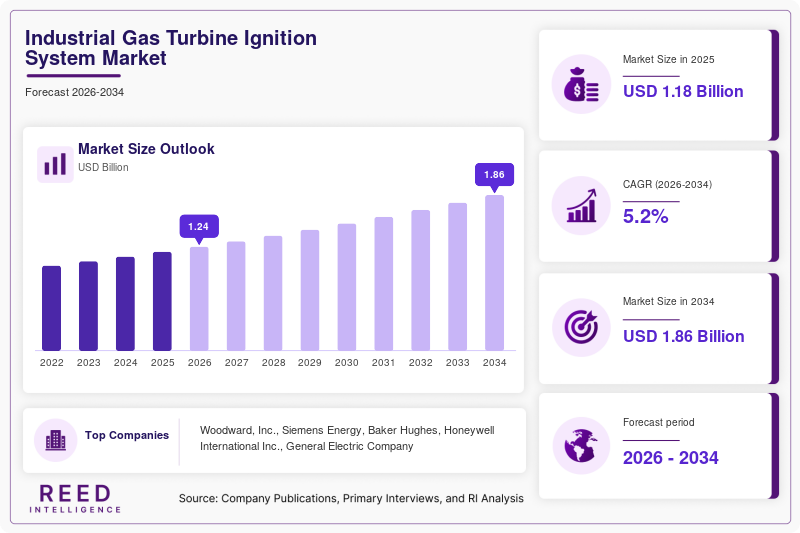
The Industrial Gas Turbine Ignition System Market size was valued at USD 1.18 billion in 2025 and is projected to reach USD 1.86 billion by 2034, expanding at a CAGR of 5.2% during 2025–2034. Growth in this market has been primarily supported by increasing investments in gas-fired power generation infrastructure and modernization of aging industrial turbine fleets. Utilities and industrial operators are upgrading ignition systems to improve turbine reliability, reduce downtime, and enhance operational safety, thereby accelerating adoption of advanced ignition technologies.
Rising demand for flexible power generation, particularly in regions transitioning toward cleaner fuels, has also contributed to market expansion. Industrial gas turbines require robust ignition systems capable of handling frequent start-stop cycles, especially in peaking power plants and backup generation facilities. As a result, manufacturers are focusing on developing high-energy ignition systems with improved durability and reduced maintenance requirements.
Key Highlights:
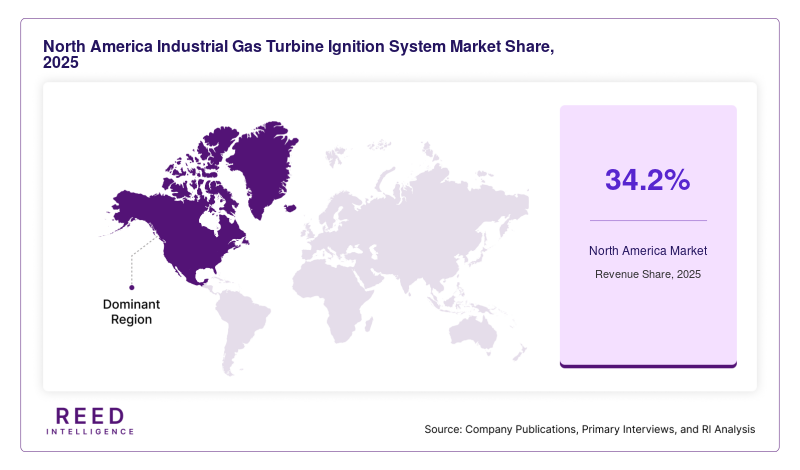
- North America dominated the market with 34.2% share in 2025, while Asia Pacific will register the fastest growth at 6.8% CAGR
- High-energy ignition systems led the type segment with 46.5% share, while laser ignition systems will grow fastest at 7.4% CAGR
- Power generation application held the largest share at 52.1%, while oil & gas will grow fastest at 6.3% CAGR
- The United States market was valued at USD 356 million in 2025 and is estimated to reach USD 372 million in 2026
Market Trends
Integration of Smart Ignition Monitoring Systems
Manufacturers are incorporating digital diagnostics and predictive maintenance features into ignition systems. These systems enable real-time monitoring of spark energy, electrode wear, and ignition reliability. Industrial operators increasingly prefer intelligent ignition systems that reduce unplanned shutdowns and extend maintenance intervals. Integration with turbine control systems allows improved performance tracking and remote troubleshooting. This trend is particularly prominent in combined-cycle power plants and critical industrial operations where uptime is essential. As Industry 4.0 adoption accelerates, ignition systems are evolving into connected components within broader asset management ecosystems.
Shift Toward High-Energy and Laser-Based Ignition Technologies
Conventional spark ignition systems are gradually being replaced by high-energy ignition solutions capable of handling lean fuel mixtures and frequent start cycles. Laser ignition technology is also gaining attention due to its precise ignition capability, reduced electrode wear, and improved combustion efficiency. Though currently limited to high-end applications, advancements in cost optimization and reliability testing are expanding adoption. The shift toward hydrogen blending and low-emission fuels is further encouraging adoption of advanced ignition technologies capable of stable combustion under varying fuel conditions.
Market Drivers
Expansion of Gas-Fired Power Generation Capacity
Global investments in gas-fired power plants are driving demand for industrial gas turbine ignition systems. Natural gas is increasingly used as a transition fuel due to lower emissions compared to coal. New combined-cycle power plants require reliable ignition systems for turbine startup and stable combustion. Additionally, grid stability requirements are encouraging installation of fast-start turbines, which increases ignition system usage frequency. This structural shift toward flexible generation is strengthening long-term market growth.
Modernization of Aging Industrial Turbine Fleet
Many industrial gas turbines installed in the early 2000s are reaching refurbishment cycles. Operators are replacing outdated ignition systems with modern high-energy units to improve efficiency and reliability. Retrofit demand is particularly strong in power generation, oil & gas, and petrochemical industries. Upgraded ignition systems reduce maintenance costs, improve start-up reliability, and enhance combustion performance. As plant operators prioritize operational efficiency, retrofit programs are expected to remain a key growth driver.
Market Restraint
High Installation and Maintenance Costs of Advanced Ignition Systems
Advanced ignition systems such as high-energy and laser-based technologies involve higher upfront costs compared to conventional spark systems. These systems require specialized components, advanced control integration, and skilled maintenance personnel. For small-scale industrial operators, the capital investment may not justify immediate replacement of existing systems. Additionally, compatibility challenges with legacy turbine infrastructure can increase installation complexity and cost. Maintenance requirements for sophisticated electronic components may also discourage adoption in cost-sensitive regions. These factors collectively slow down market penetration, particularly in developing economies where budget constraints influence procurement decisions. Although long-term operational savings offset initial costs, the high capital expenditure remains a significant barrier to widespread adoption.
Market Opportunities
Hydrogen-Ready Gas Turbine Developments
The transition toward hydrogen-blended fuels is creating new opportunities for advanced ignition systems. Hydrogen combustion requires precise ignition due to different flame characteristics. Manufacturers are developing ignition systems capable of handling hydrogen mixtures, which will drive demand across power generation and industrial sectors. As hydrogen infrastructure expands, ignition system suppliers are expected to introduce specialized products tailored for hydrogen-compatible turbines.
Growth in Distributed Energy Systems
Distributed energy systems including microgrids and industrial captive power plants are expanding globally. These systems rely on small and medium-capacity gas turbines requiring reliable ignition solutions. Increasing demand for decentralized power generation across industrial facilities and remote locations is creating additional revenue streams. Suppliers focusing on compact, modular ignition systems for distributed applications are expected to benefit from this trend.
Segmental Analysis
By Type
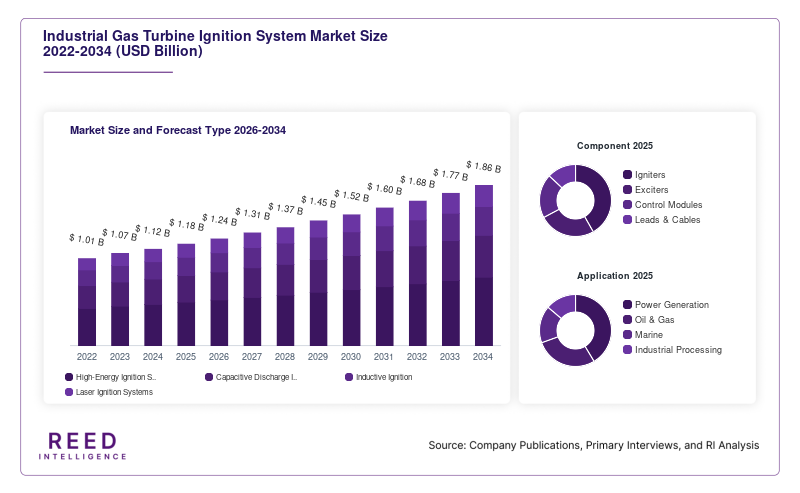
High-energy ignition systems dominated the Industrial Gas Turbine Ignition System Market, accounting for 46.5% share in 2025. These systems are widely used in industrial gas turbines due to their ability to generate strong sparks and ensure reliable ignition. Power generation facilities and heavy industrial applications prefer high-energy systems for improved combustion stability. Their durability and reduced maintenance requirements contribute to widespread adoption.
Laser ignition systems will be the fastest-growing segment, projected to expand at 7.4% CAGR. Growth will be driven by increasing demand for precise ignition in low-emission turbines. Laser systems provide electrode-free ignition, reducing wear and maintenance. Adoption will increase in advanced turbine applications and hydrogen-ready combustion systems.
By Component
Igniters dominated the component segment with 38.2% share in 2025. These components play a critical role in initiating combustion. High replacement frequency and continuous maintenance requirements contribute to their large share. Industrial operators prioritize reliable igniters to ensure turbine startup performance.
Control modules will grow fastest at 6.5% CAGR. Increasing integration of digital monitoring and automation systems will drive demand. Advanced control modules provide diagnostics and predictive maintenance features. Growing adoption of smart ignition systems will support segment growth.
By Application
Power generation accounted for 52.1% share in 2025, making it the dominant application segment. Gas turbines are widely used in utility-scale and combined-cycle power plants. Continuous demand for reliable startup performance supports ignition system adoption. Upgrades in aging power infrastructure also contribute to growth.
Oil & gas will grow fastest at 6.3% CAGR. Expansion of upstream and downstream operations will increase turbine deployment. Offshore platforms and refineries require dependable ignition systems. Increasing exploration activities will support demand.
By End-Use Industry
Utilities dominated the market with 44.8% share in 2025. Utility operators deploy large gas turbines requiring advanced ignition systems. Investments in combined-cycle plants and grid stability projects support adoption. High operational reliability requirements further drive demand.
Industrial manufacturing will grow fastest at 6.1% CAGR. Industries such as chemicals, metals, and cement are adopting captive power plants. Gas turbines offer efficient energy solutions. Increased industrial expansion will drive ignition system demand.
By Turbine Capacity
Large-capacity turbines (>100 MW) held 41.3% share in 2025. These turbines are widely used in utility-scale power plants. High reliability requirements increase demand for advanced ignition systems. Replacement and maintenance cycles further support segment dominance.
Medium-capacity turbines (30–100 MW) will grow fastest at 6.6% CAGR. Growth will be driven by distributed generation projects. Industrial facilities prefer medium-capacity turbines. Increasing microgrid adoption will support demand.
Regional Analysis
North America
North America accounted for 34.2% of the Industrial Gas Turbine Ignition System Market share in 2025. The region benefited from strong investments in natural gas-based power generation and modernization of aging turbine fleets. The market in this region will grow at a CAGR of 4.9% during 2025–2034. Increasing adoption of flexible generation capacity and retrofitting of older power plants are expected to sustain growth. Utilities are focusing on reliability improvements, driving demand for advanced ignition technologies. Additionally, regulatory emphasis on emissions reduction encourages deployment of efficient combustion systems.
The United States dominated the regional market due to extensive gas turbine installations across power generation and industrial sectors. Growth in combined-cycle power plants and peaking power units has increased demand for ignition system upgrades. Industrial facilities such as petrochemical plants and refineries also contribute to market demand. Continuous investment in grid stability and backup generation capacity is expected to strengthen the country's market position.
Europe
Europe held 24.6% share of the Industrial Gas Turbine Ignition System Market in 2025. The region will grow at a CAGR of 4.5% through 2034. Increasing focus on energy transition and flexible power generation has encouraged deployment of gas turbines as backup for renewable energy sources. Aging turbine infrastructure across Western Europe is also driving retrofit demand for ignition systems. Industrial decarbonization initiatives are further influencing adoption of efficient combustion technologies.
Germany emerged as the dominant country in the region. The country's industrial base and investments in combined-cycle plants support ignition system demand. Gas turbines are widely used for balancing intermittent renewable energy generation. Retrofit programs for older turbines and adoption of hydrogen-ready technologies are expected to sustain growth. Additionally, industrial CHP plants contribute to stable market expansion.
Asia Pacific
Asia Pacific represented 22.8% of market share in 2025 and will register the fastest growth at 6.8% CAGR during the forecast period. Rapid industrialization and rising electricity demand are driving installation of gas turbine-based power plants. Governments in the region are focusing on cleaner power generation, increasing reliance on natural gas. Expansion of manufacturing facilities and petrochemical industries is also boosting demand.
China dominated the regional market due to significant investments in gas-fired power plants and industrial infrastructure. The country's efforts to reduce coal dependency are increasing gas turbine deployment. Industrial sectors such as chemicals, refining, and heavy manufacturing are adopting gas turbines for captive power generation. Increasing adoption of distributed energy systems further supports demand for ignition systems.
Middle East & Africa
The Middle East & Africa accounted for 10.9% share in 2025 and will grow at 5.7% CAGR through 2034. The region benefits from strong presence of oil & gas industries and high reliance on gas turbines for power generation. New power plant construction and industrial expansion are driving ignition system demand. Harsh environmental conditions also necessitate durable ignition solutions.
Saudi Arabia dominated the regional market due to large-scale power generation projects and oil & gas infrastructure. Gas turbines are widely used for industrial power and utility-scale electricity production. Investments in energy diversification and industrial expansion are expected to drive further demand. Additionally, modernization of existing power plants contributes to market growth.
Latin America
Latin America captured 7.5% share in 2025 and will expand at 5.1% CAGR during the forecast period. Growth is supported by increasing adoption of gas-fired power plants and industrial energy projects. Countries in the region are diversifying energy sources to improve reliability. Retrofit demand for existing turbine installations also contributes to market expansion.
Brazil emerged as the dominant country. Expansion of gas-based power generation and industrial energy projects are driving ignition system adoption. The country is investing in flexible generation capacity to complement hydropower. Industrial facilities such as refineries and chemical plants further support demand. Continued infrastructure development is expected to maintain growth.
Competitive Landscape
The Industrial Gas Turbine Ignition System Market is moderately consolidated, with key players focusing on product innovation and retrofit solutions. Companies are investing in advanced ignition technologies and digital monitoring capabilities to enhance reliability. Strategic partnerships with turbine manufacturers and service providers are common to expand market presence.
One leading player, Woodward, Inc., has introduced a next-generation high-energy ignition system designed for hydrogen-ready turbines. The development emphasizes improved spark reliability and reduced maintenance. Other companies are focusing on expanding service networks and aftermarket support. Market participants are also targeting emerging economies through localized manufacturing and partnerships.
Key Players List
- Woodward, Inc.
- Siemens Energy
- Baker Hughes
- Honeywell International Inc.
- General Electric Company
- Champion Aerospace
- Altronic LLC
- Meggitt PLC
- Unison Industries
- Pyromation Inc.
- Ignition Technologies Ltd.
- Advanced Energy Industries
- Power Flame Inc.
- Turbine Controls Ltd.
- Safran Group
- Emerson Electric Co.
- AMETEK Inc.
Recent Developments
- 2024: A major manufacturer launched a hydrogen-compatible ignition system for industrial gas turbines.
- 2024: A global turbine service provider introduced predictive maintenance software integrated with ignition modules.
- 2023: An ignition system supplier expanded manufacturing capacity in Asia Pacific.
- 2023: A power generation equipment company announced retrofit ignition kits for aging turbines.
- 2023: A technology firm introduced laser ignition testing for industrial turbine applications.
Industrial Gas Turbine Ignition System Market Segments
Type
- High-Energy Ignition Systems
- Capacitive Discharge Ignition
- Inductive Ignition
- Laser Ignition Systems
Component
- Igniters
- Exciters
- Control Modules
- Leads & Cables
Application
- Power Generation
- Oil & Gas
- Marine
- Industrial Processing
End-Use Industry
- Utilities
- Oil & Gas
- Manufacturing
- Marine
Turbine Capacity
- <30 MW
- 30–100 MW
- >100 MW
By Region
- North America
- Europe
- APAC
- Middle East and Africa
- LATAM