Industrial Heat Pump Market Size, Share & Demand Report By Type (Closed-Cycle Heat Pumps, Open-Cycle Heat Pumps, High-Temperature Heat Pumps, Mechanical Vapor Recompression Systems), By Application (Food and Beverage Processing, Chemical Processing, District Heating, Drying and Dehydration, Pulp and Paper Processing, Pharmaceutical Manufacturing), By End-Use Industry (Chemicals, Food and Beverage, Pharmaceuticals, Pulp and Paper, Textile Manufacturing, Energy and Utilities) By Region & Segment F
USD 3950
Market Overview
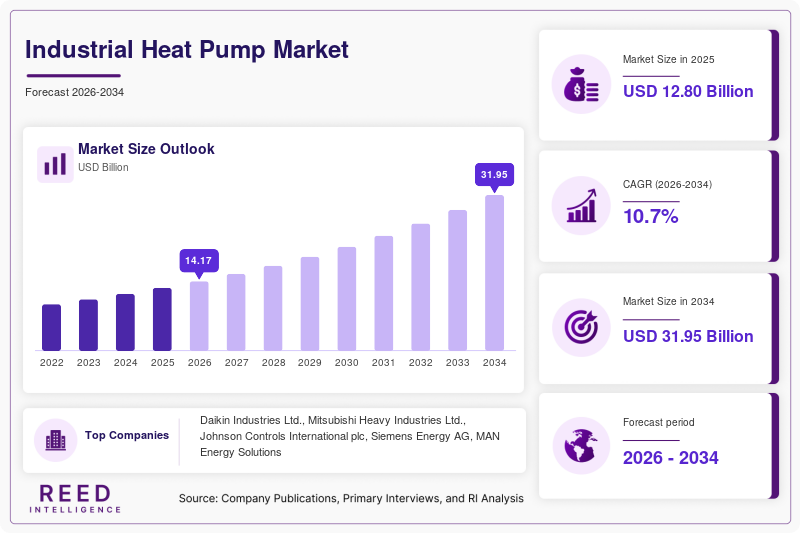
The global Industrial Heat Pump Market size was valued at USD 12.8 billion in 2026 and is projected to reach USD 28.9 billion by 2034, expanding at a CAGR of 10.7% during the forecast period from 2026 to 2034. Industrial heat pumps are gaining strong traction across manufacturing, food processing, chemicals, pulp and paper, and district heating applications due to their ability to reduce energy consumption and carbon emissions. Industries are increasingly adopting advanced heat recovery technologies to improve thermal efficiency and lower operational costs. The growing shift toward electrification of industrial heating systems is also supporting market expansion across developed and emerging economies.
One of the major global factors supporting market growth is the implementation of carbon reduction policies and industrial decarbonization targets. Governments across Europe, North America, and Asia Pacific are encouraging industries to replace fossil-fuel-based heating systems with energy-efficient alternatives. Industrial heat pumps can utilize waste heat streams and convert them into usable thermal energy, making them suitable for industries seeking long-term sustainability goals. Rising electricity grid modernization and increasing investments in renewable energy integration are also creating favorable conditions for market growth. In addition, industrial facilities are focusing on reducing fuel price volatility and achieving stable long-term operating expenses, which further supports product adoption.
Key Highlights
- North America dominated the market with a 35.4% share in 2025.
- Asia Pacific is expected to grow at the fastest CAGR of 11.8% during 2026–2034.
- By type, closed-cycle heat pumps accounted for the largest share of 44.3%, while high-temperature industrial heat pumps are projected to grow at a CAGR of 12.5%.
- By application, food and beverage processing led with a 31.6% share, whereas district heating applications are expected to expand at a CAGR of 12.1%.
- The United States remained the dominant country, with market values of USD 3.9 billion in 2024 and USD 4.3 billion in 2025.
Market Trends
Integration of High-Temperature Heat Pump Systems in Manufacturing Facilities
Industrial facilities are increasingly integrating high-temperature heat pump systems to replace conventional steam boilers and fossil-fuel-based heating equipment. These systems can now deliver process temperatures exceeding 120°C, enabling wider deployment across chemical processing, pharmaceuticals, paper manufacturing, and textile operations. Companies are investing in advanced refrigerants, improved compressor technologies, and heat recovery systems to improve thermal efficiency and operational flexibility. The trend is becoming more visible in regions with strict emission reduction policies and higher industrial electricity adoption. Manufacturers are also focusing on modular industrial heat pump solutions that can be integrated into existing production infrastructure without extensive plant redesign. The ability to recover waste heat from industrial processes and convert it into reusable thermal energy is helping industries lower energy consumption and improve sustainability performance.
Expansion of Industrial Waste Heat Recovery Projects
The growing emphasis on circular energy systems is increasing investments in industrial waste heat recovery projects. Industries are recognizing the economic value of capturing excess heat generated during production activities and reusing it for heating, drying, or district energy systems. Industrial heat pumps play a critical role in upgrading low-grade waste heat into useful process heat. This trend is particularly strong in Europe and Asia Pacific, where governments are introducing incentives for energy-efficient industrial infrastructure. Food processing plants, breweries, pulp and paper mills, and chemical manufacturers are actively deploying waste heat recovery systems to reduce operating expenses and meet environmental regulations. In addition, rising energy prices are encouraging industries to improve energy productivity through advanced heat pump integration. The trend is expected to create long-term opportunities for manufacturers offering customized industrial heat recovery technologies.
Market Drivers
Growing Industrial Decarbonization Initiatives Across Major Economies
Industrial decarbonization initiatives are significantly driving the adoption of industrial heat pumps across global markets. Governments and industrial organizations are introducing aggressive carbon neutrality targets, creating strong demand for low-emission heating systems. Industrial heat pumps provide a practical alternative to fossil-fuel-based heating by utilizing electricity and waste heat recovery mechanisms. Industries such as chemicals, food processing, pulp and paper, and pharmaceuticals are investing in electrified heating technologies to comply with emission standards and reduce dependence on natural gas. In addition, rising carbon taxation policies and mandatory energy audits are encouraging companies to modernize thermal management systems. Financial incentives, subsidies, and industrial energy transition programs are also accelerating investments in industrial heat pump deployment across manufacturing facilities.
Rising Demand for Energy-Efficient Industrial Heating Solutions
Increasing energy costs and operational efficiency requirements are driving industries toward energy-efficient heating technologies. Industrial heat pumps can generate multiple units of thermal energy for every unit of electricity consumed, making them highly efficient compared to traditional heating systems. Manufacturing facilities are focusing on reducing production costs and improving energy utilization efficiency to remain competitive in global markets. Industrial heat pumps help industries achieve lower fuel consumption, reduced maintenance requirements, and improved thermal control across production operations. The growing use of automation and smart energy monitoring systems is also improving the operational performance of industrial heat pump installations. In addition, industries are increasingly adopting sustainable production strategies to strengthen brand positioning and meet customer expectations regarding environmental responsibility, which further supports market growth.
Market Restraint
High Initial Capital Investment and Infrastructure Modification Requirements
The Industrial Heat Pump Market faces challenges related to high upfront installation costs and infrastructure modification requirements. Large-scale industrial heat pump systems require advanced compressors, heat exchangers, refrigerants, and control systems, which increase initial investment expenses for industrial operators. In many manufacturing facilities, existing heating infrastructure is designed around conventional fossil-fuel-based systems, making integration of industrial heat pumps technically complex and capital intensive. Retrofitting industrial plants often requires pipeline modifications, electrical upgrades, thermal storage systems, and production line adjustments. Small and medium-sized enterprises may face financial limitations when considering large-scale heat pump implementation, particularly in regions with limited government incentives.
The restraint is more visible in energy-intensive industries where uninterrupted thermal supply is essential for production continuity. Companies may delay investments due to concerns regarding payback periods and operational disruptions during installation. In developing economies, limited awareness regarding long-term energy savings and inadequate technical expertise can further slow adoption. In addition, fluctuations in electricity prices can affect operational cost calculations, making some industries hesitant to transition from traditional heating technologies. Although lifecycle cost benefits remain favorable, the high capital intensity associated with industrial heat pump deployment continues to restrict rapid market penetration.
Market Opportunities
Expansion of District Heating Networks Using Industrial Heat Pumps
The expansion of district heating infrastructure is creating substantial opportunities for industrial heat pump manufacturers. Urban regions are increasingly adopting centralized heating systems to improve energy efficiency and reduce greenhouse gas emissions. Industrial heat pumps can utilize waste heat from industrial facilities, wastewater treatment plants, and data centers to support district heating operations. Governments in Europe and Asia Pacific are investing in low-carbon heating networks as part of broader climate transition strategies. High-capacity industrial heat pumps are becoming essential components in modern district energy systems due to their ability to deliver reliable thermal output with lower emissions.
The opportunity is also supported by increasing urbanization and rising demand for sustainable residential and commercial heating solutions. Municipal authorities are partnering with energy companies to develop integrated thermal networks that can operate using renewable electricity and recovered industrial heat. The adoption of large-scale heat pump systems within district heating projects is expected to increase significantly over the forecast period as cities focus on energy resilience and long-term sustainability goals.
Rising Adoption of Heat Recovery Systems in Food and Beverage Industries
The food and beverage industry presents strong growth opportunities for industrial heat pump manufacturers due to rising adoption of energy-efficient heat recovery technologies. Food processing facilities generate large volumes of excess heat during refrigeration, pasteurization, drying, and cleaning processes. Industrial heat pumps can recover this waste heat and reuse it for water heating, steam generation, and space heating applications. Companies in the food sector are increasingly focusing on reducing energy expenses and improving sustainability performance to comply with environmental standards and consumer expectations.
The growing demand for processed and packaged food products is encouraging manufacturers to modernize production infrastructure with efficient thermal management systems. Industrial heat pumps also help food processing facilities improve temperature consistency and operational reliability. The opportunity is particularly significant in emerging economies where rapid industrialization and expansion of cold chain infrastructure are driving investments in advanced food manufacturing technologies. Increasing awareness regarding energy savings and carbon reduction benefits is expected to accelerate adoption across dairy processing, beverage production, meat processing, and bakery industries.
Segmental Analysis
By Type
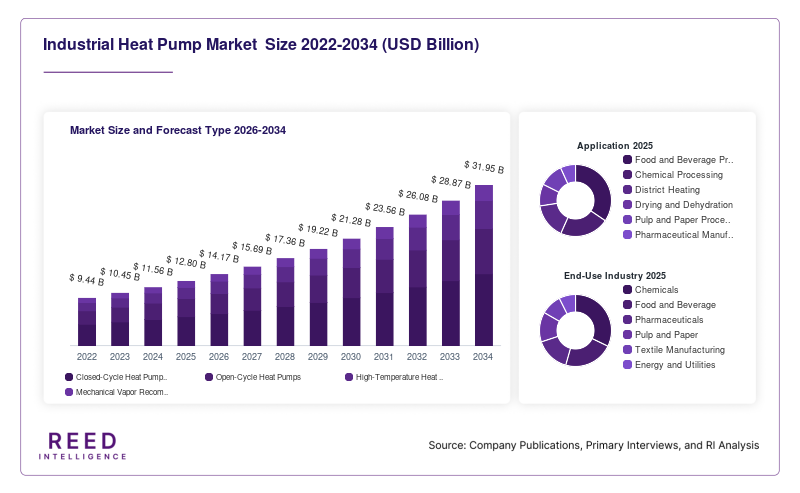
Closed-cycle industrial heat pumps accounted for the largest market share of 44.3% in 2024 due to their strong operational efficiency and broad industrial applicability. These systems are widely used across chemical processing, food production, pharmaceuticals, and pulp and paper industries because they provide reliable heat transfer performance while maintaining process stability. Closed-cycle systems can effectively recover and reuse waste heat, helping industries lower fuel consumption and operational costs. The increasing emphasis on industrial energy efficiency and carbon reduction targets has accelerated the adoption of closed-cycle technologies across developed economies. Manufacturers are also introducing advanced compressor systems and environmentally friendly refrigerants to improve overall system performance and regulatory compliance.
High-temperature industrial heat pumps are expected to witness the fastest CAGR of 12.5% during the forecast period due to rising demand for industrial heating applications above 100°C. Industries such as chemicals, textiles, and industrial drying require higher thermal output for critical manufacturing processes, creating strong demand for advanced heat pump systems. Technological improvements in compressor efficiency and refrigerant management are enabling manufacturers to deliver reliable high-temperature performance with lower energy consumption. In addition, increasing pressure to replace fossil-fuel-based boilers with electrified heating solutions is encouraging industrial operators to adopt high-temperature industrial heat pumps for sustainable production operations.
By Application
Food and beverage processing accounted for the largest share of 31.6% in 2024 due to the high demand for process heating, refrigeration integration, and thermal recovery systems. Industrial heat pumps are extensively used in dairy processing, brewing, meat processing, and packaged food production to improve energy efficiency and reduce operating costs. These systems help maintain stable process temperatures while recovering waste heat generated during cooling and refrigeration activities. Rising global demand for processed food products and increasing investments in automated food manufacturing facilities are supporting segment growth. In addition, food manufacturers are focusing on sustainable production methods and compliance with environmental standards, which is further increasing adoption.
District heating applications are projected to expand at the fastest CAGR of 12.1% during the forecast period due to increasing investments in sustainable urban heating infrastructure. Governments and municipal authorities are promoting centralized heating systems powered by renewable electricity and industrial waste heat recovery technologies. Industrial heat pumps can efficiently convert low-grade waste heat into usable thermal energy for residential and commercial heating networks. The segment is gaining momentum in Europe and Asia Pacific, where urban energy transition programs are supporting low-carbon district heating projects. Rising energy security concerns and the need for long-term thermal efficiency are also encouraging adoption.
By End-Use Industry
The chemical industry held the largest market share of 28.4% in 2024 due to its extensive requirement for continuous process heating and thermal energy management. Chemical manufacturing facilities operate energy-intensive production systems that generate significant amounts of recoverable waste heat. Industrial heat pumps help chemical companies improve thermal efficiency, reduce fuel dependency, and comply with environmental regulations. The increasing focus on industrial sustainability and carbon reduction strategies is encouraging chemical producers to adopt electrified heating technologies. In addition, advancements in high-temperature heat pump systems are expanding their use in chemical distillation, drying, and reactor heating processes, supporting segment dominance.
The pharmaceutical industry is expected to record the fastest CAGR of 11.9% during the forecast period owing to rising investments in temperature-controlled manufacturing infrastructure. Pharmaceutical production facilities require precise thermal management for sterilization, drying, and process heating applications. Industrial heat pumps provide consistent temperature control while reducing energy consumption and operational costs. The rapid expansion of pharmaceutical manufacturing capacity in Asia Pacific and North America is creating strong demand for advanced heating technologies. In addition, increasing regulatory emphasis on sustainable manufacturing practices and energy efficiency is encouraging pharmaceutical companies to integrate industrial heat pump systems within production operations.
Regional Analysis
North America
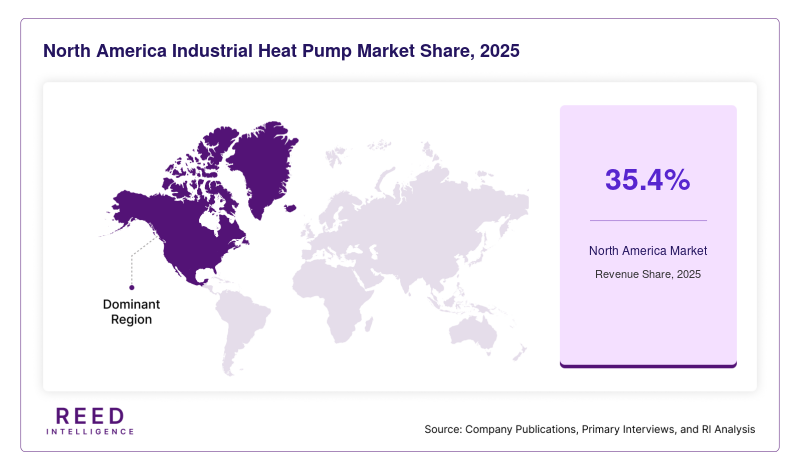
North America accounted for 35.4% of the global Industrial Heat Pump Market share in 2025 and is expected to maintain a stable growth trajectory during the forecast period. The regional market is projected to expand at a CAGR of 9.8% from 2026 to 2034 due to increasing industrial electrification and energy efficiency initiatives. Industrial facilities across the United States and Canada are investing in advanced heating systems to reduce carbon emissions and improve thermal efficiency. The presence of established industrial infrastructure, favorable government incentives, and rising corporate sustainability commitments continue to support regional market expansion.
The United States remains the dominant country in North America due to strong investments in industrial decarbonization and energy modernization projects. Major manufacturing industries are adopting industrial heat pumps to lower dependence on fossil fuels and reduce long-term operating costs. The food processing and chemical sectors are among the leading adopters of high-capacity heat recovery systems. In addition, the expansion of renewable electricity generation and grid modernization programs is creating favorable conditions for industrial heat pump deployment across large manufacturing facilities.
Europe
Europe represented 29.8% of the global market share in 2025 and continues to play a significant role in the adoption of sustainable industrial heating technologies. The region is forecast to expand at a CAGR of 10.4% during the study period due to stringent environmental regulations and increasing carbon neutrality commitments. European industries are actively replacing conventional heating systems with low-emission alternatives to comply with climate policies. Government support programs and energy transition funding initiatives are encouraging industries to invest in industrial heat pump systems for waste heat recovery and process heating applications.
Germany remains the leading country within the European market due to its strong manufacturing base and focus on industrial energy efficiency. The country is witnessing increasing adoption of high-temperature industrial heat pumps across chemical processing, automotive manufacturing, and food production sectors. Industrial operators are investing in smart thermal management technologies to optimize energy consumption and lower carbon emissions. In addition, rising energy costs and strict industrial emission standards are encouraging companies to accelerate the transition toward electrified heating systems.
Asia Pacific
Asia Pacific held 23.7% of the global Industrial Heat Pump Market share in 2025 and is projected to register the fastest CAGR of 11.8% during the forecast period. Rapid industrialization, expanding manufacturing activities, and increasing energy demand are supporting market growth across the region. Governments are implementing policies to improve industrial energy efficiency and reduce greenhouse gas emissions. Countries such as China, Japan, South Korea, and India are investing heavily in sustainable industrial infrastructure and renewable energy integration, creating strong demand for industrial heat pump technologies.
China dominates the Asia Pacific market due to its extensive industrial manufacturing base and large-scale investments in clean energy technologies. The country is focusing on reducing industrial coal consumption and improving energy productivity across manufacturing sectors. Food processing, textiles, chemicals, and district heating applications are contributing significantly to industrial heat pump demand. In addition, government subsidies for energy-efficient industrial equipment and the expansion of industrial waste heat recovery projects are supporting long-term market development.
Middle East & Africa
The Middle East & Africa region accounted for 6.1% of the global market share in 2025 and is expected to grow at a CAGR of 8.7% during the forecast period. Industrial diversification strategies and increasing investments in sustainable infrastructure are supporting market expansion across the region. Governments are encouraging industries to adopt energy-efficient technologies to reduce electricity consumption and improve industrial productivity. The development of food processing, mining, and chemical manufacturing sectors is also contributing to rising demand for industrial heat pump systems.
Saudi Arabia remains the dominant country in the regional market due to ongoing industrial diversification initiatives and large-scale infrastructure investments. The country is focusing on modernizing industrial facilities and improving energy efficiency within manufacturing operations. Industrial heat pumps are increasingly being used in food processing, desalination support systems, and district cooling integration projects. In addition, the expansion of renewable energy projects and industrial sustainability programs is creating favorable opportunities for advanced thermal management technologies.
Latin America
Latin America captured 5.0% of the global Industrial Heat Pump Market share in 2025 and is anticipated to grow at a CAGR of 8.9% between 2026 and 2034. Industrial modernization efforts and rising awareness regarding energy-efficient technologies are supporting regional market growth. Countries across the region are investing in sustainable industrial development to reduce operational costs and improve manufacturing competitiveness. The increasing adoption of industrial automation and energy monitoring systems is also supporting the deployment of industrial heat pumps in production facilities.
Brazil remains the leading market in Latin America due to its expanding food processing and beverage manufacturing industries. Industrial companies in the country are increasingly investing in waste heat recovery systems to lower energy consumption and improve production efficiency. Government initiatives focused on industrial sustainability and renewable energy adoption are also encouraging the use of advanced heating technologies. In addition, the expansion of export-oriented manufacturing industries is expected to create long-term demand for energy-efficient thermal management solutions.
Competitive Landscape
The Industrial Heat Pump Market is characterized by the presence of established multinational companies focusing on product innovation, strategic partnerships, and expansion of manufacturing capabilities. Leading market participants are investing in high-temperature heat pump technologies, environmentally friendly refrigerants, and digital energy management systems to strengthen their competitive position. Companies are also emphasizing research and development activities to improve thermal efficiency and expand application capabilities across industrial sectors.
Daikin Industries Ltd. remains one of the leading companies in the market due to its broad industrial heating portfolio and strong global distribution network. The company continues to focus on high-capacity industrial heat pump systems designed for manufacturing and district heating applications. In 2025, the company announced the expansion of its industrial heating technology division to support rising demand for energy-efficient industrial thermal systems across Europe and Asia Pacific.
Key Players
- Daikin Industries Ltd.
- Mitsubishi Heavy Industries Ltd.
- Johnson Controls International plc
- Siemens Energy AG
- MAN Energy Solutions
- GEA Group AG
- Emerson Electric Co.
- Danfoss A/S
- Mayekawa Mfg. Co., Ltd.
- Carrier Global Corporation
- Trane Technologies plc
- Bosch Industriekessel GmbH
- Thermax Limited
- Viessmann Group
- Atlas Copco AB
Recent Developments
- In February 2025, GEA Group AG introduced a new high-temperature industrial heat pump platform designed for chemical and food processing facilities requiring process temperatures above 120°C.
- In July 2025, Johnson Controls International plc partnered with an industrial automation company to develop integrated heat recovery and smart thermal management systems for manufacturing plants.
- In November 2024, Daikin Industries Ltd. expanded its European manufacturing capacity for industrial heat pump systems to address increasing regional demand for low-carbon industrial heating technologies.
- In March 2025, Mitsubishi Heavy Industries Ltd. launched an advanced industrial heat recovery solution focused on reducing energy consumption within pharmaceutical and district heating applications.
Industrial Heat Pump Market Segments
Type
- Closed-Cycle Heat Pumps
- Open-Cycle Heat Pumps
- High-Temperature Heat Pumps
- Mechanical Vapor Recompression Systems
Application
- Food and Beverage Processing
- Chemical Processing
- District Heating
- Drying and Dehydration
- Pulp and Paper Processing
- Pharmaceutical Manufacturing
End-Use Industry
- Chemicals
- Food and Beverage
- Pharmaceuticals
- Pulp and Paper
- Textile Manufacturing
- Energy and Utilities
By Region
- North America
- Europe
- APAC
- Middle East and Africa
- LATAM