Industrial High Shear Mixers Market Size, Share, Demand Report By Type (Batch High Shear Mixers, Inline High Shear Mixers), By Application (Pharmaceuticals, Food & Beverage), By End-Use Industry (Pharmaceutical & Biopharmaceutical, Food Processing, Chemical Manufacturing), By Distribution Channel (Direct Sales, Distributor Networks) By Region & Segment Forecasts, 2026–2034.
USD 3950
Market Overview
The Industrial High Shear Mixers Market size is estimated at USD 1.85 billion, and it is projected to reach USD 3.20 billion by 2034, registering a CAGR of 7.1% during the forecast period (2026–2034). One of the primary global factors supporting Industrial High Shear Mixers Market growth is the increasing adoption of advanced processing equipment in pharmaceutical manufacturing, particularly for nano-emulsions, injectable formulations, and controlled-release drug systems. This has significantly enhanced demand for high-efficiency mixing systems capable of delivering uniform particle size distribution.
A major global factor driving the Industrial High Shear Mixers Market growth is the increasing shift toward advanced pharmaceutical manufacturing, including biologics, vaccines, and nano-formulation-based drug development. This has significantly boosted the adoption of inline and multi-stage high shear mixers for achieving uniform dispersion and regulatory compliance.
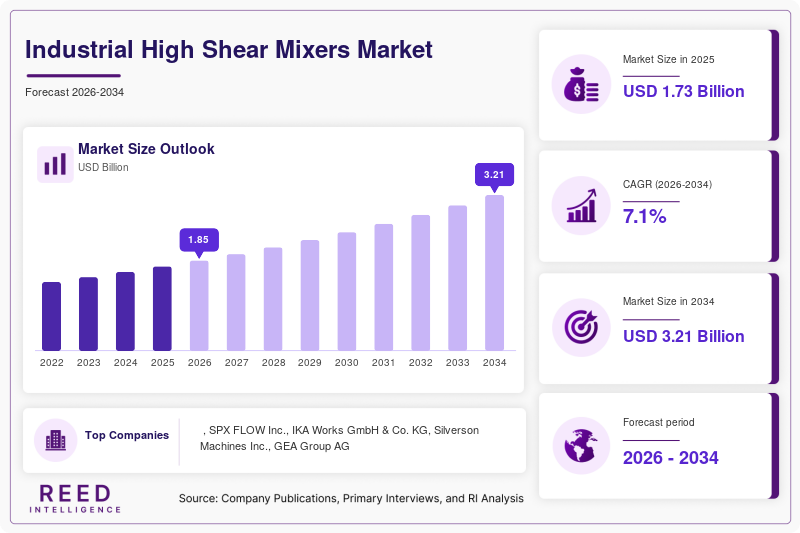
Key Highlights of the Industrial High Shear Mixers Market include:
- Dominant region share (2025): Asia Pacific held 34.6% of the global market
- Fastest-growing region CAGR (2026–2034): Middle East & Africa at 8.2%
- Leading subsegment: Inline high shear mixers dominated Type segment in 2025
- Fastest-growing subsegment: Multi-stage high shear mixers are projected to grow at 8.4% CAGR
- Dominant country: United States recorded USD 420 million (2024) and USD 445 million (2025) market value
Market Trends
Continuous Processing Adoption in Manufacturing
A major trend in the Industrial High Shear Mixers Market is the shift toward continuous processing systems. Manufacturers are increasingly replacing batch processes with inline high shear mixers to improve consistency, reduce production time, and enhance scalability. This transition is particularly strong in pharmaceutical and chemical manufacturing facilities aiming for process intensification.
Growth of Nano-Emulsion and Micro-Dispersion Technologies
Another significant trend shaping the Industrial High Shear Mixers Market is the rising use of nano-emulsion and micro-dispersion technologies. These systems require precise particle size reduction, which high shear mixers efficiently deliver. This trend is strongly influenced by demand in nutraceuticals, cosmetics, and advanced drug delivery formulations.
Market Drivers
Expansion of Pharmaceutical Manufacturing Capacity
The rapid expansion of pharmaceutical production facilities across developed and emerging economies is a key driver for the Industrial High Shear Mixers Market. Increasing demand for vaccines, biologics, and injectable drugs has pushed manufacturers to adopt advanced mixing systems that ensure uniformity and sterility. High shear mixers play a critical role in achieving regulatory compliance and process consistency.
Rising Demand in Food and Beverage Processing
The food and beverage industry is increasingly adopting high shear mixing technologies to improve product texture, stability, and emulsification. Applications such as sauces, dairy products, beverages, and bakery fillings require precise mixing capabilities. This growing industrial requirement continues to support Industrial High Shear Mixers Market growth globally.
Market Restraint
High Equipment and Maintenance Costs
One of the key restraints in the Industrial High Shear Mixers Market is the relatively high capital investment and maintenance costs associated with advanced mixing systems. Small and medium-sized manufacturers often face challenges in adopting these technologies due to budget constraints and the need for skilled operators.
Market Opportunities
Expansion in Biopharmaceutical Applications
The increasing focus on biologics, biosimilars, and mRNA-based therapies presents a strong opportunity for the Industrial High Shear Mixers Market. These applications require precise emulsification and particle size control, creating demand for advanced inline and multi-stage mixers in sterile production environments.
Growth in Emerging Economies
Emerging economies in Asia Pacific, Latin America, and Africa are witnessing rapid industrialization and infrastructure development. This is creating new opportunities for the Industrial High Shear Mixers Market, particularly in food processing, pharmaceuticals, and chemical manufacturing sectors where modernization of production systems is ongoing.
Segmental Analysis
By Type
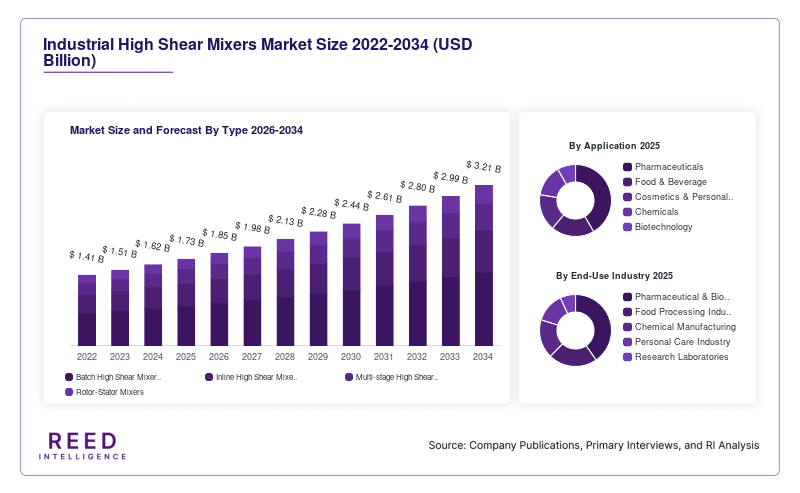
Inline High Shear Mixers dominated the Industrial High Shear Mixers Market in 2025 with a 41.2% share, driven by continuous processing requirements in pharmaceuticals and chemicals. These systems offer improved efficiency and scalability.
Multi-stage High Shear Mixers are projected to grow at a CAGR of 8.4% (2026–2034) due to increasing demand for ultra-fine emulsification and nano-dispersion applications in biotechnology and cosmetics.
By Application
Pharmaceutical Applications held the largest share of 38.5% in 2025 due to widespread use in drug formulation and vaccine production. Regulatory compliance and precision requirements continue to support this dominance.
Cosmetics & Personal Care applications are expected to grow at a CAGR of 8.1%, driven by rising demand for stable emulsions in skincare, haircare, and anti-aging formulations.
By End-Use Industry
Chemical Industry accounted for 33.7% share in 2025, driven by large-scale production of adhesives, polymers, and emulsions.
Biopharmaceutical Industry is projected to grow at a CAGR of 8.6%, supported by rising investment in biologics and advanced therapeutic production requiring high shear emulsification systems.
Regional Analysis
North America
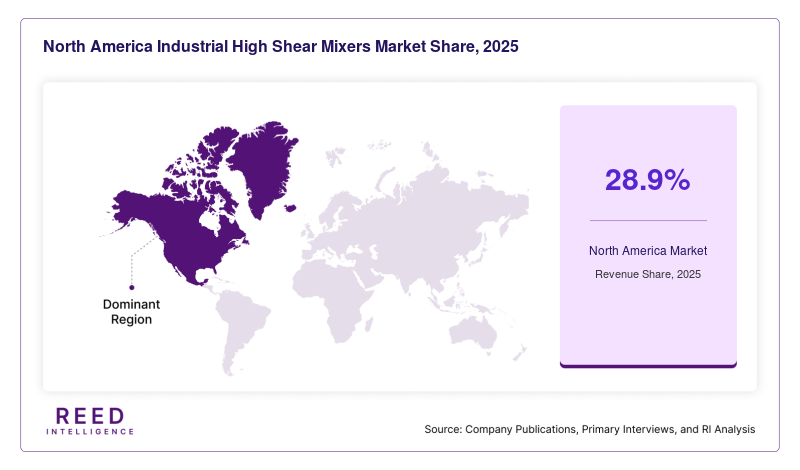
North America accounted for 28.9% share of the Industrial High Shear Mixers Market in 2025, with a projected CAGR of 6.5% (2026–2034). The region benefits from strong pharmaceutical R&D and advanced manufacturing infrastructure. The United States leads growth due to high adoption of continuous processing technologies and strong presence of global pharma companies.
Europe
Europe held 24.7% share in 2025, and is expected to grow at a 6.8% CAGR during 2026–2034. Germany dominates the region due to its strong chemical and engineering base. Strict regulatory standards in food and pharmaceutical production are encouraging adoption of high-performance mixing systems.
Asia Pacific
Asia Pacific dominated the Industrial High Shear Mixers Market with 34.6% share in 2025, and is projected to expand at a 7.8% CAGR. China leads the region due to large-scale pharmaceutical production and expanding food processing industries. Rapid industrialization and export-oriented manufacturing are key growth factors.
Middle East & Africa
The Middle East & Africa region accounted for 6.3% share in 2025, with a forecast CAGR of 8.2% (2026–2034). Saudi Arabia leads the region due to investments in pharmaceutical localization and food manufacturing diversification under national industrial strategies.
Latin America
Latin America held 5.5% share in 2025, and is projected to grow at a 6.9% CAGR. Brazil is the leading country due to expansion in food processing and chemical manufacturing industries. Increasing foreign investment is supporting modernization of production infrastructure.
Competitive Landscape
The Industrial High Shear Mixers Market is moderately consolidated, with several global and regional manufacturers competing on technology innovation, efficiency, and customization capabilities. Key players focus on expanding product portfolios and integrating automation and digital monitoring features into mixing systems.
Leading companies include SPX FLOW, IKA Works, Silverson Machines, GEA Group, and Charles Ross & Son Company. Among these, SPX FLOW holds a leading position due to its strong global distribution network and continuous investment in process engineering solutions. The company recently introduced next-generation inline high shear mixers designed for pharmaceutical and food applications with enhanced energy efficiency and CIP (clean-in-place) capabilities.
Other players are focusing on modular designs and energy-efficient systems to meet evolving industrial requirements. Strategic partnerships, capacity expansion, and regional manufacturing facilities are key competitive strategies shaping the Industrial High Shear Mixers Market landscape.
Key Players List
- SPX FLOW Inc.
- IKA Works GmbH & Co. KG
- Silverson Machines Inc.
- GEA Group AG
- Charles Ross & Son Company
- Admix Inc.
- Ystral GmbH
- Primix Corporation
- FrymaKoruma AG
- Bematek Systems
- Scott Turbon Mixer
- Sonic Corporation
- Netzsch Vakumix
- Lee Industries
- MilliporeSigma (Merck KGaA)
Recent Developments
- In 2025, SPX FLOW expanded its pharmaceutical-grade mixer production facility in Europe to meet rising demand from biopharmaceutical manufacturers.
- IKA Works introduced a digitally controlled inline high shear mixer with real-time viscosity monitoring capabilities in 2025.
- GEA Group enhanced its continuous processing portfolio with upgraded rotor-stator technology aimed at reducing energy consumption in large-scale production systems.
- Silverson Machines launched a new laboratory-to-production scalable mixer line designed for nano-emulsion applications in cosmetics and nutraceuticals.
- Admix Inc. expanded its North American distribution network to strengthen supply chain efficiency for food and beverage manufacturers.
Industrial High Shear Mixers Market Segments
By Type
- Batch High Shear Mixers
- Inline High Shear Mixers
- Multi-stage High Shear Mixers
- Rotor-Stator Mixers
By Application
- Pharmaceuticals
- Food & Beverage
- Cosmetics & Personal Care
- Chemicals
- Biotechnology
By End-Use Industry
- Pharmaceutical & Biopharmaceutical
- Food Processing Industry
- Chemical Manufacturing
- Personal Care Industry
- Research Laboratories
By Distribution Channel
- Direct Sales
- Distributor Networks
- Online Industrial Platforms
By Region
- North America
- Europe
- APAC
- Middle East and Africa
- LATAM