Industrial Kiln Market Size, Share & Demand Report By Kiln Type (Rotary Kilns, Tunnel Kilns, Shuttle Kilns, Vertical Kilns, Roller Hearth Kilns), By Fuel Type (Gas-Fired Kilns, Electric Kilns, Coal-Fired Kilns, Hybrid Kilns), By End-Use Industry (Cement Manufacturing, Ceramics and Refractories, Metallurgy, Chemicals and Minerals, Advanced Ceramics, Waste Processing and Recycling), By Region & Segment Forecasts, 2026–2034
USD 3950
Market Overview
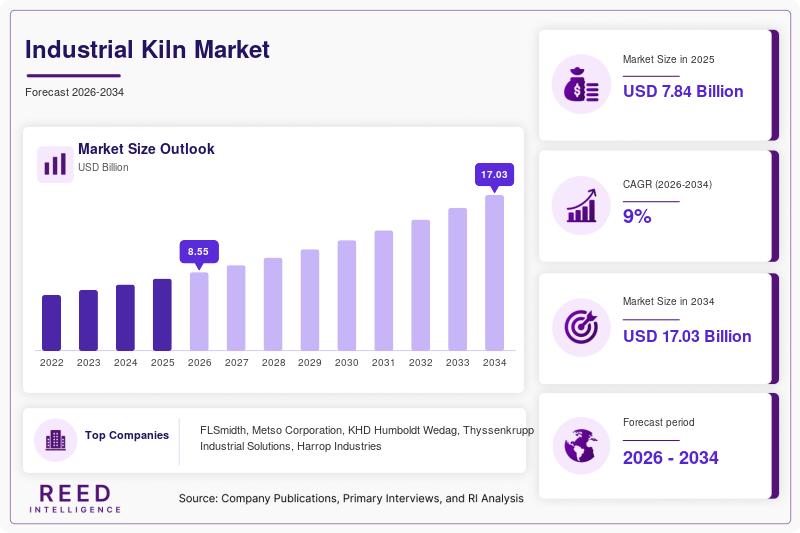
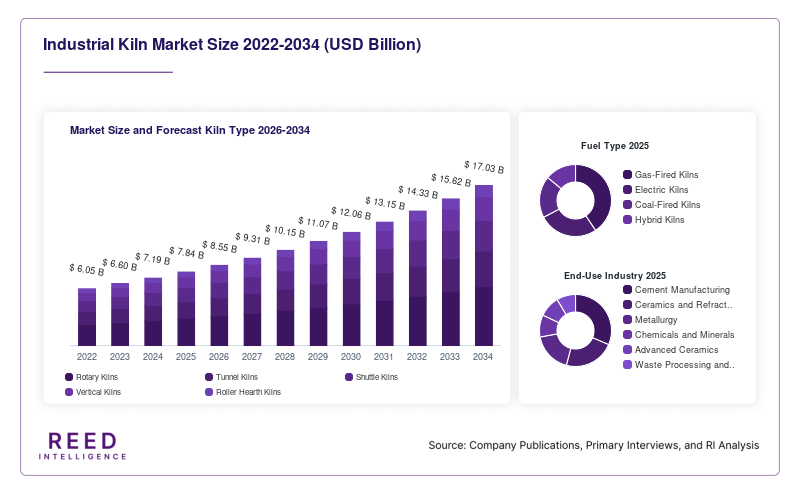
The global Industrial Kiln Market size was valued at USD 7.84 billion in 2026 and is projected to reach USD 15.62 billion by 2034, expanding at a CAGR of 9.0% during the forecast period from 2026 to 2034. Industrial kilns are widely used across ceramics, cement, metallurgy, refractories, chemicals, and advanced materials manufacturing due to their ability to deliver consistent thermal processing at controlled temperatures. Growing industrialization across developing economies and the rising adoption of energy-efficient thermal equipment continue to strengthen long-term market demand. Manufacturers are increasingly replacing traditional furnace systems with digitally monitored kiln solutions that improve fuel efficiency, reduce production downtime, and support automation goals.
One of the major global factors supporting market expansion is the increasing investment in infrastructure and construction activities. The growth of smart cities, transportation networks, and commercial construction projects has accelerated demand for cement, steel, glass, and ceramic materials, all of which rely heavily on industrial kiln systems. In addition, environmental regulations are encouraging industries to deploy advanced kiln technologies equipped with low-emission burners and heat recovery systems. Companies are also integrating predictive maintenance tools and IoT-enabled monitoring systems to improve operational efficiency and reduce energy losses.
Key Highlights
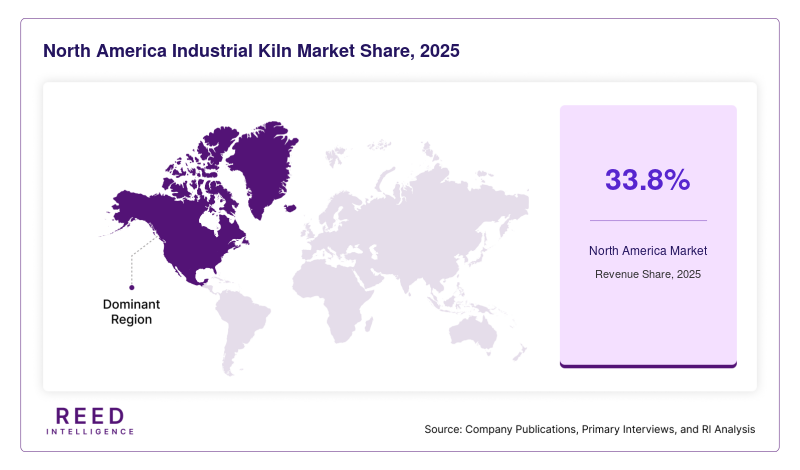
- North America dominated the market with a 33.8% share in 2025, while Asia Pacific is expected to grow at the fastest CAGR of 10.9% during 2026–2034.
- By kiln type, rotary kilns accounted for the largest share of 42.6%, while tunnel kilns are projected to grow at a CAGR of 11.3%.
- By fuel type, gas-fired kilns led with a 39.1% share, whereas electric kilns are expected to expand at a CAGR of 12.1%.
- By end-use industry, cement manufacturing held the largest share of 36.4%, while advanced ceramics are projected to grow at a CAGR of 11.8%.
- The United States remained the dominant country, with market values of USD 1.92 billion in 2024 and USD 2.08 billion in 2025.
Market Trends
Integration of Smart Monitoring and Automation Technologies
Industrial kiln manufacturers are increasingly integrating automation platforms, AI-assisted monitoring systems, and remote diagnostics into thermal processing operations. Modern kiln systems are now equipped with temperature sensors, digital control panels, predictive maintenance software, and cloud-based analytics tools that improve process stability and operational visibility. These technologies help manufacturers reduce fuel consumption, optimize heating cycles, and minimize equipment failure risks. Industries such as ceramics, cement, and metallurgy are adopting automated kiln systems to improve production consistency and lower labor dependency. Automated process control also enables operators to maintain precise thermal conditions, which is important for high-value industrial materials. As manufacturing plants continue moving toward Industry 4.0 standards, demand for connected kiln infrastructure is expected to remain strong throughout the forecast period.
Rising Demand for Energy-Efficient and Low-Emission Kilns
Environmental regulations and increasing fuel costs are encouraging industries to adopt energy-efficient kiln technologies. Manufacturers are focusing on developing low-emission kiln systems with advanced insulation, waste heat recovery units, and optimized combustion systems to reduce operational expenses and carbon emissions. Electric and hybrid kilns are also gaining attention due to stricter environmental compliance standards across developed economies. Cement and ceramic manufacturers are particularly investing in modern kiln systems that support alternative fuels and lower greenhouse gas output. The transition toward sustainable industrial operations has accelerated the replacement of aging thermal equipment with efficient models that provide higher output with reduced energy intensity. This trend is expected to create long-term opportunities for kiln suppliers focused on environmentally optimized production technologies.
Market Drivers
Expansion of Construction and Infrastructure Development Activities
Rapid urbanization and infrastructure development across emerging economies continue to support strong demand for industrial kilns. Governments in Asia Pacific, the Middle East, and Latin America are investing heavily in highways, airports, residential buildings, and industrial zones, increasing the need for cement, steel, glass, and ceramic products. Industrial kilns are essential in producing these materials at commercial scale. Growing construction activity has encouraged manufacturers to expand production capacity and modernize thermal processing equipment. In addition, the rising demand for prefabricated construction materials and advanced ceramic components is increasing kiln utilization rates across manufacturing facilities. Large infrastructure modernization programs in countries such as China, India, Saudi Arabia, and Indonesia are expected to create consistent opportunities for industrial kiln suppliers over the coming years.
Growth of Advanced Materials and Specialty Ceramics Production
The increasing use of specialty ceramics and advanced industrial materials in electronics, aerospace, medical devices, and renewable energy applications is driving demand for precision kiln systems. Advanced ceramics require highly controlled thermal environments to maintain material strength, conductivity, and dimensional accuracy. Industrial kiln manufacturers are therefore developing systems capable of operating at extremely stable temperatures with improved airflow management and automation features. The expansion of semiconductor manufacturing and electric vehicle battery production has also increased the use of technical ceramics and heat-resistant materials. As industries continue to prioritize lightweight, durable, and high-performance materials, the need for technologically advanced kiln solutions is expected to increase significantly across global manufacturing sectors.
Market Restraint
High Capital Investment and Energy Consumption Challenges
The Industrial Kiln Market continues to face limitations associated with high installation costs and elevated energy consumption. Advanced kiln systems require substantial capital investment for equipment procurement, plant integration, insulation systems, and emission control technologies. Small and medium-scale manufacturers often face financial constraints when upgrading from traditional furnace systems to automated kilns. In addition, industrial kilns operate at extremely high temperatures for extended periods, resulting in significant fuel and electricity expenses. Volatility in natural gas and electricity prices can directly affect operational profitability for industries such as cement, ceramics, and metallurgy. Environmental compliance requirements also increase overall ownership costs due to the need for filtration systems and emission reduction technologies. In regions with limited energy infrastructure, manufacturers may delay kiln modernization projects because of concerns related to operational expenses and uncertain returns on investment.
Market Opportunities
Adoption of Electric and Hybrid Kiln Technologies
The transition toward cleaner industrial operations is creating strong opportunities for electric and hybrid kiln systems. Manufacturers are increasingly exploring alternatives to conventional fossil fuel-powered kilns in order to reduce carbon emissions and improve energy efficiency. Electric kilns provide better temperature control, reduced maintenance requirements, and lower localized emissions compared to traditional systems. Hybrid technologies that combine electric heating with gas-based systems are also gaining traction in industries requiring operational flexibility. Government incentives supporting industrial decarbonization are encouraging manufacturers to invest in sustainable kiln infrastructure. The growing availability of renewable electricity sources further supports the long-term adoption of electric kiln technologies across developed and emerging markets.
Increasing Investments in Recycling and Circular Manufacturing
The expansion of recycling industries and circular manufacturing practices is expected to create additional opportunities for industrial kiln suppliers. Kilns are increasingly used in waste treatment, metal recovery, biomass processing, and recycling operations involving ceramics, glass, and industrial minerals. Governments and private organizations are encouraging resource recovery initiatives to reduce landfill waste and improve material reuse efficiency. Industrial kilns designed for recycling applications can process secondary raw materials while maintaining thermal stability and environmental compliance. The growing focus on sustainable manufacturing and industrial waste management is expected to increase demand for specialized kiln systems capable of handling recycled feedstock materials with improved operational efficiency and reduced environmental impact.
Segmental Analysis
By Kiln Type
Rotary kilns accounted for the largest share of the Industrial Kiln Market in 2024 due to their extensive use across cement manufacturing, metallurgy, and chemical processing industries. These kilns are preferred for large-scale continuous production operations because they provide uniform heat distribution and high processing efficiency. Rotary kilns are capable of handling a wide range of raw materials while maintaining stable operating temperatures for extended production cycles. Industrial manufacturers continue to rely on rotary kilns for applications requiring consistent thermal treatment and high-volume output. Their ability to support multiple fuel options, including natural gas, coal, and alternative fuels, also contributes to widespread adoption across industrial sectors. Growing demand for cement and processed industrial minerals continues to support the dominant position of rotary kilns within the global market.
Tunnel kilns are expected to register the fastest CAGR of 11.3% during the forecast period due to increasing demand for energy-efficient and automated thermal processing systems. Tunnel kilns are widely used in ceramics, refractories, and advanced material manufacturing because they provide continuous production capability with optimized heat utilization. Manufacturers are increasingly adopting tunnel kilns to reduce operational costs and improve production consistency. These systems also support automated material handling and advanced temperature control technologies that improve manufacturing efficiency. The growing production of specialty ceramics, sanitary ware, and technical ceramic components is expected to accelerate demand for tunnel kiln systems. In addition, environmental regulations encouraging reduced fuel consumption are motivating industries to invest in modern tunnel kilns equipped with energy recovery technologies.
By Fuel Type
Gas-fired kilns held the dominant share of the Industrial Kiln Market in 2024 due to their operational flexibility, high thermal efficiency, and relatively lower emissions compared to coal-fired systems. These kilns are extensively used across cement, ceramics, metallurgy, and glass manufacturing industries where consistent heat generation is required. Natural gas-based kiln systems allow manufacturers to maintain accurate temperature control while reducing particulate emissions and operational maintenance requirements. Industrial operators continue to favor gas-fired systems because they support stable combustion performance and faster heating cycles. The increasing availability of natural gas infrastructure across developed and emerging economies has further strengthened adoption. Many industrial manufacturers are also upgrading older coal-based systems to gas-fired alternatives in response to stricter environmental regulations and rising sustainability goals.
Electric kilns are projected to expand at the fastest CAGR of 12.1% during the forecast period due to increasing demand for low-emission industrial processing technologies. These kilns are gaining popularity across advanced ceramics, electronics, and specialty materials manufacturing industries because they provide highly precise temperature control and cleaner operating conditions. Electric kilns eliminate direct combustion emissions and reduce contamination risks during thermal processing operations. The growing availability of renewable energy sources and supportive government policies for industrial decarbonization are encouraging manufacturers to adopt electric kiln systems. In addition, advancements in heating element technologies and digital control systems are improving the efficiency and scalability of electric kilns. Rising investments in semiconductor production and electric vehicle component manufacturing are expected to create strong long-term demand for electrically powered kiln technologies.
By End-Use Industry
Cement manufacturing accounted for the largest share of the Industrial Kiln Market in 2024 owing to the extensive use of kilns in clinker production and large-scale infrastructure development activities worldwide. Cement plants require continuous high-temperature processing systems capable of operating under demanding industrial conditions. Industrial kilns are essential for converting raw materials into clinker while maintaining production efficiency and product consistency. Rapid urbanization, transportation infrastructure projects, and residential construction activities continue to increase global cement demand. Developing economies across Asia Pacific, the Middle East, and Africa are investing heavily in infrastructure modernization, which further supports kiln deployment in cement manufacturing facilities. Technological improvements in kiln insulation, combustion systems, and waste heat recovery solutions are also helping cement producers improve operational efficiency and reduce energy consumption.
Advanced ceramics are expected to witness the fastest CAGR of 11.8% during the forecast period due to rising applications across electronics, medical devices, aerospace, and renewable energy industries. Advanced ceramic materials require highly controlled thermal processing conditions to maintain structural integrity and material performance. Industrial kiln manufacturers are therefore developing precision heating systems equipped with advanced airflow control, automation technologies, and digital monitoring capabilities. Increasing production of semiconductor components, battery materials, and high-performance industrial coatings is supporting strong demand for specialized kiln systems. The growing use of lightweight and heat-resistant materials in electric vehicles and aerospace manufacturing is also contributing to segment growth. As industries continue investing in high-performance materials, advanced ceramic production is expected to remain a major opportunity area for kiln equipment suppliers.
Regional Analysis
North America
North America accounted for 33.8% of the global Industrial Kiln Market in 2025 and is expected to expand at a CAGR of 8.4% during the forecast period. The region maintains a strong manufacturing base supported by advanced industrial infrastructure and continuous investments in production modernization. Demand for industrial kilns remains high across cement manufacturing, metallurgy, ceramics, and chemical processing industries. Industrial operators are increasingly replacing conventional kiln systems with digitally integrated solutions that improve fuel efficiency and reduce operational downtime. Environmental regulations encouraging low-emission industrial equipment also continue to support regional market expansion.
The United States remained the dominant country in North America due to its extensive industrial manufacturing ecosystem and strong investments in advanced thermal processing technologies. The country continues to witness rising demand for energy-efficient kiln systems across cement production, aerospace materials, and industrial ceramics manufacturing. One unique growth factor supporting the U.S. market is the increasing expansion of semiconductor and battery manufacturing facilities that require precision thermal processing equipment. Government incentives supporting domestic industrial production and infrastructure modernization are further contributing to long-term demand for advanced kiln technologies.
Europe
Europe represented a significant share of the Industrial Kiln Market in 2025 and is projected to grow at a CAGR of 7.9% through 2034. Industrial manufacturers across the region are increasingly focusing on sustainable production methods and emission reduction strategies. The demand for advanced kiln systems has increased due to strict environmental regulations targeting carbon-intensive industries such as cement, steel, and ceramics. Manufacturers are adopting modern kilns equipped with waste heat recovery systems, automated temperature control technologies, and low-emission combustion solutions. The presence of well-established engineering companies and strong industrial automation capabilities also supports steady market growth.
Germany remained the leading country within the European market due to its advanced manufacturing sector and strong focus on industrial efficiency. German companies continue investing in technologically advanced kiln systems to improve energy utilization and maintain production consistency across industrial applications. A unique factor driving market growth in Germany is the rapid expansion of advanced ceramic materials used in automotive electronics, renewable energy systems, and precision engineering. The country’s emphasis on sustainable industrial manufacturing and technological innovation continues to create opportunities for kiln manufacturers focused on high-performance thermal processing systems.
Asia Pacific
Asia Pacific is expected to register the fastest CAGR of 10.9% during the forecast period due to rapid industrialization and increasing infrastructure development activities. The region continues to experience strong demand for cement, steel, ceramics, and glass products driven by urban expansion and manufacturing growth. Industrial kiln adoption is increasing across China, India, Indonesia, Vietnam, and South Korea as manufacturers expand production capacities to meet rising domestic and export demand. Government support for industrial modernization and foreign direct investment in manufacturing sectors is also encouraging the deployment of efficient thermal processing technologies.
China dominated the Asia Pacific market due to its large-scale industrial manufacturing sector and extensive cement and ceramics production capacity. The country continues to invest heavily in modern kiln systems capable of improving fuel efficiency and reducing industrial emissions. One distinct growth factor supporting the Chinese market is the ongoing transition toward automated smart factories integrated with digital process monitoring technologies. Industrial operators are increasingly adopting AI-based temperature management and predictive maintenance systems to improve production efficiency. This technological shift is expected to support sustained demand for advanced industrial kilns across multiple manufacturing sectors.
Middle East & Africa
The Middle East & Africa region is projected to witness stable growth in the Industrial Kiln Market during the forecast period, supported by rising infrastructure investments and industrial diversification programs. Demand for industrial kilns is increasing across cement manufacturing, mining, and mineral processing industries. Governments in the region are investing in industrial development projects to reduce economic dependence on oil exports and strengthen domestic manufacturing capabilities. Industrial operators are also focusing on upgrading aging thermal processing infrastructure to improve energy efficiency and production reliability. The adoption of modern kiln systems is gradually increasing as environmental standards continue evolving.
Saudi Arabia emerged as the dominant country in the regional market due to its large infrastructure pipeline and expanding industrial manufacturing sector. The country continues to invest in cement production facilities, industrial parks, and construction megaprojects that require advanced thermal processing equipment. A unique growth factor supporting the Saudi Arabian market is the implementation of large-scale economic diversification initiatives under national industrial development programs. These initiatives are encouraging investments in non-oil manufacturing industries, including ceramics, metals, and industrial minerals, thereby increasing long-term demand for industrial kiln systems.
Latin America
Latin America accounted for a moderate share of the global Industrial Kiln Market in 2025 and is expected to grow at a CAGR of 7.2% through 2034. Increasing investments in infrastructure construction, mining operations, and industrial manufacturing are supporting regional demand for kiln technologies. Cement and metallurgy industries remain the primary users of industrial kilns across the region. Manufacturers are gradually adopting energy-efficient systems to improve operational productivity and reduce fuel costs. The expansion of industrial production facilities and government support for infrastructure upgrades continue to create opportunities for kiln equipment suppliers.
Brazil remained the dominant country within the Latin American market due to its extensive industrial base and large-scale construction sector. The country continues to witness rising demand for cement, ceramics, and processed industrial minerals used in infrastructure and residential projects. One unique factor supporting market growth in Brazil is the increasing development of mineral processing operations linked to export-oriented mining activities. Mining companies are investing in modern thermal processing equipment to improve material quality and operational efficiency. These developments are expected to strengthen long-term demand for industrial kiln systems across the country.
Competitive Landscape
The Industrial Kiln Market remains moderately consolidated, with major manufacturers focusing on product innovation, energy-efficient technologies, and strategic partnerships to strengthen their market presence. Leading companies are investing in automation platforms, low-emission combustion systems, and predictive maintenance technologies to improve operational efficiency for industrial users. Market participants are also expanding regional manufacturing capabilities to address increasing demand from emerging economies. Competitive intensity continues to increase as manufacturers develop customized kiln solutions tailored to specific industrial applications such as advanced ceramics, metallurgy, and waste processing.
FLSmidth remained one of the leading companies in the market due to its extensive portfolio of rotary kiln systems and strong presence in cement and mining applications. The company recently introduced upgraded digital process optimization tools designed to improve kiln efficiency and reduce fuel consumption. Other prominent companies are also focusing on mergers, modernization projects, and technology partnerships to expand their customer base. Several manufacturers are investing in electric kiln technologies and hybrid thermal processing systems to align with industrial decarbonization goals and changing environmental standards.
Key Players
- FLSmidth
- Metso Corporation
- KHD Humboldt Wedag
- Thyssenkrupp Industrial Solutions
- Harrop Industries
- Noritake Co., Limited
- Nutec Bickley
- L&L Kiln Mfg.
- Nabertherm GmbH
- Carbolite Gero
- Andritz AG
- Saint-Gobain
- Thermal Product Solutions
- Höganäs AB
- Zhengzhou Taida Group
Recent Developments
- In 2025, FLSmidth introduced an AI-enabled rotary kiln optimization platform designed to improve fuel efficiency and reduce operational downtime in cement manufacturing plants.
- In 2024, Metso Corporation expanded its thermal processing equipment production facility in Asia Pacific to support rising demand from mining and industrial mineral processing industries.
- In 2025, Nabertherm GmbH launched a new generation of energy-efficient electric kilns equipped with advanced digital temperature control systems for ceramics and specialty materials applications.
- In 2024, Thyssenkrupp Industrial Solutions partnered with Middle Eastern cement producers to modernize industrial kiln infrastructure using low-emission burner and waste heat recovery technologies.
Industrial Kiln Market Segments
Kiln Type
- Rotary Kilns
- Tunnel Kilns
- Shuttle Kilns
- Vertical Kilns
- Roller Hearth Kilns
Fuel Type
- Gas-Fired Kilns
- Electric Kilns
- Coal-Fired Kilns
- Hybrid Kilns
End-Use Industry
- Cement Manufacturing
- Ceramics and Refractories
- Metallurgy
- Chemicals and Minerals
- Advanced Ceramics
- Waste Processing and Recycling
By Region
- North America
- Europe
- APAC
- Middle East and Africa
- LATAM