Industrial Linear Accelerator Market Size, Share, Demand Report By Type (High-Energy Linear Accelerators, Compact Linear Accelerators, Superconducting Linear Accelerators, Low-Energy Linear Accelerators), By Application (Non-Destructive Testing, Semiconductor Processing, Sterilization and Irradiation, Scientific Research), By End-Use Industry (Electronics Manufacturing, Healthcare Manufacturing, Energy and Utilities, Automotive Industry) By Region & Segment Forecasts, 2026–2034
USD 3950
Market Overview
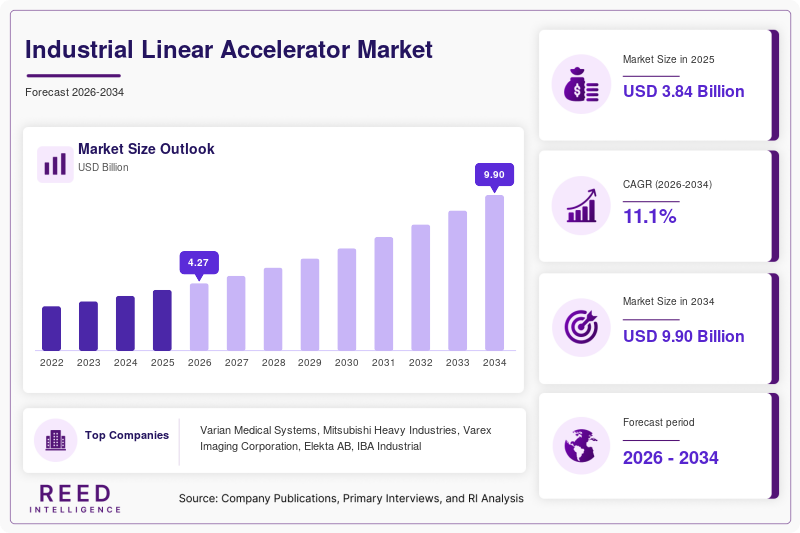
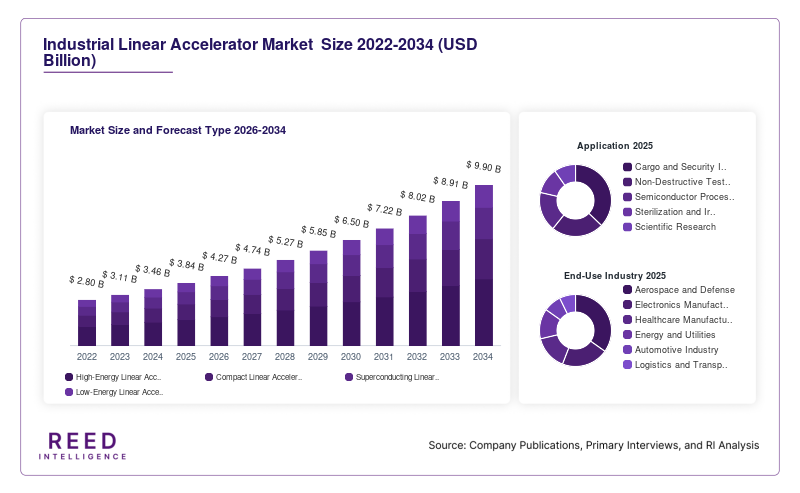
The global Industrial Linear Accelerator Market size was valued at USD 3.84 billion in 2026 and is projected to reach USD 8.91 billion by 2034, expanding at a CAGR of 11.1% during the forecast period from 2026 to 2034. Industrial linear accelerators are widely used in material processing, non-destructive testing, cargo inspection, semiconductor manufacturing, sterilization, and advanced scientific research applications. The market continues to gain traction as industries focus on high-precision inspection systems, automated production processes, and radiation-based treatment technologies that improve operational efficiency and product quality. Rising investments in industrial automation and quality assurance systems across aerospace, automotive, healthcare equipment, and electronics manufacturing are also supporting long-term market expansion.
One major global factor supporting Industrial Linear Accelerator Market growth is the increasing adoption of advanced security and inspection infrastructure across international trade hubs and logistics facilities. Governments and private logistics operators are investing in high-energy scanning systems capable of detecting concealed materials, defective components, and hazardous cargo with greater accuracy. Industrial linear accelerators are becoming critical in large-scale cargo inspection systems because they reduce manual intervention and improve throughput efficiency. In addition, increasing industrial safety regulations and the need for precise testing standards are encouraging manufacturers to upgrade from conventional X-ray systems to high-energy accelerator-based platforms.
Key Highlights
- North America dominated the market with a 34.2% share in 2025.
- Asia Pacific is expected to grow at the fastest CAGR of 11.9% during 2026–2034.
- By type, high-energy linear accelerators accounted for the largest share of 44.8%.
- while compact linear accelerators are projected to grow at a CAGR of 12.6%.
- By application, cargo and security inspection led with a 39.3% share.
- whereas semiconductor processing is expected to expand at a CAGR of 13.1%.
- By end-use industry, aerospace and defense held the dominant share of 31.7%.
- while electronics manufacturing is anticipated to grow at a CAGR of 12.8%.
- The United States remained the dominant country, with market values of USD 790 million in 2024 and USD 865 million in 2025.
Market Trends
Integration of AI-Enabled Inspection Systems
The integration of artificial intelligence and machine learning algorithms into industrial linear accelerator platforms is emerging as a major market trend. Manufacturers are increasingly combining accelerator-based imaging systems with AI-powered analytics software to improve defect detection accuracy and reduce operational downtime. These advanced systems can automatically identify structural flaws, hidden materials, and inconsistencies during high-speed industrial inspections. Industries such as aerospace manufacturing, automotive component production, and logistics screening are deploying intelligent accelerator systems to improve throughput and reduce human error. AI-supported inspection platforms also enable predictive maintenance by analyzing radiation output patterns and equipment performance data. As factories continue to move toward smart manufacturing environments, industrial operators are demanding integrated accelerator solutions that can communicate with centralized digital monitoring systems. This trend is expected to create new revenue opportunities for manufacturers offering software-driven accelerator platforms with enhanced automation capabilities.
Expansion of Compact and Portable Accelerator Solutions
Compact industrial linear accelerators are gaining significant attention due to their flexibility, lower installation requirements, and suitability for decentralized industrial operations. Traditional accelerator systems often required large-scale infrastructure and dedicated facilities, limiting adoption among mid-sized enterprises. However, advances in accelerator engineering and compact beam generation technology are enabling manufacturers to develop portable systems for field inspection and mobile scanning operations. Energy companies, construction contractors, and transportation infrastructure providers are increasingly adopting portable accelerator systems for on-site inspection of pipelines, bridges, and industrial machinery. Compact systems also support lower energy consumption and reduced maintenance requirements compared to older high-capacity installations. The growing need for rapid inspection solutions in remote industrial environments is encouraging vendors to focus on smaller and modular accelerator configurations. This trend is expected to accelerate adoption across emerging economies where industrial infrastructure modernization remains a strategic priority.
Market Drivers
Rising Demand for Advanced Cargo and Border Security Systems
The growing requirement for advanced cargo screening and border security infrastructure is driving strong demand in the Industrial Linear Accelerator Market. International trade volumes continue to rise, increasing the need for high-speed inspection technologies capable of detecting hazardous materials, contraband, and concealed goods within shipping containers. Industrial linear accelerators provide deeper penetration capabilities and higher imaging precision compared to traditional scanning systems, making them suitable for large-scale cargo inspection. Governments across North America, Europe, and Asia Pacific are increasing investments in intelligent border surveillance and transportation security programs. Airports, seaports, and logistics centers are upgrading their inspection infrastructure to improve operational efficiency and reduce security risks. The ability of industrial linear accelerators to process high cargo volumes while maintaining detailed imaging accuracy is encouraging wider adoption in both public and private sectors.
Increasing Adoption of Non-Destructive Testing Across Industries
Industrial manufacturers are increasingly implementing non-destructive testing technologies to maintain product quality, reduce material waste, and comply with safety regulations. Industrial linear accelerators are widely used for radiographic testing of welds, structural components, turbine systems, and aerospace assemblies because they provide accurate internal imaging without damaging the tested material. The aerospace and automotive industries are particularly dependent on advanced inspection systems due to strict quality standards and growing use of lightweight composite materials. In addition, renewable energy infrastructure projects, including wind turbines and power transmission systems, require high-precision inspection technologies for operational safety. The growing complexity of industrial components and the increasing demand for reliability testing are encouraging companies to invest in advanced accelerator-based inspection platforms. These factors are contributing to stable long-term market demand across several industrial sectors.
Market Restraint
High Capital Investment and Complex Regulatory Requirements
The high initial investment associated with industrial linear accelerator systems remains a significant restraint for market growth. Large-scale accelerator installations require advanced shielding infrastructure, radiation safety systems, dedicated operational facilities, and specialized technical expertise. These factors substantially increase setup and maintenance costs, particularly for small and medium-sized enterprises operating with limited capital budgets. In addition, industrial accelerator systems are subject to strict regulatory frameworks governing radiation exposure, operational safety, and equipment certification. Compliance procedures often vary across countries, creating additional complexity for international manufacturers and distributors. Delays in regulatory approvals can slow down project deployment timelines and increase operational costs for end users. For example, manufacturing facilities planning to integrate accelerator-based inspection systems may require extensive safety audits and workforce training before commercial deployment. These challenges can limit market penetration in cost-sensitive industries and emerging economies where infrastructure readiness remains uneven.
Market Opportunities
Growing Semiconductor Manufacturing Investments
The rapid expansion of global semiconductor manufacturing presents a major opportunity for the Industrial Linear Accelerator Market. Semiconductor fabrication facilities require highly precise irradiation, material analysis, and quality inspection technologies to maintain production accuracy for advanced electronic components. Industrial linear accelerators are increasingly used in wafer inspection, ion implantation support, and contamination analysis processes. Governments across Asia Pacific, North America, and Europe are introducing semiconductor production incentives to strengthen domestic chip manufacturing capabilities, creating favorable conditions for accelerator equipment suppliers. As demand for electric vehicles, artificial intelligence hardware, and high-performance computing devices increases, semiconductor manufacturers are expanding fabrication capacity and investing in next-generation process technologies. Industrial linear accelerator providers can benefit from this transition by offering specialized systems tailored for cleanroom environments, high-resolution imaging, and automated production integration.
Expansion of Sterilization and Medical Equipment Processing Applications
Industrial linear accelerators are gaining wider acceptance in sterilization and medical equipment processing applications, creating strong future growth opportunities. Healthcare manufacturers increasingly rely on radiation-based sterilization methods to ensure the safety of surgical tools, pharmaceutical packaging, and disposable medical products. Industrial linear accelerators offer faster processing cycles and reduced chemical dependency compared to conventional sterilization technologies. The global expansion of healthcare infrastructure and rising demand for single-use medical devices are contributing to higher sterilization requirements across hospitals and manufacturing facilities. In addition, pharmaceutical companies are investing in advanced irradiation systems for product safety and contamination control. Emerging economies are also expanding domestic healthcare manufacturing capabilities, increasing demand for reliable sterilization infrastructure. These developments are expected to support long-term adoption of accelerator-based sterilization systems in both healthcare and industrial processing environments.
Segmental Analysis
By Type
High-energy linear accelerators accounted for the dominant share of the Industrial Linear Accelerator Market in 2024, representing 44.8% of total revenue. These systems are widely used in cargo inspection, aerospace testing, defense applications, and heavy industrial radiography because they provide superior penetration capabilities and high-resolution imaging performance. Large logistics facilities and border security agencies continue to prefer high-energy systems for inspection of densely packed cargo containers and transportation equipment. In aerospace manufacturing, high-energy accelerators support detailed inspection of turbine components, composite materials, and structural assemblies without causing material damage. Their ability to deliver accurate imaging across large industrial structures has strengthened adoption in sectors where safety and compliance standards remain critical. Continuous investments in defense modernization and industrial quality assurance programs are expected to sustain demand for high-energy accelerator platforms across developed markets.
Compact linear accelerators are projected to witness the fastest CAGR of 12.6% during the forecast period. Growing demand for portable and space-efficient inspection technologies is driving adoption across mid-sized industrial facilities and remote operational environments. Compact systems provide operational flexibility, lower energy consumption, and reduced installation requirements compared to traditional large-scale accelerator units. Industries such as construction, pipeline maintenance, transportation infrastructure, and energy utilities are increasingly deploying compact accelerators for on-site testing and field inspection activities. Manufacturers are also focusing on modular accelerator designs that can be integrated into automated industrial production lines. The expansion of decentralized manufacturing facilities and mobile inspection services is expected to accelerate demand for compact accelerator systems, particularly in emerging economies where infrastructure modernization projects are expanding rapidly.
By Application
Cargo and security inspection represented the leading application segment in 2024, accounting for 39.3% of the global Industrial Linear Accelerator Market share. Governments and logistics operators are increasingly adopting accelerator-based scanning systems to strengthen border security, improve customs inspection efficiency, and reduce illegal trade activities. Industrial linear accelerators provide deep penetration imaging capabilities that allow operators to inspect large cargo containers with greater precision than conventional X-ray systems. Airports, seaports, and railway terminals are deploying advanced scanning infrastructure to handle growing trade volumes and evolving security threats. The increasing movement of international freight and expansion of global e-commerce logistics networks are further supporting market demand. In addition, investments in automated cargo inspection systems integrated with AI-driven analytics are enhancing operational efficiency across transportation and logistics industries.
Semiconductor processing is expected to emerge as the fastest-growing application segment, expanding at a CAGR of 13.1% during the forecast period. Semiconductor manufacturers require highly precise irradiation and inspection technologies to maintain production quality for advanced microchips and electronic components. Industrial linear accelerators support contamination analysis, wafer inspection, and process optimization within semiconductor fabrication facilities. Rising global demand for electric vehicles, data centers, consumer electronics, and artificial intelligence hardware is driving semiconductor production capacity expansion across multiple regions. Governments are also introducing incentives to encourage domestic chip manufacturing and reduce supply chain dependency. These developments are increasing investments in advanced fabrication technologies, creating favorable opportunities for industrial accelerator suppliers specializing in precision electronics manufacturing environments.
By End-Use Industry
Aerospace and defense accounted for the largest share of the Industrial Linear Accelerator Market in 2024, contributing 31.7% of total revenue. The sector relies heavily on advanced non-destructive testing technologies to ensure structural integrity, operational reliability, and compliance with stringent safety regulations. Industrial linear accelerators are used extensively for inspection of aircraft components, missile systems, turbine blades, and composite structures. The increasing use of lightweight materials and advanced engineering designs in aerospace manufacturing has created demand for high-resolution radiographic testing systems capable of detecting hidden defects. Defense organizations are also investing in accelerator-based scanning systems for cargo inspection, weapons testing, and infrastructure security operations. Continuous modernization of military equipment and expansion of commercial aviation fleets are expected to maintain strong demand from this segment.
Electronics manufacturing is projected to record the fastest CAGR of 12.8% during the forecast period. Rapid growth in consumer electronics, electric vehicles, telecommunications infrastructure, and smart devices is increasing the need for advanced inspection and irradiation technologies across electronics production facilities. Industrial linear accelerators are increasingly integrated into automated manufacturing lines to support quality control, semiconductor inspection, and precision material analysis. Electronics manufacturers require highly accurate inspection systems to reduce production defects and improve operational efficiency in high-volume manufacturing environments. In addition, the expansion of next-generation technologies such as artificial intelligence hardware, wearable electronics, and advanced sensors is encouraging investments in sophisticated manufacturing infrastructure. These trends are expected to create substantial growth opportunities for accelerator suppliers focused on electronics and semiconductor applications.
Regional Analysis
North America
North America accounted for the largest share of the Industrial Linear Accelerator Market in 2025, representing 34.2% of global revenue. The region is expected to maintain steady growth at a CAGR of 10.4% during the forecast period. Strong demand from aerospace manufacturing, defense inspection systems, and border security infrastructure continues to support market expansion. The presence of advanced industrial automation facilities and established radiation technology providers has strengthened regional adoption. In addition, government investments in cargo inspection modernization and national security infrastructure are encouraging replacement of older scanning systems with high-energy accelerator platforms.
The United States remained the dominant country within North America due to large-scale defense spending and strong industrial research capabilities. The country benefits from high adoption of accelerator-based non-destructive testing technologies across aerospace, energy, and automotive sectors. One unique growth factor is the expansion of domestic semiconductor manufacturing projects supported by industrial policy initiatives and private investment programs. These projects are increasing demand for precision inspection and irradiation technologies within advanced manufacturing environments. Canada is also experiencing stable demand from energy infrastructure inspection and logistics security operations.
Europe
Europe held a significant share of the Industrial Linear Accelerator Market in 2025 and is projected to expand at a CAGR of 9.8% through 2034. Regional growth is supported by stringent industrial quality standards and increasing adoption of advanced testing technologies across automotive and aerospace manufacturing sectors. European industries continue to invest in high-precision radiographic inspection systems to meet regulatory compliance requirements and improve product reliability. The region is also witnessing increasing demand for accelerator-based sterilization systems within healthcare manufacturing and pharmaceutical processing facilities. Industrial modernization programs across Western Europe are further supporting technology adoption.
Germany remained the leading country in the European market due to its strong industrial manufacturing base and advanced engineering infrastructure. The country has established expertise in automotive production, industrial robotics, and precision engineering, all of which require reliable inspection technologies. A unique growth factor in Germany is the increasing integration of accelerator systems into smart factory environments focused on automated quality assurance. France and the United Kingdom are also investing in cargo inspection and aviation security infrastructure, creating additional opportunities for accelerator equipment suppliers across transportation and logistics applications.
Asia Pacific
Asia Pacific is projected to record the fastest growth in the Industrial Linear Accelerator Market, with an expected CAGR of 11.9% during 2026–2034. The region is benefiting from rapid industrialization, expansion of electronics manufacturing, and growing investments in infrastructure modernization. Countries across Asia Pacific are increasingly adopting industrial accelerator systems for semiconductor production, material testing, and cargo inspection applications. The rise of export-oriented manufacturing industries has increased the need for advanced quality control technologies capable of supporting high-volume production environments. Government support for industrial automation and domestic technology manufacturing is also contributing to regional market growth.
China remained the dominant country in Asia Pacific due to its extensive electronics manufacturing ecosystem and large-scale industrial infrastructure investments. The country continues to expand semiconductor fabrication facilities and advanced manufacturing operations, creating strong demand for accelerator-based inspection systems. One unique growth factor is the rapid development of transportation and logistics networks requiring advanced cargo screening technologies at ports and border checkpoints. India is also emerging as a promising market due to rising investments in healthcare manufacturing, industrial safety infrastructure, and defense modernization programs.
Middle East & Africa
The Middle East & Africa Industrial Linear Accelerator Market is expected to witness moderate but stable growth over the forecast period. The region accounted for a smaller share of global revenue in 2025, yet demand is increasing steadily as governments invest in industrial diversification and infrastructure security projects. Oil and gas companies are adopting accelerator-based non-destructive testing systems to inspect pipelines, storage facilities, and refinery components. In addition, airport modernization programs and cargo security initiatives are increasing the deployment of high-energy scanning technologies. Industrial development strategies in Gulf countries are further supporting adoption of advanced inspection systems.
Saudi Arabia remained the dominant market within the region due to large-scale industrial infrastructure projects and energy sector investments. The country is actively expanding manufacturing capabilities and logistics infrastructure as part of broader economic diversification initiatives. One unique growth factor is the rising use of industrial linear accelerators for inspection and maintenance of energy transmission systems and petrochemical facilities. The United Arab Emirates is also increasing investments in smart logistics hubs and aviation security technologies, creating additional opportunities for accelerator manufacturers operating in the regional market.
Latin America
Latin America represented a developing segment of the Industrial Linear Accelerator Market in 2025 and is anticipated to expand at a CAGR of 8.7% through 2034. Market growth is supported by increasing industrial automation and modernization of transportation infrastructure across several countries. Manufacturing companies are gradually adopting advanced inspection systems to improve operational efficiency and product quality. The region is also experiencing growing demand for accelerator-based sterilization technologies within pharmaceutical and healthcare manufacturing sectors. Investments in mining infrastructure and energy facilities are further contributing to the need for non-destructive testing solutions.
Brazil remained the leading country within the Latin American market due to its diversified industrial sector and expanding healthcare manufacturing capabilities. The country continues to invest in logistics modernization and industrial quality control systems to support export-oriented industries. One unique growth factor is the increasing deployment of accelerator-based inspection technologies within mining and heavy industrial operations. Mexico is also emerging as a significant market because of strong automotive manufacturing activity and growing integration with North American industrial supply chains, which require advanced testing and inspection standards

Competitive Landscape
The Industrial Linear Accelerator Market is characterized by moderate consolidation, with several established technology providers competing through product innovation, strategic partnerships, and regional expansion initiatives. Leading companies are focusing on improving imaging accuracy, automation capabilities, and energy efficiency to strengthen their competitive position. Market participants are also investing in compact accelerator systems and AI-integrated inspection platforms to address changing industrial requirements. Strategic collaborations with aerospace manufacturers, logistics operators, and semiconductor companies remain a common growth strategy among major vendors.
Varian Medical Systems maintained a leading position in the market due to its broad accelerator technology portfolio, strong research capabilities, and extensive global distribution network. The company continues to expand its industrial application offerings beyond healthcare-related accelerator technologies. Recent developments in the market include increased investment in high-energy cargo scanning systems, expansion of semiconductor inspection solutions, and deployment of automated industrial radiography platforms. Companies are also focusing on software integration and remote monitoring features to improve operational efficiency and customer service capabilities across industrial inspection environments.
Key Players
- Varian Medical Systems
- Mitsubishi Heavy Industries
- Varex Imaging Corporation
- Elekta AB
- IBA Industrial
- Toshiba Energy Systems & Solutions
- Hitachi High-Tech Corporation
- Siemens AG
- Canon Electron Tubes & Devices
- Mevex Corporation
- Accuray Incorporated
- Nuctech Company Limited
- Wasik Associates
- Shinva Medical Instrument Co., Ltd.
- CGN Dasheng Electron Accelerator Technology Co., Ltd.
Recent Developments
- In February 2026, Varian Medical Systems introduced an upgraded industrial accelerator platform designed for automated cargo inspection systems with enhanced AI-enabled image processing capabilities.
- In August 2025, Mitsubishi Heavy Industries expanded its accelerator manufacturing operations in Asia Pacific to support rising semiconductor inspection equipment demand.
- In November 2025, Smiths Detection partnered with a regional airport authority to deploy high-energy accelerator-based cargo screening systems for advanced logistics security applications.
- In March 2026, Varex Imaging Corporation launched a compact industrial linear accelerator solution targeted at mobile non-destructive testing operations within the energy and infrastructure sectors.
Industrial Linear Accelerator Market Segments
Type
- High-Energy Linear Accelerators
- Compact Linear Accelerators
- Superconducting Linear Accelerators
- Low-Energy Linear Accelerators
Application
- Cargo and Security Inspection
- Non-Destructive Testing
- Semiconductor Processing
- Sterilization and Irradiation
- Scientific Research
End-Use Industry
- Aerospace and Defense
- Electronics Manufacturing
- Healthcare Manufacturing
- Energy and Utilities
- Automotive Industry
- Logistics and Transportation
By Region
- North America
- Europe
- APAC
- Middle East and Africa
- LATAM