Industrial Liquid Tight Flexible Non Metallic Conduit Market Size, Share & Demand Report By Material Type (PVC, Thermoplastic Elastomer, Nylon, Polypropylene, Others), By Application (Industrial Automation, Power Distribution, Renewable Energy), By End Use Industry (Manufacturing, Oil & Gas, Energy & Utilities, Transportation, Food & Beverage), By Conduit Size (Up to 1/2 Inch, 1/2 Inch to 1 Inch, 1 Inch to 2 Inches, Above 2 Inches) By Region & Segment Forecasts, 2026–2034
USD 3950
Market Overview
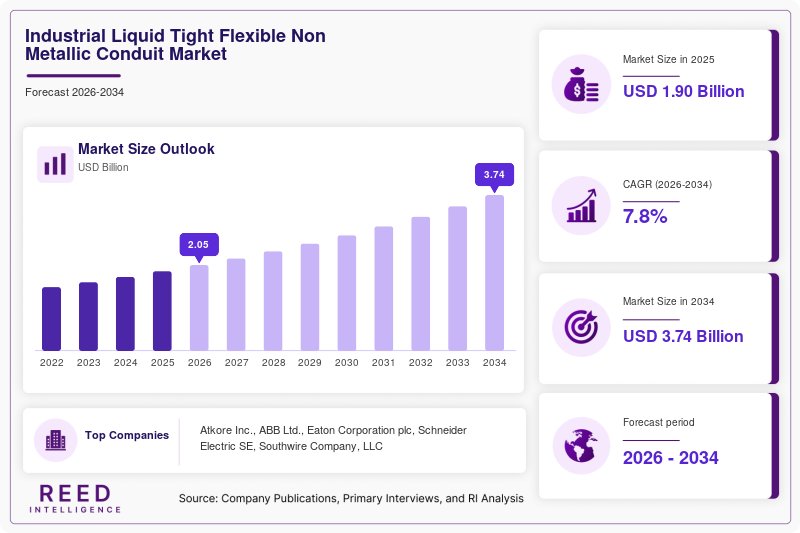
The Industrial Liquid Tight Flexible Non Metallic Conduit Market size was valued at USD 1.9 billion in 2026 and is projected to reach USD 3.5 billion by 2034, expanding at a CAGR of 7.8% during the forecast period (2026–2034). The market growth has been supported by rising investments in industrial automation, electrical infrastructure modernization, and the expansion of smart manufacturing facilities across developed and emerging economies. Increasing demand for durable conduit systems capable of protecting electrical wiring from moisture, chemicals, oils, and harsh industrial environments has further accelerated product adoption across industrial facilities, transportation infrastructure, energy projects, and commercial construction activities.
Industrial liquid tight flexible non metallic conduit systems are gaining attention due to their corrosion resistance, lightweight properties, flexibility, and lower installation costs compared to traditional metallic conduit alternatives. Manufacturers are increasingly introducing advanced conduit materials with enhanced UV resistance, flame retardancy, and temperature tolerance to meet strict industrial safety standards. The growing integration of automation systems, robotics, and digital electrical networks in manufacturing plants has also contributed to higher demand for flexible cable protection solutions.
Key Highlights
- North America accounted for 34.8% of the global Industrial Liquid Tight Flexible Non Metallic Conduit Market share in 2025, while Asia Pacific is projected to register the fastest CAGR of 9.2% during 2026–2034.
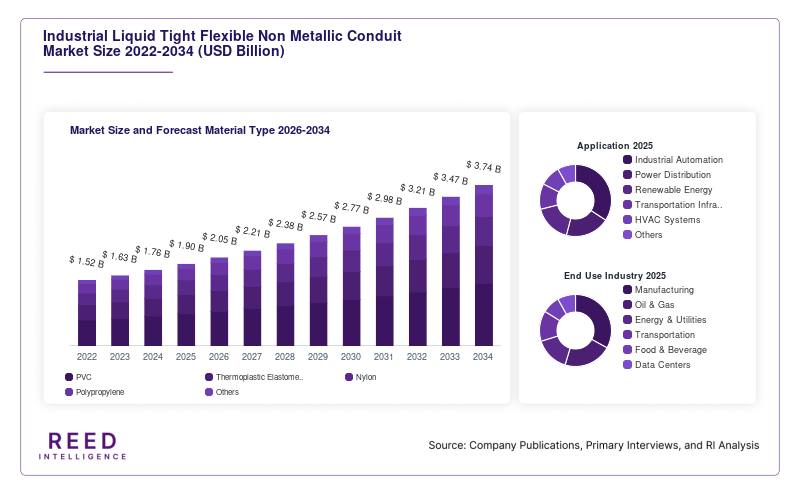
- By material type, PVC-based conduits held the leading market share of 41.5% in 2025, while thermoplastic elastomer conduits are anticipated to grow at a CAGR of 9.6% during the forecast period.
- By conduit size, 1/2 inch to 1 inch conduits dominated the market with a 38.4% share in 2025, whereas conduits above 2 inches are forecast to expand at a CAGR of 8.9%.
- By application, industrial automation systems represented 32.7% of the market share in 2025, while renewable energy installations are expected to witness a CAGR of 9.8%.
- The U.S. Industrial Liquid Tight Flexible Non Metallic Conduit Market was valued at USD 412 million in 2024 and reached USD 439 million in 2025.
Market Trends
Increasing Adoption of Smart Manufacturing Infrastructure
Industrial facilities are increasingly adopting smart manufacturing technologies that require advanced electrical cable management systems. Flexible non metallic conduits are becoming essential in automated production lines due to their ability to protect electrical wiring while supporting complex machine movements and vibration-heavy environments. Manufacturers are focusing on conduits with enhanced bend radius flexibility and chemical resistance for robotic systems and industrial control panels.
Rising Preference for Corrosion-Resistant Electrical Protection Systems
Industries operating in chemically aggressive and moisture-prone environments are shifting toward non metallic conduit systems instead of traditional metal alternatives. Food processing facilities, marine infrastructure, wastewater treatment plants, and renewable energy projects are increasingly using liquid tight flexible conduits because of their non-corrosive characteristics and lightweight installation advantages. This trend is expected to strengthen as industries prioritize longer service life and reduced maintenance costs.
Market Drivers
Expansion of Industrial Automation and Robotics
The increasing deployment of automation equipment across manufacturing facilities has significantly contributed to the Industrial Liquid Tight Flexible Non Metallic Conduit Market growth. Automated production systems require highly flexible and durable conduit systems capable of protecting electrical cables from vibration, movement, moisture, and industrial contaminants. Industries such as automotive manufacturing, pharmaceuticals, semiconductors, and electronics assembly are investing heavily in automated infrastructure, supporting sustained demand for advanced conduit systems.
Growth in Renewable Energy and Infrastructure Projects
Renewable energy installations including solar power plants and wind energy facilities are creating strong demand for liquid tight conduit solutions. These conduits are widely used for protecting electrical cables exposed to outdoor environments, UV radiation, moisture, and fluctuating temperatures. Additionally, expanding infrastructure modernization projects involving railways, airports, industrial parks, and data centers are driving higher adoption of flexible electrical conduit systems globally.
Market Restraint
Fluctuating Raw Material Prices
Volatility in the prices of PVC, thermoplastic elastomers, and specialty polymers has remained a major challenge for conduit manufacturers. Raw material cost fluctuations directly affect manufacturing expenses and profit margins, particularly for small and medium-sized suppliers operating in competitive regional markets. Pricing instability may also impact procurement decisions among industrial end users.
Market Opportunities
Development of Halogen-Free and Eco-Friendly Conduits
Manufacturers are increasingly investing in environmentally safer conduit materials with low smoke emission and halogen-free properties. The growing focus on sustainable industrial infrastructure and fire safety regulations is expected to create opportunities for innovative conduit products designed for environmentally sensitive applications and green building projects.
Increasing Demand from Data Center Infrastructure
The expansion of hyperscale data centers and cloud computing infrastructure is creating new growth opportunities for flexible non metallic conduit systems. Data centers require advanced cable management solutions that offer high durability, moisture protection, and simplified installation. Rising investments in digital infrastructure across North America, Europe, and Asia Pacific are anticipated to support market expansion during the forecast period.
Segmental Analysis
By Material Type
Based on material type, the market is segmented into PVC, thermoplastic elastomer, nylon, polypropylene, and others.
PVC conduits accounted for the largest market share of 41.5% in 2025 due to their cost efficiency, chemical resistance, and widespread usage across industrial applications. These conduits are extensively utilized in manufacturing facilities, wastewater treatment plants, and infrastructure projects because of their flexibility and ease of installation.
Thermoplastic elastomer conduits are projected to witness the fastest CAGR of 9.6% during the forecast period. The growth will be driven by increasing demand for conduits with superior flexibility, high-temperature resistance, and enhanced durability in advanced automation systems and robotics applications. Their suitability for dynamic industrial environments is expected to support market expansion.
By Conduit Size
Based on conduit size, the market is categorized into up to 1/2 inch, 1/2 inch to 1 inch, 1 inch to 2 inches, and above 2 inches.
The 1/2 inch to 1 inch segment dominated the market with a 38.4% share in 2025 because these conduit sizes are commonly used in industrial machinery, control systems, and commercial electrical installations. Their compatibility with standard industrial wiring applications supported widespread adoption.
Conduits above 2 inches are anticipated to register the fastest CAGR of 8.9% during 2026–2034. The growth will be supported by rising demand for large-capacity cable management systems in renewable energy projects, heavy industrial facilities, and large-scale infrastructure developments requiring extensive electrical protection systems.
By Application
Based on application, the market is divided into industrial automation, power distribution, renewable energy, transportation infrastructure, HVAC systems, and others.
Industrial automation accounted for the largest market share of 32.7% in 2025 due to increasing adoption of robotics, automated assembly lines, and machine control systems. Flexible conduit systems played a vital role in protecting cables exposed to vibration, movement, and harsh industrial conditions.
Renewable energy applications are expected to grow at the fastest CAGR of 9.8% during the forecast period. Increasing investments in solar and wind power installations will create higher demand for UV-resistant and moisture-proof conduit systems capable of supporting outdoor electrical infrastructure.
By End Use Industry
Based on end use industry, the market is segmented into manufacturing, oil & gas, energy & utilities, transportation, food & beverage, and data centers.
Manufacturing held the dominant market share of 35.1% in 2025 due to extensive usage of conduit systems in industrial machinery, automated equipment, and factory electrical networks. Industrial modernization and increasing adoption of smart production systems contributed significantly to segment growth.
Data centers are forecast to witness the fastest CAGR of 9.4% during 2026–2034. Growing global demand for cloud computing infrastructure and digital connectivity will increase investments in advanced cable management and electrical protection systems across hyperscale data center facilities.
Regional Analysis
North America
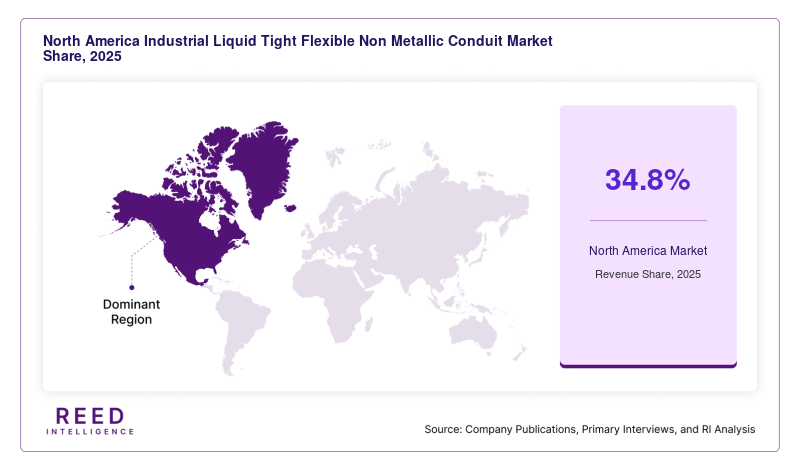
North America accounted for 34.8% of the global Industrial Liquid Tight Flexible Non Metallic Conduit Market share in 2025 and is projected to grow at a CAGR of 7.1% during 2026–2034. The regional market growth has been supported by strong investments in industrial automation, renewable energy infrastructure, and modernization of electrical systems across manufacturing facilities. The United States remained the dominant country due to increasing deployment of automated industrial equipment and large-scale expansion of data center infrastructure. Growing replacement of metallic conduits in corrosive industrial environments further strengthened product demand across the country.
Europe
Europe held 26.3% of the global Industrial Liquid Tight Flexible Non Metallic Conduit Market share in 2025 and is expected to expand at a CAGR of 6.9% during the forecast period. Demand for flexible conduit systems increased due to strict electrical safety regulations and rising adoption of sustainable industrial infrastructure. Germany dominated the regional market because of its advanced manufacturing sector and strong focus on industrial automation technologies. The growing integration of robotics and Industry 4.0 systems in industrial facilities contributed significantly to conduit demand across the country.
Asia Pacific
Asia Pacific represented 24.7% of the global Industrial Liquid Tight Flexible Non Metallic Conduit Market share in 2025 and is forecast to register the fastest CAGR of 9.2% during 2026–2034. Rapid industrialization, urban infrastructure development, and expansion of manufacturing operations supported market growth throughout the region. China emerged as the leading country owing to extensive investments in industrial production facilities, electrical infrastructure, and renewable energy projects. Rising construction of smart factories and electronics manufacturing plants also accelerated the demand for flexible conduit systems.
Middle East & Africa
Middle East & Africa accounted for 8.1% of the global market share in 2025 and is anticipated to grow at a CAGR of 7.4% during the forecast period. Industrial expansion in oil & gas processing, power generation, and infrastructure construction supported the regional market outlook. Saudi Arabia dominated the region due to ongoing industrial diversification projects and investments in smart infrastructure initiatives. The demand for corrosion-resistant conduit systems increased significantly across petrochemical and energy facilities operating in harsh environmental conditions.
Latin America
Latin America captured 6.1% of the global Industrial Liquid Tight Flexible Non Metallic Conduit Market share in 2025 and is projected to expand at a CAGR of 6.7% during 2026–2034. Infrastructure modernization and increasing industrial investments contributed to regional market development. Brazil remained the dominant country due to rising manufacturing activity and expansion of renewable energy infrastructure. Industrial construction projects involving utilities and transportation systems further supported conduit demand across the country.
Competitive Landscape
The Industrial Liquid Tight Flexible Non Metallic Conduit Market remains moderately fragmented with the presence of global manufacturers and regional suppliers focusing on product innovation, industrial partnerships, and expansion of manufacturing capabilities. Companies are investing in advanced conduit materials that provide improved flame resistance, flexibility, UV protection, and chemical durability for industrial environments.
Atkore Inc. remained one of the leading market participants due to its extensive industrial conduit product portfolio and strong distribution network across North America and Europe. The company recently expanded its flexible conduit manufacturing capabilities to support rising demand from industrial automation and renewable energy sectors.
ABB Ltd. continued strengthening its industrial electrical infrastructure business by introducing advanced conduit solutions designed for harsh industrial applications. Eaton Corporation focused on developing conduit systems compatible with smart electrical infrastructure and automated industrial equipment.
Schneider Electric emphasized integrated cable management systems for industrial automation and energy infrastructure projects. Southwire Company expanded its conduit offerings targeting data center and renewable energy applications.
Key Players List
- Atkore Inc.
- ABB Ltd.
- Eaton Corporation plc
- Schneider Electric SE
- Southwire Company, LLC
- Anamet Electrical Inc.
- Electri-Flex Company
- AFC Cable Systems
- HellermannTyton Group PLC
- Delikon Electric Flexible Conduit
- Thomas & Betts Corporation
- Cantex Inc.
- Legrand SA
- Bahra Electric
- Calpipe Industries
Industrial Liquid Tight Flexible Non Metallic Conduit Market Segments
Material Type
- PVC
- Thermoplastic Elastomer
- Nylon
- Polypropylene
- Others
Application
- Industrial Automation
- Power Distribution
- Renewable Energy
- Transportation Infrastructure
- HVAC Systems
- Others
End Use Industry
- Manufacturing
- Oil & Gas
- Energy & Utilities
- Transportation
- Food & Beverage
- Data Centers
Conduit Size
- Up to 1/2 Inch
- 1/2 Inch to 1 Inch
- 1 Inch to 2 Inches
- Above 2 Inches
By Region
- North America
- Europe
- APAC
- Middle East and Africa
- LATAM