Industrial Motor Brakes Market Size, Share & Demand Report By Brake Type (Electromagnetic Brakes, Spring-Applied Brakes, Hydraulic Brakes, Pneumatic Brakes, Permanent Magnet Brakes), By Application (Machine Tools, Conveyors, Cranes and Hoists, Elevators and Escalators, Packaging Equipment), By End-Use Industry (Manufacturing, Mining, Oil & Gas, Energy & Utilities, Renewable Energy, Transportation), By Region & Segment Forecasts, 2026–2034
USD 3950
Market Overview
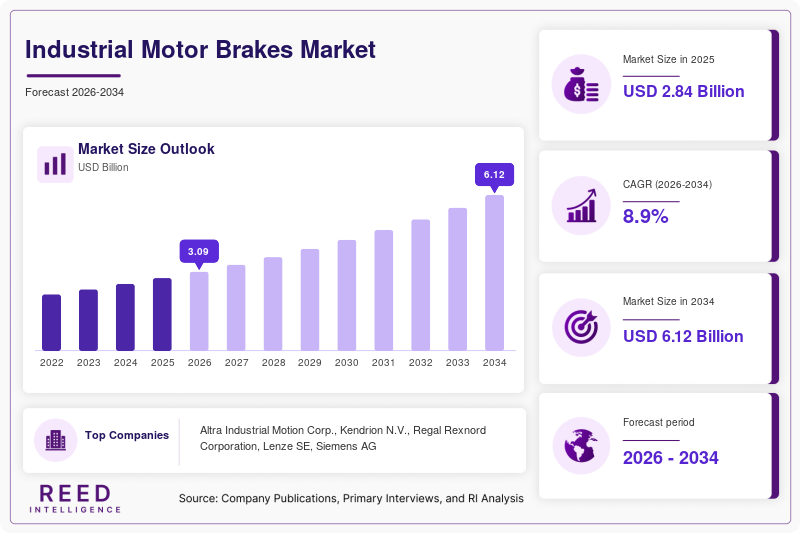
The global Industrial Motor Brakes Market size was valued at approximately USD 2.84 billion in 2026 and is projected to reach USD 5.63 billion by 2034, expanding at a CAGR of 8.9% during 2026–2034. Industrial motor brakes are critical components used to control motion, improve operational safety, and enhance positioning accuracy in industrial machinery. These systems are widely deployed across manufacturing facilities, material handling equipment, mining operations, robotics, energy infrastructure, and transportation systems where precise stopping and holding capabilities are required.
Growing industrial automation across developed and emerging economies continues to support market expansion. Manufacturers are increasingly integrating advanced motor brake systems into automated production lines to improve worker safety, reduce downtime, and maintain operational efficiency. The adoption of smart manufacturing practices and Industry 4.0 technologies has further increased demand for reliable braking solutions capable of supporting high-performance motors and automated equipment.
Key Highlights
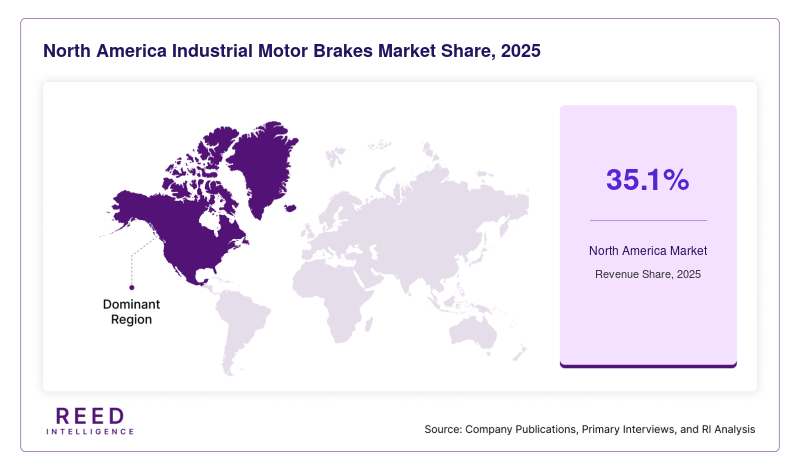
- North America dominated the market with a 35.1% share in 2025.
- Asia Pacific is expected to grow at the fastest CAGR of 10.8% during 2026–2034.
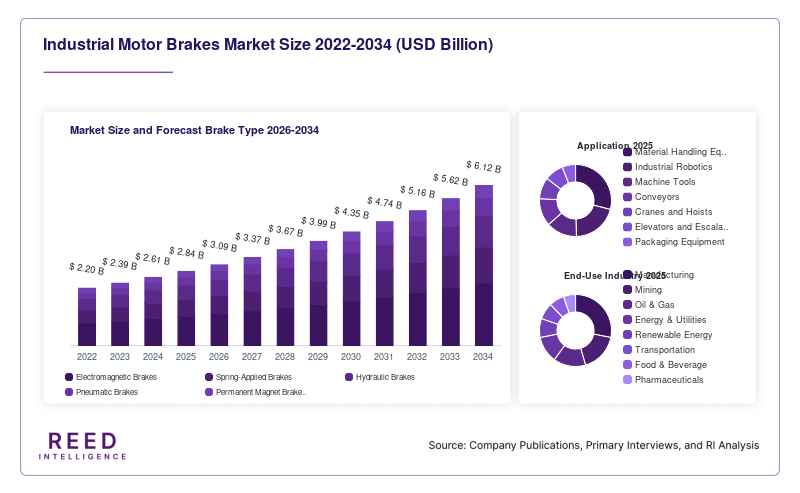
- By brake type, electromagnetic brakes accounted for the largest share of 39.4%.
- while spring-applied brakes are projected to grow at a CAGR of 10.5%.
- By application, material handling equipment led with a 36.8% share.
- whereas industrial robotics is expected to expand at a CAGR of 11.6%.
- By end-use industry, manufacturing represented the largest share of 33.7%.
- while the renewable energy sector is forecast to grow at a CAGR of 11.2%.
- The United States remained the dominant country, with market values of USD 760 million in 2024 and USD 815 million in 2025.
Market Trends
Integration of Smart Monitoring Technologies in Industrial Brake Systems
Industrial facilities are increasingly adopting intelligent motor brake systems equipped with sensors and condition-monitoring capabilities. These technologies allow operators to monitor brake wear, temperature fluctuations, vibration levels, and performance efficiency in real time. Predictive maintenance solutions are becoming a significant component of industrial operations as manufacturers seek to reduce unplanned downtime and maintenance expenses. Smart brake systems help maintenance teams identify potential failures before they occur, improving equipment reliability and extending component lifespan. The trend is particularly visible in automated production facilities, logistics centers, and mining operations where equipment availability directly influences productivity. As digital transformation accelerates across industrial sectors, demand for connected braking solutions is expected to continue rising throughout the forecast period.
Rising Adoption of Compact and Energy-Efficient Brake Designs
Industrial equipment manufacturers are increasingly focusing on compact brake systems that deliver high torque performance while minimizing energy consumption. Modern production environments require machinery that occupies less space while maintaining operational effectiveness. As a result, brake manufacturers are developing lightweight and compact solutions suitable for robotics, automated guided vehicles, conveyors, and precision machinery. Energy-efficient brake technologies are also gaining popularity because industries are prioritizing sustainability initiatives and operational cost reductions. Advanced materials and improved electromagnetic designs are enabling manufacturers to reduce power requirements without compromising braking performance. This trend is expected to strengthen as industrial operators continue investing in energy optimization and environmentally responsible manufacturing practices.
Market Drivers
Expansion of Industrial Automation and Smart Manufacturing
The rapid expansion of industrial automation remains a major growth driver for the Industrial Motor Brakes Market. Manufacturing facilities across sectors are deploying automated production lines, robotic systems, and intelligent machinery to improve productivity and maintain consistent product quality. Industrial motor brakes play an essential role in ensuring precise positioning, controlled stopping, and operational safety within automated environments. As factories become increasingly connected through Industry 4.0 initiatives, the need for advanced braking solutions capable of supporting automated equipment continues to increase. The growing emphasis on minimizing operational disruptions and improving production efficiency further encourages investment in reliable motor brake systems, supporting sustained market growth throughout the forecast period.
Increasing Demand from Material Handling and Logistics Operations
Global growth in warehousing, logistics, and distribution infrastructure has significantly increased demand for industrial motor brakes. Material handling equipment such as cranes, hoists, conveyors, elevators, and automated storage systems relies heavily on braking mechanisms for safe and accurate operation. The expansion of e-commerce activities has accelerated investments in warehouse automation and distribution centers worldwide. These facilities require high-performance braking systems capable of supporting continuous operation and ensuring workplace safety. Furthermore, modernization initiatives in ports, airports, and industrial transportation networks are contributing to increased brake installations. As logistics operators continue enhancing efficiency and throughput, demand for advanced industrial motor brake solutions is expected to remain strong.
Market Restraint
High Initial Costs Associated with Advanced Braking Technologies
The relatively high cost of advanced industrial motor brake systems presents a challenge for market growth, particularly among small and medium-sized enterprises. Modern braking solutions equipped with intelligent monitoring functions, enhanced safety mechanisms, and high-performance materials often require substantial capital investment. In addition to equipment acquisition costs, installation, integration, and maintenance expenses can increase overall project budgets. Many industrial operators in developing economies continue relying on conventional braking systems due to budget limitations and concerns regarding return on investment. For example, a mid-sized manufacturing facility upgrading multiple production lines may face significant upfront expenditures when replacing traditional brake assemblies with smart braking systems. While long-term operational benefits are considerable, the initial financial burden may delay adoption decisions and limit market penetration in cost-sensitive regions.
Market Opportunities
Growing Deployment of Industrial Robotics Across Manufacturing Facilities
The increasing use of industrial robots creates substantial opportunities for the Industrial Motor Brakes Market. Robotics applications require precise motion control, positioning accuracy, and dependable safety mechanisms, making motor brakes essential components within robotic systems. Automotive, electronics, pharmaceutical, and food processing industries are expanding robotic deployments to improve productivity and reduce labor-intensive processes. As robot installations continue rising globally, demand for compact and high-performance braking solutions is expected to increase significantly. Manufacturers are also developing specialized brake systems designed specifically for robotic joints and automated motion-control applications. This evolving landscape presents considerable opportunities for innovation, product differentiation, and long-term revenue generation.
Expansion of Renewable Energy Infrastructure
Investments in renewable energy projects are creating new growth avenues for industrial motor brake manufacturers. Wind turbines, solar tracking systems, and various renewable energy equipment require reliable braking systems to ensure operational safety and performance stability. Wind energy installations, in particular, utilize motor brakes to control rotor movement during maintenance activities and extreme weather conditions. Governments across multiple regions are supporting clean energy development through policy initiatives and infrastructure investments. As renewable energy capacity expands worldwide, demand for durable and high-performance industrial braking solutions is expected to increase. Manufacturers capable of delivering specialized products for renewable energy applications are likely to benefit from emerging opportunities throughout the forecast period.
Segmental Analysis
By Brake Type
Electromagnetic brakes emerged as the dominant subsegment, accounting for approximately 39.4% of market share in 2024. Their widespread adoption can be attributed to high reliability, rapid response times, and compatibility with a broad range of industrial applications. These brakes are extensively utilized in conveyors, machine tools, packaging equipment, and automated production systems where precise stopping performance is essential. The increasing adoption of automated machinery across manufacturing facilities has further strengthened demand for electromagnetic braking solutions. Their ability to support efficient motion control while maintaining operational safety makes them a preferred choice among industrial operators seeking dependable and cost-effective braking technologies.
Spring-applied brakes are projected to register the fastest CAGR of 10.5% during the forecast period. These systems are gaining popularity because of their fail-safe characteristics, which automatically engage braking action when power is interrupted. Industries prioritizing safety and compliance are increasingly selecting spring-applied designs for elevators, hoists, cranes, and automated equipment. Growing regulatory emphasis on worker protection and machinery safety is accelerating adoption. In addition, advancements in compact designs and material technologies are improving operational efficiency and reducing maintenance requirements. These factors collectively support strong growth prospects for the segment over the coming years.
By Application
Material handling equipment represented the largest application segment, accounting for approximately 36.8% of total market revenue in 2024. Industrial motor brakes are critical components in cranes, conveyors, elevators, hoists, and automated storage systems where controlled movement and safe operation are essential. The expansion of logistics infrastructure, warehousing facilities, and distribution centers has increased demand for reliable braking technologies. Growing e-commerce activities continue to drive investments in material handling equipment capable of improving throughput and operational efficiency. As businesses focus on reducing workplace accidents and enhancing productivity, demand for advanced braking systems within this application segment remains substantial.
Industrial robotics is expected to record the fastest growth rate, expanding at a CAGR of 11.6% through 2034. Robotics applications require highly precise braking mechanisms to ensure accurate positioning and safe operation during automated tasks. Increasing adoption of collaborative robots, assembly-line automation, and advanced manufacturing systems is creating favorable conditions for market growth. Industries including automotive, electronics, pharmaceuticals, and food processing are rapidly integrating robotic solutions into production environments. The need for compact, lightweight, and energy-efficient braking systems that support high-performance robotic movements is expected to drive significant expansion within this application category.
By End-Use Industry
Manufacturing accounted for the largest share of the Industrial Motor Brakes Market in 2024, representing approximately 33.7% of total revenue. Manufacturing facilities rely extensively on motor brake systems to ensure equipment safety, precision control, and uninterrupted production processes. Industries such as automotive, metal fabrication, machinery production, and consumer goods manufacturing require dependable braking solutions across a wide range of machinery. The continued implementation of industrial automation technologies and smart manufacturing initiatives has strengthened demand for advanced braking systems. Furthermore, increasing emphasis on productivity optimization and preventive maintenance supports ongoing investments in reliable motor brake technologies.
The renewable energy sector is projected to be the fastest-growing end-use segment, expanding at a CAGR of 11.2% during 2026–2034. Wind energy installations, solar tracking systems, and energy storage infrastructure increasingly rely on specialized braking systems to maintain operational stability and safety. Government support for renewable energy projects and rising investments in sustainable power generation are creating favorable market conditions. Technological advancements in renewable energy equipment are also increasing demand for durable braking solutions capable of operating under challenging environmental conditions. As clean energy deployment accelerates globally, opportunities within this segment are expected to expand significantly.
Regional Analysis
North America
North America accounted for approximately 35.1% of the global Industrial Motor Brakes Market in 2025 and continues to represent a significant revenue contributor. The region is projected to expand at a CAGR of 8.2% through 2034. Strong industrial automation adoption, advanced manufacturing infrastructure, and increasing deployment of robotics across production facilities support market growth. The presence of established equipment manufacturers and continuous investments in factory modernization contribute to stable demand for industrial motor brake systems.
The United States remains the dominant country within the region. A key growth factor is the widespread implementation of smart manufacturing technologies across automotive, aerospace, and logistics industries. Companies are investing heavily in predictive maintenance systems and intelligent equipment that require advanced braking mechanisms. Increasing warehouse automation and modernization of industrial infrastructure continue to strengthen the country's position in the market.
Europe
Europe represented approximately 27.8% of global market revenue in 2025 and is anticipated to register a CAGR of 8.1% during the forecast period. Industrial automation initiatives, stringent workplace safety regulations, and continuous technological innovation are supporting market expansion across the region. Manufacturers are increasingly adopting advanced motor brake systems to improve operational efficiency and comply with regulatory standards related to machinery safety and performance.
Germany maintains its position as the leading country in the European market. A major growth factor is the country's highly developed industrial machinery sector and strong focus on Industry 4.0 implementation. German manufacturers continue investing in intelligent production systems and precision engineering technologies that require reliable braking components. These investments are expected to support long-term market growth throughout the forecast horizon.
Asia Pacific
Asia Pacific captured approximately 24.5% of the Industrial Motor Brakes Market in 2025 and is expected to witness the fastest CAGR of 10.8% between 2026 and 2034. Rapid industrialization, expanding manufacturing capacity, and increasing automation investments are creating favorable market conditions. Countries across the region are modernizing industrial infrastructure while adopting advanced machinery to improve competitiveness and production efficiency.
China dominates the regional market due to its extensive manufacturing base and large-scale industrial development projects. One unique growth factor is the country's continued investment in automated factories and smart production facilities. Government initiatives supporting advanced manufacturing and industrial modernization are encouraging widespread deployment of automated equipment, thereby increasing demand for industrial motor brake systems.
Middle East & Africa
The Middle East & Africa accounted for approximately 6.1% of global market revenue in 2025 and is forecast to grow at a CAGR of 8.7% through 2034. Industrial diversification efforts, infrastructure development projects, and increasing investments in manufacturing activities are supporting regional demand. Mining operations, material handling systems, and energy infrastructure projects represent important application areas contributing to market expansion.
Saudi Arabia leads the regional market owing to its industrial development initiatives and economic diversification programs. A significant growth factor is the expansion of industrial cities and manufacturing facilities under long-term national development strategies. These projects require advanced machinery and automation systems equipped with reliable motor braking solutions, supporting continued market growth across the country.
Latin America
Latin America held approximately 6.5% of the global Industrial Motor Brakes Market in 2025 and is expected to grow at a CAGR of 8.4% during the forecast period. Increasing industrial investments, modernization of manufacturing operations, and growing demand for automation technologies are contributing to market development. The region is witnessing gradual adoption of advanced production equipment across various industrial sectors.
Brazil remains the dominant country in Latin America. A key growth factor is the modernization of manufacturing and mining operations aimed at improving productivity and operational safety. Industrial operators are increasingly upgrading equipment with advanced braking technologies to support automation initiatives and reduce maintenance-related downtime. These developments are expected to sustain market demand over the coming years.
Competitive Landscape
The Industrial Motor Brakes Market is characterized by the presence of established global manufacturers and specialized regional suppliers competing through product innovation, strategic partnerships, and geographic expansion. Market participants are focusing on developing intelligent braking systems with predictive maintenance capabilities, improved durability, and enhanced energy efficiency.
Among leading companies, Altra Industrial Motion Corp. maintains a strong market position due to its diversified product portfolio and extensive global distribution network. The company recently introduced advanced electromagnetic braking solutions designed for automated industrial applications, strengthening its presence in high-growth automation markets.
Other prominent players continue investing in research and development to address evolving industrial requirements. Strategic collaborations with automation equipment manufacturers and expansion into emerging economies remain common growth strategies. Companies are also emphasizing customized braking solutions tailored to robotics, renewable energy, material handling, and precision manufacturing applications. Increasing demand for intelligent and safety-focused braking technologies is expected to intensify competition and encourage further product innovation throughout the forecast period.
Key Players
- Altra Industrial Motion Corp.
- Kendrion N.V.
- Regal Rexnord Corporation
- Lenze SE
- Siemens AG
- ABB Ltd.
- SEW-EURODRIVE GmbH & Co KG
- Ringspann GmbH
- Warner Electric
- Ogura Industrial Corp.
- Nidec Corporation
- Eaton Corporation
- Intorq GmbH & Co. KG
- Bosch Rexroth AG
- Mayr GmbH + Co. KG
Recent Developments
- Altra Industrial Motion introduced a new range of smart electromagnetic motor brakes featuring predictive maintenance functionality for automated manufacturing systems in 2025.
- Kendrion expanded its industrial brake production capacity in Asia to address rising demand from robotics and factory automation applications during 2025.
- Regal Rexnord Corporation launched enhanced spring-applied braking solutions designed for renewable energy equipment and heavy-duty industrial machinery in 2026.
- Mayr GmbH developed compact safety brake systems optimized for collaborative robotics and precision automation environments in 2025.
- Siemens AG strengthened its industrial automation portfolio through integration of intelligent motor control and braking technologies for smart manufacturing facilities in 2026.
Industrial Motor Brakes Market Segments
Brake Type
- Electromagnetic Brakes
- Spring-Applied Brakes
- Hydraulic Brakes
- Pneumatic Brakes
- Permanent Magnet Brakes
Application
- Material Handling Equipment
- Industrial Robotics
- Machine Tools
- Conveyors
- Cranes and Hoists
- Elevators and Escalators
- Packaging Equipment
End-Use Industry
- Manufacturing
- Mining
- Oil & Gas
- Energy & Utilities
- Renewable Energy
- Transportation
- Food & Beverage
- Pharmaceuticals
By Region
- North America
- Europe
- APAC
- Middle East and Africa
- LATAM