Industrial Oxygen Market Size, Share & Demand Report By Form (Compressed Oxygen, Liquid Oxygen), By Application (Metallurgy, Healthcare, Chemicals, Energy, Others), By Production Method (Cryogenic Distillation, Pressure Swing Adsorption (PSA), Membrane Separation), By End-Use Industry (Manufacturing, Healthcare, Energy & Power, Chemicals, Others), By Region & Segment Forecasts, 2025–2034
USD 3950
Market Overview
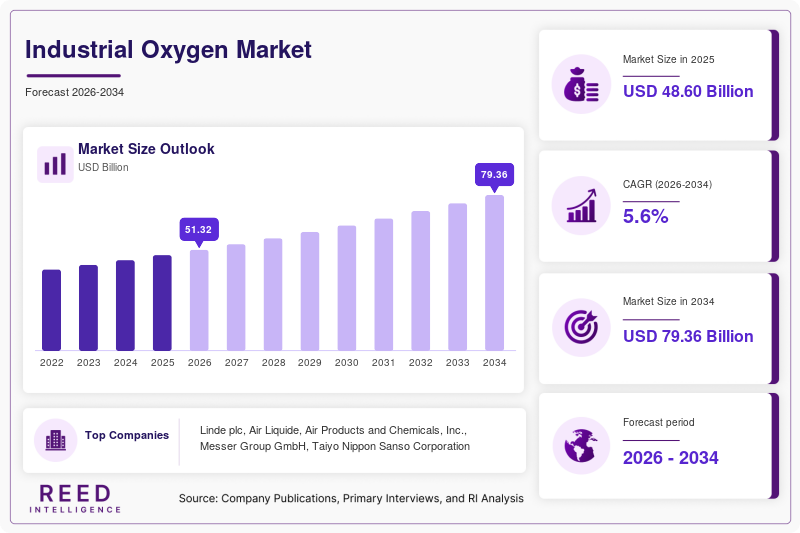
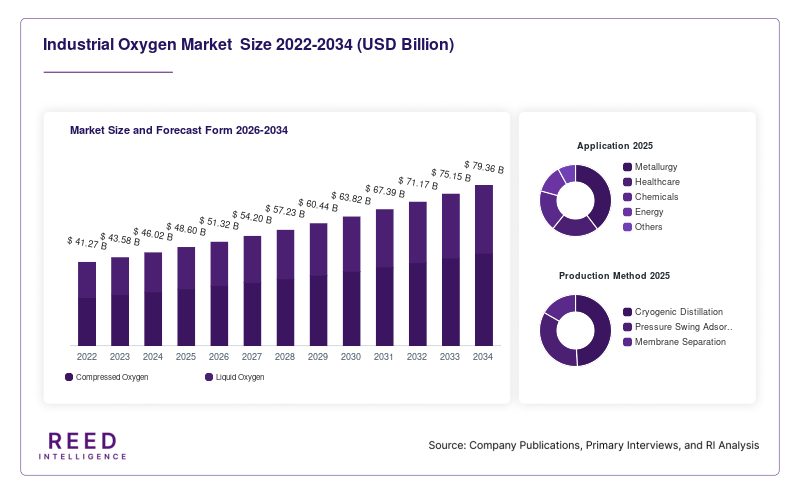
The Industrial Oxygen Market size was valued at approximately USD 48.6 billion in 2025 and is projected to reach USD 79.3 billion by 2034, expanding at a CAGR of 5.6% during the forecast period (2025–2034). Industrial oxygen plays a critical role across multiple industries, including metallurgy, healthcare, chemicals, and energy, owing to its essential function in combustion, oxidation, and life-support processes. The increasing demand for efficient manufacturing processes and clean energy solutions has significantly supported market expansion globally.
One of the key global factors driving growth has been the rising adoption of oxygen in steel production and metal fabrication processes. Industrial oxygen enhances combustion efficiency, reduces fuel consumption, and improves product quality, making it indispensable in modern industrial operations. Additionally, the growing focus on sustainable industrial practices has further accelerated the demand for oxygen-based processes.
Key Highlights:
- Asia Pacific dominated the Industrial Oxygen Market with a share of 42.8% in 2025, while the Middle East & Africa is expected to witness the fastest growth at a CAGR of 6.4%.
- By application, metallurgy held the largest share at 38.5% in 2024, whereas healthcare is projected to be the fastest-growing segment with a CAGR of 6.8%.
- By form, compressed oxygen accounted for 54.2% of the market share in 2024, while liquid oxygen is expected to grow at a CAGR of 6.1%.
- China remained the dominant country, with market values of USD 9.8 billion in 2024 and USD 10.4 billion in 2025.
Market Trends
Integration of Oxygen in Green Steel Production
The Industrial Oxygen Market is witnessing a shift toward environmentally sustainable steel production methods. Oxygen-based processes, such as basic oxygen furnace (BOF) technology, are being optimized to reduce carbon emissions and improve efficiency. The growing adoption of hydrogen-based steelmaking, where oxygen plays a complementary role, is further influencing market dynamics.
Rising Use of Oxygen in Healthcare Infrastructure
Another notable trend is the increasing integration of industrial oxygen in healthcare systems. The expansion of hospital infrastructure, particularly in developing economies, has driven demand for reliable oxygen supply systems. Industrial oxygen is increasingly being purified and used in medical applications, especially in emergency care and respiratory treatments. The emphasis on decentralized oxygen generation systems, including on-site oxygen plants, is also reshaping the market landscape.
Market Drivers
Expanding Steel and Metal Processing Industry
The continuous growth of the global steel industry is a primary driver of the Industrial Oxygen Market. Oxygen is extensively used in blast furnaces and refining processes to enhance combustion and remove impurities. As infrastructure development and urbanization increase worldwide, demand for steel continues to rise, subsequently boosting oxygen consumption.
Increasing Demand from Chemical Manufacturing
Industrial oxygen is widely used in chemical synthesis, oxidation reactions, and wastewater treatment. The expansion of the chemical industry, particularly in emerging economies, has significantly contributed to market growth. Oxygen enables efficient chemical processing and improves yield, making it a crucial component in modern chemical production facilities.
Market Restraint
High Storage and Transportation Costs
One of the key challenges in the Industrial Oxygen Market is the high cost associated with storage and transportation. Oxygen requires specialized cryogenic tanks or high-pressure cylinders, which increases operational expenses. Additionally, transportation over long distances poses logistical challenges and safety concerns. These factors can limit market penetration, especially in remote or underdeveloped regions where infrastructure is inadequate. The need for continuous monitoring and compliance with safety regulations further adds to the cost burden, restricting adoption among small and medium enterprises.
Market Opportunities
Growth of On-Site Oxygen Generation Systems
The increasing adoption of on-site oxygen generation technologies presents a significant opportunity for market growth. Industries are shifting toward pressure swing adsorption (PSA) systems to produce oxygen at their facilities, reducing dependence on external suppliers. This trend is particularly beneficial in regions with limited supply chain infrastructure.
Expansion in Emerging Economies
Rapid industrialization in emerging markets offers substantial growth potential for the Industrial Oxygen Market. Countries in Asia, Africa, and Latin America are investing heavily in infrastructure, healthcare, and manufacturing sectors. This expansion creates a strong demand for industrial gases, including oxygen, thereby opening new avenues for market players.
Segmental Analysis
By Form
Compressed oxygen dominated the Industrial Oxygen Market, accounting for 54.2% of the market share in 2024. This dominance was attributed to its widespread use in small- and medium-scale industrial applications, where portability and ease of handling are critical. Compressed oxygen cylinders have been extensively utilized in welding, cutting, and healthcare settings due to their convenience and accessibility.
Liquid oxygen is expected to be the fastest-growing segment, with a projected CAGR of 6.1% during the forecast period. The growth will be driven by its higher storage efficiency and suitability for large-scale industrial operations. Liquid oxygen enables bulk transportation and storage, making it ideal for industries such as steel manufacturing and energy production.
By Application
Metallurgy held the largest share of the Industrial Oxygen Market, accounting for 38.5% in 2024. The use of oxygen in steelmaking and metal refining processes has been a major factor contributing to this dominance. Oxygen enhances combustion efficiency and improves the quality of metal products.
Healthcare is anticipated to be the fastest-growing application segment, with a CAGR of 6.8%. The increasing demand for medical oxygen in hospitals and emergency care will drive growth. The expansion of healthcare infrastructure and the rising prevalence of respiratory diseases will further support demand.
By Production Method
Cryogenic distillation dominated the market, capturing 61.3% of the share in 2024. This method has been widely used for large-scale oxygen production due to its ability to deliver high-purity oxygen. It has been the preferred choice for industries requiring consistent and reliable supply.
Pressure swing adsorption (PSA) is projected to grow at the fastest CAGR of 6.5%. The growth will be driven by its cost-effectiveness and suitability for on-site oxygen generation. PSA systems offer flexibility and reduce dependency on external supply chains.
By End-Use Industry
The manufacturing sector accounted for the largest share, representing 46.7% in 2024. The extensive use of oxygen in metal fabrication, welding, and chemical processing has contributed to this dominance. Industrial oxygen has been a critical component in enhancing production efficiency.
The healthcare sector is expected to witness the fastest growth, with a CAGR of 6.9%. Increasing investments in healthcare infrastructure and the rising demand for medical-grade oxygen will drive this segment. The adoption of advanced medical technologies will further support growth.
Regional Analysis
North America
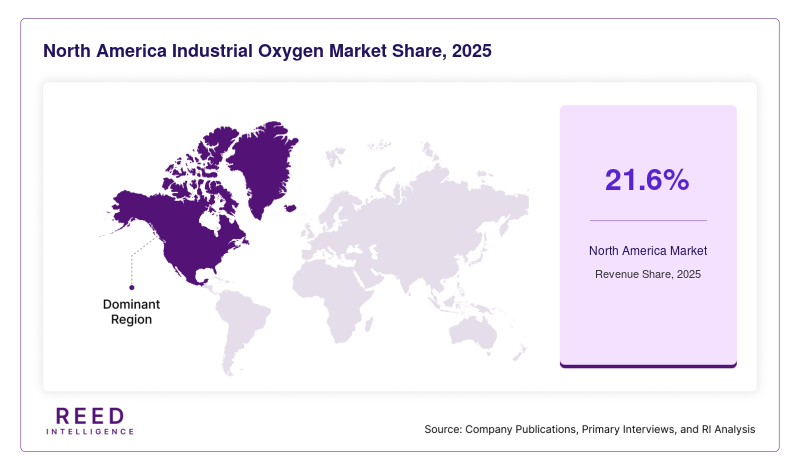
North America accounted for approximately 21.6% of the Industrial Oxygen Market share in 2025 and is expected to grow at a CAGR of 4.9% during the forecast period. The region has been characterized by stable demand from mature industries such as healthcare, chemicals, and metal fabrication. Advanced infrastructure and technological integration have supported consistent oxygen consumption across industrial applications.
The United States dominated the regional market due to its strong healthcare infrastructure and high adoption of advanced manufacturing technologies. The presence of large-scale chemical processing industries has contributed to sustained demand. Additionally, the increasing focus on clean energy projects has further supported the use of oxygen in gasification and carbon capture processes.
Europe
Europe held a market share of 18.9% in 2025 and is projected to grow at a CAGR of 5.1% through 2034. The region has experienced steady demand driven by environmental regulations and the adoption of cleaner industrial processes. Oxygen is widely used in waste treatment and energy-efficient manufacturing practices.
Germany emerged as the leading country in Europe due to its strong industrial base and emphasis on sustainable production methods. The country’s advanced metallurgy and automotive sectors have significantly contributed to oxygen consumption. The transition toward low-emission technologies has further reinforced market growth.
Asia Pacific
Asia Pacific dominated the Industrial Oxygen Market with a share of 42.8% in 2025 and is anticipated to grow at a CAGR of 5.9% over the forecast period. Rapid industrialization and urban development have been key factors driving demand in the region. The expansion of steel production and chemical industries has further accelerated market growth.
China led the regional market due to its large-scale manufacturing and infrastructure projects. The country’s extensive steel production capacity has been a major driver of oxygen demand. Additionally, government initiatives supporting industrial efficiency and environmental sustainability have contributed to increased adoption.
Middle East & Africa
The Middle East & Africa accounted for 9.7% of the market share in 2025 and is expected to grow at a CAGR of 6.4%, making it the fastest-growing region. The region has witnessed increasing investments in energy and industrial sectors, which has driven demand for industrial gases.
Saudi Arabia dominated the regional market due to its expanding petrochemical and energy industries. The use of oxygen in refining and gas processing applications has significantly contributed to market growth. The development of new industrial projects is expected to further enhance demand.
Latin America
Latin America held a market share of 7.0% in 2025 and is projected to grow at a CAGR of 5.3% during the forecast period. The region has experienced gradual growth driven by industrial development and increasing investments in healthcare infrastructure.
Brazil emerged as the dominant country due to its growing manufacturing sector and expanding healthcare facilities. The demand for oxygen in metal processing and medical applications has been a key growth factor. Continued economic development is expected to support market expansion.
Competitive Landscape
The Industrial Oxygen Market is moderately consolidated, with key players focusing on capacity expansion, technological advancements, and strategic partnerships. Leading companies are investing in on-site generation systems and sustainable production methods to strengthen their market position.
Linde plc remains a market leader, leveraging its extensive global presence and advanced gas production technologies. The company has recently expanded its on-site oxygen generation capabilities to cater to growing industrial demand.Other prominent players include Air Liquide, Air Products and Chemicals, Inc., Messer Group, and Taiyo Nippon Sanso Corporation. These companies are actively engaged in mergers, acquisitions, and collaborations to enhance their product offerings and expand their geographic footprint.
Key Players
- Linde plc
- Air Liquide
- Air Products and Chemicals, Inc.
- Messer Group GmbH
- Taiyo Nippon Sanso Corporation
- Praxair Technology, Inc.
- Gulf Cryo
- SOL Group
- Yingde Gases Group Company Limited
- INOX Air Products Ltd.
Recent Developments
- In 2025, Linde plc expanded its oxygen production facility in Asia to meet rising industrial demand.
- Air Liquide launched advanced on-site oxygen generation systems for healthcare facilities.
- Air Products announced new investments in sustainable gas production technologies.
- INOX Air Products Ltd. strengthened its distribution network across emerging markets.
- Messer Group entered strategic partnerships to enhance its regional presence in Europe.
Industrial Oxygen Market Segments
Form
- Compressed Oxygen
- Liquid Oxygen
Application
- Metallurgy
- Healthcare
- Chemicals
- Energy
- Others
Production Method
- Cryogenic Distillation
- Pressure Swing Adsorption (PSA)
- Membrane Separation
End-Use Industry
- Manufacturing
- Healthcare
- Energy & Power
- Chemicals
- Others
By Region
- North America
- Europe
- APAC
- Middle East and Africa
- LATAM