Industrial Robot Market Size, Share & Demand Report By Robot Type (Articulated Robots, SCARA Robots, Cartesian Robots, Collaborative Robots, Cylindrical Robots), By Application (Welding and Soldering, Material Handling, Assembly and Disassembly, Painting and Coating, Inspection and Testing), By End-Use Industry (Automotive, Electronics and Semiconductor, Food and Beverage, Healthcare and Pharmaceuticals, Metals and Machinery, Logistics and Warehousing) By Region & Segment Forecasts, 2026–2034
USD 3950
Market Overview
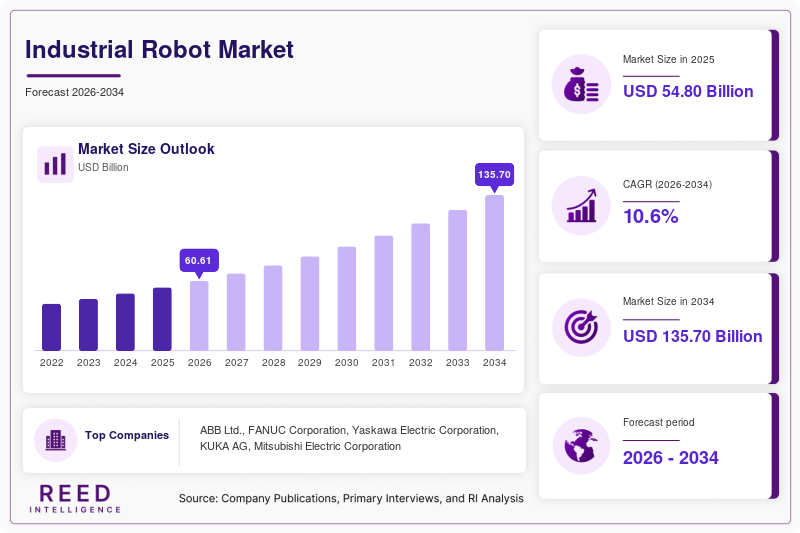
The global Industrial Robot Market size was valued at USD 54.8 billion in 2026 and is projected to reach USD 122.6 billion by 2034, expanding at a CAGR of 10.6% during the forecast period from 2026 to 2034. The market continues to experience stable growth due to increasing automation across manufacturing industries, rising labor cost pressures, and the growing need for operational precision in high-volume production facilities. Industrial robots are increasingly deployed in automotive assembly, electronics manufacturing, food processing, pharmaceuticals, and logistics applications to improve efficiency, reduce downtime, and maintain product consistency.
One major global factor supporting market expansion is the accelerated adoption of smart manufacturing and Industry 4.0 technologies. Manufacturers across developed and emerging economies are integrating robotics with artificial intelligence, machine vision systems, cloud analytics, and industrial IoT platforms to improve productivity and process control. Industrial robots are becoming more flexible, collaborative, and cost-efficient, allowing small and medium-sized enterprises to adopt automation solutions that were previously limited to large-scale manufacturers. In addition, the shift toward electric vehicle production and semiconductor manufacturing has increased the demand for robotic welding, assembly, and material-handling systems worldwide.
Key Highlights
- Asia Pacific dominated the market with a 39.4% share in 2025, while Latin America is expected to grow at the fastest CAGR of 11.8% during 2026–2034.
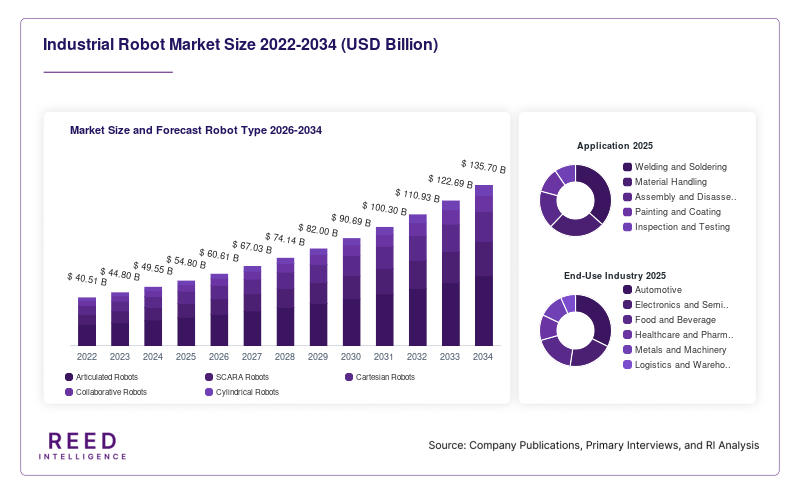
- By robot type, articulated robots accounted for the largest share of 43.1%, while collaborative robots are projected to grow at a CAGR of 13.6%.
- By application, welding and soldering led with a 34.8% share, whereas material handling is expected to expand at a CAGR of 12.2%.
- By end-use industry, automotive held the largest share of 36.7%, while electronics and semiconductor manufacturing is forecast to grow at a CAGR of 12.9%.
- China remained the dominant country, with market values of USD 10.9 billion in 2024 and USD 12.1 billion in 2025.
Market Trends
Expansion of Collaborative Robotics Across Mid-Sized Manufacturing Facilities
Collaborative robots are becoming an important trend within the Industrial Robot Market as manufacturers seek automation systems that can operate alongside human workers without extensive safety barriers. These robots are increasingly adopted in electronics assembly, packaging, food processing, and pharmaceutical production environments where flexibility and compact deployment are essential. Unlike conventional robotic systems, collaborative robots are easier to program and require lower installation costs, making them suitable for mid-sized enterprises transitioning toward automation. Manufacturers are also integrating advanced sensors and AI-enabled motion control systems to improve adaptability and precision in dynamic production settings. The growing preference for human-robot collaboration is expected to reshape industrial workflows and support broader market penetration during the forecast period.
Rising Integration of Artificial Intelligence and Predictive Analytics
The integration of artificial intelligence and predictive analytics into industrial robotic systems is transforming production efficiency and operational monitoring. Manufacturers are increasingly deploying AI-enabled robots capable of self-optimization, real-time decision-making, and predictive maintenance analysis. These technologies help reduce machine downtime, improve production quality, and optimize energy consumption across automated facilities. Advanced machine vision systems combined with AI algorithms also enable robots to identify product defects, improve assembly accuracy, and handle variable production tasks. The growing use of cloud-connected robotics platforms allows manufacturers to collect operational data across multiple facilities and improve production planning. As industries continue to prioritize digital transformation, intelligent robotic systems are expected to witness sustained adoption across global manufacturing sectors.
Market Drivers
Growing Adoption of Automation in Automotive and Electronics Manufacturing
The increasing use of automation in automotive and electronics manufacturing remains a primary growth driver for the Industrial Robot Market. Automotive manufacturers continue to invest heavily in robotic welding, painting, assembly, and inspection systems to improve production speed and reduce operational errors. The transition toward electric vehicle manufacturing has further accelerated robotic deployments, particularly in battery assembly and precision component handling. Similarly, electronics manufacturers require high-speed robotic systems capable of handling miniature components with high accuracy and consistency. Industrial robots help manufacturers maintain product quality standards while improving throughput and reducing labor dependency. The growing complexity of consumer electronics and electric mobility solutions is expected to continue supporting strong demand for robotic automation technologies over the coming years.
Increasing Labor Cost Pressures and Workplace Safety Requirements
Rising labor costs and stricter workplace safety regulations are encouraging industries to adopt robotic automation systems across production environments. Manufacturers are facing challenges related to workforce shortages, rising wages, and employee safety compliance, particularly in hazardous or repetitive industrial operations. Industrial robots help reduce workplace injuries by performing tasks involving high temperatures, heavy lifting, toxic materials, and repetitive motion activities. In addition, robotic systems operate continuously with minimal downtime, allowing companies to improve productivity and optimize manufacturing costs. Governments and industrial organizations are also promoting smart manufacturing initiatives and automation investments to improve industrial competitiveness. These factors are collectively driving higher deployment of industrial robots across developed and emerging economies.
Market Restraint
High Initial Investment and Integration Complexity Limiting Adoption
The high capital investment associated with industrial robotic systems remains a major restraint for the Industrial Robot Market, particularly among small and medium-sized enterprises. Robotic deployment involves significant expenses related to hardware acquisition, software integration, programming, infrastructure upgrades, and workforce training. Many companies operating with limited budgets struggle to justify the long-term return on investment associated with advanced automation systems. In addition, integrating robots into existing manufacturing environments can create operational disruptions and require extensive customization. Industries with older production infrastructure often face compatibility issues during robotic implementation, increasing project complexity and deployment timelines. Maintenance costs and the shortage of skilled robotics engineers further limit adoption across certain regions. For example, smaller metal fabrication companies in developing economies often continue to rely on manual operations because robotic implementation costs exceed available capital expenditure budgets. These challenges may slow adoption rates among cost-sensitive manufacturers despite the long-term efficiency advantages offered by industrial automation technologies.
Market Opportunities
Expansion of Robotics Adoption in Logistics and Warehouse Automation
The growing use of automation in logistics and warehouse operations presents substantial opportunities for the Industrial Robot Market. E-commerce growth and rising consumer expectations for rapid delivery are encouraging logistics providers to invest in robotic sorting, packaging, palletizing, and inventory management systems. Industrial robots improve warehouse efficiency by reducing manual handling errors and increasing operational speed in distribution centers. Autonomous mobile robots and robotic picking systems are increasingly used to optimize inventory movement and improve order fulfillment accuracy. Retailers and third-party logistics providers are expanding investments in smart warehouses equipped with AI-driven robotic systems to manage increasing shipment volumes. The rapid modernization of supply chain operations is expected to create strong long-term demand for industrial robotics solutions worldwide.
Increasing Demand for Robotic Automation in Healthcare and Pharmaceuticals
The healthcare and pharmaceutical industries are emerging as attractive opportunities for industrial robot manufacturers due to rising demand for precision automation and sterile manufacturing environments. Pharmaceutical companies are adopting robotic systems for laboratory automation, drug packaging, medical device assembly, and cleanroom material handling applications. Industrial robots help improve consistency, reduce contamination risks, and support high-volume pharmaceutical production processes. Healthcare manufacturers are also integrating robotic technologies into surgical equipment manufacturing and diagnostic device assembly operations. The growing focus on healthcare infrastructure expansion and pharmaceutical production capacity is expected to increase investments in automated manufacturing technologies. As regulatory standards for product quality and traceability continue to strengthen, robotic automation is likely to become a critical component of healthcare manufacturing operations globally.
Segmental Analysis
By Robot Type
Articulated robots dominated the Industrial Robot Market in 2024, accounting for 43.1% of total market share. These robots are widely used across automotive, metal fabrication, electronics, and heavy manufacturing industries because of their high flexibility, broad range of motion, and precision capabilities. Articulated robotic systems are commonly deployed for welding, painting, assembly, and material-handling operations that require multi-axis movement and consistent performance. Manufacturers prefer articulated robots for high-volume production environments where automation efficiency and repeatability are essential. Increasing demand for robotic welding systems in electric vehicle manufacturing and advanced automotive assembly lines continues to support the expansion of this subsegment. In addition, technological advancements in servo motors, robotic controllers, and machine vision systems are improving operational performance and enabling broader industrial applications.
Collaborative robots are projected to witness the fastest CAGR of 13.6% during the forecast period due to their flexibility, affordability, and ease of integration within manufacturing facilities. These robots are designed to work safely alongside human operators without requiring extensive protective barriers, making them suitable for small and medium-sized enterprises. Collaborative robots are increasingly adopted in packaging, electronics assembly, healthcare manufacturing, and logistics operations where production flexibility is important. Their ability to perform repetitive tasks while improving worker productivity is driving strong market demand. Manufacturers are also integrating AI-powered sensors and advanced safety technologies into collaborative robotic systems to improve operational adaptability. Rising labor shortages and the growing preference for modular automation solutions are expected to further accelerate collaborative robot adoption across multiple industries worldwide.
By Application
Welding and soldering represented the largest application segment in the Industrial Robot Market in 2024, holding a market share of 34.8%. Industrial robots are widely used in welding operations because they improve production speed, maintain consistent weld quality, and reduce material waste. Automotive manufacturers remain the largest users of robotic welding systems, particularly for vehicle body assembly and electric vehicle battery manufacturing. Robotic welding technologies also help manufacturers improve workplace safety by minimizing worker exposure to hazardous fumes, heat, and repetitive physical strain. The increasing complexity of automotive designs and lightweight metal fabrication processes has further increased the demand for precise robotic welding systems. In addition, robotic soldering applications are expanding across electronics manufacturing facilities where precision and high-volume production capabilities are critical for product quality and operational efficiency.
Material handling is expected to emerge as the fastest-growing application segment, registering a CAGR of 12.2% during the forecast period. The increasing demand for warehouse automation, logistics optimization, and high-speed inventory management is driving strong adoption of robotic material-handling systems. Industrial robots are increasingly deployed for palletizing, packaging, sorting, and automated storage applications within manufacturing plants and distribution centers. The rapid growth of e-commerce operations has accelerated investments in autonomous robotic systems capable of improving order fulfillment speed and reducing manual handling errors. Companies are also integrating AI-enabled robotic platforms with warehouse management software to optimize operational workflows and improve supply chain visibility. Growing labor shortages within warehouse operations and increasing consumer demand for rapid product delivery are expected to continue supporting strong market expansion in this application segment.
By End-Use Industry
The automotive industry held the dominant position in the Industrial Robot Market in 2024, accounting for 36.7% of overall revenue share. Automotive manufacturers continue to rely heavily on industrial robots for assembly, welding, painting, and inspection processes that require high precision and operational consistency. The increasing production of electric vehicles has further strengthened demand for robotic systems used in battery manufacturing and lightweight component assembly. Industrial robots help automotive manufacturers improve productivity while maintaining stringent quality standards and reducing operational costs. In addition, robotic automation allows automotive companies to increase manufacturing flexibility and support customized vehicle production strategies. Growing investments in autonomous vehicle technologies and advanced manufacturing facilities are expected to sustain strong robotic adoption across the global automotive industry over the coming years.
Electronics and semiconductor manufacturing is anticipated to register the fastest CAGR of 12.9% during the forecast period due to rising demand for precision manufacturing and miniaturized electronic components. Industrial robots are widely used in semiconductor wafer handling, circuit board assembly, testing, and packaging operations where accuracy and contamination control are critical. The rapid growth of consumer electronics, artificial intelligence hardware, and advanced semiconductor production is encouraging manufacturers to increase automation investments. Robotic systems help electronics manufacturers improve production efficiency while minimizing defects and material losses. Governments across multiple regions are also investing in semiconductor manufacturing expansion projects to strengthen domestic technology supply chains. These developments are expected to significantly increase demand for advanced industrial robotic systems within electronics and semiconductor manufacturing facilities.
Regional Analysis
North America
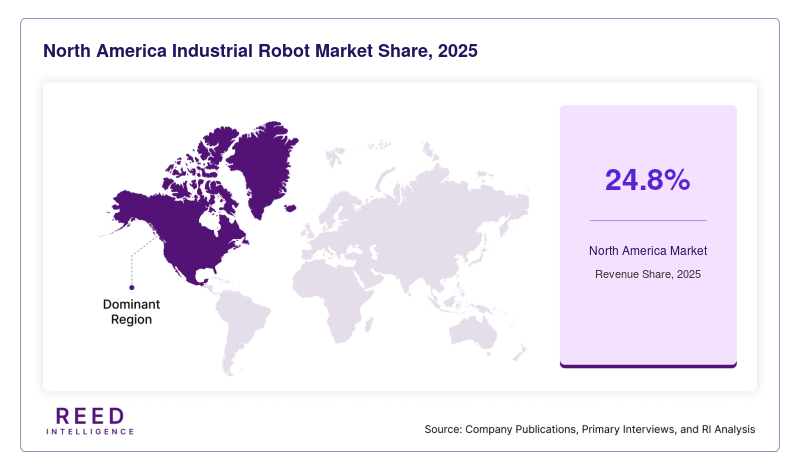
North America accounted for 24.8% of the global Industrial Robot Market share in 2025 and is projected to expand at a CAGR of 9.7% during the forecast period. The region continues to benefit from high adoption of industrial automation technologies across automotive, aerospace, and electronics manufacturing sectors. Companies are increasingly integrating AI-enabled robotic systems to improve operational productivity and reduce labor costs. Growing investments in advanced manufacturing facilities and smart factory infrastructure are further supporting regional market growth. Demand for robotic welding, inspection, and material-handling systems remains strong across the United States and Canada.
The United States dominates the North American market due to its advanced industrial infrastructure and strong investment in robotics innovation. The country is witnessing increasing deployment of collaborative robots and autonomous manufacturing systems across automotive assembly plants and logistics centers. One unique growth factor supporting the U.S. market is the rapid expansion of domestic semiconductor manufacturing facilities, which require highly precise robotic systems for wafer handling and assembly processes. Rising reshoring initiatives are also encouraging industrial automation investments across multiple manufacturing industries.
Europe
Europe represented 22.6% of the Industrial Robot Market in 2025 and is expected to grow at a CAGR of 9.3% through 2034. The region has a well-established industrial base supported by advanced automotive and machinery manufacturing industries. European manufacturers are increasingly adopting robotics solutions to address labor shortages and maintain competitive production efficiency. Demand for energy-efficient robotic systems and sustainable manufacturing practices is also contributing to market growth. Industrial robots are widely used in precision engineering, packaging, and pharmaceutical manufacturing applications across the region.
Germany remains the dominant country within the European market due to its strong automotive manufacturing ecosystem and leadership in industrial engineering technologies. The country continues to invest in Industry 4.0 initiatives and smart manufacturing facilities that rely heavily on robotic automation systems. One unique growth factor supporting the German market is the integration of robotics into sustainable production processes aimed at reducing industrial emissions and improving energy efficiency. This trend is accelerating the adoption of advanced robotic platforms across manufacturing facilities.
Asia Pacific
Asia Pacific held the largest share of the Industrial Robot Market at 39.4% in 2025 and is forecast to expand at a CAGR of 11.4% during the assessment period. The region benefits from rapid industrialization, large-scale manufacturing activity, and strong government support for automation technologies. Countries across Asia Pacific are investing heavily in smart manufacturing and factory modernization initiatives to improve industrial productivity. Demand for robotic systems is especially high in electronics, automotive, and semiconductor production industries. Increasing labor cost pressures are further encouraging automation adoption among regional manufacturers.
China dominates the Asia Pacific market due to its massive manufacturing sector and aggressive industrial automation investments. The country is rapidly deploying robotic systems across automotive, electronics, metal fabrication, and logistics industries. One unique growth factor supporting the Chinese market is the government-backed initiative promoting domestic robotics manufacturing and technological self-sufficiency. These policies are encouraging local companies to expand production capacity and accelerate robotic innovation, strengthening China's position as a global leader in industrial automation deployment.
Middle East & Africa
The Middle East & Africa region accounted for 6.3% of the global Industrial Robot Market share in 2025 and is expected to grow at a CAGR of 10.1% during the forecast period. The market is gradually expanding as governments and industrial organizations invest in manufacturing diversification and smart industrial infrastructure. Countries within the Gulf Cooperation Council are focusing on industrial automation to reduce dependency on oil-based economic activities. Industrial robots are increasingly used in packaging, petrochemical processing, and food manufacturing facilities across the region.
Saudi Arabia remains the dominant country in the regional market due to its expanding industrial development programs and manufacturing modernization initiatives. The country is investing in automated production technologies across energy, chemicals, and food processing industries to improve industrial productivity. One unique growth factor driving the Saudi Arabian market is the implementation of large-scale economic diversification strategies aimed at developing advanced manufacturing capabilities. These initiatives are encouraging greater adoption of industrial robotics and automated production systems across industrial sectors.
Latin America
Latin America represented 6.9% of the Industrial Robot Market in 2025 and is anticipated to register the fastest CAGR of 11.8% between 2026 and 2034. The region is experiencing increasing industrial automation adoption across automotive assembly, food processing, and consumer goods manufacturing industries. Companies are investing in robotic systems to improve production quality and reduce dependence on manual labor. Growing foreign direct investment in regional manufacturing operations is also supporting demand for industrial robotics solutions. Automation technologies are becoming increasingly accessible to mid-sized manufacturers across the region.
Brazil dominates the Latin American market due to its large automotive manufacturing base and expanding industrial production activities. The country is increasingly deploying robotic systems in automotive assembly lines, packaging facilities, and warehouse operations. One unique growth factor supporting the Brazilian market is the modernization of agricultural processing industries that require automated packaging and material-handling solutions. Investments in export-oriented manufacturing and logistics infrastructure are further contributing to the growing adoption of industrial robotics technologies throughout the country.
Competitive Landscape
The Industrial Robot Market is characterized by strong competition among global robotics manufacturers focusing on automation efficiency, AI integration, and collaborative robotics innovation. Leading companies are investing in advanced motion control technologies, machine vision systems, and cloud-connected robotic platforms to strengthen their market position. Strategic partnerships, acquisitions, and production expansion activities remain common competitive strategies across the industry.
ABB Ltd. continues to maintain a leading position in the market due to its extensive robotic product portfolio and strong presence across automotive and electronics manufacturing sectors. The company recently expanded its AI-enabled robotic automation solutions designed for flexible manufacturing operations and warehouse automation applications. Other major participants including FANUC Corporation, Yaskawa Electric Corporation, KUKA AG, and Mitsubishi Electric Corporation are also increasing investments in collaborative robotics and smart factory technologies.
Manufacturers are focusing on developing energy-efficient robotic systems with improved operational flexibility and predictive maintenance capabilities. Companies are also expanding regional manufacturing facilities and software integration services to support rising industrial automation demand worldwide. Increasing competition among global and regional robotic suppliers is expected to encourage technological innovation and product diversification throughout the forecast period.
Key Players
- ABB Ltd.
- FANUC Corporation
- Yaskawa Electric Corporation
- KUKA AG
- Mitsubishi Electric Corporation
- Kawasaki Heavy Industries Ltd.
- Denso Corporation
- Omron Corporation
- Nachi-Fujikoshi Corp.
- Epson Robots
- Universal Robots A/S
- Staubli International AG
- Comau S.p.A.
- Hyundai Robotics
- Toshiba Machine Co., Ltd.
Recent Developments
- In March 2026, ABB Ltd. launched an AI-enabled collaborative robotic platform designed for flexible electronics manufacturing and warehouse automation applications.
- In November 2025, FANUC Corporation expanded its industrial robot production facility in Japan to address increasing global demand from automotive and semiconductor manufacturers.
- In July 2025, KUKA AG introduced a new energy-efficient robotic welding system focused on electric vehicle battery assembly operations.
- In January 2026, Yaskawa Electric Corporation partnered with a software automation company to develop predictive maintenance solutions for industrial robotic systems.
- In September 2025, Mitsubishi Electric Corporation announced the expansion of its smart factory robotics portfolio targeting high-speed packaging and logistics automation applications.
Industrial Robot Market Segments
Robot Type
- Articulated Robots
- SCARA Robots
- Cartesian Robots
- Collaborative Robots
- Cylindrical Robots
Application
- Welding and Soldering
- Material Handling
- Assembly and Disassembly
- Painting and Coating
- Inspection and Testing
End-Use Industry
- Automotive
- Electronics and Semiconductor
- Food and Beverage
- Healthcare and Pharmaceuticals
- Metals and Machinery
- Logistics and Warehousing
By Region
- North America
- Europe
- APAC
- Middle East and Africa
- LATAM