Inertial Navigation System Market Size, Share Demand Report By Technology (MEMS-Based INS, Fiber Optic Gyroscope (FOG)-Based INS), By Component (Accelerometers, Gyroscopes), By Platform (Aircraft, Naval Vessels, Land Vehicles), By End User (Defense & Military, Commercial Aviation, Maritime Transportation, Industrial Automation, Commercial Autonomous Systems) By Region & Segment Forecasts, 2026–2034
USD 3950
Market Overview
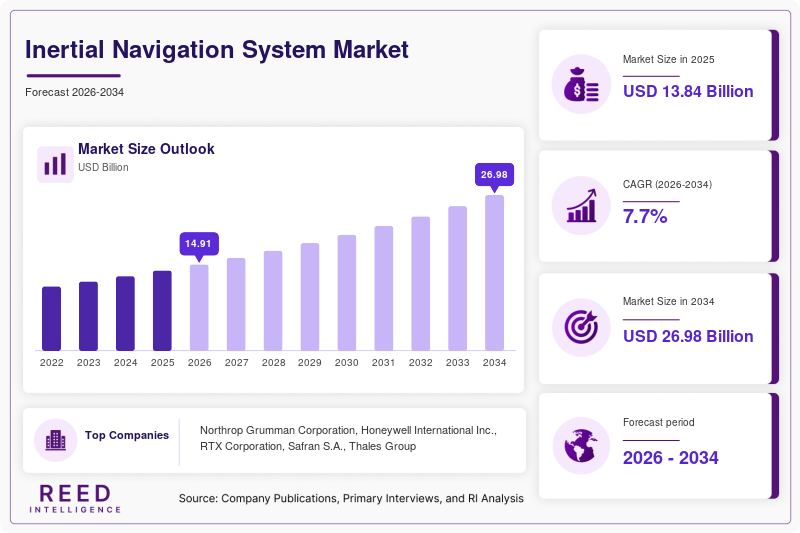
The Inertial Navigation System Market size was valued at USD 13.84 billion in 2026 and is projected to reach USD 24.97 billion by 2034, registering a CAGR of 7.7% during the forecast period (2026–2034). One major global factor supporting market growth has been the rising deployment of autonomous and intelligent navigation technologies across commercial and defense sectors. Organizations increasingly require highly reliable navigation solutions capable of operating in GPS-denied environments, supporting real-time positioning and enhancing operational safety. Growing investments in advanced aircraft, unmanned systems, smart transportation networks, and next-generation defense platforms have significantly accelerated the adoption of inertial navigation systems worldwide.
Technological advancements in microelectromechanical systems (MEMS), fiber optic gyroscopes, ring laser gyroscopes, and integrated navigation software have improved accuracy, reliability, and cost efficiency. Manufacturers continue developing compact, lightweight, and energy-efficient navigation systems suitable for modern aerospace, maritime, and industrial applications. Furthermore, increasing investments in digital transformation, automation, and intelligent mobility solutions are creating favorable conditions for long-term market expansion.
Key Highlights
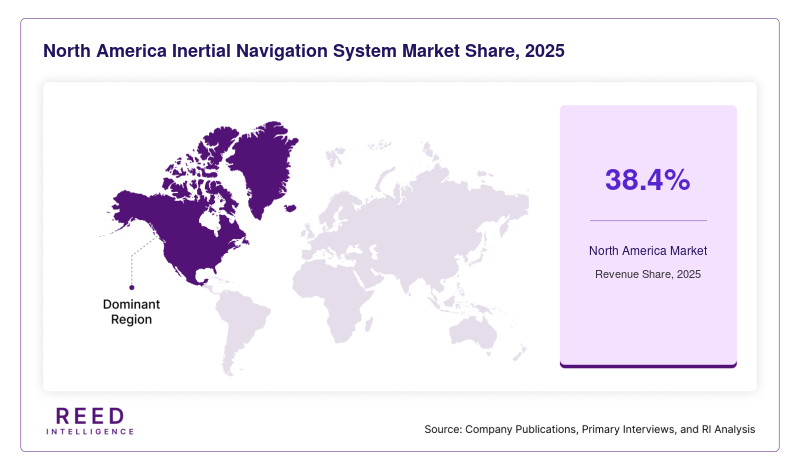
- North America accounted for the largest market share of 38.4% in 2025, while Asia Pacific is projected to register the fastest CAGR of 9.1% during 2026–2034.
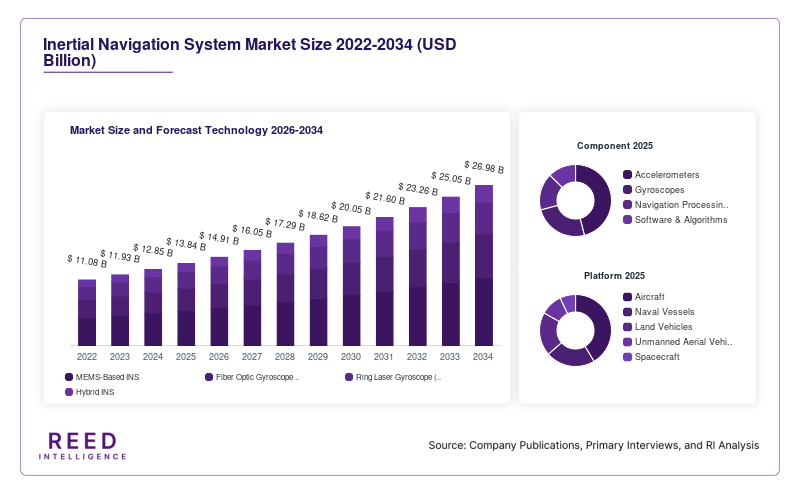
- By Technology, MEMS-Based INS held the dominant share of 44.8% in 2025, whereas Fiber Optic Gyroscope (FOG)-Based INS is expected to expand at a CAGR of 8.8% through 2034.
- By Component, Accelerometers represented 36.2% market share in 2025, while Navigation Processing Units are forecast to grow at a CAGR of 9.3%.
- By Platform, Aircraft captured 41.5% of the market in 2025, while Unmanned Aerial Vehicles (UAVs) are anticipated to record a CAGR of 10.4%.
- By End User, Defense & Military remained the leading segment with 47.6% share in 2025, whereas Commercial Autonomous Systems are forecast to grow at 10.1% CAGR.
- The United States remained the dominant country, with market values of USD 3.52 billion in 2024 and USD 3.81 billion in 2025.
Market Trends
Growing Integration of INS with Multi-Sensor Navigation Architectures
The Inertial Navigation System Market is witnessing increasing integration of INS technologies with satellite navigation systems, LiDAR sensors, radar systems, vision-based positioning platforms, and artificial intelligence algorithms. Multi-sensor fusion enables improved accuracy, redundancy, and reliability in dynamic operating environments. Industries are increasingly adopting integrated navigation solutions capable of delivering uninterrupted positioning data even under challenging conditions. This trend is supporting demand for advanced INS platforms across aerospace, defense, and autonomous mobility applications.
Miniaturization of Navigation Systems for Autonomous Platforms
Manufacturers are increasingly developing compact and lightweight inertial navigation solutions for drones, robotic systems, autonomous vehicles, and portable defense equipment. Advancements in MEMS technology have enabled significant reductions in system size while maintaining performance standards. The growing use of autonomous and remotely operated platforms is accelerating demand for miniaturized navigation technologies capable of supporting high-precision operations in space-constrained environments.
Market Drivers
Increasing Procurement of Advanced Defense Navigation Systems
Global defense modernization initiatives continue to generate strong demand for advanced inertial navigation technologies. Military organizations require highly accurate navigation systems for aircraft, missiles, naval vessels, armored vehicles, and tactical platforms operating in contested environments. INS technologies provide critical navigation capabilities independent of external communication infrastructure, making them indispensable for modern defense operations. Rising defense procurement programs continue to support market growth.
Expansion of Commercial Aviation and Air Mobility Programs
The increasing development of commercial aircraft fleets, urban air mobility concepts, and advanced air transportation systems is driving demand for precise navigation technologies. Airlines, aircraft manufacturers, and aviation service providers require reliable inertial navigation solutions to enhance operational efficiency and flight safety. Continued expansion of air transportation infrastructure and aircraft production activities is contributing to market growth.
Market Restraint
High Development and Integration Costs
The design, calibration, and integration of advanced inertial navigation systems require sophisticated engineering expertise and specialized manufacturing processes. High development costs and stringent performance requirements can increase overall system expenses, particularly for high-precision applications. These factors may limit adoption among cost-sensitive end users and emerging market participants.
Market Opportunities
Emergence of Autonomous Maritime Navigation Solutions
The growing development of autonomous ships, unmanned surface vessels, and intelligent marine navigation platforms presents significant opportunities for the Inertial Navigation System Market. Reliable positioning and motion-tracking capabilities are essential for autonomous maritime operations. Increasing investments in digital shipping technologies are expected to create new demand for advanced INS solutions.
Expansion of Space Exploration and Satellite Deployment Programs
The increasing number of satellite launches, commercial space missions, and deep-space exploration initiatives is creating substantial opportunities for navigation system providers. Spacecraft and satellite platforms require highly accurate inertial navigation technologies capable of operating in extreme conditions. Growing investments in space infrastructure are expected to support future market expansion.
Segmental Analysis
By Technology
The market is segmented into:
- MEMS-Based INS
- Fiber Optic Gyroscope (FOG)-Based INS
- Ring Laser Gyroscope (RLG)-Based INS
- Hybrid INS
MEMS-Based INS dominated the market with 44.8% share in 2025 due to its compact design, lower production costs, and broad applicability across commercial and industrial applications. Widespread deployment in drones, robotics, and transportation systems contributed to segment leadership.
Fiber Optic Gyroscope (FOG)-Based INS is projected to witness the fastest growth at a CAGR of 8.8% through 2034. Increasing requirements for enhanced accuracy and stability in demanding operational environments will support broader adoption across aerospace and defense applications.
By Component
The market includes:
- Accelerometers
- Gyroscopes
- Navigation Processing Units
- Software & Algorithms
Accelerometers accounted for 36.2% market share in 2025 owing to their essential role in motion sensing and position estimation across all inertial navigation systems. Continued deployment across multiple navigation platforms supported dominant segment positioning.
Navigation Processing Units are expected to record the fastest growth at a CAGR of 9.3% during the forecast period. Increasing computational requirements and advancements in sensor fusion technologies will accelerate demand for high-performance processing solutions.
By Platform
The market is categorized into:
- Aircraft
- Naval Vessels
- Land Vehicles
- Unmanned Aerial Vehicles (UAVs)
- Spacecraft
Aircraft represented 41.5% market share in 2025 due to extensive utilization of inertial navigation systems in commercial aviation, military aircraft, and business jets. Reliable navigation performance remains critical for aviation operations worldwide.
Unmanned Aerial Vehicles (UAVs) are forecast to register the highest CAGR of 10.4% through 2034. Growing deployment of drones across defense, agriculture, logistics, and infrastructure monitoring applications will continue driving demand for lightweight navigation systems.
By End User
The market is segmented into:
- Defense & Military
- Commercial Aviation
- Maritime Transportation
- Industrial Automation
- Commercial Autonomous Systems
Defense & Military held 47.6% market share in 2025 due to extensive adoption of advanced navigation technologies across military aircraft, missiles, naval vessels, and tactical vehicles. Continued modernization efforts supported strong segment demand.
Commercial Autonomous Systems are anticipated to expand at a CAGR of 10.1% during the assessment period. Increasing deployment of autonomous vehicles, robotic systems, and intelligent mobility platforms will contribute significantly to segment growth.
Regional Analysis
North America
North America held 38.4% of the Inertial Navigation System Market share in 2025 and is projected to expand at a CAGR of 7.2% during 2026–2034. The region benefits from extensive aerospace manufacturing capabilities, defense technology investments, and advanced research infrastructure. Strong demand for navigation technologies across military and commercial aviation sectors continues to support market development.
The United States remained the dominant country due to sustained investments in defense modernization programs and next-generation aerospace technologies. Ongoing procurement of advanced navigation systems for military and commercial applications continues to strengthen market demand.
Europe
Europe accounted for 26.7% market share in 2025 and is expected to grow at a CAGR of 7.0% through 2034. The region benefits from established aerospace industries, defense collaborations, and growing investments in autonomous mobility technologies. Demand remains strong across aviation, maritime, and industrial automation applications.
France emerged as the leading country owing to its extensive aerospace manufacturing ecosystem and continued investments in advanced navigation technologies. The country’s involvement in commercial aviation and defense programs supports market growth.
Asia Pacific
Asia Pacific represented 24.8% of the global Inertial Navigation System Market in 2025 and is forecast to register the fastest CAGR of 9.1% during the assessment period. Rising investments in defense capabilities, aerospace manufacturing, and autonomous transportation systems continue to create favorable market conditions. The region is also witnessing significant growth in drone deployments and industrial automation initiatives.
China dominated the regional market due to substantial investments in aerospace programs, defense technologies, and intelligent transportation infrastructure. Expanding domestic manufacturing capabilities continue to accelerate INS adoption.
Middle East & Africa
The Middle East & Africa captured 5.4% market share in 2025 and is projected to grow at a CAGR of 7.5% during 2026–2034. Regional demand is supported by defense modernization programs, aviation infrastructure expansion, and increasing adoption of advanced surveillance technologies. Investments in strategic transportation and security initiatives continue to contribute to market development.
Saudi Arabia maintained regional leadership owing to increasing defense procurement activities and ongoing investments in aviation and security infrastructure. The country’s modernization initiatives continue to generate demand for advanced navigation technologies.
Latin America
Latin America accounted for 4.7% share of the market in 2025 and is expected to expand at a CAGR of 7.3% through 2034. The region is witnessing increasing utilization of navigation technologies across aviation, maritime operations, and industrial applications. Infrastructure modernization efforts are contributing to growing technology adoption.
Brazil remained the dominant country due to its aerospace manufacturing sector and expanding investments in aviation infrastructure. Growing demand for advanced navigation and positioning systems continues to support regional market growth.
Competitive Landscape
The Inertial Navigation System Market remains competitive, with major companies focusing on technological innovation, product miniaturization, software integration, and strategic partnerships. Market participants continue investing in advanced sensor technologies and intelligent navigation platforms to strengthen competitive positioning.
Northrop Grumman Corporation remained a leading market participant due to its extensive portfolio of aerospace and defense navigation solutions. In 2025, the company introduced an enhanced next-generation inertial navigation platform featuring improved sensor fusion capabilities and increased operational resilience for advanced defense applications.
Other major industry participants continue expanding product portfolios and strengthening global market presence through research investments and technology collaborations. Companies are increasingly focusing on integrated navigation ecosystems capable of supporting evolving aerospace, defense, and autonomous mobility requirements.
Key Players List
- Northrop Grumman Corporation
- Honeywell International Inc.
- RTX Corporation
- Safran S.A.
- Thales Group
- Collins Aerospace
- General Dynamics Corporation
- KVH Industries, Inc.
- Teledyne Technologies Incorporated
- Analog Devices, Inc.
- Bosch Sensortec GmbH
- STMicroelectronics N.V.
- iXblue Group
- Exail Technologies
- LORD Corporation
Recent Developments
- In 2025, several navigation technology providers introduced advanced MEMS-based inertial navigation systems designed for autonomous mobility and drone applications.
- Multiple aerospace manufacturers expanded collaborations with navigation system developers to improve integrated flight guidance capabilities.
- New sensor fusion software platforms were launched to enhance positioning accuracy in GPS-denied environments.
- Defense contractors increased investments in resilient navigation technologies capable of supporting next-generation military operations.
- Industry participants accelerated research into compact navigation architectures suitable for space missions, autonomous vehicles, and intelligent robotic systems.
Inertial Navigation System Market Segments
Technology
- MEMS-Based INS
- Fiber Optic Gyroscope (FOG)-Based INS
- Ring Laser Gyroscope (RLG)-Based INS
- Hybrid INS
Component
- Accelerometers
- Gyroscopes
- Navigation Processing Units
- Software & Algorithms
Platform
- Aircraft
- Naval Vessels
- Land Vehicles
- Unmanned Aerial Vehicles (UAVs)
- Spacecraft
End User
- Defense & Military
- Commercial Aviation
- Maritime Transportation
- Industrial Automation
- Commercial Autonomous Systems
By Region
- North America
- Europe
- APAC
- Middle East and Africa
- LATAM