Infant Fever Sticker Market Size, Share & Demand Report By Type (Disposable Fever Stickers, Reusable Fever Stickers, Smart Fever Stickers), By Material (Polymer-based, Hydrogel-based, Fabric-based), By Application (Home Care, Pediatric Clinics, Hospitals), By End-Use (Households, Hospitals, Daycare Centers), By Distribution Channel (Online, Offline), By Region & Segment Forecasts, 2025–2034
USD 3950
Market Overview
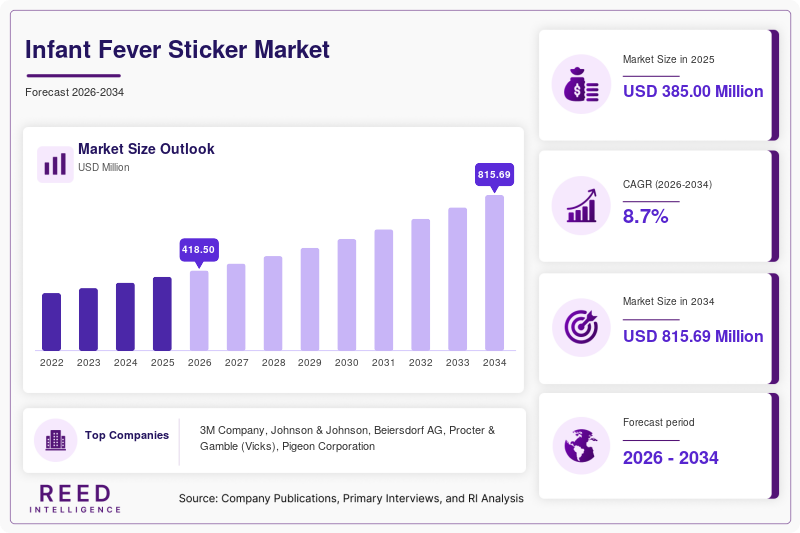
The global Infant Fever Sticker Market size was valued at USD 385 million in 2025 and is projected to reach USD 812 million by 2034, expanding at a CAGR of 8.7% from 2025 to 2034. The market has gained steady traction due to increasing parental focus on non-invasive, easy-to-use health monitoring solutions for infants. Fever stickers, which provide continuous temperature monitoring through color-changing technology, have emerged as a convenient alternative to traditional thermometers.
A major global factor supporting market growth is the rising awareness of infant healthcare and preventive monitoring practices. Parents are increasingly adopting smart and passive health tracking solutions, particularly in urban areas where access to healthcare information and products is expanding rapidly. Additionally, the growing penetration of e-commerce platforms has made infant fever stickers more accessible across both developed and emerging economies.
Key Highlights
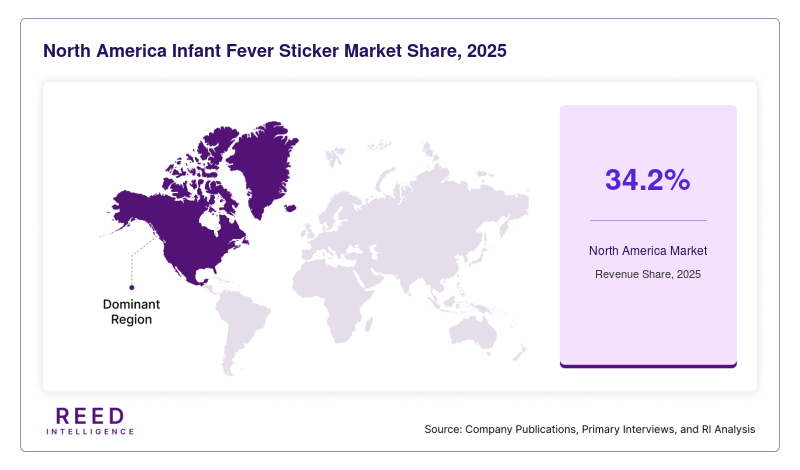
- North America dominated the Infant Fever Sticker Market with 34.2% share in 2025, while Asia Pacific is expected to register the fastest CAGR of 10.4% during the forecast period.
- The reusable fever sticker segment led the market with 58% share, while smart fever stickers are anticipated to grow at the fastest CAGR of 11.2%.
- Among applications, home care accounted for the largest share at 64%, while pediatric clinics are projected to grow at a CAGR of 9.5%.
- The U.S. remained the dominant country with a market value of USD 112 million in 2025, expected to reach USD 121 million in 2026.
Market Trends
Rising Adoption of Smart Temperature Monitoring Solutions
The Infant Fever Sticker Market is witnessing a shift toward smart and connected solutions. Manufacturers are introducing advanced fever stickers integrated with Bluetooth-enabled sensors that sync with mobile applications. These products allow real-time temperature tracking, alerts, and historical data analysis. The integration of digital health ecosystems has enhanced product utility, making them more appealing to tech-savvy parents. This trend is particularly strong in developed markets, where digital health adoption is high.
Increasing Demand for Skin-Friendly and Hypoallergenic Materials
Consumers are increasingly prioritizing product safety, especially for infant skincare. As a result, there is growing demand for fever stickers made from hypoallergenic, breathable, and non-toxic materials. Manufacturers are investing in dermatologically tested adhesives and eco-friendly substrates to meet regulatory standards and consumer expectations. This trend is contributing to product differentiation and brand loyalty, particularly in premium product segments.
Market Drivers
Growing Awareness of Infant Health Monitoring
The rising awareness among parents regarding early detection of fever and illness in infants is a key driver of the Infant Fever Sticker Market. Fever is often the first symptom of infections, and continuous monitoring helps in timely medical intervention. Fever stickers offer a non-invasive and stress-free solution compared to traditional thermometers, making them highly preferred for infants.
Expansion of E-commerce and Retail Accessibility
The rapid expansion of online retail platforms has significantly boosted product visibility and availability. Parents can easily compare products, read reviews, and access a wide range of options. Additionally, pharmacies and baby care stores are increasingly stocking fever stickers, further enhancing distribution networks. This improved accessibility is driving market penetration across urban and semi-urban regions.
Market Restraint
Limited Accuracy Compared to Digital Thermometers
One of the primary challenges facing the Infant Fever Sticker Market is the perception of limited accuracy compared to digital thermometers. While fever stickers provide continuous monitoring, they may not offer precise temperature readings required for medical diagnosis. This limitation can reduce consumer confidence, especially among healthcare professionals who rely on accurate measurements for treatment decisions. Additionally, variations in skin temperature due to environmental factors can affect performance. As a result, some parents use fever stickers only as a preliminary screening tool rather than a primary monitoring device. This restraint may slow adoption in clinical settings and among cautious consumers.
Market Opportunities
Growth in Emerging Markets
Emerging economies present significant growth opportunities for the Infant Fever Sticker Market. Rising disposable incomes, increasing urbanization, and improving healthcare awareness are driving demand for infant care products. Governments and healthcare organizations are also promoting child health monitoring, which indirectly supports market growth. Local manufacturers can capitalize on cost-effective production to cater to price-sensitive consumers.
Product Innovation and Customization
Innovation in design, functionality, and user experience offers strong growth potential. Companies are developing fever stickers with longer monitoring durations, improved adhesive properties, and child-friendly designs. Customization options such as cartoon-themed stickers and multi-functional patches are attracting consumers. Additionally, integration with wearable health devices could open new avenues for growth in the digital health segment.
Segmental Analysis
By Type
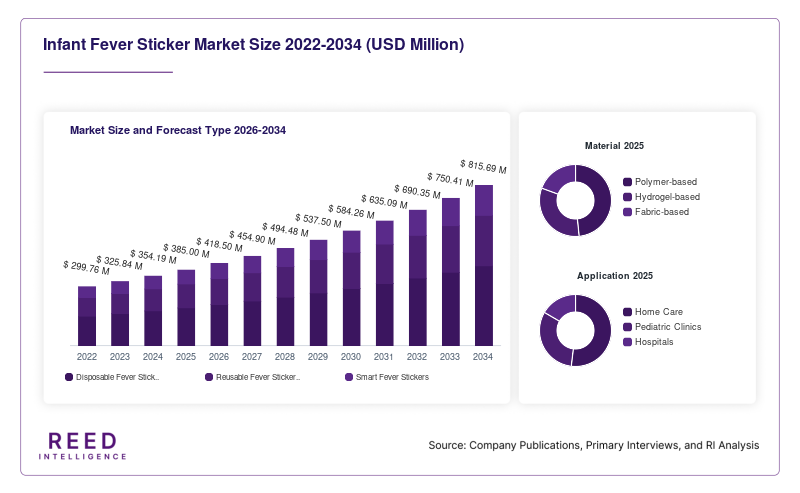
Reusable fever stickers dominated the Infant Fever Sticker Market with a 58% share in 2025. These products gained popularity due to their cost-effectiveness and longer usability. Parents preferred reusable options as they provided extended monitoring without frequent replacement.
Smart fever stickers are expected to grow at the fastest CAGR of 11.2%. Their growth will be driven by integration with mobile applications and real-time monitoring capabilities. The ability to track temperature trends and receive alerts enhances their value proposition.
By Material
Polymer-based materials held the largest share at 61% in 2025. These materials offered durability, flexibility, and better adhesion, making them suitable for infant use.
Hydrogel-based materials are projected to grow at a CAGR of 9.8%. Their growth will be driven by superior comfort and skin compatibility. These materials provide better breathability and reduce irritation, making them ideal for sensitive skin.
By Application
Home care accounted for 64% of the market share in 2025. Parents preferred using fever stickers at home for continuous monitoring without disturbing the infant. Convenience and ease of use were key factors driving this segment.
Pediatric clinics are expected to grow at a CAGR of 9.5%. Increasing adoption of non-invasive monitoring tools in clinical settings will support growth. Healthcare professionals are using fever stickers for preliminary screening.
By End-Use
Households dominated the market with a 67% share in 2025. The increasing focus on preventive healthcare and self-monitoring drove demand in this segment.
Hospitals are anticipated to grow at a CAGR of 8.9%. The adoption of supportive monitoring tools in neonatal care units will drive growth. Hospitals are increasingly using fever stickers for continuous observation.
By Distribution Channel
Offline retail held the largest share at 55% in 2025. Pharmacies and baby care stores played a crucial role in product availability and consumer trust.
Online channels are projected to grow at a CAGR of 10.7%. The convenience of home delivery and access to a wide range of products will drive growth. Digital marketing strategies and customer reviews will further boost adoption.
Regional Analysis
North America
North America accounted for 34.2% of the Infant Fever Sticker Market share in 2025 and is expected to grow at a CAGR of 7.9% during the forecast period. The region’s growth was supported by high awareness of infant healthcare products and strong purchasing power. The presence of established healthcare infrastructure and widespread adoption of innovative baby care solutions contributed to market expansion.
The United States dominated the regional market due to increasing demand for non-invasive monitoring tools. A key growth factor was the rising preference for convenience-driven healthcare products among working parents. The availability of technologically advanced fever stickers and strong distribution channels further supported market growth.
Europe
Europe held 26.5% share of the Infant Fever Sticker Market in 2025 and is projected to grow at a CAGR of 7.5%. The region benefited from stringent safety regulations and high consumer awareness regarding infant care. Demand for certified, skin-safe products drove market expansion.
Germany emerged as the dominant country due to its strong healthcare system and emphasis on product quality. The increasing adoption of eco-friendly and dermatologically tested products contributed to growth. Parents in the region showed a preference for reusable and sustainable fever monitoring solutions.
Asia Pacific
Asia Pacific accounted for 22.8% of the Infant Fever Sticker Market in 2025 and is expected to grow at the fastest CAGR of 10.4%. Rapid urbanization, rising birth rates, and increasing healthcare awareness were key growth factors. The expansion of e-commerce platforms significantly boosted product accessibility.
China led the regional market due to its large population and growing middle class. A major growth factor was the increasing demand for affordable and innovative infant care products. Local manufacturers played a crucial role in offering cost-effective solutions, driving market penetration.
Middle East & Africa
The Middle East & Africa held 8.1% share in 2025 and is projected to grow at a CAGR of 8.3%. The market was driven by improving healthcare infrastructure and rising awareness of child health monitoring. Increasing investments in healthcare systems supported market development.
The United Arab Emirates dominated the region due to higher healthcare spending and adoption of advanced products. The growing expatriate population and demand for premium baby care products contributed to market growth.
Latin America
Latin America accounted for 8.4% share in 2025 and is expected to grow at a CAGR of 8.0%. The region experienced steady growth due to improving economic conditions and increasing focus on infant healthcare.
Brazil emerged as the leading country due to its large population and expanding retail sector. The availability of affordable products and increasing awareness among parents supported market expansion.
Competitive Landscape
The Infant Fever Sticker Market is moderately fragmented, with several regional and global players competing on product innovation and pricing. Leading companies focus on developing safe, effective, and user-friendly products to gain a competitive edge.
The market leader, 3M Company, has maintained its position through continuous product innovation and strong distribution networks. The company recently introduced advanced adhesive technologies to improve skin compatibility and product performance.
Other key players are focusing on expanding their product portfolios and entering emerging markets. Strategic collaborations, product launches, and investments in research and development are common strategies adopted by market participants.
Key Players
- 3M Company
- Vicks (Procter & Gamble)
- Beiersdorf AG
- Johnson & Johnson
- Pigeon Corporation
- Unicharm Corporation
- Chicco (Artsana Group)
- Dr. Trust
- Mee Mee (Me N Moms)
- Mothercare plc
- Omron Healthcare
- Philips Healthcare
- Summer Infant Inc.
- Babyhug (FirstCry)
- Braun GmbH
Recent Developments
- 2024: A leading manufacturer launched a smart fever sticker with app connectivity for real-time monitoring.
- 2023: A major company introduced eco-friendly fever stickers made from biodegradable materials.
- 2023: Expansion of online distribution channels improved product accessibility in emerging markets.
- 2022: New product variants with extended monitoring duration were introduced.
- 2022: Strategic partnerships between healthcare brands and e-commerce platforms increased market reach.
Infant Fever Sticker Market Segments
Type
- Disposable Fever Stickers
- Reusable Fever Stickers
- Smart Fever Stickers
Material
- Polymer-based
- Hydrogel-based
- Fabric-based
Application
- Home Care
- Pediatric Clinics
- Hospitals
End-Use
- Households
- Hospitals
- Daycare Centers
Distribution Channel
- Online Retail
- Pharmacies & Drug Stores
- Supermarkets & Baby Care Stores
By Region
- North America
- Europe
- APAC
- Middle East and Africa
- LATAM