Inflatable Decoy Market Size, Share & Trends Analysis Report By Type (Tanks, Vehicles, Aircraft), By Material (PVC, Rubber, Fabric, Others), By Application (Drills & Training, Military Action) and By Region (North America, Europe, APAC, Middle East and Africa, LATAM) Forecasts, 2026–2034
USD 3950
Inflatable Decoy Market Size
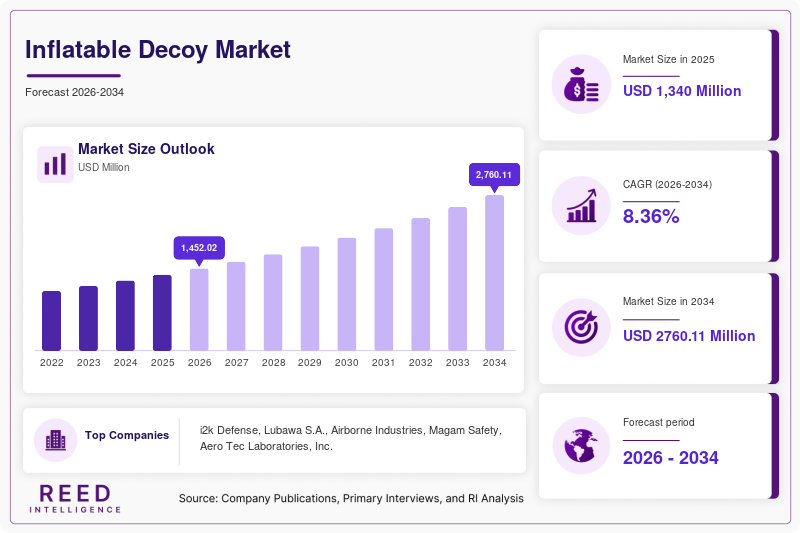
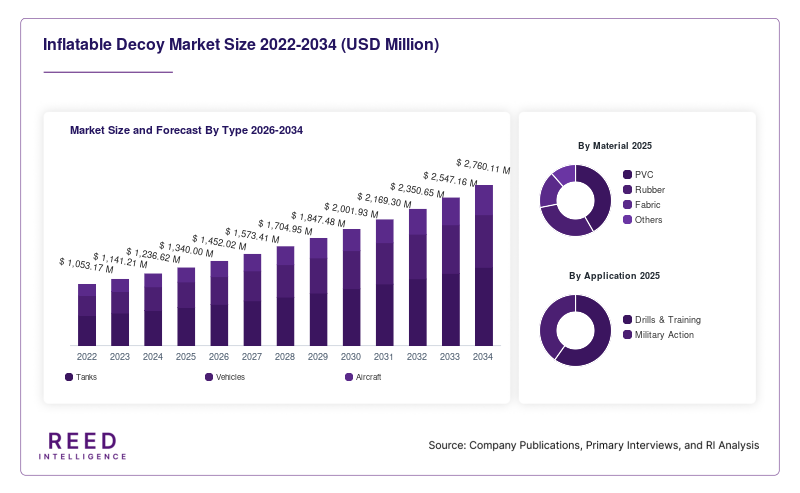
The global Inflatable decoy market is valued at USD 1,340 Million in 2025 and USD 1,452.02 Million in 2026. The market is projected to reach USD 2,760.11 Million by 2034, registering an 8.36% CAGR during the forecast period.
The Inflatable decoy market comprises lightweight, transportable replicas used to imitate military equipment or other target objects for training, signature management and deception-related applications. Modern inflatable decoys range from vehicle and tank replicas to aircraft and radar-system mockups and increasingly incorporate visual, infrared and radar-relevant characteristics to create more realistic representations for sensing and training environments.
The core commercial advantage of inflatable construction is the combination of low weight, compact storage, relatively fast deployment and lower handling burden compared with full-scale rigid mockups. India's Defence Research and Development Organisation (DRDO) describes conventional metallic aircraft decoys as bulky and labor-intensive to transport and deploy, while its Air Retainable type Inflatable Aircraft Decoy technology uses coated fabrics, modular construction and automated pressure management to reduce handling requirements.
Inflatable Decoy Market Drivers
Expanding military training and simulation requirements are creating demand for lower-cost, rapidly deployable target representations
Military organizations require training environments that can represent a variety of equipment without necessarily using operational assets for every scenario. Inflatable decoys provide a portable option for creating full-scale visual and sensing-reference objects.
The U.S. Air Force's 2026 Misawa requirement explicitly sought inflatable training decoys that were true to the requested system size and suitable for radar- and infrared-relevant simulation. The U.S. Marine Corps likewise specified full-scale inflatable decoy systems for training requirements in June 2026.
DRDO also explicitly identifies inflatable decoys as useful for training and wartime deception while emphasizing the handling advantages over metallic alternatives.
Because training inventories can require multiple representations of different asset classes, the portable nature of inflatables can lower storage and transportation requirements and increase flexibility in exercise environments.
Higher sensor density is increasing demand for more realistic multispectral decoys
Modern surveillance systems increasingly rely on multiple sensing modalities. The U.S. Army's July-August 2026 Military Review discusses the increasing role of radar, thermal and other technical signatures in modern reconnaissance and notes that decoys increasingly need technical characteristics beyond visual appearance to remain credible against complex sensing systems.
Suppliers are responding by integrating technical features into inflatable structures. Lubawa describes visible, thermal and radiolocation simulation, while i2k Defense describes visual replicas augmented with thermal and radar-relevant features.
This trend raises the value of engineering content within each decoy and shifts competition toward materials, thermal management, radar-signature enhancement, structural design and realistic external detailing.
Rising defense expenditure in Europe and Asia is broadening procurement opportunities
The market's largest demand base is defense-related, making procurement closely linked to military budgets.
SIPRI reported that global military expenditure increased to USD 2.887 Trillion in 2025. European military spending increased 14%, while spending in Asia and Oceania rose 8.1%. SIPRI said the global increase was driven by continued wars, uncertainty and large-scale armament programs.
The Council of the EU expects member-state defense spending to reach approximately EUR 454 Billion in 2026, while the Asia-Pacific region is also seeing continued defense-budget expansion.
Inflatable decoys compete within this larger procurement environment as relatively transportable and reusable training or simulation assets. Their comparatively modest logistical burden can make them relevant to organizations seeking more training capacity from constrained infrastructure.
Inflatable Decoy Market Restraints
Advanced sensor environments can reduce the realism advantage of purely visual inflatable decoys
A decoy's effectiveness depends on the sensing environment against which it is being evaluated. A visually convincing object may not provide sufficient information when surveillance systems use thermal, radar or other signatures.
The U.S. Army's 2026 Military Review explicitly notes that increasing sensor sophistication is raising the fidelity requirements for decoys.
This increases product-development costs because manufacturers may need to add multispectral features, technical components, specialized materials and signature-management systems.
Weather resistance, repeated deployment and maintenance requirements raise lifecycle complexity
Inflatable decoys must operate outdoors and can be exposed to wind, precipitation, ultraviolet radiation, temperature variation and handling stress.
Lubawa specifies resistance to UV exposure, rain, snow, temperature variation, marine weather and winds up to 105 km/h for one of its inflatable mockups. i2k Defense similarly specifies weather-resistant materials and anchoring or structural systems for its military decoys.
Damage repair, inflation equipment, storage, inspections and replacement of worn components can therefore add to total ownership cost. For organizations operating large inventories, durability and repairability become important purchasing criteria.
Inflatable Decoy Market Opportunities
Air-retainable and low-maintenance architectures can improve deployment economics
Continuous-air systems require an active air supply, whereas air-retainable designs can maintain shape for defined periods without continuous blower operation.
DRDO's InfADec specifically addresses this issue through low-permeability coated fabric, automated pressure control and an air-retainable structure. The organization reports that the decoy can retain its shape for up to eight hours without air top-up under the stated conditions.
i2k Defense also describes both constant-air and sealed-air models and notes that sealed-air configurations can maintain inflation without continuous electrical power after initial inflation.
This creates an opportunity for suppliers to differentiate through longer unattended operation, lower power requirements, lighter field equipment and simpler logistics.
Indigenous manufacturing and technology-transfer programs can expand supplier participation in emerging defense markets
Technology-transfer initiatives can lower entry barriers for domestic manufacturers while supporting local maintenance and customization.
DRDO published InfADec as a Category A technology for transfer to industry partners in May 2025 and listed three licenses as available. The technology is based on coated fabrics, modular construction and automated air-pressure control.
This provides an example of how domestic defense-industrial ecosystems can move from procurement of finished decoys toward local design, production and support.
High-fidelity training inventories can create recurring replacement and refurbishment demand
Airborne Industries states that some of its military targets have remained in heavy use for more than 15 years, supported by spare and refurbishment kits.
This demonstrates that inflatable decoy demand is not necessarily limited to initial procurement. Long-lived inventories can generate recurring requirements for repair kits, replacement components, refurbishment, updated external detailing and new decoy configurations.
Type Analysis
Vehicles hold the dominant type share because ground-equipment replicas address both training and broad equipment-simulation requirements
The Vehicles segment accounts for 43% of the global market in 2026 and is projected to register a 8.10% CAGR.
Vehicle decoys include armored vehicles, tactical trucks, missile-system carriers, radar vehicles and other ground assets. i2k Defense maintains a broad portfolio of vehicle and air-defense-system inflatables, while Lubawa offers pneumatic replicas of the KTO Rosomak, BWP-1 and T-72.
The broad range of represented ground systems supports demand across land-force training and broader signature-management programs.
Aircraft are the fastest-growing major type as high-value air assets increasingly require portable full-scale simulation
The Aircraft segment accounts for 27% of the global market in 2026 and is projected to register a 9.80% CAGR, making it the fastest-growing major type.
Aircraft decoys benefit from the large difference in logistical burden between conventional full-scale mockups and inflatable systems. DRDO developed InfADec specifically to address the handling, transportation and deployment challenges of metallic aircraft decoys.
i2k Defense supplies multiple inflatable aircraft configurations, including fighter-aircraft replicas, and describes custom visual, thermal and structural options.
Material Analysis
PVC remains the dominant material because coated PVC-based structures provide a practical balance of strength, weather resistance, manufacturability and cost
The PVC segment accounts for 55% of the global market in 2026 and is projected to register a 8.00% CAGR.
i2k Defense uses commercial-specification PVC or PVC-coated nylon in several military decoy designs and highlights lightweight construction, weather resistance and portability. The U.S. Air Force's 2026 Misawa solicitation similarly specified PVC-coated nylon and UV-resistant construction for the requested training decoys.
PVC-based structures are therefore well suited to the market's requirement for large-area skins that can be printed, reinforced, folded and repeatedly deployed.
Fabric is the fastest-growing major material because air-retainable and lightweight architectures are increasing demand for engineered textile structures
The Fabric segment accounts for 23% of the global market in 2026 and is projected to register a 9.20% CAGR, making it the fastest-growing material category.
DRDO's InfADec uses specially designed coated fabrics with low air permeability and modular construction. Lubawa uses rubberized textile in its BWP-1 decoy, while Airborne Industries emphasizes proven and approved materials for durable military targets.
Rubber continues to support flexible and repairable decoy structures
The Rubber segment is projected to register a 7.60% CAGR.
Rubberized constructions remain useful where high flexibility, puncture resistance and repairability are important. Magam Safety states that its broader inflatable portfolio uses engineered rubber constructions for durability and simple field repair, while its decoy portfolio emphasizes robust construction and repeated use.
Application Analysis
Military Action remains the dominant application as defense organizations expand signature-management and operational simulation requirements
The Military Action segment accounts for 64% of the global market in 2026 and is projected to register a 8.60% CAGR.
Inflatable decoys are used to represent military assets in broader defense deception and signature-management programs. Lubawa describes its decoys as systems for battlefield simulation and the representation of actual equipment, while Magam Safety positions its products for combat-deception and military-training contexts.
The application benefits directly from defense investment cycles. SIPRI reported significant increases in European and Asian military spending in 2025, while the Council of the EU expects further growth in defense expenditure during 2026.
Drills & Training is the fastest-growing major application as armed forces seek portable and reusable simulation assets
The Drills & Training segment accounts for 36% of the global market in 2026 and is projected to register a 8.80% CAGR, making it the fastest-growing application.
Training demand is directly visible in recent government procurement. The U.S. Office of Naval Research purchased high-fidelity inflatable vehicle decoys for training and image collection in March 2026, while the U.S. Marine Corps and U.S. Air Force both issued or awarded 2026 requirements for inflatable training decoys .the rapid growth reflects the ability to transport and redeploy training assets without the infrastructure associated with rigid full-scale replicas.
Inflatable Decoy Market Regional Analysis
North America Inflatable Decoy Market
North America remains the dominant regional market because of its large defense budget, advanced training infrastructure, mature defense-industrial base and demonstrated government procurement of inflatable decoy systems.
The North America region accounts for 39% of the global market in 2026 and is projected to register a 8.10% CAGR.
The United States generated several concrete 2026 demand signals. The Office of Naval Research awarded I2K Defense a purchase order for seven high-fidelity inflatable decoys in March, the U.S. Marine Corps awarded Inflatable 2000 a July contract, and the Air Force procured inflatable systems for Misawa Air Base.
The region also supports suppliers with domestic manufacturing capability. i2k Defense operates a more than 30,000-square-foot manufacturing facility in Los Angeles County and states that it designs and manufactures its inflatable military products in the United States.
Europe Inflatable Decoy Market
Europe is the fastest-growing regional market as defense spending rises, readiness requirements expand and European defense-industrial supply chains seek greater domestic capacity.
The Europe region accounts for 24% of the global market in 2026 and is projected to register a 9.10% CAGR, making it the fastest-growing regional market.
SIPRI reported a 14% increase in European military expenditure in 2025, while EU member states are expected to spend an estimated EUR 454 Billion on defense in 2026.
European suppliers include Airborne Industries in the UK and Lubawa in Poland. Both companies maintain established inflatable-decoy portfolios for military applications, indicating regional manufacturing expertise in this specialized category.
The regional opportunity is also supported by continuing modernization of training and simulation capabilities across European armed forces.
APAC Inflatable Decoy Market
APAC is projected to register a 8.90% CAGR, supported by high defense spending in China, India, Japan, South Korea and Australia together with growing interest in indigenous defense technologies.
SIPRI reported that Asia and Oceania's military spending reached USD 681 Billion in 2025, 8.1% higher than in 2024. China remained the world's second-largest military spender, while Japan's military expenditure reached its highest share of GDP since 1958 under SIPRI's methodology.
India provides a particularly visible technology-development example. DRDO published its air-retainable inflatable aircraft-decoy technology for transfer to industry partners in May 2025, creating opportunities for domestic commercialization.
India also showed active procurement demand in September 2026, when a Ministry of Defence requirement for an inflatable T-72 decoy was reported through the Government e-Marketplace system. A separate September 2026 Indian Army procurement involved an inflatable ICV BMP-2 decoy, with HEMKUNT Enterprises reported as the winning bidder.
Middle East and Africa Inflatable Decoy Market
The Middle East and Africa market is projected to register a 8.20% CAGR, supported by defense spending, military training activity and demand for mobile, weather-resistant simulation assets.
Magam Safety, based in Israel, supplies inflatable military decoys and positions them for military customers globally. Airborne Industries also states that its targets have been used in Middle Eastern training operations.
Demand is particularly relevant to armed forces operating across large training areas where transportability and storage efficiency can be important procurement considerations.
LATAM Inflatable Decoy Market
LATAM is projected to register a 8.00% CAGR, supported by military modernization, training requirements and the need for portable simulation assets.
The region remains smaller than North America, Europe and APAC but can provide opportunities for suppliers offering modular, exportable systems that reduce transportation and storage burdens relative to rigid replicas.
Inflatable Decoy Market Competitive Landscape
The Inflatable decoy market is characterized by a relatively specialized supplier base comprising defense-focused inflatable manufacturers, technical-textile companies and firms with experience in military targets and signature-management products.
i2k Defense is one of the most visible U.S. suppliers, offering aircraft, tank, vehicle, missile-system and radar-system inflatables. The company states that it has more than 25 years of experience in military inflatables, operates a more than 30,000-square-foot manufacturing facility and provides custom full-scale replicas.
Lubawa S.A. competes through a broader signature-management portfolio that includes pneumatic decoys for the KTO Rosomak, BWP-1 and T-72. Its systems can incorporate visible, thermal and radiolocation simulation and use technical textiles engineered for outdoor durability.
Key Market Players
- i2k Defense
- Lubawa S.A.
- Airborne Industries
- Magam Safety
- Aero Tec Laboratories, Inc.
- AIRTECH Systems
- JSC SPE RUSBALT
- Hangzhou Gauss Inflatable Tech Co., Ltd.
- China Greenhill Gap Toy Factory
- Shape Inflatable Manufacturing Co., Ltd.
- Inflatable Military Decoy
- Inflatable 2000, Inc.
- HEMKUNT Enterprises
- Regional Military Simulation and Decoy Manufacturers
Recent Developments
September 2026 – India issued a procurement requirement for an inflatable T-72 decoy tank. The Ministry of Defence/Indian Army requirement called for one inflatable T-72 decoy, demonstrating continuing demand for full-scale vehicle replicas within India's defense-training and simulation ecosystem.
September 2026 – An inflatable ICV BMP-2 decoy procurement in India reached bid-result stage. The reported GeM result identified a winning bidder for an inflatable BMP-2/ICV decoy following a September 2026 procurement process, providing another current signal of Indian military demand for inflatable ground-equipment representations.
Inflatable Decoy Market Segments
By Type
- Tanks
- Vehicles
- Aircraft
By Material
- PVC
- Rubber
- Fabric
- Others
By Application
- Drills & Training
- Military Action
By Region
- North America
- Europe
- APAC
- Middle East and Africa
- LATAM