Inkjet Printhead Market Size, Share & Demand Report By Technology (Piezoelectric Inkjet Printheads, Thermal Inkjet Printheads, Continuous Inkjet Printheads), By Application (Packaging Printing, Textile Printing, Commercial Printing, Coding and Marking), By End-Use Industry (Commercial Printing, Industrial Manufacturing, Textile Industry, Packaging Industry), By Region & Segment Forecasts, 2026–2034
USD 3950
Market Overview
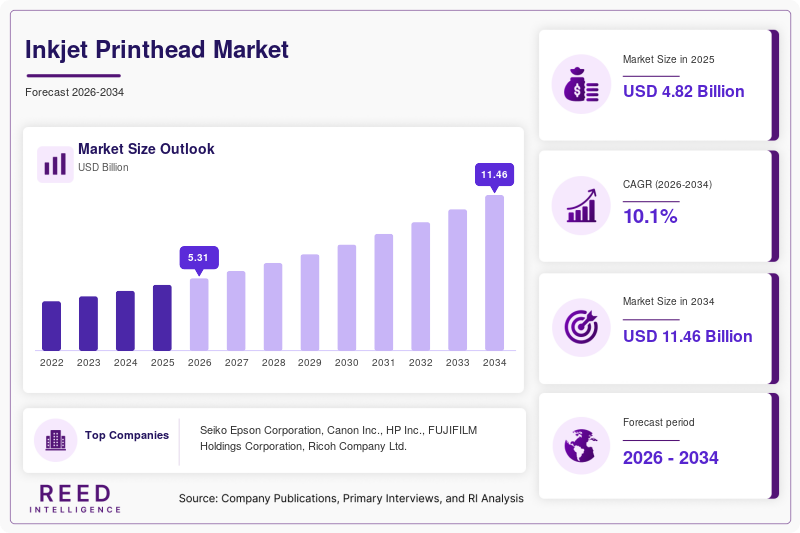
The global Inkjet Printhead Market size was valued at USD 4.82 billion in 2026 and is projected to reach USD 10.41 billion by 2034, expanding at a CAGR of 10.1% during the forecast period from 2026 to 2034. The market is witnessing stable expansion due to the increasing adoption of digital printing technologies across packaging, textile, industrial coding, and commercial printing applications. Inkjet printheads have become an important component in high-speed printing systems because they support precise droplet placement, reduced ink waste, and flexible printing on multiple substrates. Manufacturers are also focusing on high-resolution printing capabilities to address changing customer requirements in label production, textile decoration, and personalized packaging.
A major factor supporting global market growth is the rapid shift toward on-demand and short-run printing operations. Businesses across packaging and industrial manufacturing are increasingly adopting inkjet printing systems to reduce inventory costs and improve production flexibility. The growth of e-commerce has further increased demand for customized labels, corrugated packaging prints, and variable data printing, which continues to strengthen the adoption of advanced printhead technologies. In addition, advancements in piezoelectric and thermal inkjet systems are improving printing speed, operational efficiency, and maintenance performance across commercial and industrial environments.
Key Highlights
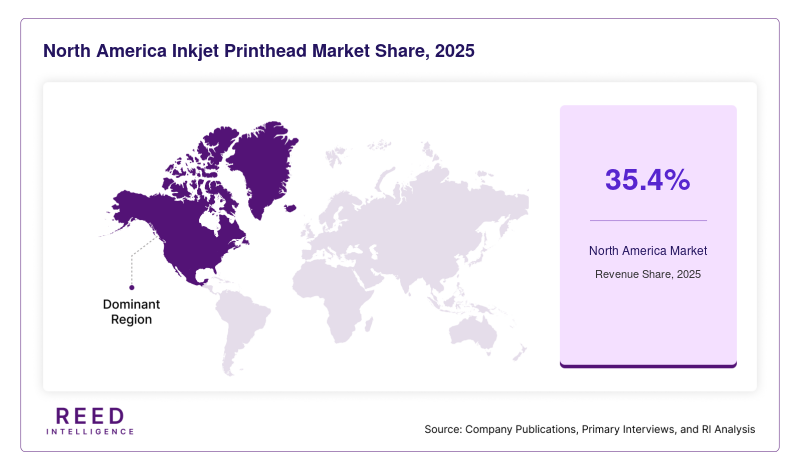
- North America dominated the market with a 35.4% share in 2025, while Asia Pacific is expected to grow at the fastest CAGR of 11.8% during 2026–2034.
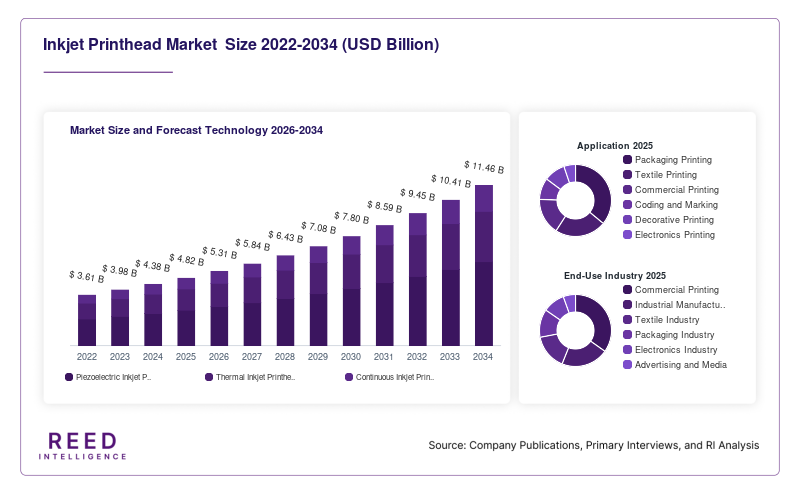
- By technology, piezoelectric inkjet printheads accounted for the largest share of 56.8%, while thermal inkjet printheads are projected to grow at a CAGR of 11.5%.
- By application, packaging printing led with a 39.6% share, whereas textile printing is expected to expand at a CAGR of 12.2%.
- By end-use industry, commercial printing accounted for the highest share of 33.7%, while industrial manufacturing is projected to grow at a CAGR of 11.9%.
- The United States remained the dominant country, with market values of USD 1.12 billion in 2024 and USD 1.24 billion in 2025.
Market Trends
Rising Integration of Industrial Inkjet Systems in Packaging Operations
The increasing use of industrial inkjet systems in flexible packaging, labeling, and corrugated box printing is emerging as a major trend in the Inkjet Printhead Market. Packaging companies are shifting toward digital production methods to improve customization capabilities and reduce turnaround times. Inkjet printheads support high-speed production with consistent image quality, making them suitable for variable data printing and short production cycles. The food and beverage industry, pharmaceutical sector, and consumer goods manufacturers are increasingly using digital packaging technologies to improve branding and product traceability. Advanced printheads with higher nozzle density and improved durability are also enabling better printing accuracy on non-porous materials, including plastics and coated surfaces.
The adoption of water-based and UV-curable inks is further supporting this trend, as manufacturers focus on reducing environmental impact while maintaining high-quality printing output. Packaging converters are investing in automated digital printing systems that include advanced printhead assemblies capable of supporting continuous industrial operations. Demand for personalized packaging campaigns and seasonal promotional labeling is also contributing to the wider deployment of digital inkjet technologies across global packaging facilities.
Expansion of Textile Digital Printing Applications
Digital textile printing is becoming an important trend driving innovation in the Inkjet Printhead Market. Apparel manufacturers and textile producers are increasingly replacing traditional screen-printing methods with digital systems to reduce production waste and improve design flexibility. Inkjet printheads provide detailed color accuracy and support rapid design modifications, making them suitable for customized textile production and small-batch manufacturing. Fashion brands are adopting digital textile printing to respond quickly to changing consumer preferences and reduce inventory risks associated with mass production.
The trend is particularly visible across Asia Pacific and Europe, where textile manufacturers are modernizing printing infrastructure to improve operational efficiency. The increasing popularity of home décor fabrics, printed sportswear, and customized fashion products is creating additional demand for advanced printhead technologies. Manufacturers are also developing printheads compatible with pigment-based and sublimation inks to support printing on different fabric materials. Continuous improvements in print resolution and print speed are expected to strengthen the adoption of digital textile printing systems over the coming years.
Market Drivers
Growing Demand for High-Speed Commercial Printing Solutions
The growing requirement for high-speed and high-volume printing systems across publishing, advertising, and packaging industries is driving the expansion of the Inkjet Printhead Market. Commercial printing businesses are increasingly investing in digital printing equipment that can deliver faster turnaround times while maintaining print quality. Inkjet printheads enable continuous printing operations with reduced setup requirements compared to conventional analog printing systems. This operational flexibility is supporting their adoption in book printing, promotional materials, direct mail campaigns, and transactional printing applications.
In addition, the increasing use of variable data printing in marketing and packaging operations is contributing to higher demand for advanced printhead systems. Businesses are prioritizing efficient printing technologies capable of supporting customized content and shorter production runs. Technological improvements in nozzle architecture, ink circulation systems, and printhead durability are also helping manufacturers reduce maintenance costs and improve production efficiency, further strengthening market demand.
Increasing Adoption of Digital Manufacturing Technologies
The wider adoption of digital manufacturing technologies across industrial sectors is supporting the growth of the Inkjet Printhead Market. Industrial manufacturers are increasingly using inkjet printing systems for product coding, electronics printing, ceramic decoration, and 3D printing applications. Inkjet printheads support precise deposition of inks and functional materials, making them suitable for industrial production processes requiring accuracy and consistency.
The automotive, electronics, and healthcare industries are adopting industrial inkjet technologies to improve product marking and component customization. Demand for compact and energy-efficient printing systems is also encouraging equipment manufacturers to integrate advanced printheads into automated production lines. Furthermore, ongoing investments in smart manufacturing and Industry 4.0 infrastructure are increasing the use of digitally controlled printing systems. These developments are expected to create stable long-term demand for durable and high-performance inkjet printheads across multiple industrial environments.
Market Restraint
High Maintenance Costs and Technical Complexity of Advanced Printheads
The high maintenance requirements associated with advanced inkjet printheads remain a significant restraint for market growth. Industrial printing systems rely on precise nozzle performance and stable ink flow to maintain print quality, making printhead maintenance an important operational requirement. Frequent clogging, nozzle damage, and ink compatibility issues can increase downtime and operational expenses for end users. Small and medium-sized printing businesses often face challenges in managing the maintenance costs of industrial-grade printhead systems, particularly in high-volume production environments.
Technical complexity is another challenge affecting market expansion. Advanced printheads require specialized calibration, controlled operating conditions, and trained personnel to ensure consistent performance. In industrial applications such as textile and packaging printing, improper maintenance can result in defective output and material wastage. Replacement costs for high-performance printheads also remain relatively high, limiting adoption among cost-sensitive businesses. In addition, compatibility concerns between printheads and specialized inks may create operational limitations for some manufacturers. These factors continue to influence purchasing decisions and may slow the adoption of advanced inkjet printing technologies in developing markets.
Market Opportunities
Increasing Adoption of Inkjet Technology in Electronics Printing
The growing use of inkjet technology in electronics manufacturing is creating new opportunities for the Inkjet Printhead Market. Electronics manufacturers are adopting precision inkjet systems for printed circuit boards, conductive ink deposition, and flexible electronics production. Inkjet printheads enable accurate placement of functional materials while reducing material waste during production processes. The increasing demand for wearable devices, flexible displays, and compact electronic components is encouraging manufacturers to adopt advanced digital deposition technologies.
Research activities related to printed electronics are also supporting market expansion. Companies are investing in printhead technologies capable of handling conductive inks, nanomaterials, and specialized substrates used in electronics manufacturing. The expansion of smart devices and connected technologies is expected to create long-term demand for precision printing systems. As industrial automation continues to expand, inkjet printheads are likely to gain wider adoption in electronic component manufacturing and advanced material printing applications.
Growth Potential in Sustainable Printing Solutions
The rising focus on environmentally responsible manufacturing practices is creating opportunities for sustainable printing technologies within the Inkjet Printhead Market. Companies across packaging, publishing, and textile industries are adopting digital printing systems to reduce chemical waste, energy consumption, and excess inventory generation. Inkjet printheads support precise ink usage, which helps minimize production waste compared to conventional printing methods.
Manufacturers are also developing printheads compatible with eco-friendly inks, including water-based and low-VOC formulations. Regulatory pressure regarding industrial emissions and waste management is encouraging businesses to invest in sustainable digital printing systems. The expansion of recyclable packaging applications and environmentally conscious textile production is expected to support future demand for efficient printhead technologies. In addition, corporate sustainability initiatives are encouraging end users to modernize legacy printing infrastructure with energy-efficient digital systems.
Segmental Analysis
By Technology
Piezoelectric inkjet printheads accounted for the largest share of the Inkjet Printhead Market in 2024, representing 56.8% of global revenue. The segment dominates because piezoelectric technology offers superior precision, long operational life, and compatibility with multiple ink formulations. These printheads are widely used in packaging, textile, and industrial printing applications where high-resolution output and continuous operation are essential. Manufacturers prefer piezoelectric systems because they can handle UV-curable, solvent-based, and water-based inks without generating excessive thermal stress. The technology is also suitable for high-speed industrial environments that require stable droplet placement and consistent print quality across long production cycles.
Thermal inkjet printheads are projected to expand at the fastest CAGR of 11.5% during the forecast period. The growth of this segment is linked to increasing adoption across commercial printing, office printing, and low-cost industrial applications. Thermal systems are becoming more efficient due to advancements in nozzle design and energy management technologies. Manufacturers are also improving print resolution and reducing operational costs, making thermal printheads attractive for small and medium-sized businesses. Rising demand for compact and affordable digital printing equipment in developing economies is expected to support long-term growth. In addition, the increasing use of thermal inkjet systems in coding and marking applications is strengthening market expansion.
By Application
Packaging printing emerged as the dominant application segment in 2024, accounting for 39.6% of the global Inkjet Printhead Market. The segment benefits from the increasing use of digital printing technologies in flexible packaging, labels, and corrugated packaging production. Packaging companies are adopting advanced printheads to support short-run production, variable data printing, and personalized branding campaigns. Inkjet systems provide operational flexibility while reducing setup time and material waste compared to traditional analog printing methods. The food and beverage industry, pharmaceutical sector, and personal care manufacturers continue to invest heavily in digital packaging infrastructure to improve supply chain efficiency and product differentiation.
Textile printing is expected to witness the fastest CAGR of 12.2% from 2026 to 2034. The expansion of digital textile printing technologies is supporting demand for high-speed and high-resolution printheads capable of handling specialized fabric inks. Fashion brands and textile producers are increasingly adopting digital systems to improve design flexibility and respond quickly to changing consumer preferences. Growth in customized apparel production and home décor printing is also contributing to segment expansion. Manufacturers are developing printheads optimized for pigment, reactive, and sublimation inks to support multiple fabric applications. The increasing focus on sustainable textile production and reduced water consumption is expected to further strengthen the adoption of digital textile printing systems.
By End-Use Industry
Commercial printing accounted for the highest share of the Inkjet Printhead Market in 2024, representing 33.7% of total revenue. The segment remains dominant because commercial printing companies require high-speed digital systems capable of handling books, catalogs, direct mail materials, and promotional graphics. Inkjet printheads support faster turnaround times and efficient variable data printing, which are important for modern commercial printing operations. Businesses are increasingly shifting toward digital workflows to reduce inventory costs and improve customization capabilities. The publishing industry and advertising sector continue to invest in advanced printhead technologies to improve productivity and maintain print quality in competitive markets.
Industrial manufacturing is projected to register the fastest CAGR of 11.9% during the forecast period. The growth of this segment is driven by increasing adoption of inkjet printing technologies for coding, marking, electronics printing, and product decoration applications. Industrial manufacturers are integrating digital printing systems into automated production lines to improve operational efficiency and product traceability. Demand for precise material deposition in electronics manufacturing and additive manufacturing applications is also supporting segment growth. In addition, Industry 4.0 initiatives and investments in smart factory infrastructure are encouraging the deployment of digitally controlled printing technologies across manufacturing facilities worldwide.
Regional Analysis
North America
North America accounted for 35.4% of the global Inkjet Printhead Market in 2025 and is expected to maintain stable growth during the forecast period, registering a CAGR of 9.4% from 2026 to 2034. The region benefits from strong adoption of industrial printing technologies across packaging, publishing, and commercial advertising sectors. Printing equipment manufacturers in the United States and Canada continue to invest in advanced digital printing systems that improve production speed and reduce operational costs. Demand for variable data printing and personalized packaging solutions is also contributing to market expansion.
The United States remains the dominant country within the regional market due to the strong presence of commercial printing companies and industrial manufacturing facilities. One major growth factor is the increasing investment in digital packaging infrastructure by food, beverage, and pharmaceutical companies. These industries are adopting advanced printhead systems to support traceability labeling, short-run production, and customized packaging campaigns. Continuous innovation in UV-curable and water-based printing technologies is further strengthening market development across the country.
Europe
Europe represented 27.1% of the global Inkjet Printhead Market in 2025 and is projected to grow at a CAGR of 9.7% during the forecast period. The regional market is supported by the expansion of textile printing, decorative printing, and industrial labeling applications. European manufacturers are increasingly adopting advanced printhead systems to improve production efficiency and reduce environmental impact. Demand for sustainable digital printing technologies is particularly strong across Germany, Italy, France, and the United Kingdom.
Germany remains the leading country in the regional market due to its advanced industrial manufacturing sector and strong engineering capabilities. A unique growth factor supporting the German market is the integration of digital printing systems into automotive and industrial component production. Manufacturers are increasingly using inkjet printheads for precision coding, product identification, and customized industrial marking. Government support for sustainable manufacturing and industrial automation initiatives is also encouraging investment in modern digital printing infrastructure.
Asia Pacific
Asia Pacific held 24.6% of the global Inkjet Printhead Market in 2025 and is expected to register the fastest CAGR of 11.8% between 2026 and 2034. The region is experiencing rapid industrialization and expansion of packaging, textile, and electronics manufacturing activities. Countries including China, Japan, India, and South Korea are increasing investments in digital printing technologies to support industrial modernization. The growth of e-commerce and consumer goods manufacturing is also driving demand for customized packaging and labeling solutions.
China continues to dominate the regional market due to its extensive manufacturing base and strong electronics production sector. One important growth factor is the rapid expansion of domestic textile and apparel manufacturing operations using digital printing systems. Chinese manufacturers are increasingly adopting high-speed inkjet printheads to improve production efficiency and support export-oriented textile production. Government initiatives promoting industrial automation and smart manufacturing are further supporting market growth across the country.
Middle East & Africa
The Middle East & Africa region accounted for 6.2% of the global Inkjet Printhead Market in 2025 and is anticipated to expand at a CAGR of 8.6% during the forecast period. The market is gradually growing due to increasing investments in packaging, advertising, and construction-related printing applications. Commercial printing companies across the Gulf countries are modernizing printing facilities to improve efficiency and support demand for customized promotional materials. The expansion of retail and consumer goods industries is also contributing to market growth.
The United Arab Emirates remains the dominant country within the regional market because of its growing commercial printing and packaging industries. A unique growth factor supporting the market is the increasing demand for large-format digital printing solutions used in retail advertising, tourism campaigns, and infrastructure development projects. Businesses are investing in advanced inkjet printing systems to meet rising demand for high-quality visual graphics and branding materials across the region.
Latin America
Latin America represented 6.7% of the global Inkjet Printhead Market in 2025 and is expected to grow at a CAGR of 8.9% through 2034. The market is supported by increasing adoption of digital printing technologies across packaging, publishing, and textile applications. Companies in Brazil, Mexico, and Argentina are gradually transitioning from conventional printing methods toward digital systems that offer improved operational flexibility and reduced production waste. Rising demand for customized product packaging is also contributing to regional growth.
Brazil remains the leading country in the Latin American market due to its established packaging and textile manufacturing industries. One significant growth factor is the increasing use of digital printing technologies in food packaging and beverage labeling operations. Local manufacturers are investing in advanced printhead systems to improve printing efficiency and support promotional packaging campaigns. Growth in e-commerce and retail distribution networks is further increasing demand for digital printing infrastructure across the country.
Competitive Landscape
The Inkjet Printhead Market is characterized by continuous technological innovation, strategic partnerships, and product development activities among major industry participants. Leading companies are focusing on improving print speed, durability, and compatibility with multiple ink types to strengthen their market position. The competitive environment is moderately consolidated, with global manufacturers competing through advanced research and development capabilities and strong distribution networks.
Seiko Epson Corporation remains one of the leading participants in the market due to its broad portfolio of piezoelectric printhead technologies and extensive presence across industrial printing applications. The company continues to expand its industrial printing solutions portfolio through investments in high-speed digital printing technologies. Canon Inc., FUJIFILM Holdings Corporation, Ricoh Company Ltd., and HP Inc. are also focusing on new product launches and strategic collaborations to expand market reach.
A recent industry development includes the introduction of next-generation industrial printheads with enhanced nozzle density and improved UV ink compatibility for packaging and textile applications. Several manufacturers are also increasing investments in sustainable printing technologies and AI-enabled maintenance systems to improve operational reliability and reduce downtime across industrial printing environments.
Key Players
- Seiko Epson Corporation
- Canon Inc.
- HP Inc.
- FUJIFILM Holdings Corporation
- Ricoh Company Ltd.
- Konica Minolta Inc.
- Kyocera Corporation
- Brother Industries Ltd.
- Xaar plc
- Toshiba Tec Corporation
- Roland DG Corporation
- Durst Group
- Memjet Technology Limited
- Electronics For Imaging Inc.
- Xerox Holdings Corporation
- Panasonic Corporation
- Lexmark International Inc.
Recent Developments
- In 2025, Seiko Epson Corporation introduced a new industrial inkjet printhead platform designed for high-speed corrugated packaging printing with improved durability and reduced maintenance requirements.
- In 2024, FUJIFILM Holdings Corporation expanded its digital textile printing portfolio by launching advanced printheads compatible with water-based pigment inks for sustainable textile production.
- In 2025, Ricoh Company Ltd. announced the development of AI-supported printhead monitoring systems aimed at improving predictive maintenance capabilities in industrial printing operations.
- In 2024, Canon Inc. expanded its commercial printing solutions portfolio with new high-resolution printhead technologies focused on variable data printing applications.
Inkjet Printhead Market Segments
Technology
- Piezoelectric Inkjet Printheads
- Thermal Inkjet Printheads
- Continuous Inkjet Printheads
Application
- Packaging Printing
- Textile Printing
- Commercial Printing
- Coding and Marking
- Decorative Printing
- Electronics Printing
End-Use Industry
- Commercial Printing
- Industrial Manufacturing
- Textile Industry
- Packaging Industry
- Electronics Industry
- Advertising and Media
By Region
- North America
- Europe
- APAC
- Middle East and Africa
- LATAM