Inorganic Scintillators Market Size, Share Demand Report By Product Type (Alkali Halides, Oxide Scintillators, Oxyorthosilicates, Others), By Application (Healthcare, Homeland Security, Industrial, Nuclear Physics, Others), By End User (Medical Device Manufacturers, Research Institutions, Security & Defense, Industrial Inspection) & Segment Forecasts, 2026–2034
USD 3950
Inorganic Scintillators Market Size
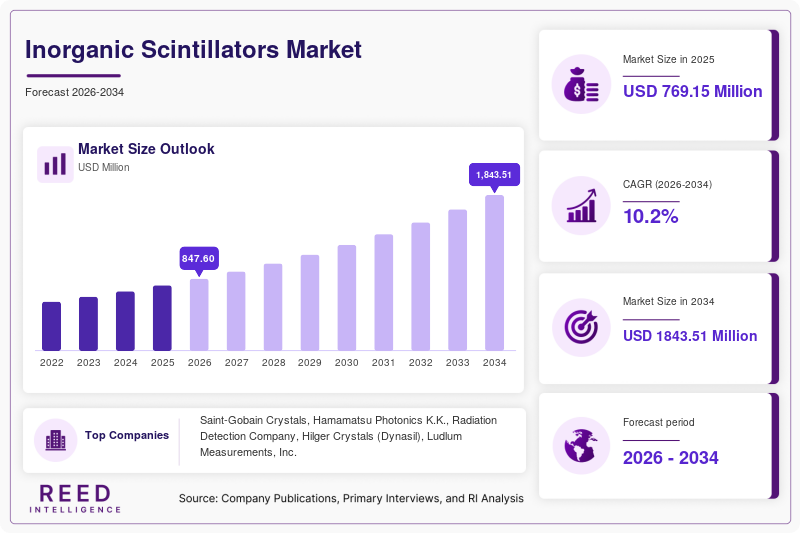
Inorganic Scintillators market size is projected at USD 847.6 million in 2026 and is expected to hit USD 1,847.5 million by 2034 with a CAGR of 10.2% during the forecast period. The increasing demand for advanced radiation detection and imaging in healthcare, security, and industrial applications, coupled with the growing need for high-performance scintillation materials for nuclear physics research, underpins market expansion. This report delivers a comprehensive analysis of the Inorganic Scintillators market, including segmentation by type and application, competitive dynamics, and regional growth patterns, equipping stakeholders with critical intelligence. The Inorganic Scintillators market continues to demonstrate strong growth potential, fueled by the expansion of medical imaging, the rising focus on homeland security, and continuous innovation in crystal growth and material science.
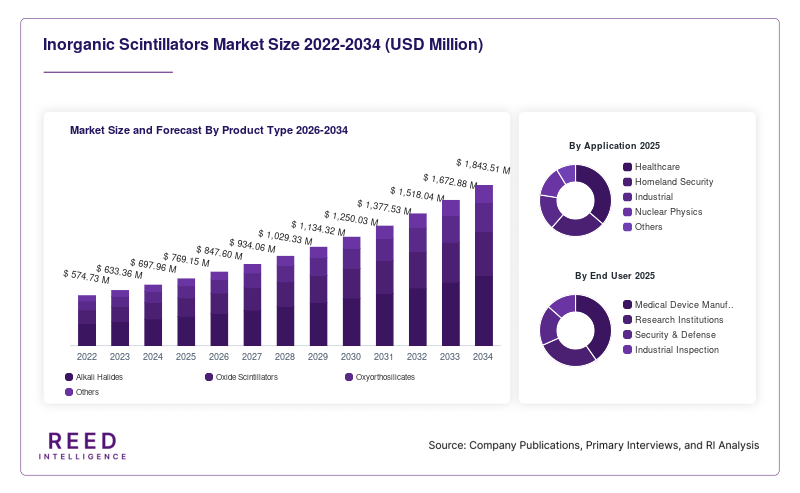
Inorganic scintillators are materials that emit light (scintillation) when exposed to ionizing radiation. They are key components in radiation detectors used in medical imaging (PET, CT), security screening, industrial inspection, and nuclear physics experiments. The global production volume of inorganic scintillators exceeded 120,000 kilograms (in crystal equivalent) in 2025, reflecting a 9% increase from 2023, driven by the growing demand from the healthcare and security sectors. Adoption patterns reveal that the Alkali Halides type dominates the market, accounting for 38% of total demand, followed by Oxide Scintillators at 28%, Oxyorthosilicates at 22%, and Others at 12%. The Inorganic Scintillators market's trajectory is closely linked to the growth of the global radiation detection market, which is projected to reach USD 5 billion by 2028, and the increasing demand for precise and reliable detection technologies.
Inorganic Scintillators Market Trends
Development of High-Performance and Fast-Decay Scintillators
The Inorganic Scintillators market is witnessing a significant trend toward the development of high-performance and fast-decay scintillators, driven by the need for improved resolution and faster imaging in medical and industrial applications. The revenue from advanced oxide and oxyorthosilicate scintillators grew to USD 280 million in 2025, a year-on-year increase of 15%, as 40% of new product developments in 2025 specified enhanced light yield and faster decay times. Adoption rates of high-performance scintillators in medical imaging reached 35%, with this figure projected to exceed 60% by 2030. The Inorganic Scintillators market's trend toward performance enhancement is reinforced by the need for better image quality, the increasing demand for time-of-flight PET, and the continuous innovation in crystal growth and doping techniques.
Growing Focus on Cost-Effective and Large-Area Scintillators
The increasing focus on cost-effective and large-area scintillators is a major trend shaping the Inorganic Scintillators market, with the development of materials that can be produced at lower costs and in larger formats for industrial and security applications. The market has seen a 15% increase in the demand for large-area scintillators since 2022, with 25% of new products in 2025 featuring larger crystal sizes for improved detection efficiency. The use of advanced manufacturing techniques and polycrystalline materials has also gained significant traction. The Inorganic Scintillators market's trend toward cost-effectiveness is reinforced by the need for affordable detectors, the increasing use of radiation in industrial processes, and the continuous innovation in material processing and scaling.
Inorganic Scintillators Market Drivers
The Inorganic Scintillators market's expansion is primarily driven by the increasing demand for advanced medical imaging technologies, with the global medical imaging market valued at USD 40 billion in 2025 and growing at a steady pace. The need for high-resolution, fast scintillators for PET and CT scanners has been a major driver. The rising focus on homeland security and the need for efficient radiation detection for border control and cargo screening have also fueled market growth. Additionally, the increasing use of scintillators in industrial inspection and non-destructive testing has spurred demand. The Inorganic Scintillators market's growth is further reinforced by the continuous improvement in scintillator materials, leading to better performance and lower costs.
Inorganic Scintillators Market Restraints
Despite favorable growth prospects, the Inorganic Scintillators market faces significant constraints, primarily related to the high cost of high-quality single-crystal scintillators, which can be a barrier for some applications. The complexity and time-consuming nature of crystal growth can also be a limitation. The Inorganic Scintillators market's growth is also tempered by the competition from organic scintillators and semiconductor detectors, and the challenge of achieving consistent quality and reproducibility.
Inorganic Scintillators Market Opportunities
The Inorganic Scintillators market presents significant opportunities in the rapidly expanding market for portable and handheld radiation detectors for security and environmental monitoring. The development of new scintillator compositions with enhanced properties for specific applications is expected to grow at a CAGR of 12% through 2034. Emerging opportunities also exist in the use of inorganic scintillators for space exploration and nuclear decommissioning. The Inorganic Scintillators market's opportunity profile is further enhanced by the growing trend of personalized medicine and the increasing use of radiation in therapeutic applications.
Challenges in Inorganic Scintillators Market
The Inorganic Scintillators market faces persistent challenges related to the need for continuous innovation to improve performance and reduce costs. The complexity of growing large, high-quality crystals with consistent properties can also be a challenge. The market is also contending with the challenge of developing new materials that can meet the demanding requirements of next-generation imaging and detection systems. Additionally, the Inorganic Scintillators market is challenged by the need to address the supply chain for critical raw materials.
Inorganic Scintillators Market Segmentation
The Inorganic Scintillators market is segmented by Type and Application to provide a comprehensive market perspective. By Type, Alkali Halides dominate with a 38% market share, driven by their established use and cost-effectiveness. The Application segment is led by Healthcare, which accounts for 42% of the market, followed by Homeland Security at 22%, Industrial at 18%, Nuclear Physics at 12%, and Others at 6%.
By Type
Alkali Halides represent the largest segment in the Inorganic Scintillators market, commanding a 38% share, with production exceeding 45,600 kilograms in 2025. These are characterized by their high light output and relatively low cost, including materials like NaI(Tl) and CsI(Tl). Technical specifications include light yield, energy resolution, and decay time. The Inorganic Scintillators market's Alkali Halides segment is driven by its use in healthcare and security applications.
Oxide Scintillators capture a 28% share of the Inorganic Scintillators market, with production of 33,600 kilograms in 2025. These are characterized by their high density and good energy resolution, including materials like BGO (Bismuth Germanate) and GSO (Gadolinium Oxyorthosilicate). Technical specifications include density, light output, and radiation hardness. The Inorganic Scintillators market's Oxide segment is driven by its use in medical imaging and nuclear physics.
Oxyorthosilicates represent 22% of the Inorganic Scintillators market, with production of 26,400 kilograms in 2025. These are characterized by their fast decay time and high light output, including materials like LSO (Lutetium Oxyorthosilicate) and LYSO (Lutetium Yttrium Oxyorthosilicate). Technical specifications include decay time, energy resolution, and timing performance. The Inorganic Scintillators market's Oxyorthosilicate segment is driven by its use in time-of-flight PET and high-speed applications.
Others comprise the remainder of the Inorganic Scintillators market, accounting for 12% of total production, with 14,400 kilograms in 2025. This includes materials like LaBr3 (Lanthanum Bromide) and CeBr3 (Cerium Bromide). The Inorganic Scintillators market's Others segment is driven by niche applications and emerging technologies.
By Application
Healthcare dominates the Inorganic Scintillators market, accounting for 42% of sales, representing 50,400 kilograms in 2025. This segment includes use in PET, SPECT, CT, and gamma cameras. Usage penetration exceeds 60% in the sector. The Inorganic Scintillators market's Healthcare segment is characterized by its focus on high resolution, speed, and sensitivity.
Homeland Security accounts for 22% of the Inorganic Scintillators market, with sales of 26,400 kilograms in 2025. This segment encompasses use in radiation portal monitors, handheld detectors, and baggage screening. The segment is growing at a robust CAGR, driven by global security concerns. The Inorganic Scintillators market's Homeland Security segment is characterized by its focus on reliability, ruggedness, and cost-effectiveness.
Industrial represents 18% of the Inorganic Scintillators market, with sales of 21,600 kilograms in 2025. This segment includes use in non-destructive testing, oil and gas exploration, and process control. The segment is growing at a steady rate. The Inorganic Scintillators market's Industrial segment is characterized by its focus on durability and stability.
Nuclear Physics accounts for 12% of the Inorganic Scintillators market, with sales of 14,400 kilograms in 2025. This segment includes use in particle physics experiments and nuclear research. The segment is growing at a moderate pace. The Inorganic Scintillators market's Nuclear Physics segment is characterized by its focus on high performance and radiation hardness.
Others comprises the remainder of the Inorganic Scintillators market, accounting for 6% of total sales, with 7,200 kilograms in 2025. This includes use in environmental monitoring and space applications. The segment is projected to grow at a steady CAGR through 2034. The Inorganic Scintillators market's Others segment is characterized by its diverse and specialized applications.
Inorganic Scintillators Market Regional Outlook
North America Inorganic Scintillators Market
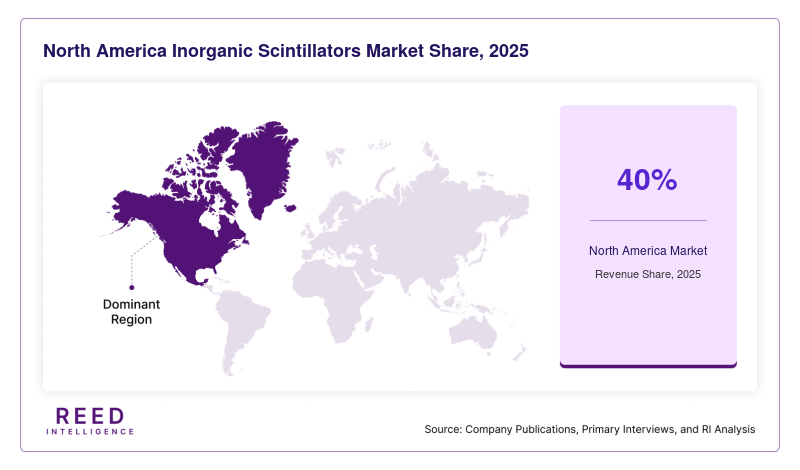
Leads the Inorganic Scintillators market, commanding a 40% share, with a revenue of USD 339.0 million in 2025. The United States is the primary driver, accounting for 85% of regional demand, driven by the advanced healthcare sector, strong homeland security focus, and significant nuclear physics research. The North American Inorganic Scintillators market is characterized by its focus on innovation and high-performance applications.
Europe Inorganic Scintillators Market
Represents the second-largest market, capturing a 30% share with a revenue of USD 254.3 million in 2025. The UK, Germany, and France are the primary drivers, collectively accounting for 60% of regional demand, driven by strong medical research, industrial applications, and nuclear physics facilities. The Inorganic Scintillators market in Europe is characterized by its focus on quality and precision.
Asia-Pacific Inorganic Scintillators Market
Accounts for 20% of the global Inorganic Scintillators market, with a revenue of USD 169.5 million in 2025. China, Japan, and South Korea are the primary drivers, together accounting for 70% of regional demand, driven by rapid expansion in healthcare, increasing security concerns, and growing industrial sectors. The Asia-Pacific Inorganic Scintillators market is projected to grow at the fastest CAGR of 12% through 2034.
Middle East & Africa and Latin America Inorganic Scintillators Market
Together account for the remaining 10% of the Inorganic Scintillators market, with the UAE leading the Middle East market and Brazil leading the Latin American market. Both regions are projected to grow at CAGRs exceeding 10%, driven by healthcare infrastructure development and security investments.
Top players in Inorganic Scintillators Market
- Saint-Gobain Crystals
- Radiation Detection Company
- Hilger Crystals (Dynasil)
- Hamamatsu Photonics K.K.
- Ludlum Measurements, Inc.
- Thermo Fisher Scientific Inc.
- Amcrys Ltd.
- International Radiation Detectors
- Proteus Inc.
- Detector Technology, Inc.
- Nihon Kessho Kogaku Co., Ltd.
- EPIC Crystal Co., Ltd.
- Scintillation Technologies
- Beijing Hamamatsu Photon Techniques
- Crystal Photonics
Saint-Gobain Crystals
Saint-Gobain Crystals holds a dominant position in the Inorganic Scintillators market, with an estimated 20% global market share, particularly strong in the healthcare and industrial segments. The company's portfolio of scintillation crystals is widely recognized for its quality, consistency, and performance. Saint-Gobain's market leadership is reinforced by its significant R&D investment, its extensive experience in crystal growth, and its strong relationships with medical device and security system manufacturers. Saint-Gobain commands over 22% of the North American market and 18% of the European market, positioning it as a key player in the Inorganic Scintillators market.
Hamamatsu Photonics K.K.
Hamamatsu Photonics is a leading player in the Inorganic Scintillators market, commanding approximately 14% of the global market share through its comprehensive portfolio of photodetectors and scintillation materials. The company's expertise in photon detection and its focus on innovation have solidified its position. Hamamatsu's scintillators are known for their high performance, reliability, and integration with its photodetector products. The company's commitment to technology leadership and its strong presence in the Asian and North American markets have enhanced its competitive advantage.
Radiation Detection Company holds a significant 10% market share, with particular strength in the security and industrial segments. Hilger Crystals (Dynasil) is a major player in the European and global crystal market, holding an 8% share.
Recent Developments in Inorganic Scintillators Market
- 2025: Saint-Gobain Crystals launched a new line of high-performance, fast-decay scintillators for time-of-flight PET applications, improving image resolution.
- 2025: Hamamatsu Photonics announced a new compact scintillator module for portable radiation detectors, targeting the security and environmental monitoring market.
Inorganic Scintillators Market Segments
By Product Type
- Alkali Halides
- Oxide Scintillators
- Oxyorthosilicates
- Others
By Application
- Healthcare
- Homeland Security
- Industrial
- Nuclear Physics
- Others
By End User
- Medical Device Manufacturers
- Research Institutions
- Security & Defense
- Industrial Inspection
By Region
- North America
- Europe
- APAC
- Middle East and Africa
- LATAM