Integrated Microwave Assembly Market Size, Share & Demand Report By Frequency Band (L-Band Assemblies, S-Band Assemblies, C-Band Assemblies), By Application (Defense and Military Systems, Satellite Communication Systems, Radar Systems), By Component Type (Amplifiers, Filters, Oscillators, Mixers), By End-Use Industry (Aerospace and Defense, Telecommunications, Industrial Electronics) By Region & Segment Forecasts, 2026–2034
USD 3950
Market Overview
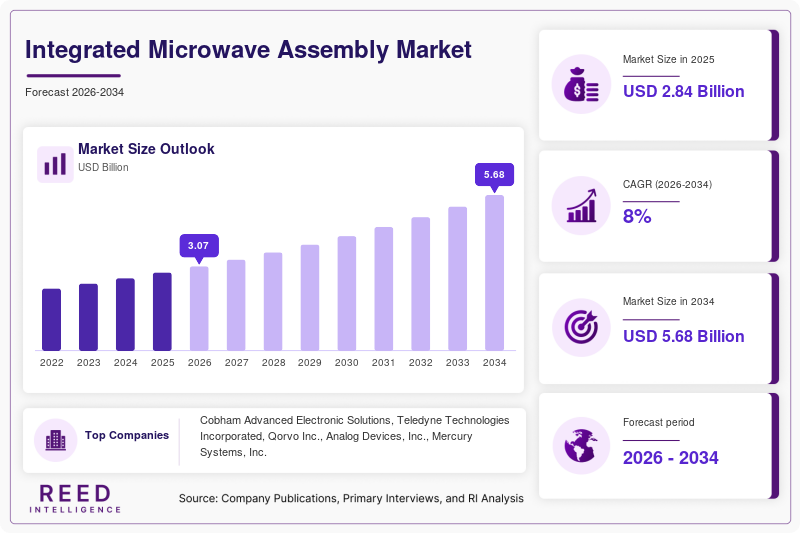
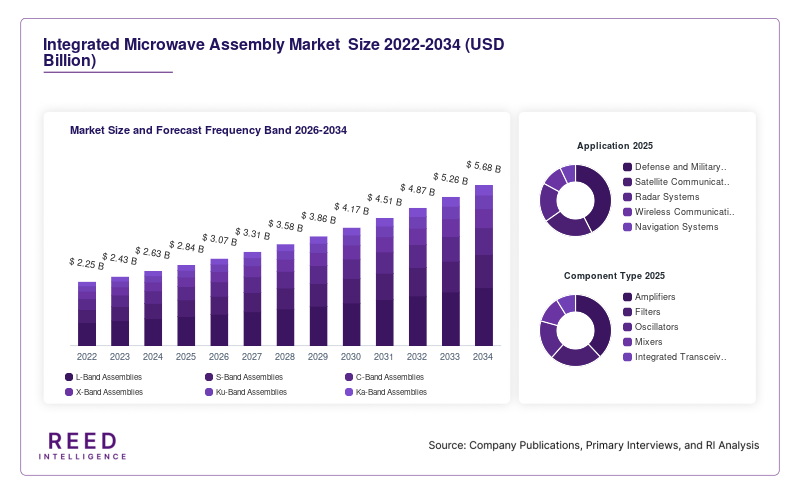
The global Integrated Microwave Assembly Market size was valued at USD 2.84 billion in 2026 and is projected to reach USD 5.26 billion by 2034, expanding at a CAGR of 8.0% during the forecast period (2026–2034). The market growth was supported by increasing deployment of advanced communication systems across defense, aerospace, telecommunications, and satellite applications. The growing adoption of high-frequency electronic systems and radar technologies significantly accelerated the demand for integrated microwave assemblies worldwide.
Integrated microwave assemblies are compact electronic modules designed to process, amplify, filter, and transmit microwave-frequency signals in high-performance applications. These assemblies are widely used in radar systems, electronic warfare equipment, satellite communication infrastructure, navigation systems, and wireless communication networks. Rising investments in next-generation defense electronics and 5G infrastructure contributed substantially to market expansion.
Key Highlights
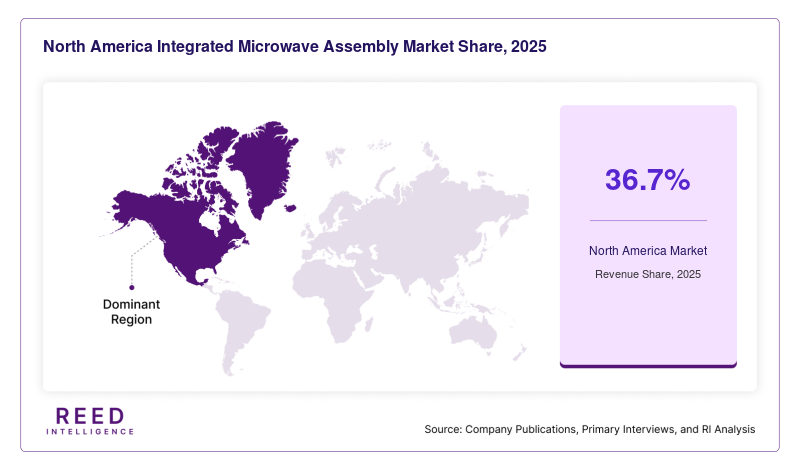
- North America accounted for 36.7% of the global Integrated Microwave Assembly Market share in 2025, while Asia Pacific is projected to register the fastest CAGR of 9.1% during the forecast period.
- Among frequency segments, X-band assemblies held the dominant share of 31.4% in 2025, whereas Ka-band assemblies are expected to grow at a CAGR of 9.6% through 2034.
- By application, defense and military systems represented the leading segment with 41.8% market share in 2025, while satellite communication systems are projected to expand at a CAGR of 9.4%.
- By component type, amplifiers captured 28.9% market share in 2025, whereas integrated transceivers are anticipated to grow at a CAGR of 9.2%.
- The United States Integrated Microwave Assembly Market was valued at USD 648 million in 2024 and reached USD 703 million in 2025 due to increasing investments in defense modernization and advanced radar systems.
Market Trends
Increasing Deployment of 5G Communication Infrastructure
The increasing deployment of 5G communication infrastructure emerged as a major trend shaping the Integrated Microwave Assembly Market. Telecommunications providers increasingly adopted high-frequency microwave assemblies to support faster data transmission, low latency, and improved network reliability.
Integrated microwave assemblies became essential components in base stations, small cells, and advanced wireless communication equipment. Growing investments in global 5G expansion significantly strengthened demand for compact and high-performance microwave systems.
Rising Adoption of Miniaturized Microwave Electronics
The rising adoption of miniaturized microwave electronics significantly influenced the Integrated Microwave Assembly Market outlook. Manufacturers increasingly developed smaller and lighter microwave assemblies to meet the evolving requirements of aerospace, satellite, and portable defense applications.
Miniaturization improved power efficiency, thermal performance, and installation flexibility while reducing overall system weight. This trend accelerated the use of advanced semiconductor materials and multilayer packaging technologies.
Market Drivers
Growth in Defense and Electronic Warfare Programs
The expansion of defense modernization and electronic warfare programs globally significantly supported the Integrated Microwave Assembly Market growth. Governments increased investments in radar systems, missile guidance technologies, surveillance equipment, and secure military communication infrastructure.
Integrated microwave assemblies play a critical role in military electronics due to their ability to process high-frequency signals with accuracy and operational stability. Increasing geopolitical tensions and defense technology upgrades further accelerated product demand.
Expansion of Satellite Communication Networks
The rapid expansion of satellite communication networks contributed substantially to the growth of the Integrated Microwave Assembly Market. Commercial and government organizations increasingly deployed satellite systems for navigation, broadcasting, broadband connectivity, and earth observation applications.
Integrated microwave assemblies enabled efficient signal transmission and high-frequency communication in satellite payloads and ground station systems. Rising satellite launches and space exploration initiatives strengthened market demand globally.
Market Restraint
High Development and Manufacturing Costs
High development and manufacturing costs associated with advanced microwave assemblies restrained broader market growth. Precision engineering requirements, complex semiconductor integration, and strict reliability standards increased production expenses for manufacturers.
In addition, specialized testing and quality assurance processes further raised operational costs, particularly for aerospace and defense-grade applications.
Market Opportunities
Expansion of Commercial Space Programs
The increasing expansion of commercial space programs is expected to create significant opportunities for the Integrated Microwave Assembly Market. Private aerospace companies increasingly invest in satellite constellations, reusable launch systems, and space-based communication networks.
Integrated microwave assemblies are expected to witness rising demand across satellite communication payloads and aerospace electronic systems.
Growth of Autonomous and Connected Systems
The growth of autonomous and connected systems is projected to support new market opportunities. Autonomous vehicles, unmanned aerial systems, and smart transportation technologies increasingly rely on radar and wireless communication systems operating at microwave frequencies.
Manufacturers are expected to develop advanced microwave assemblies capable of supporting real-time data processing and high-frequency connectivity across autonomous platforms.
Segmental Analysis
By Frequency Band
X-Band Assemblies Dominated the Market
X-band assemblies accounted for 31.4% of the global Integrated Microwave Assembly Market share in 2025. These assemblies gained widespread adoption across radar systems, defense electronics, and satellite communication equipment due to their balanced frequency performance and signal stability.
Defense organizations increasingly preferred X-band technologies for surveillance and navigation systems because of their operational reliability and efficient signal transmission capabilities.
Ka-Band Assemblies to Witness Fastest Growth
Ka-band assemblies are projected to grow at a CAGR of 9.6% during the forecast period. These assemblies support high-speed data transmission and enhanced bandwidth capacity for advanced satellite communication systems.
The increasing deployment of broadband satellite networks and next-generation communication infrastructure is expected to strengthen segment growth globally.
By Application
Defense and Military Systems Held the Largest Share
Defense and military systems represented 41.8% of the Integrated Microwave Assembly Market share in 2025. Integrated microwave assemblies are extensively used in radar systems, missile guidance equipment, electronic warfare systems, and secure communication platforms.
Growing investments in advanced military electronics and border surveillance infrastructure significantly supported segment dominance.
Satellite Communication Systems to Register Rapid Growth
Satellite communication systems are anticipated to grow at a CAGR of 9.4% during the forecast period. The increasing deployment of low-earth orbit satellite constellations and commercial communication satellites is expected to accelerate demand for microwave assemblies.
Growing global demand for broadband connectivity and space-based communication services will further support segment expansion.
By Component Type
Amplifiers Accounted for the Largest Share
Amplifiers captured 28.9% of the global Integrated Microwave Assembly Market share in 2025. These components played a critical role in signal enhancement and microwave power transmission across communication and radar systems.
Manufacturers increasingly integrated high-frequency amplifiers into defense and aerospace platforms requiring stable signal performance and operational efficiency.
Integrated Transceivers to Witness Accelerated Growth
Integrated transceivers are expected to grow at a CAGR of 9.2% through 2034. These systems combine transmission and reception functions within compact modules, supporting miniaturized and high-performance communication equipment.
The growing adoption of portable communication systems and advanced wireless networks is expected to strengthen segment demand.
By End-Use Industry
Aerospace and Defense Dominated the Market
Aerospace and defense accounted for 46.3% of the global Integrated Microwave Assembly Market share in 2025. Increasing deployment of military aircraft, unmanned aerial vehicles, and radar systems supported substantial demand for microwave assemblies.
The requirement for reliable communication systems and electronic warfare technologies further strengthened segment growth.
Telecommunications to Grow Steadily
The telecommunications segment is projected to grow at a CAGR of 8.8% during the forecast period. Rapid 5G infrastructure deployment and increasing data traffic are expected to support demand for advanced microwave communication systems.
Telecommunication providers increasingly adopt integrated microwave assemblies to improve network performance and high-frequency connectivity.
Regional Analysis
North America
North America accounted for 36.7% of the global Integrated Microwave Assembly Market share in 2025 and is projected to grow at a CAGR of 7.6% during the forecast period. The region benefited from strong investments in aerospace technology, defense modernization, and advanced communication infrastructure.
The United States dominated the regional market due to increasing procurement of radar systems, electronic warfare equipment, and satellite communication technologies. Government defense contracts and rising investments in space programs significantly supported market growth.
Canada also experienced stable growth due to increasing aerospace manufacturing activities and communication infrastructure development.
Europe
Europe held 24.5% of the global Integrated Microwave Assembly Market share in 2025 and is anticipated to grow at a CAGR of 7.4% through 2034. The region maintained steady growth due to rising investments in defense electronics and satellite communication programs.
Germany represented the dominant country market owing to its strong aerospace engineering sector and increasing development of advanced radar technologies. Growing investments in industrial communication systems further strengthened market demand.
France and the United Kingdom also contributed significantly through defense modernization initiatives and space research programs.
Asia Pacific
Asia Pacific accounted for 27.8% of the global Integrated Microwave Assembly Market share in 2025 and is forecast to register the fastest CAGR of 9.1% during the assessment period. The region benefited from rapid telecommunications expansion, rising defense budgets, and increasing satellite deployment activities.
China dominated the regional market due to strong investments in military communication systems, 5G infrastructure, and satellite technologies. Expanding semiconductor manufacturing capabilities further accelerated product adoption.
India emerged as a rapidly growing market supported by defense electronics development and increasing investments in indigenous aerospace technologies. Japan and South Korea also maintained substantial market presence through innovation in communication and radar systems.
Middle East & Africa
The Middle East & Africa represented 6.1% of the global Integrated Microwave Assembly Market share in 2025 and is expected to expand at a CAGR of 7.8% during the forecast period. Increasing investments in defense communication infrastructure and smart surveillance systems supported regional market growth.
Saudi Arabia dominated the regional market due to rising procurement of military radar systems and aerospace communication equipment. Investments in smart city projects and digital connectivity infrastructure also contributed to market expansion.
The United Arab Emirates experienced notable growth through satellite communication initiatives and advanced defense technology adoption.
Latin America
Latin America captured 4.9% of the global Integrated Microwave Assembly Market share in 2025 and is projected to grow at a CAGR of 7.0% through 2034. The region benefited from expanding communication infrastructure and increasing adoption of defense surveillance technologies.
Brazil dominated the regional market due to investments in aerospace manufacturing and military communication modernization. Growing satellite connectivity projects further supported market demand.
Mexico also contributed to regional expansion through telecommunications infrastructure upgrades and industrial electronics development.
Competitive Landscape
The Integrated Microwave Assembly Market remained moderately competitive with companies focusing on high-frequency technology innovation, miniaturization, and advanced semiconductor integration. Manufacturers emphasized defense contracts, aerospace partnerships, and communication infrastructure projects to strengthen market positioning.
Market Leader
Cobham Advanced Electronic Solutions maintained a leading position in the Integrated Microwave Assembly Market due to its extensive portfolio of microwave communication and defense electronics solutions. The company recently expanded its high-frequency microwave assembly technologies for satellite and radar applications.
Other Major Players
- Teledyne Technologies Incorporated focused on advanced microwave subsystem development.
- Qorvo Inc. expanded high-frequency RF component manufacturing capabilities.
- Analog Devices, Inc. strengthened investments in microwave signal processing solutions.
- Mercury Systems, Inc. developed compact microwave assemblies for defense applications.
Key Players List
- Cobham Advanced Electronic Solutions
- Teledyne Technologies Incorporated
- Qorvo Inc.
- Analog Devices, Inc.
- Mercury Systems, Inc.
- L3Harris Technologies
- Northrop Grumman Corporation
- Kratos Defense & Security Solutions
- MACOM Technology Solutions
- Mini-Circuits
- Smiths Interconnect
- Rohde & Schwarz
- Thales Group
- RTX Corporation
- Broadcom Inc.
Recent Developments
- In 2025, Cobham Advanced Electronic Solutions introduced advanced Ka-band microwave assemblies for satellite communication platforms.
- In 2024, Qorvo Inc. expanded RF semiconductor manufacturing capacity for high-frequency communication systems.
- In 2025, Mercury Systems, Inc. launched compact integrated microwave assemblies for electronic warfare applications.
- In 2024, Teledyne Technologies Incorporated strengthened aerospace microwave subsystem production capabilities.
- In 2025, Analog Devices, Inc. developed advanced microwave signal processing solutions for radar and communication systems.
Integrated Microwave Assembly Market Segments
Frequency Band
- L-Band Assemblies
- S-Band Assemblies
- C-Band Assemblies
- X-Band Assemblies
- Ku-Band Assemblies
- Ka-Band Assemblies
Application
- Defense and Military Systems
- Satellite Communication Systems
- Radar Systems
- Wireless Communication Infrastructure
- Navigation Systems
Component Type
- Amplifiers
- Filters
- Oscillators
- Mixers
- Integrated Transceivers
End-Use Industry
- Aerospace and Defense
- Telecommunications
- Industrial Electronics
- Automotive Electronics
- Research and Scientific Applications
By Region
- North America
- Europe
- APAC
- Middle East and Africa
- LATAM