Integration Brokerage Software Market Size, Share & Demand Report By Deployment Mode (Cloud-Based, On-Premise, Hybrid), By Enterprise Size (Large Enterprises, Small and Medium Enterprises), By End-Use Industry (BFSI, Healthcare, Retail and E-commerce, Manufacturing, IT and Telecommunications, Government, Others) By Region & Segment Forecasts, 2026–2034
USD 3950
Market Overview
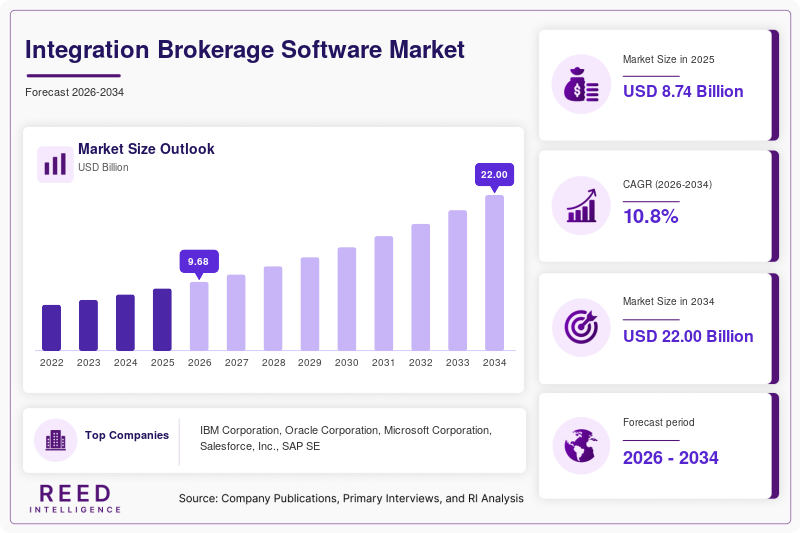
The global Integration Brokerage Software Market size was valued at USD 8.74 billion in 2026 and is projected to reach USD 19.86 billion by 2034, expanding at a CAGR of 10.8% during the forecast period from 2026 to 2034. The market growth is being supported by the increasing adoption of hybrid cloud environments, enterprise automation platforms, and API-led connectivity frameworks across industries. Organizations are investing in integration brokerage software to simplify complex IT ecosystems, streamline data exchange, and improve interoperability between cloud-based and on-premise applications. The growing need for centralized integration management in sectors such as banking, healthcare, retail, manufacturing, and telecommunications continues to strengthen long-term demand.
The rapid rise of digital transformation initiatives among medium and large enterprises has accelerated software deployment across customer relationship management, enterprise resource planning, supply chain, and analytics platforms. Businesses increasingly rely on integration brokerage solutions to reduce operational inefficiencies and support real-time data synchronization. The expansion of low-code and no-code integration capabilities has also improved accessibility for non-technical users, enabling wider market penetration.
Key Highlights
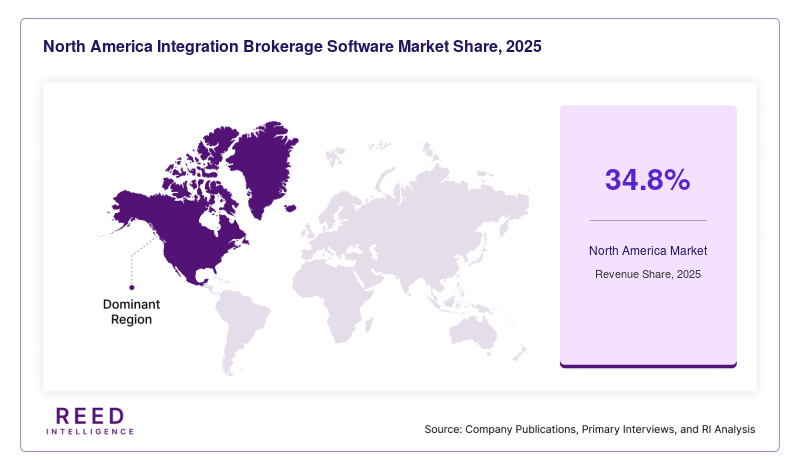
- North America dominated the market with a 34.8% share in 2025, while Asia Pacific is expected to grow at the fastest CAGR of 12.1% during 2026–2034.
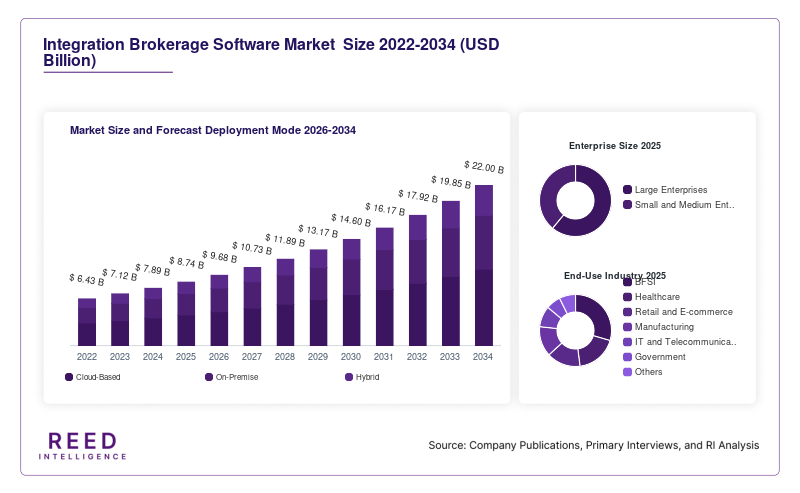
- By deployment mode, cloud-based solutions accounted for the largest share of 61.4%, while hybrid deployment is projected to grow at a CAGR of 12.8%.
- By enterprise size, large enterprises led with a 67.2% share, whereas small and medium enterprises are expected to expand at a CAGR of 11.9%.
- By end-use industry, BFSI held the largest share of 24.5%, while healthcare is projected to grow at a CAGR of 13.2%.
- The United States remained the dominant country, with market values of USD 2.41 billion in 2024 and USD 2.68 billion in 2025.
Market Trends
Growing Adoption of AI-Enabled Integration Automation
Artificial intelligence is becoming a central component of integration brokerage software platforms. Vendors are integrating machine learning algorithms, predictive analytics, and intelligent workflow engines into their solutions to improve operational efficiency and reduce manual intervention. AI-enabled integration systems can identify data inconsistencies, automate process mapping, and optimize application performance across enterprise environments. Organizations are increasingly adopting these advanced capabilities to reduce integration delays and improve decision-making accuracy. Financial institutions, healthcare providers, and e-commerce companies are among the primary adopters of AI-driven integration platforms due to their high-volume transactional environments.
The trend is also supported by rising investments in digital process automation and intelligent business operations. Companies are demanding integration brokerage solutions capable of managing structured and unstructured data from multiple channels in real time. AI-powered monitoring dashboards and automated incident response tools are improving visibility across enterprise systems. As businesses continue to migrate workloads to cloud ecosystems, the integration of AI technologies within brokerage software is expected to remain a major industry trend throughout the forecast period.
Expansion of API-Centric Connectivity Frameworks
The increasing use of APIs across enterprise applications is transforming the integration brokerage software landscape. Organizations are shifting toward API-centric architectures to support agile business models, third-party integrations, and omnichannel customer experiences. Integration brokerage software providers are responding by developing platforms that simplify API lifecycle management, governance, and security. These capabilities are becoming essential as enterprises adopt multi-cloud environments and digital commerce ecosystems requiring seamless communication between applications.
The expansion of SaaS platforms has further accelerated API usage across industries including retail, healthcare, telecommunications, and logistics. Businesses are implementing integration brokerage software to manage growing API traffic and ensure consistent application performance. API marketplaces and developer portals are also becoming standard features within enterprise integration suites. Furthermore, organizations are focusing on reusable integration assets to reduce development costs and accelerate deployment timelines. This trend is expected to support sustained market growth as enterprises continue prioritizing scalable and flexible connectivity infrastructure.
Market Drivers
Rising Enterprise Digital Transformation Investments
The growing emphasis on digital transformation across global enterprises is a significant driver for the integration brokerage software market. Organizations are modernizing legacy IT systems and implementing cloud applications to improve operational efficiency, customer engagement, and business agility. These digital initiatives require reliable integration platforms capable of connecting multiple applications, databases, and business processes across distributed environments. Integration brokerage software helps enterprises simplify complex infrastructure management while enabling faster deployment of digital services.
Large organizations operating across multiple geographic locations are increasingly adopting centralized integration platforms to maintain data consistency and streamline workflows. Industries such as banking, manufacturing, retail, and healthcare are investing heavily in integration software to support real-time analytics and intelligent automation. The increasing adoption of remote work models and digital collaboration tools has further strengthened demand for seamless application connectivity. As enterprises continue expanding cloud ecosystems and automation strategies, the need for integration brokerage software is expected to rise steadily during the forecast period.
Increasing Demand for Hybrid and Multi-Cloud Management
The rapid expansion of hybrid and multi-cloud environments is another important market driver. Enterprises are deploying applications across private clouds, public clouds, and on-premise infrastructure to optimize performance, scalability, and cost efficiency. However, managing data exchange and interoperability between these environments remains a major challenge. Integration brokerage software addresses this issue by providing centralized integration management, secure data transfer, and real-time synchronization capabilities.
Organizations are increasingly seeking flexible integration platforms capable of supporting diverse cloud providers and enterprise applications. This demand is especially strong among businesses undergoing mergers, acquisitions, and global expansion projects. The rise of cloud-native applications and containerized environments has further accelerated the need for robust integration orchestration solutions. Vendors are enhancing their offerings with low-code integration tools, API gateways, and automated workflow management features to meet evolving enterprise requirements. These developments are expected to support sustained market expansion throughout the forecast timeline.
Market Restraint
Concerns Related to Data Security and Integration Complexity
Data security concerns and implementation complexity continue to restrain the growth of the integration brokerage software market. Enterprises handling sensitive customer information, financial records, and operational data often face challenges in ensuring secure communication between interconnected systems. The increasing number of cyberattacks targeting cloud infrastructure and enterprise APIs has raised concerns regarding unauthorized access, data breaches, and compliance violations. Organizations operating in regulated industries such as banking, healthcare, and government are particularly cautious about deploying integration brokerage platforms without advanced security controls and governance frameworks.
Another major challenge involves the complexity associated with integrating legacy infrastructure with modern cloud-based applications. Many enterprises operate highly customized systems that require extensive configuration, testing, and maintenance during integration deployment. This increases implementation timelines and operational costs, particularly for small and medium enterprises with limited IT budgets. In some cases, integration failures can disrupt business operations and reduce productivity. Companies also face difficulties in managing multiple vendor ecosystems and maintaining consistent data quality across interconnected platforms. These challenges may slow adoption rates among organizations with limited technical expertise or constrained financial resources.
Market Opportunities
Rising Adoption Among Small and Medium Enterprises
The growing digitalization of small and medium enterprises is creating substantial opportunities for the integration brokerage software market. SMEs are increasingly adopting cloud-based business applications to improve operational efficiency, customer management, and supply chain visibility. As these businesses expand their digital ecosystems, they require integration platforms capable of connecting accounting software, CRM systems, e-commerce applications, and communication tools. Affordable subscription-based integration brokerage solutions are becoming attractive due to their scalability and reduced infrastructure requirements.
Software vendors are introducing low-code and no-code integration platforms specifically designed for smaller organizations with limited technical resources. These solutions simplify deployment and reduce dependency on specialized IT teams. The increasing availability of industry-specific integration templates is also helping SMEs accelerate digital adoption. In addition, government-led digital transformation initiatives and growing internet penetration across emerging economies are encouraging smaller businesses to modernize operations. This trend is expected to generate strong revenue opportunities for software providers targeting underserved SME segments during the forecast period.
Expansion of Integration Brokerage Solutions in Healthcare
The healthcare sector presents significant growth opportunities for integration brokerage software providers. Hospitals, diagnostic laboratories, insurance companies, and telemedicine providers are increasingly adopting digital healthcare platforms that require secure and efficient data exchange. Integration brokerage software enables healthcare organizations to connect electronic health record systems, billing platforms, patient management tools, and remote monitoring applications. These capabilities improve operational coordination and support better patient outcomes.
The expansion of telehealth services and wearable health technologies is generating large volumes of patient data that must be integrated across multiple systems in real time. Healthcare providers are investing in advanced integration platforms to improve interoperability and comply with data governance regulations. AI-driven analytics integration is also becoming increasingly important for predictive healthcare management and clinical decision support. Furthermore, growing investments in healthcare infrastructure across Asia Pacific and the Middle East are creating new opportunities for software vendors. The healthcare segment is expected to remain one of the fastest-growing application areas in the global market.
Segmental Analysis
By Deployment Mode
Cloud-based deployment accounted for the dominant share of the Integration Brokerage Software Market in 2024, representing approximately 61.4% of total revenue. Enterprises increasingly prefer cloud-based integration solutions due to lower upfront infrastructure costs, simplified maintenance, and flexible scalability. Organizations adopting remote work models and digital collaboration platforms are prioritizing cloud integration systems to ensure seamless connectivity across distributed environments. The deployment model is especially popular among businesses operating in retail, BFSI, healthcare, and telecommunications industries where real-time data exchange is critical for operational efficiency. Vendors are also enhancing cloud security features and API management capabilities to improve adoption rates among enterprises handling sensitive business information.
Hybrid deployment is projected to witness the fastest growth during the forecast period, expanding at a CAGR of 12.8%. Enterprises are increasingly adopting hybrid integration models to balance the benefits of cloud scalability with the security and control offered by on-premise infrastructure. This deployment strategy is particularly attractive for organizations operating in regulated industries such as healthcare, government, and financial services. Hybrid integration brokerage platforms support seamless communication between legacy systems and cloud-native applications, enabling gradual digital transformation without disrupting existing operations. The increasing adoption of multi-cloud environments and edge computing infrastructure is also contributing to segment growth. Vendors are investing in advanced orchestration tools and automated workload management capabilities to support evolving enterprise requirements.
By Enterprise Size
Large enterprises dominated the market in 2024 with a share of approximately 67.2% due to extensive digital transformation initiatives and complex IT ecosystems. These organizations typically operate across multiple geographic regions and require sophisticated integration platforms to manage enterprise applications, databases, and communication systems. Integration brokerage software enables large enterprises to streamline business processes, reduce operational inefficiencies, and improve decision-making through centralized data visibility. Industries including banking, manufacturing, healthcare, and telecommunications are among the largest adopters due to high transaction volumes and complex workflow requirements. The availability of dedicated IT budgets and skilled technology teams further supports widespread adoption among multinational corporations.
Small and medium enterprises are anticipated to register the fastest CAGR of 11.9% during the forecast period. SMEs are increasingly adopting cloud-based business applications and digital commerce platforms to improve competitiveness and customer engagement. As these businesses expand operations, the need for affordable and scalable integration brokerage solutions is rising steadily. Vendors are responding by offering subscription-based pricing models, simplified deployment options, and low-code integration tools specifically designed for smaller organizations. Government-supported digitalization initiatives and improved internet infrastructure across emerging economies are also accelerating software adoption among SMEs. Additionally, growing awareness regarding automation benefits and operational efficiency improvements is expected to strengthen demand throughout the forecast timeline.
By End-Use Industry
The BFSI segment accounted for the largest share of the Integration Brokerage Software Market in 2024, contributing nearly 24.5% of global revenue. Financial institutions rely heavily on integration brokerage platforms to connect banking systems, payment gateways, fraud detection tools, and customer relationship management applications. The increasing demand for real-time transaction processing and digital banking services has accelerated software adoption across the sector. Banks and insurance providers are also implementing integration solutions to improve regulatory compliance, enhance cybersecurity, and support omnichannel customer experiences. The rapid growth of fintech ecosystems and digital payment platforms continues to create strong demand for advanced integration management capabilities within the BFSI industry.
Healthcare is expected to emerge as the fastest-growing end-use segment, registering a CAGR of 13.2% during the forecast period. Healthcare providers are increasingly adopting integration brokerage software to improve interoperability between electronic health records, telemedicine systems, laboratory management platforms, and patient monitoring applications. The expansion of digital healthcare services and remote patient management technologies is generating large volumes of data that require secure and efficient integration. Regulatory requirements related to patient data security and healthcare compliance are also encouraging software adoption across hospitals and clinics. Additionally, rising investments in AI-driven healthcare analytics and connected medical devices are expected to support sustained growth within the segment over the coming years.
Regional Analysis
North America
North America accounted for the largest share of the Integration Brokerage Software Market in 2025, representing approximately 34.8% of global revenue. The regional market is projected to expand at a CAGR of 10.3% during the forecast period due to widespread adoption of cloud computing and enterprise automation technologies. Large enterprises across the United States and Canada are investing heavily in integration platforms to support hybrid work environments and digital business transformation. The strong presence of technology providers and advanced IT infrastructure continues to support market leadership across the region.
The United States remained the dominant country in North America due to high enterprise software spending and rapid cloud migration strategies among businesses. Companies operating in banking, healthcare, retail, and telecommunications sectors are increasingly deploying integration brokerage platforms to improve operational visibility and customer engagement. The growth of AI-driven enterprise applications and rising investments in cybersecurity integration frameworks are also contributing to market expansion. Additionally, favorable investment activity in SaaS and enterprise software startups continues to strengthen innovation across the regional ecosystem.
Europe
Europe represented a significant share of the global integration brokerage software industry in 2025 and is expected to witness stable growth during the forecast timeline. The regional market is projected to expand at a CAGR of 9.8% between 2026 and 2034. Organizations across Germany, the United Kingdom, France, and the Netherlands are increasingly adopting integration solutions to support digital operations and regulatory compliance. The rising use of cloud-based enterprise applications and cross-border data exchange platforms is contributing to steady market growth throughout the region.
Germany emerged as the leading country in the European market due to strong industrial automation investments and widespread enterprise digitization initiatives. Manufacturing companies are increasingly integrating supply chain, logistics, and production systems to improve operational efficiency and predictive maintenance capabilities. The implementation of data governance regulations and cybersecurity standards is also encouraging enterprises to adopt secure integration brokerage platforms. Furthermore, increasing demand for Industry 4.0 infrastructure and connected manufacturing environments is expected to drive continued software adoption in the country.
Asia Pacific
Asia Pacific is anticipated to register the fastest growth rate in the Integration Brokerage Software Market, with a projected CAGR of 12.1% during the forecast period. The region is witnessing rapid digital transformation across emerging economies including China, India, Japan, and Southeast Asian countries. Growing cloud adoption, rising internet penetration, and expanding enterprise IT spending are creating favorable market conditions. Businesses across retail, banking, healthcare, and telecommunications sectors are investing in integration brokerage solutions to improve digital service delivery and operational scalability.
China remained the dominant country in the regional market due to extensive investments in cloud infrastructure, enterprise software, and industrial digitalization programs. Large-scale adoption of e-commerce platforms and smart manufacturing technologies is accelerating the need for advanced integration management solutions. The expansion of domestic technology providers and government-led digital economy initiatives are also supporting market growth. In addition, increasing adoption of AI-powered business applications and data analytics platforms is expected to strengthen long-term software demand across the country.
Middle East & Africa
The Middle East & Africa market is experiencing gradual expansion as organizations increasingly adopt digital business platforms and cloud infrastructure solutions. The regional market is forecast to grow at a CAGR of 9.1% during the assessment period. Governments across Gulf Cooperation Council countries are investing heavily in digital transformation projects, smart city initiatives, and public sector modernization. These developments are driving demand for integration brokerage software capable of connecting multiple enterprise systems and supporting secure data exchange across public and private organizations.
Saudi Arabia emerged as the dominant country within the regional market due to large-scale investments in digital infrastructure and enterprise modernization programs. Businesses in banking, healthcare, and energy sectors are implementing integration platforms to improve workflow automation and customer service capabilities. The country's focus on economic diversification and smart technology adoption is encouraging software vendors to expand regional operations. Furthermore, the increasing deployment of cloud data centers and cybersecurity solutions is expected to contribute to sustained market growth throughout the forecast period.
Latin America
Latin America is projected to witness moderate growth in the integration brokerage software industry over the coming years. The market is expected to expand at a CAGR of 8.9% during the forecast period due to increasing enterprise digitization and rising cloud adoption among businesses. Organizations across Brazil, Mexico, and Argentina are gradually modernizing legacy IT infrastructure and implementing software integration platforms to improve operational efficiency. Growing awareness regarding API management and digital workflow automation is further supporting market development across the region.
Brazil remained the leading country in Latin America due to strong demand for enterprise software solutions within banking, retail, and telecommunications industries. Companies are increasingly investing in integration brokerage platforms to support omnichannel business models and digital customer engagement strategies. The expansion of fintech ecosystems and e-commerce platforms is also contributing to software demand. Additionally, improving internet infrastructure and growing investments in cloud services are expected to create favorable opportunities for market participants operating in the country.
Competitive Landscape
The Integration Brokerage Software Market is characterized by strong competition among global enterprise software providers, cloud platform vendors, and specialized integration solution companies. Market participants are focusing on product innovation, strategic acquisitions, and partnerships to strengthen market presence and expand customer portfolios. Companies are increasingly integrating AI-based automation, API management tools, and low-code development capabilities into their platforms to improve operational efficiency and enhance user experience.
Leading vendors are also prioritizing cloud-native architecture and cybersecurity enhancements to address evolving enterprise requirements. The market is witnessing increased investment in hybrid integration capabilities as organizations continue adopting multi-cloud environments. Major players are expanding regional operations and industry-specific offerings to improve competitiveness across healthcare, BFSI, retail, and manufacturing sectors.
Key Players
- IBM Corporation
- Oracle Corporation
- Microsoft Corporation
- Salesforce, Inc.
- SAP SE
- MuleSoft LLC
- Software AG
- TIBCO Software Inc.
- Boomi LP
- Informatica Inc.
- Fujitsu Limited
- SnapLogic Inc.
- Workato Inc.
- OpenText Corporation
- Celigo Inc.
Recent Developments
- In February 2026, Microsoft Corporation expanded its Azure integration services portfolio with AI-enabled workflow automation capabilities for enterprise customers.
- In July 2025, Boomi LP launched a low-code API orchestration platform designed to simplify hybrid cloud integration for mid-sized enterprises.
- In November 2025, SAP SE introduced advanced real-time analytics integration features within its enterprise integration suite to improve operational visibility.
- In April 2026, Oracle Corporation announced strategic partnerships with regional cloud providers to strengthen multi-cloud integration services across Asia Pacific.
- In September 2025, Informatica Inc. enhanced its data governance and cybersecurity integration capabilities for regulated industries including banking and healthcare.
Integration Brokerage Software Market Segments
Deployment Mode
- Cloud-Based
- On-Premise
- Hybrid
Enterprise Size
- Large Enterprises
- Small and Medium Enterprises
End-Use Industry
- BFSI
- Healthcare
- Retail and E-commerce
- Manufacturing
- IT and Telecommunications
- Government
- Others
By Region
- North America
- Europe
- APAC
- Middle East and Africa
- LATAM