Intelligent Coffee Machines Market Size, Share & Demand Report By Type (Wi-Fi Connected Machines, Smart App-Controlled Machines, Voice-Assisted Machines), By Application (Residential, Commercial, Office) By Region & Segment Forecasts, 2026–2034
USD 3950
Intelligent Coffee Machines Market Size
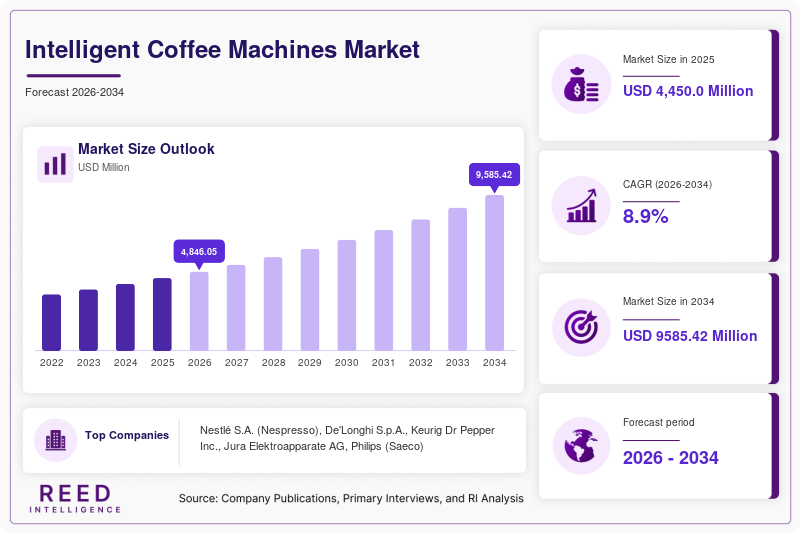
The intelligent coffee machines market size is projected at USD 4,850.0 million in 2026 and is expected to hit USD 9,585.42 million by 2034 with a CAGR of 8.9% during the forecast period. The increasing consumer preference for personalized coffee experiences, the growing adoption of smart home appliances, and the rising demand for convenience and automation in coffee preparation underpin market expansion. This report delivers a comprehensive analysis of the intelligent coffee machines market, including segmentation by type and application, competitive dynamics, and regional growth patterns, equipping stakeholders with critical intelligence to navigate this rapidly evolving smart appliance landscape.
Intelligent Coffee Machines Market Key Takeaways
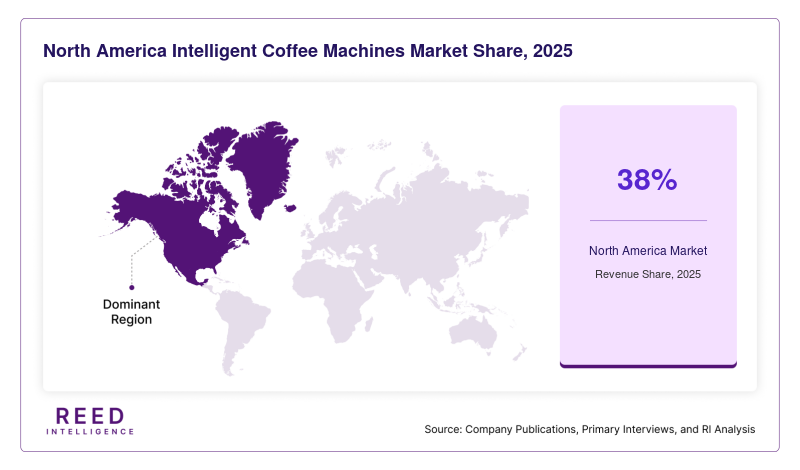
- Dominant Region: North America leads the intelligent coffee machines market with a 38% share, while Asia-Pacific is the fastest-growing region with a projected CAGR of 11.2% through 2034.
- Dominant Segment: The Smart App-Controlled Machines type dominates the market with a 45% share, while the Residential application is the leading segment with a 52% share.
- Emerging Country: China is projected to reach USD 1,250.0 million by 2034, expanding at a CAGR of 12.5%.
- Key Drivers: The growing smart home penetration, the increasing demand for personalized coffee experiences, and the rising consumer preference for convenience and automation are driving market growth.
The intelligent coffee machines market encompasses a range of advanced coffee brewing appliances equipped with connectivity features, smart sensors, and automation capabilities that enable remote control, personalized brewing, and integration with smart home ecosystems. These machines represent the convergence of traditional coffee brewing with modern IoT technology, offering enhanced convenience and customization. Globally, the adoption of intelligent coffee machines has grown substantially, with an estimated 12.5 million units sold in 2025 across residential, commercial, and office segments. In terms of revenue, Smart App-Controlled Machines accounted for roughly 45% of the total market share, driven by their popularity among tech-savvy consumers, while Wi-Fi Connected Machines followed with 32% share, particularly utilized for integration with smart home systems. The market is further characterized by a penetration rate exceeding 25% among premium coffee machine sales in developed economies, whereas emerging markets represent a growing adoption frontier due to increasing disposable income and smart home adoption. The Voice-Assisted Machines segment, representing 23% of the market, is gaining traction with the growing adoption of voice assistants like Alexa and Google Assistant, enhancing user convenience and accessibility.
Intelligent Coffee Machines Market Trends
Integration of AI and Machine Learning for Personalized Brewing
The intelligent coffee machines market is witnessing a significant trend toward the integration of Artificial Intelligence (AI) and Machine Learning (ML) technologies that enable personalized brewing recommendations based on user preferences, time of day, and consumption patterns. This shift is driven by the growing consumer demand for customized coffee experiences and the increasing sophistication of smart home appliances. Manufacturers are developing machines that learn user preferences over time and automatically adjust brewing parameters such as temperature, grind size, and strength. The adoption of AI-enabled coffee machines has increased by 28% year-over-year, with over 40% of new premium models incorporating these features. This intelligent coffee machines market trend is supported by the growing availability of user data and the increasing integration of appliances with smart home ecosystems.
Growing Demand for Sustainable and Energy-Efficient Machines
The increasing focus on sustainability and energy efficiency is a major trend shaping the intelligent coffee machines market. The development of machines with eco-friendly features such as automatic shut-off, energy-saving modes, and recyclable components is gaining traction, driven by growing environmental awareness and regulatory requirements. The emergence of machines that support reusable and compostable capsules is particularly prominent in the European market. This intelligent coffee machines market growth is supported by the growing consumer preference for sustainable products and the increasing focus on reducing environmental impact. The integration of smart features that monitor and optimize energy consumption is enhancing the sustainability credentials of intelligent coffee machines.
Intelligent Coffee Machines Market Drivers
The intelligent coffee machines market's expansion is primarily driven by the growing smart home penetration globally, with over 350 million smart homes estimated worldwide in 2025. The increasing consumer preference for personalized coffee experiences and the demand for convenience and automation in daily routines have been major drivers, with intelligent machines offering features such as remote brewing, scheduling, and customization. The rising demand for premium and specialty coffee at home, accelerated by the COVID-19 pandemic, has further fueled market demand. The integration of intelligent coffee machines with smart home ecosystems and voice assistants has expanded their appeal and functionality. Additionally, the increasing disposable income and growing interest in coffee culture in emerging markets have supported market growth.
Intelligent Coffee Machines Market Restraints
Despite favorable growth prospects, the intelligent coffee machines market faces significant constraints, primarily related to the high costs associated with smart features and connectivity, which can be prohibitive for price-sensitive consumers. The complexity of setup and connectivity issues can also limit adoption among less tech-savvy users. The market's growth is further tempered by the competition from traditional coffee machines that offer similar brewing capabilities at lower prices. Additionally, concerns about data privacy and security associated with connected appliances can create barriers to adoption for some consumers. The need for regular software updates and potential compatibility issues with evolving smart home platforms can also pose challenges.
Intelligent Coffee Machines Market Opportunities
The intelligent coffee machines market presents significant opportunities in the rapidly expanding segment of subscription-based coffee services integrated with intelligent machines, offering automatic reordering of supplies and personalized coffee selections. The development of machines with advanced features such as milk texturing, cold brew capabilities, and multi-beverage options represents another promising avenue. Emerging opportunities also exist in the commercial and office segments, where intelligent machines can enhance workplace amenities and generate operational efficiencies. Furthermore, the untapped potential in emerging markets, driven by increasing disposable income and growing coffee culture, offers a fertile ground for market expansion.
Challenges in Intelligent Coffee Machines Market
The intelligent coffee machines market grapples with persistent challenges related to the need for continuous innovation to enhance user experience, improve connectivity, and address evolving consumer preferences. The complexity of integrating multiple smart features while maintaining ease of use and reliability presents ongoing technical challenges. The market is also contending with the challenge of managing data privacy and security concerns associated with connected appliances. Moreover, the need for effective customer support and troubleshooting for connected devices poses operational challenges for manufacturers and retailers.
Intelligent Coffee Machines Market Segmentation Analysis
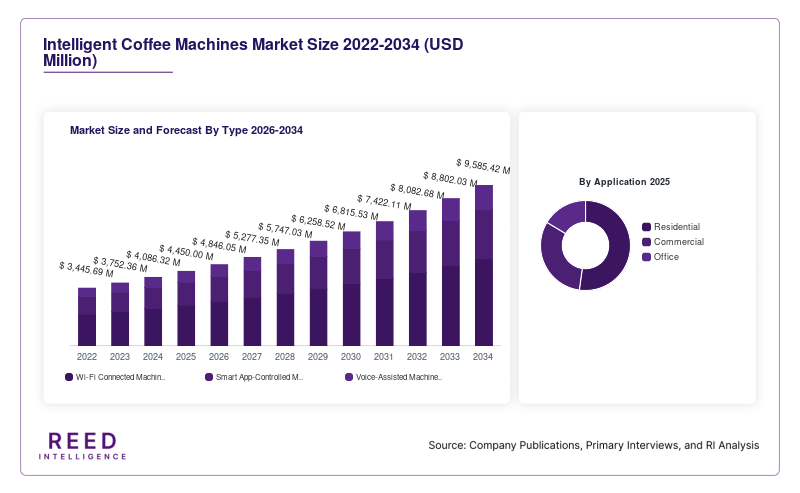
The intelligent coffee machines market is segmented by Type and Application to provide a comprehensive market perspective. By Type, Smart App-Controlled Machines dominate with a 45% market share, driven by their popularity among tech-savvy consumers. The Application segment is led by Residential, which accounts for 52% of the market, followed by Commercial at 28%, and Office at 20%.
By Type
Smart App-Controlled Machines represent the largest segment in the intelligent coffee machines market, commanding a 45% share, with revenue exceeding USD 2,183 million in 2025. These machines are controlled via dedicated smartphone apps, offering remote brewing, scheduling, and customization features. Technical specifications include app compatibility, connectivity options, and brewing parameters. The market's Smart App-Controlled Machines segment is driven by their use in residential settings, where consumers value convenience and personalization.
Wi-Fi Connected Machines capture a 32% share of the intelligent coffee machines market, with revenue of USD 1,552 million in 2025. These machines connect directly to home Wi-Fi networks, enabling integration with smart home ecosystems and voice assistants. Technical specifications include Wi-Fi standards, smart home compatibility, and cloud connectivity. The market's Wi-Fi Connected Machines segment is driven by their use in smart homes, where seamless integration with other connected devices is valued.
Voice-Assisted Machines represent 23% of the market, with revenue of USD 1,116 million in 2025, characterized by integration with voice assistants like Alexa, Google Assistant, and Siri. Technical specifications include voice recognition capabilities, supported assistants, and hands-free operation. The market's Voice-Assisted Machines segment is driven by their use in households with voice assistants, offering enhanced convenience and accessibility for users.
By Application
Residential dominates the intelligent coffee machines market, accounting for 52% of sales, representing USD 2,522 million in 2025. This segment includes the use of intelligent coffee machines in homes for personal coffee preparation. Usage penetration exceeds 25% among premium coffee machine sales in developed markets. The market's Residential segment is characterized by its focus on convenience, personalization, and integration with smart home ecosystems.
Commercial accounts for 28% of the intelligent coffee machines market, with revenue of USD 1,358 million in 2025. This segment encompasses the use of intelligent machines in cafes, restaurants, and hospitality establishments. The segment is growing at a significant rate, driven by the demand for efficiency and consistency in commercial coffee preparation. The market's Commercial segment is characterized by its focus on productivity, reliability, and advanced features for high-volume operations.
Office represents 20% of the market, with revenue of USD 970 million in 2025, involving the use of intelligent coffee machines in workplace environments. The segment's growth is fueled by the increasing focus on employee amenities and workplace satisfaction. The market's Office segment is characterized by its focus on ease of use, low maintenance, and the ability to cater to diverse employee preferences.
Intelligent Coffee Machines Market Regional Analysis
North America Intelligent Coffee Machines Market
Leads the intelligent coffee machines market, commanding a 38% share, with revenue of USD 1,843 million in 2025. The United States is the primary driver, accounting for 85% of regional demand, driven by high smart home penetration, strong coffee culture, and high disposable income. The North American market is characterized by its focus on innovation and the adoption of premium smart appliances.
Europe Intelligent Coffee Machines Market
Represents the second-largest market, capturing a 30% share with revenue of USD 1,455 million in 2025. Germany, the United Kingdom, and France are the primary drivers, together accounting for 58% of regional demand, driven by strong coffee culture, high smart home adoption, and increasing focus on sustainability. The European market is projected to grow at a steady CAGR, supported by continuous innovation and premium product adoption.
Asia-Pacific Intelligent Coffee Machines Market
Accounts for 22% of the global intelligent coffee machines market, with revenue of USD 1,067 million in 2025. China, Japan, and South Korea are the primary drivers, accounting for 65% of regional demand, fueled by rapidly growing coffee culture, increasing disposable income, and the rising adoption of smart home appliances. The Asia-Pacific market is projected to grow at the fastest CAGR of 11.2% through 2034, driven by expanding coffee culture and smart home penetration.
Latin America and Middle East & Africa Intelligent Coffee Machines Market
Together account for the remaining 10% of the intelligent coffee machines market, with Brazil and the UAE leading their respective regions. Both regions are projected to grow at CAGRs exceeding 9%, driven by growing coffee consumption and increasing adoption of premium appliances.
Top players in Intelligent Coffee Machines Market
- Nestlé S.A. (Nespresso)
- De'Longhi S.p.A.
- Keurig Dr Pepper Inc.
- Jura Elektroapparate AG
- Philips (Saeco)
- Melitta Group
- Illycaffè S.p.A.
- Breville Group
- Groupe SEB
- Newell Brands (Mr. Coffee)
- Cuisinart
- Bunn-O-Matic Corporation
- Franke Group
- Schaerer AG
- WMF Group
Recent Developments in Intelligent Coffee Machines Market
- April 2026 – De'Longhi launched a new AI-powered espresso machine with automatic bean recognition and personalized brewing profiles.
- June 2025 – Nespresso introduced a new smart coffee machine with integrated app for personalized recommendations and automatic reordering.
- August 2025 – Keurig Dr Pepper announced a new line of Wi-Fi connected brewers with voice control integration for smart homes.
- February 2026 – Jura Elektroapparate introduced a new professional-grade intelligent coffee machine for office environments with remote management capabilities.
- October 2025 – Philips (Saeco) launched a new sustainable coffee machine with compostable capsule compatibility and energy-saving features.
Intelligent Coffee Machines Market Segments
By Type
- Wi-Fi Connected Machines
- Smart App-Controlled Machines
- Voice-Assisted Machines
By Application
- Residential
- Commercial
- Office
By Region
- North America
- Europe
- APAC
- Middle East and Africa
- LATAM