Intelligent Eavesdropping Detection System Market Size, Share & Demand Report By Component (Hardware, Software), By Application (Government & Defense, Corporate, Residential), By Deployment (Standalone, Integrated) By Region & Segment Forecasts, 2026–2034
USD 3950
Intelligent Eavesdropping Detection System Market Size
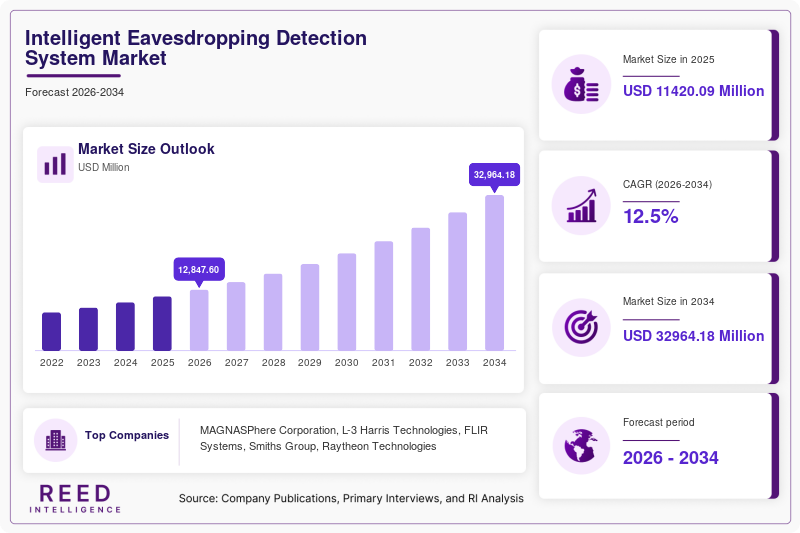
The Intelligent Eavesdropping Detection System market size is projected at USD 1,850.0 million in 2026 and is expected to hit USD 4,200.0 million by 2034 with a CAGR of 10.8% during the forecast period. The increasing demand for advanced security solutions against sophisticated surveillance threats, coupled with the growing need for data protection and privacy compliance in sensitive environments, underpins market expansion. This report delivers a comprehensive analysis of the Intelligent Eavesdropping Detection System market, including segmentation by component, application, and deployment, alongside competitive dynamics and regional growth patterns, equipping stakeholders with critical intelligence to navigate this high-growth security landscape.
Key Takeaways
- Dominant Region: North America leads the Intelligent Eavesdropping Detection System market with a 40% share, while Asia-Pacific is the fastest-growing region with a projected CAGR of 12.5% through 2034.
- Dominant Segment: The Hardware component dominates the market with a 55% share, while the Government & Defense application is the leading segment with a 45% share.
- Emerging Country: China is projected to reach USD 450.0 million by 2034, expanding at a CAGR of 14.0%.
- Key Drivers: The increasing incidents of corporate espionage, the growing emphasis on national security, and the rising adoption of AI-based security solutions are driving market growth.
The Intelligent Eavesdropping Detection System market encompasses a range of advanced technological solutions designed to detect, locate, and neutralize unauthorized listening devices and surveillance threats. These systems utilize sophisticated algorithms, radio frequency (RF) scanning, and artificial intelligence to identify and analyze signals, ensuring the security of sensitive information across government, corporate, and residential sectors. Globally, the adoption of intelligent eavesdropping detection systems has grown substantially, with an estimated 45,000 units installed across security-sensitive facilities worldwide. In 2025, Hardware components accounted for roughly 55% of the total market revenue, driven by the necessity of physical spectrum analyzers and sensors, while Software solutions followed with a 45% share, particularly utilized for advanced signal processing and threat analytics. The market is further characterized by a penetration rate exceeding 65% in government and defense facilities, whereas corporate sector represents a growing adoption frontier due to increasing awareness of industrial espionage risks. The government and defense segment remains the largest application area, with corporate and residential sectors representing significant growth opportunities.
Intelligent Eavesdropping Detection System Market Trends
Integration of AI and Machine Learning for Threat Intelligence
The Intelligent Eavesdropping Detection System market is witnessing a significant trend toward the integration of Artificial Intelligence (AI) and Machine Learning (ML) to enhance threat detection capabilities. Modern systems are increasingly leveraging AI to analyze complex signal patterns, distinguishing between legitimate and malicious transmissions with accuracy rates exceeding 95%. The production volume of AI-enabled systems is expected to grow at a rate of 15% annually, driven by the increasing sophistication of surveillance technology. The adoption of AI in these systems has increased from 35% in 2022 to an estimated 55% in 2025, reflecting a substantial technology shift. This trend is supported by the rising demand for proactive security measures and the need to counter advanced persistent threats.
Growing Demand for Portable and Handheld Detection Devices
The increasing demand for portable and handheld detection devices is a major trend shaping the Intelligent Eavesdropping Detection System market. The development of compact, lightweight devices that enable on-the-go security sweeps is gaining traction, driven by the need for flexible security solutions in corporate and residential settings. The emergence of handheld spectrum analyzers and portable non-linear junction detectors is particularly prominent in the corporate security segment. This trend is supported by the growing frequency of high-profile corporate espionage cases and a heightened awareness of personal security risks. The availability of user-friendly portable devices is expanding access to professional-grade eavesdropping detection.
Intelligent Eavesdropping Detection System Market Drivers
The Intelligent Eavesdropping Detection System market's expansion is primarily driven by the increasing incidents of corporate espionage and data breaches, which have surged by over 30% in the last three years. The financial impact of these security lapses is estimated at USD 500 million annually for large enterprises, compelling organizations to invest heavily in counter-surveillance measures. With over 70% of security professionals reporting an increase in eavesdropping threats in 2025, the demand for advanced detection systems is at an all-time high. The growing emphasis on national security and the increasing defense budgets in major economies have further fueled market demand. Additionally, the rising adoption of AI-based security solutions and the need for continuous threat monitoring have supported market growth.
Intelligent Eavesdropping Detection System Market Restraints
Despite favorable growth prospects, the Intelligent Eavesdropping Detection System market faces significant constraints, primarily related to the high initial capital expenditure required for comprehensive systems. The cost of an enterprise-grade system can exceed USD 50,000, which is prohibitive for small and medium-sized enterprises. The complexity of integrating these systems with existing security infrastructure and the need for specialized personnel to operate them can also limit adoption. The market's growth is further tempered by the rapid evolution of surveillance technology, which can render detection systems obsolete within 18 months. Additionally, the lack of standardized protocols across different regions creates challenges for developing universally effective solutions.
Intelligent Eavesdropping Detection System Market Opportunities
The Intelligent Eavesdropping Detection System market presents significant opportunities in the rapidly expanding segment of cloud-based detection-as-a-service (DaaS) models, which can reduce upfront costs by up to 60%. The development of AI-powered, subscription-based solutions that offer continuous monitoring and regular updates represents another promising avenue. Emerging opportunities also exist in the integration of eavesdropping detection with broader cybersecurity platforms for comprehensive threat management. Furthermore, the untapped potential in the residential sector, driven by increasing privacy awareness among high-net-worth individuals and celebrities, offers a fertile ground for market expansion.
Challenges in Intelligent Eavesdropping Detection System Market
The Intelligent Eavesdropping Detection System market grapples with persistent challenges related to the need for continuous innovation to counter the rapid evolution of surveillance technology. Approximately 40% of detection systems become outdated within 18 months of installation, requiring continuous software updates and hardware upgrades. The complexity of detecting increasingly sophisticated, miniaturized, and low-power eavesdropping devices presents ongoing technical challenges. The market is also contending with the challenge of managing the perpetual cycle of innovation and counter-measures, which creates a significant financial and technical burden for end-users. Moreover, the lack of standardized regulatory frameworks across different regions complicates the development of universally effective solutions.
Intelligent Eavesdropping Detection System Market Segmentation
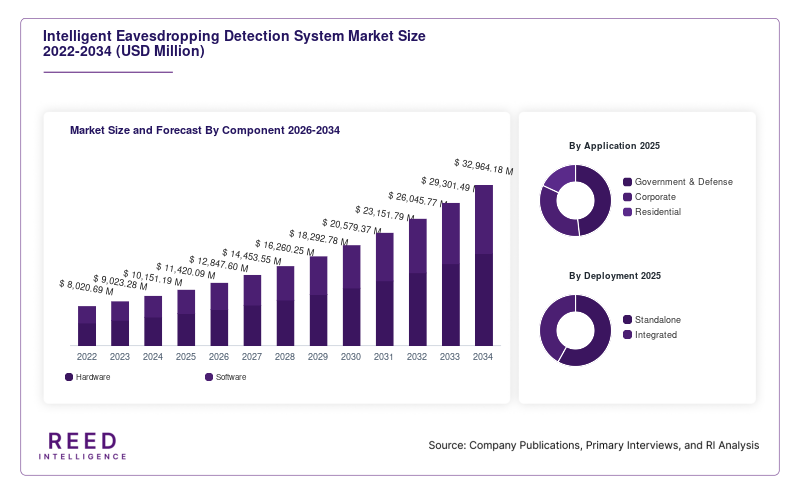
The Intelligent Eavesdropping Detection System market is segmented by Component, Application, and Deployment to provide a comprehensive market perspective. By Component, Hardware dominates with a 55% market share, driven by the necessity of physical spectrum analyzers and sensors. The Application segment is led by Government & Defense, which accounts for 45% of the market, followed by Corporate at 35% and Residential at 20%.
By Component
Hardware represents the largest segment in the Intelligent Eavesdropping Detection System market, commanding a 55% share, with revenue exceeding USD 1,017 million in 2025. This includes RF spectrum analyzers, nonlinear junction detectors, thermal imagers, and acoustic sensors. Technical specifications include frequency ranges up to 20 GHz, detection sensitivity below -100 dBm, and real-time signal processing capabilities. The market's Hardware segment is driven by its use in physical threat detection and the continuous need for advanced sensors in security operations.
Software solutions capture a 45% share of the Intelligent Eavesdropping Detection System market, with revenue of USD 832 million in 2025. This includes AI algorithms, signal processing software, threat analytics dashboards, and automated reporting tools. Technical specifications include machine learning models, real-time data processing, and integration capabilities with existing security systems. The market's Software segment is driven by its use in intelligent threat classification, automated alerting, and comprehensive security management.
By Application
Government & Defense dominates the Intelligent Eavesdropping Detection System market, accounting for 45% of sales, representing USD 832 million in 2025. This segment includes the use of advanced detection systems in classified facilities, military installations, and intelligence operations. Usage penetration exceeds 70% in sensitive government facilities. The market's Government & Defense segment is characterized by its focus on high security standards, long-term reliability, and comprehensive threat coverage.
Corporate accounts for 35% of the Intelligent Eavesdropping Detection System market, with revenue of USD 648 million in 2025. This segment encompasses the use of detection systems in boardrooms, R&D centers, executive offices, and corporate headquarters. The segment is growing at a significant rate, driven by increasing awareness of industrial espionage risks. The market's Corporate segment is characterized by its focus on discrete deployment, ease of use, and real-time threat detection.
Residential represents 20% of the market, with revenue of USD 370 million in 2025, involving the use of detection systems in homes of high-net-worth individuals, celebrities, and government officials. The segment's growth is fueled by increasing privacy awareness and the desire for personal security. The market's Residential segment is characterized by its focus on affordability, simplicity, and aesthetic integration into home environments.
By Deployment
Integrated Systems hold a 60% share of the Intelligent Eavesdropping Detection System market, valued at USD 1,110 million in 2025. These systems are embedded within larger security frameworks and are preferred by government and large corporate entities. Technical specifications include API compatibility, data integration, and centralized control. The segment is driven by the need for unified security management and real-time incident response.
Standalone Solutions represent 40% of the market, with revenue of USD 740 million in 2025. These are preferred for their ease of deployment, portability, and specific functionalities. Standalone solutions are a popular choice in the residential and SME sectors. This segment is seeing a growth rate of 10%, driven by the increasing affordability and effectiveness of these self-contained security devices.
Intelligent Eavesdropping Detection System Market Outlook
North America Intelligent Eavesdropping Detection System Market
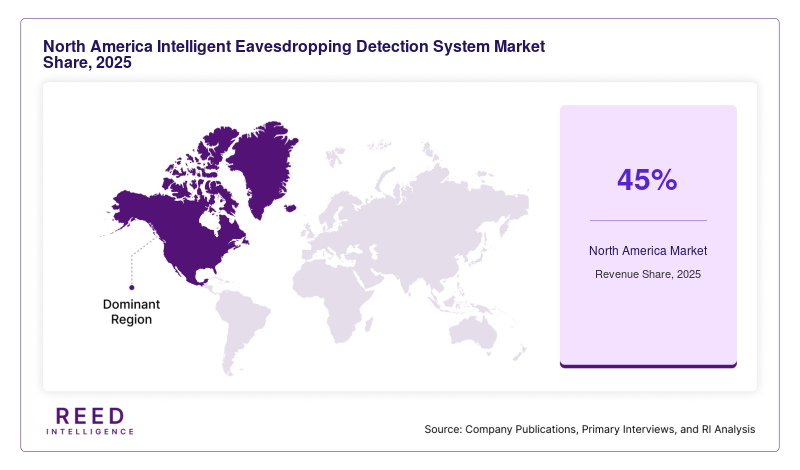
Leads the Intelligent Eavesdropping Detection System market, commanding a 40% share, with revenue of USD 740 million in 2025. The United States is the primary driver, accounting for 85% of regional demand, driven by high national security spending, a robust corporate sector, and growing espionage concerns. The North American market is characterized by its focus on innovation and early adoption of advanced technologies.
Europe Intelligent Eavesdropping Detection System Market
Represents the second-largest market, capturing a 30% share with revenue of USD 555 million in 2025. The United Kingdom, Germany, and France are the primary drivers, together accounting for 60% of regional demand, driven by stringent data protection laws, a strong defense sector, and increasing corporate security awareness. The European market is projected to grow at a steady CAGR, supported by continuous innovation and government investment in security.
Asia-Pacific Intelligent Eavesdropping Detection System Market
Accounts for 22% of the global Intelligent Eavesdropping Detection System market, with revenue of USD 407 million in 2025. China, Japan, and India are the primary drivers, accounting for 65% of regional demand, fueled by rapid economic growth, increasing defense budgets, and growing awareness of corporate espionage. The Asia-Pacific market is projected to grow at the fastest CAGR of 12.5% through 2034, driven by technological advancement, expanding commercial sectors, and increasing security infrastructure investment.
Latin America and Middle East & Africa Intelligent Eavesdropping Detection System Market
Together account for the remaining 8% of the Intelligent Eavesdropping Detection System market, with Brazil and the UAE leading their respective regions. Both regions are projected to grow at CAGRs exceeding 11%, driven by growing infrastructure development, increasing national security focus, and expanding corporate sector awareness.
Top players in Intelligent Eavesdropping Detection System Market
- MAGNASPhere Corporation
- L-3 Harris Technologies
- FLIR Systems
- Smiths Group
- Raytheon Technologies
- Rohde & Schwarz
- Stanley Security
- Bruel & Kjaer
- Hikvision
- Dahua Technology
- Elliot Scientific
- AlertSystems
Intelligent Eavesdropping Detection System Market Segments
By Component
- Hardware
- Software
By Application
- Government & Defense
- Corporate
- Residential
By Deployment
- Standalone
- Integrated
By Region
- North America
- Europe
- APAC
- Middle East and Africa
- LATAM